
Apr 16, 2017 | Theology

It is a glorious thing that on this day all around the world billions of Christians celebrate the bodily resurrection of their Savior. Those who don’t, think that those of us who do are deluded. Maybe we are, but the vast majority of those who reject the bodily resurrection of Christ have never given a single solitary minute to examining the evidence. Most of these don’t believe a man coming back from the dead is possible, so why bother with evidence. I’m sure there are others who don’t want to engage the evidence because they don’t want it to be true. If God did become a man, died for their sins, and was raised for their justification, then they are confronted with a choice. Rebels have a hard time giving up their rebellion.
For me, if this resurrection of Jesus of Nazareth really did happen, it is, by very far, the most important historical fact of human history. And orthodox Christians don’t believe Jesus’ resurrection is a “spiritual resurrection” in our hearts, a beautiful idea about new life and some such thing. No, we believe the man himself, a human being just like you and me, was killed by the Romans, was laid in a tomb, and three days later revealed himself as risen to his followers. We believe this because there is a significant amount of historical evidence that it in fact happened. Jesus himself knew we, and his followers at the time, needed evidence because, well, people don’t just rise from the dead!
(more…)

Mar 30, 2017 | Theology

Modern Evangelicalism is a hybrid of Christian traditions that came out of the Reformation. When I became a Christian in college I had no idea this was the case because I was taught that Christianity, the real kind, was just me and the Bible. My relationship with Jesus mediated through the Bible was the very definition of Christianity. Little did I know that the Christianity I was living in college had historical antecedents. Unfortunately, history wan’t real important to the Christians who introduced me to the Faith. Such historical apathy is indicative of far too much of Evangelicalism today, as it is of general American culture.
Modern Evangelicals have far more in common with 19th century revivalist Christianity than their Reformation forebearers. The Second Great Awakening transformed much of Protestant Christianity from a confessional (a la Lutherans and Presbyterians) and sacramental faith, to an experiential and conversionist faith. George Marsden’s Fundamentalism and American Culture is an essential read for anyone wanting to understand why conservative Protestant Christianity (i.e. Evangelicalism) is the way it is today. You’ll find out that modern Evangelicals are historical fundamentalists. In other words, our faith today is more informed by the revivalist Christianity of the 19th and early 20th centuries, than the Reformation of the 16th.
(more…)

Feb 7, 2017 | Theology

If man had his way, the plan of redemption would be an endless and bloody conflict. In reality, salvation was bought not by Jesus’ fist, but by His nail-pierced hands; not by muscle but by love; not by vengeance but by forgiveness; not by force but by sacrifice. Jesus Christ our Lord surrendered in order that He might win; He destroyed His enemies by dying for them and conquered death by allowing death to conquer Him.
—A.W. Tozer, Preparing for Jesus’ Return: Daily Live the Blessed Hope
Jan 19, 2017 | Theology

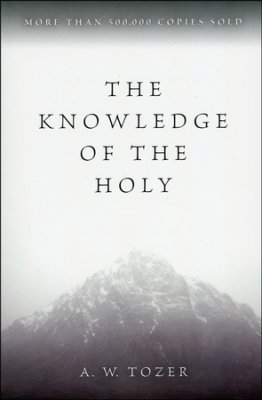
Almighty God, just because He is almighty, needs no support. The picture of a nervous, ingratiating God fawning over men to win their favor is not a pleasant one; yet if we look at the popular conception of God, that is precisely what we see.
Twentieth Century Christianity has put God on charity. So lofty is our opinion of ourselves that we find it quite easy, not to say enjoyable, to believe that we are necessary to God. But the truth is that God is not greater for our being, nor would He be less if we did not exist. That we do exist is altogether of God’s free determination, not by our desert nor by divine necessity.
—A.W. Tozer, The Knowledge of the Holy

Dec 20, 2016 | Theology

During the first half of the 20th Century, Mainline Protestant denominations were a large and powerful force in American culture. Protestant Christianity was mediated to America through these denominational bodies. This started to slowly change during what’s come to be called the fundamentalist/modernist controversies in the early part of the century (they peaked in the 1920s) when liberalism defeated the conservative fundamentalists for control of the denominations. From that moment these pillars of American Christianity began a slow slide into cultural irrelevance which persists to this day. These denominations continue to lose membership, and liberalism is why. The numbers are substantial:
Across the English-speaking world the numerical decline of mainline Protestantism is accelerating. The largest mainline Protestant denominations in the United States are the United Methodist Church, the Evangelical Lutheran Church in America, the Presbyterian Church (U.S.A.) and the Episcopal Church. Collectively, membership in these denominations decreases by about 1 million a year, resulting in hundreds of church closures annually.
A recent study attempts to answer the question why this is happening. I could have saved them the time. The answer is liberalism! In a study of “2,200 of the congregants, half attending growing churches and half at declining churches,” it became obvious: (more…)

Nov 30, 2016 | Theology

In my last post I wrote about the best way to ruin your kids faith is to make it all about them. It’s an extremely easy thing to let happen if you don’t actively take responsibility for the content and shape of your kids’ faith. We live in a culture where the subjective reigns in the form of the sovereign self, which is the reason the default religion of America, and especially our young people, is something called Moralistic Therapeutic Deism (MTD). The phrase was coined by sociologist Christian Smith in his 1995 book Soul Searching: The Religious and Spiritual Lives of American Teenagers. He describes MTD thus:
First, a God exists who created and orders the world and watches over human life on earth. Second, God wants people to be good, nice, and fair to each other, as taught in the Bible and by most world religions. Third, the central goal of life is to be happy and to feel good about oneself. Fourth, God does not need to be particularly involved in one’s life except when God is needed to resolve a problem. Fifth, good people go to heaven when they die.
(more…)


Recent Comments