Does God Want All People to be Saved?

Does God Want All People to be Saved?

This post is not going to make me popular with, oh I don’t know, maybe 90% of Christians. We Calvinists are in the minority among the faithful, but we are a confident and determined lot. I’m grateful, however, that God will not require a theology test to get into heaven, which brings up the most important thing in this discussion. We are not saved because of the rightness of our beliefs, but because we put our trust in Christ, that we look to him alone for our salvation. And on that day, whenever it is, we won’t be obsessing about theological niceties, but looking in hope to our Savior, all of us, every Christian from every tradition of every theological permutation. As Jesus assured us in John 3:

14 Just as Moses lifted up the snake in the wilderness, so the Son of Man must be lifted up, 15 that everyone who believes may have eternal life in him.”

Look up and trust in him is all that’s required.

Now hopefully that I have some of that 90% open to what I’ll say, let’s discuss whether God does in fact want all people to be saved. I don’t think about this much, but as I was reading through I Timothy 2, Paul got me thinking about it again

This is good, and it is pleasing in the sight of God our Savior, who desires all people to be saved and to come to the knowledge of the truth. For there is one God, and there is one mediator between God and men, the man Christ Jesus, who gave himself as a ransom for all, which is the testimony given at the proper time.

Reading this passage, I’m reminded that Paul doesn’t always mean each and every one when he uses the word all. The non-Calvinists insists he does. See, they say, God obviously wants all people, each person who has ever existed, to be saved, therefore all, every person, should have the possibility of being saved. Clearly not all are saved. No orthodox Christian believes in universalism, that everyone will in the end be saved.

The reason all meaning each and every person never made sense to me once I learned about Reformed theology, is that if a ransom takes place there must be an exchange or it cannot be considered a ransom. One thing must be given for another. If it is, an exchange will have taken place, Christ’s righteousness for the sinner’s sin. If Christ ransomed all people, each and every one, died for them, then all people, each and every one, must be saved, and universalism is true. But it isn’t true because we know some people will end up in hell. So, Paul either means Christ made salvation possible for all people, which makes the word ransom meaningless, or he must mean all people Christ ransomed will be saved.

And lest you think I’m just hanging everything on one verse, to the concept of ransom in the idea of Jesus purchasing people by his blood, there are a number of verses referencing the concept of exchange. The first verse that comes to my mind when I’m thinking about this is Revelation 5:9:

And they sang a new song, saying: “You are worthy to take the scroll and to open its seals, because you were slain, and with your blood you purchased for God persons from every tribe and language and people and nation.

You go to the store, pick up a bottle of wine, go to the clerk and hand her some money. You get the wine, the store gets the money, and a purchase and exchange has taken place. Another verse that comes to mind is Mark 10:45:

For even the Son of Man did not come to be served, but to serve, and to give his life as a ransom for many.

The word ransom is used again by the writer to the Hebrews in chapter 9:

15 For this reason Christ is the mediator of a new covenant, that those who are called may receive the promised eternal inheritance—now that he has died as a ransom to set them free from the sins committed under the first covenant.

Notice how he specifically connects those who are called as the ones who are ransomed. The same concept is used by Paul in a different context in I Corinthians 6 and 7. In chapter 6 he’s discussing sexual immorality and the body, then says:

19 Do you not know that your bodies are temples of the Holy Spirit, who is in you, whom you have received from God? You are not your own; 20 you were bought at a price. Therefore honor God with your bodies.

In chapter 7 he is discussing slavery and how we are ultimately Christ’s slave, then he says:

23 You were bought at a price; do not become slaves of human beings.

Add I’ll add one more when Paul is bidding farewell to the Ephesian elders who he’ll never see again as he’s on his way to Rome (Acts 20):

28 Keep watch over yourselves and all the flock of which the Holy Spirit has made you overseers. Be shepherds of the church of God, which he bought with his own blood.

All of these verses supporting the idea of Christ’s death actually saving people, not just making their salvation possible, are confirmed when Jesus is given his name by an angel before he is born. Speaking to Joseph in a dream he says (Matthew 1):

21 She will give birth to a son, and you are to give him the name Jesus, because he will save his people from their sins.”

And there is a footnote in some of our Bibles saying, “Jesus is the Greek form of Joshua, which means the Lord saves.” Jesus came to specifically to save his people, not make salvation possible for all people. It wasn’t the people’s choice that makes them his, but God’s choice. We have this confirmed in John 6 when Jesus says:

37 All that the Father gives me will come to me, and whoever comes to me I will never cast out.

Our Alienation from God
This is a hard pill for many Christians to swallow, but biblically it’s undeniable. In order to believe the Arminian position, that God makes salvation possible for all and only those who decide to trust Jesus are saved, all these verses, and many more, have to be explained away. I’ll never forget the night I heard this Calvinist or Reformed perspective the first time and thinking, this is upside down from how I’ve believed in Christianity for over five years. Then I went home and at the suggestion of my mentor to be read Ephesians 2, a chapter I’m sure I’d read many times before. All I could think was, how had I missed this? Here are the first 10 verses:

As for you, you were dead in your transgressions and sins, in which you used to live when you followed the ways of this world and of the ruler of the kingdom of the air, the spirit who is now at work in those who are disobedient. All of us also lived among them at one time, gratifying the cravings of our flesh and following its desires and thoughts. Like the rest, we were by nature deserving of wrath. But because of his great love for us, God, who is rich in mercy, made us alive with Christ even when we were dead in transgressions—it is by grace you have been saved. And God raised us up with Christ and seated us with him in the heavenly realms in Christ Jesus, in order that in the coming ages he might show the incomparable riches of his grace, expressed in his kindness to us in Christ Jesus. For it is by grace you have been saved, through faith—and this is not from yourselves, it is the gift of God— not by works, so that no one can boast. 10 For we are God’s handiwork, created in Christ Jesus to do good works, which God prepared in advance for us to do.

I noticed that all of the initiative is God’s. I didn’t believe because I decided to believe, I believed because God raised me spiritually from the dead. We can go to a cemetery, the old fashioned kind with headstones and grave markers, and preach the gospel with the eloquence of Whitfield, Moody, and Billy Graham combined, and not one of those people are capable of responding in faith—they’re dead! For Paul’s dead isn’t like Westley in The Prince’s Bride, mostly dead; it’s all dead, spiritually. In Colossians 2 Paul says the same thing:

13 When you were dead in your sins and in the uncircumcision of your flesh, God made you alive with Christ.

I didn’t believe when the message was preached because I decided it was a good idea, I believed because God in Christ had already raised me spiritually from the dead. Regeneration preceded belief. By God’s sovereign power because I was one of his people from before the creation of the world, my spiritual eyes were supernaturally opened, and I believed. And it’s even worse than being dead in our sin. In our unsaved spiritual state we are enemies of God. Paul says in Romans 5:

10 For if, while we were God’s enemies, we were reconciled to him through the death of his Son, how much more, having been reconciled, shall we be saved through his life!

He confirms our natural state of spiritual rebellion in Colossians 2:

21 Once you were alienated from God and were enemies in your minds because of your evil behavior. 22 But now he has reconciled you by Christ’s physical body through death to present you holy in his sight, without blemish and free from accusation.

The Greek words Paul uses for enemies leave no doubt that choosing Christ in that state of heart and mind would have been impossible. For the Greek of enemies, Strong’s says:

properly, an enemy; someone openly hostile (at enmity), animated by deep-seated hatred. 2190/exthros (“enemy”), implies irreconcilable hostility, proceeding out of a “personal” hatred bent on inflicting harm.

In a state of sin we have a deep-seated hatred of God and a personal hatred bent on inflicting harm. It’s not just that me and God we’re/ not getting along—we’re at war! There is an alienation between lost sinners and God that no amount of good news, the gospel, can overcome, unless we are by the power of God born again, and nobody chooses to be born.

God’s Initiative and the History of Redemption
We’ll notice in the history of redemption, of God saving his people from their sins, he is the one always taking the initiative. Nobody seeks God. Quite the contrary, they’re all running away until he does something remarkable to turn them back. From the very beginning that’s what rebellious sinners did. When Adam and Even disobeyed God, what did they do? They hid; they were afraid. God was now their judge, jury, and executioner because the penalty for eating from the tree was death. No wonder they were afraid.

What did God do? Took the initiative. Not only did he come looking for them, he killed an animal, the first sacrifice in human history, to clothe their nakedness and shame. Then he announced the gospel, or as the theologians call it, the protoevangelium (Gen. 3):

15 And I will put enmity
between you and the woman,
and between your offspring and hers;
he will strike your head,
and you will strike his heel.”

The offspring or seed of the woman as we know is Christ. The plan of salvation, what we call the covenant of redemption, what already set in place prior to God even having created the world. Then after driving them out of the garden God judged the world but picked Noah and his family to make a covenant with man, that he would never again destroy the human race because of their sin.

Then it really begins, God building for himself a people he will save from their sins. Out of all the human beings on earth he picked one man, Abram, and announced that through him all nations on earth would be blessed. Then his descendants become enslaved in Egypt for 400 years, and God again takes the initiative when he picks Moses by first saving his life by allowing him to be born, then saving him again when he’s an adult. He helps the Hebrews escape slavery in Egypt, and gives them his law and a sacrificial system to enable him to forgive their sins. He guides them for 40 years through their rebellion eventually into a land he promised them, and thus begins the history of Israel.

Eventually he chooses a king, David, who will become a type of the Messiah to ultimately save his people from their sins, sending prophets for hundreds of years to predict that, and to warn the people in their rebellion. Then he sends a last prophet, John the Baptist, to prepare the way. He himself comes through a woman’s birth canal as an infant, conceived in a virgin, s what we know as the incarnation, God becoming man. He is given the name Jesus by the angel, and allows himself to be tortured and killed for the his people whom he came to save, redemption accomplished. Then rose from the dead, ascended to heaven at the right hand of God, and sent his Holy Spirit to his people to save them, redemption applied. He is doing that to this very day and will continue until he has placed all his enemies under his feet, the final enemy to be defeated is death (I Cor. 15:25).

God taking the initiative and orchestrating the entire history of redemption doesn’t mean he destroys the nature of his creatures. Our agency is never compromised in the process of salvation. We are still choosing and accountable beings who must respond, and whose choices have real consequences. How all this works, God’s sovereignty and human freedom, we have no idea. I just know it’s the clear testimony of Scripture that both are true and real. God wants all his people to be saved, and he will save them.

Christian Patriotism vs. Christian Nationalism

Christian Patriotism vs. Christian Nationalism

Christian Nationalism is a completely worthless phrase; worse, it’s a distortion. Most of the time people use it as a dishonest rhetorical device to discredit any Christian who believes nations must be Christian. The assumption of those using it, never discussed or defended, or probably even thought through, is that we can and should have a secular nation, as if such a thing is even possible. Secularism is a religion; it is a faith, a belief system, a worldview. The main reason Christian Nationalism is unhelpful is because there is no single definition of it. It’s like a bucket people pour into it whatever they want, and that’s Christian Nationalism! It’s not because it doesn’t exist. It’s a figment of each user’s imagination.

Before we get to the meat of the discussion, it will be helpful to understand the history of the nation out of which could flow an “ism” attached to it. The modern nation-state is a relatively new phenomenon in the history of the world. It developed in the Christian West out of the Peace of Westphalia in 1648 in the aftermath of the 30-Years War. Prior to that nations were ill defined, and the concept of a sovereign geographic entity with its own political system and sovereign boarders didn’t exist. In world history prior to the Middle Ages, might made right, and whatever nation or state (modern concepts) had the most power, called the shots. Basically borders didn’t exist. Kingdoms and ethnic geographic entities existed to one degree or another, but boarders were malleable if they existed at all. That slowly began to change with the development of the Holy Roman Empire (greater Western Europe) after the rise of Charlamagne in 800 AD, but wouldn’t fully develop until after the Peace of Westphalia.

Once nations developed it wasn’t long before the word “nation” would define what a state is, and that it should demand supreme loyalty. The American and French Revolutions where the first “nationalist” movements where loyalty would no longer be to an empire or monarch, but to the nation itself. It further developed throughout the 19th century and into the 20th when the “ism” was added.

We must always be careful when “ism” is attached to a word. It means the concept has been turned into some kind of doctrine, theory, system, or ideology. It’s one thing to have a commune, but quite another to have communism. It’s one thing to have capital, but another to have capitalism. So, a nation is a geographic entity with recognized sovereign defensible boarders, while nationalism is some kind of ideology built around that nation.

The reason the word nationalism tends to distortion and is unhelpful is the undercurrent of Nazism. Remember they called themselves National Socialists defined by the blood of the German volk, or people. Only pure blood, white, Aryans were considered part of the volk and thus legitimate citizens in the state. After World War II, the word nationalism could never be fully divorced from this association. The critics of Christian Nationalism will throw around the phrase “blood and soil” as an epithet. They may as well be calling those who espouse Christians nations Nazis. The fact of the matter is that every nation is blood and soil to one degree or another which over time develops each nation’s unique culture. It’s when blood and soil become an “ism” like Nazism that problems arise.

We can’t leave this discussion without talking about a logical fallacy called begging the question. Today for most people that phrase means “raising the question,” but that’s only because it sounds like it should mean that. It comes from a Latin phrase, petitio principii, or assuming the starting point. It’s a form of circular reasoning. It is something in an argument or discussion that is assumed without having proved or argued for it, and it happens all the time. When you know what begging the question really means, you see it being done all the time, and in discussions of Christian Nationalism it’s almost a requirement! We’ll be exploring that question begging for the rest of the post. (I won’t defend the idea of a Christian nation here, but I described what that is in a piece earlier this year titled, “What Does It Mean to Baptize Nations?

Christian Patriotism vs. Christian Nationalism
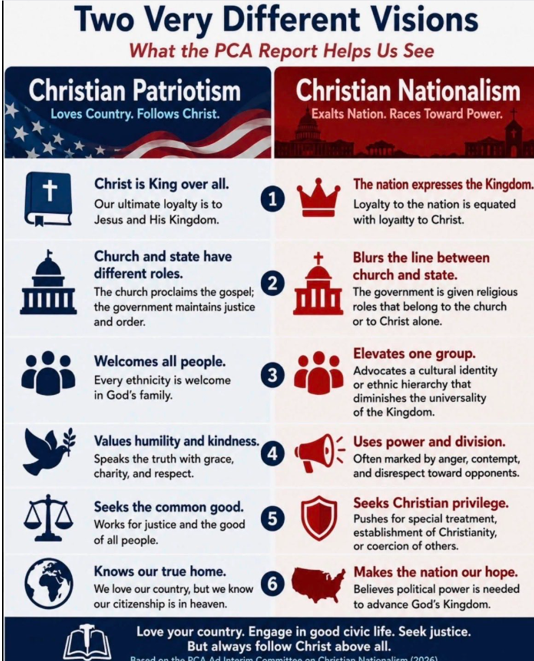
In a post on Twitter titled, “Two Very Different Visions,” we are supposedly seeing what, in the subtitle is, “What the PCA Report Helps Us See.” These visions are only in the writer’s imagination. The Presbyterian Church in America recently put together a study committee on Christian Nationalism and recently issued a report. This is one man’s version of the report, one that bears little resemblance to what is in the report.

The question begging starts with a bang. He claims that Christian Patriotism (CP) “loves country and follows Christ,” while Christian Nationalism (CN) “exalts nations and races toward power.” Those embracing CN are in effect guilty of idolatry. They can’t just love their country, they worship it. They also don’t follow Christ because they are most interested in power, presumably political power, as if that’s a bad thing. Are Christian nationalists even Christians in his book? Doesn’t seem like it. And this is just the beginning. Next he creates a chart comparing the two on six variables or metrics.

CP: Christ is king over all. Our ultimate loyalty is to Jesus and His kingdom.
CN: The nation expresses the kingdom. Loyalty to the nation is equated with loyalty to Christ.

Like all of them, this is a faulty and lazy comparison. Every person who believes nations should be Christian believes Christ is king over all. We all believe our ultimate loyalty is to Jesus and his kingdom. As for God’s kingdom, what does a nation expressing the kingdom mean? And why is that a bad thing? Is he saying we believe the nation is the kingdom? God’s kingdom can and must be expressed in the nation, but geopolitical entities like states are not to be confused with the kingdom. As I’ve written here previously, the kingdom of God is not identical to the church either. Lastly, I’ve never read or heard someone equate loyalty to the nation with loyalty to Christ. He is either assuming this from what he thinks he knows about them, or he’s being disingenuous, maybe both.

CP: Church and state have different roles. The church proclaims the gospel; the government maintains justice and order.
CN: Blurs the line between church and state. The government is given religious roles that belong to the church or to Christ alone.

I’ve yet to come across anyone who believes in Christian nations that doesn’t believe the church and state have different roles. Nobody teaches it or believes it. What they do believe, and this must be what he’s thinking, is that CNs believe God’s law should apply in every nation. The degree is to what extent, and among CNs there is considerable disagreement. Everything turns on what one means by “religious roles,” and there is considerable disagreement there as well. His assertion is as simplistic as it is inaccurate. 

CP: Welcomes all people. Every ethnicity is welcome in God’s family.
CN: Elevates one group. Advocates a cultural identity or ethnic hierarchy that diminishes the universality of the kingdom.

What does “welcomes all people” mean? Does he think nations shouldn’t protect their boarders, that boarders should be wide open to let anyone in who wants to get in? Probably not, but this is another lazy formulation. He confuses “God’s family” with the nation, which I thought we weren’t supposed to do. There is a grain of truth to his second contention among some promoters of CN, but it has nothing to do with the universality of the kingdom. Again, the nation is not the kingdom but can and should be a reflection of it. Those who espouse CN do believe that culture and cultural identity are not infinitely malleable. Each ethnic people have a unique culture and that is the way it should be.

CP: Values humility and kindness. Speaks truth with grace, charity, and respect.
CN: Uses power and division. Often marked by anger, contempt, and disrespect toward opponents.

Power and division are not inherently sinful, and nor are they a contrast to humility and kindness. We should use the latter in advancing the former. That some who espouse CN act in ways inconsistent with the fruit of the Spirit only proves sinners sin and says nothing about CN.

CP: Seeks the common good. Works for justice and the good of all people.
CN: Seeks Christian privilege. Pushes for special treatment of establishing or coercion of others.

This might be the most egregious display of question begging in this list, and it is slanderous. We don’t seek the common good? Really? The reason nations need to be Christian is exactly for the common good. When God promised Abram in Genesis 12 that all peoples on earth would be blessed through him, the promise was fulfilled in Christ and proclaimed in the Great Commission. The gospel is the good news that all nations, or peoples, tribes in the Hebrew, would be blessed, not just the individuals within those nations. CN by its very definition is for the common good! It is not to work for injustice, which is what he is implying. Like I said, slanderous.

As for seeking Christian privilege, absolutely! He is assuming there is some neutral space in a society where all religions should be treated equally, and no one religion held up as superior to others. Christianity, however, claims exactly that! Some religion or worldview, and it’s ultimate faith commitments, will inform the laws and mores, the culture, of a nation. The only question is which one it will be. Those against CN think a neutral secular nation is a possibility, and pluralism and maximal religious freedom is possible. It is not—it’s a disaster. Witness America in the last 60 plus years.

The last distortion is that CN seeks to coerce others. That is a big fear of the anti-CN folks, and it is simply not true.

CP: Knows our true home. We love our country, but we know our citizenship is in heaven.
CN: Makes the nation our hope: Believes political power is needed to advance God’s kingdom.

These statements reflect the unfortunate mentality of the modern church steeped in Pietism. It borders on Gnosticism, and is most definitely influenced by it. He is referencing Philippians 3:20 where Paul says,

But our citizenship is in heaven. And we eagerly await a Savior from there, the Lord Jesus Christ.

In my Pietistic days I used to believe this meant we Christians were just wondering through the desert of this fallen world like the Hebrews wondering in the desert after they were rescued from slavery in Egypt. We’re just strangers and aliens in this world. In a way we are, but escape to our true home in heaven isn’t the point of this verse. Rather, it is Paul telling us that as the Philippians are citizens of Rome and are building an outpost of the Empire in Asia Minor, so we are citizens of heaven building an outpost of God’s kingdom here in this fallen world. The point of the Christian life is, Thy kingdom come, Thy will be done on earth as it is in heaven, not getting away from this earth to get to the kingdom in heaven. We are bringing heaven to earth! My next book which will be published later this year is all about this, and my hope is that we begin to change the church’s focus earthward to spread the blessing God promised us 4,000 years ago.

And lastly we come back to the slander. Those of us who believe a nation must be Christian most certainly do not make the nation our hope! Christ alone is our hope, which is why we insist the nation must be Christian and not secular or any other religion. As for political power, like anything else humans do, it will be used either to advance God’s kingdom and his righteousness, or Satan’s kingdom. There is no neutrality.

A Christian Nation and the Myth of Neutrality
Someone has said, rightly, that culture is religion externalized, and a nation’s government is a reflection of its culture. That means, no nation can be religiously neutral. Yet since the end of World War II there has been a presumption in the West that nations can be secular, which to them means a declaration of religious neutrality. That is, to put it plainly, an impossibility. A nation is made up of human beings, who in addition to Aristotle’s dictum that “man is by nature a political animal,” are also religious animals, but not in fact animals but beings made in God’s image. And if we can agree that a morally neutral human being doesn’t exist, putting them in a political community doesn’t all of a sudden make the product of their community morally neutral.

By the middle of the 20th century, secularism had so worked its deceits into the West’s cultural blood stream that cultural elites completely embraced the myth of neutrality. Christianity, and religious practice in general, was exclusively for people’s private lives, and a mythical Berlin Wall of separation between church and state became the new dogma that must be obeyed. In due course we got secular tyranny. This got so ridiculous that a school would no longer be allowed to display the Ten Commandments on its walls. Sadly, although this is changing, most conservatives and Christians buy into this myth. A couple years ago I even heard Larry Arnn, the president of Hillsdale College, say a Christian nation is an oxymoron. For the most part this is dogma among doctrinaire conservatives, and if moral neutrality is a myth, then it cannot be true.

It was Jesus himself who commanded us to create Christian nations. We remember that as the Great Commission, and what makes it great is that it isn’t just for individuals, but for the nations that individuals create. All authority in heaven and on earth had been given to Jesus, and because of that he told his disciples to, “make disciples of all nations.” In doing that they were to baptize them in the name of the Triune God and teach them to obey everything he commanded. As the individuals within the nations are brought to Christ they are to take that transforming power into everything they create cultural and politically. As I said in my post about baptizing nations, “nations are baptized when the nation, it’s worldview and value system, reflects Christianity as the aspirational guiding system of the country.” That is the task before us, to take the power of the gospel out of our homes and churches into everything we do that as God promised to the Patriarchs, the nations might be blessed.

The Transformational Nature of Faith

The Transformational Nature of Faith

When most people hear the word faith they instantly think of religion. This is especially true in our secular age when it came to be assumed that faith is something religious people need, while those who are not religious do not. If we think about it for even a moment we’ll see how that contention is inaccurate, but atheists over the last two or three hundred years did a great job defining faith in a way that delegitimized religion, and specifically Christianity. It got so bad during the brief era of the so-called “New Atheists,” (there was nothing new about them), that for a brief time they got away with defining faith as, “belief without evidence,” as in, there isn’t enough evidence but I’ll believe it anyway. Mark Twain, the quintessential cynic made the quip, “Faith is belivin’ what you know ain’t so.” That most certainly is not faith!

Before I get into why faith is transformational, it’s important to define it so we’re all on the same page:

Faith is belief based on adequate evidence.

That’s it. Another word for faith is trust. It is being willing to act with limited knowledge, and given we’re finite creatures who can only ever have limited knowledge, faith is a requirement for daily existence. In other words, everyone lives by faith. It is not a religious concept, but a human concept, something required if we’re to exist, and we utilize it every day of our lives. All of this comes down to a complicated topic called epistemology, or the study of how we know things. But it’s not necessary to go down that philosophical rabbit hole to grasp the simple reality that our knowing is limited and never absolute, and faith is required to act in spite of it. Do I trust the bridge to hold my car if I drive over it even though I can’t be absolutely certain it will. The examples are endless.

As you walk down the aisle in mere moments joining with the woman who will become your wife or the man who will become your husband, you are exercising faith. You and your spouse decide to have children; talk about faith! It’s terrifying, but you do it anyway because you believe, you trust, there will be far more joy and blessing than heartache. Do you know that? Of course not, but you do it anyway. That’s faith. Or you take a job or invest in a business venture. Do you know it will work? No, but you do it anyway. That’s faith. When you love someone, do you know they will reciprocate? Of course not, but you do it anyway trusting that the person will love you in return.

We’ve recently celebrated America’s 250th anniversary as an independent nation. America is a product of faith, massive, deep, and abiding faith because few people thought it would work, and most were convinced it wouldn’t. Think of all those people starting with the Pilgrims in the 1630s who got in small rickety boats and travelled over 3,000 miles on the Atlantic Ocean to chase the dream of a new life. That is incredible faith! That faith eventually built the greatest nation on earth. Or go back earlier to Christopher Columbus, a man burning with faith to discover new worlds and share the gospel of Christ. No discovery ever happened without faith. Every explorer or discovery in history was driven by faith. All of science, in fact, is built on it.

Nothing happens without faith, and its corollary is true: faith is required for anything to happen. Just waking up in the morning is an act of faith. As is eating the food you buy from a grocery store or restaurant. Is it safe to eat? Faith. When you go to the doctor or dentist? Faith. When you plant seeds in the garden? Faith. Without faith there would be no farmers. Farming is a leap of faith because the uncertainties and difficulties are endless.

From these few examples it is apparent that faith is transformational, that believing or trusting something or someone when you can’t have absolute certainty changes things, for good and for ill. We can put our faith in the wrong thing or the wrong person, and bad things can happen. The German people in 1933 put their faith in Adolf Hitler, and that didn’t turn out so well. That means epistemology, or what we know, is a critical component of faith. As my definition implies, our faith and actions are always based on some kind of evidence, or what we think we know. Faith is a human necessity and like everything else about us, both glorious and fallen. This is why wisdom and knowledge are so emphasized in Scripture. When we step out in faith in any circumstance, we don’t want to do that in ignorance, or what we call blind faith. Faith should never be blind.

Christian Civilization and Faith
If we take a look throughout the history of the world there is a stark contrast between BC and AD, between the world before Christ and the world after Christ rose from the dead, ascended to heaven, and sent his Holy Spirit at Pentecost. We might even look at it as before and after faith. Even though faith has always been required for human beings to exist, Christianity changed the nature of what people believed in, and that made all the difference for human existence. Everything started to change well before that, however, when the Hebrew people were introduced to the world. Christianity was the fulfillment and the flowering of the change in perspective God brought through his people. Let’s look at some of these changes.

In The Gifts of the Jews: How a Tribe of Desert Nomads Change the Way Everyone Thinks and Feels,  Thomas Cahill explores the many ways Jewish belief and practice was completely unique in the ancient world. As we look at just a few of these gifts, it’s apparent these ideas transformed the faith of people, what people came to believe and trust in, and which would eventually transform the world.

Fate: Before the Hebrew people came along, life was viewed as something determined by inscrutable forces beyond any person’s control. There was nothing to be done about it but submit. That changed forever when God revealed through Scripture that He created man, male and female He created them, in His own image.What Judaism and then Christianity brought to the world was the concept of human agency, that we are not just cogs in the endless grind of existence that have to accept whatever fate and the gods bring our way. We can actually change things. This didn’t fully come to fruition until Christ because instead of this unique worldview being only available to one ethnic people in one geographic location, it became available to every person on earth. It’s easy to see how fate is inimical to faith, to believing we can make a difference and then having the trust to act on it.

Time: Prior to the idea of “In the beginning God,” all peoples of the world viewed time cyclically, one season moving into another, a wheel turning forever going nowhere. The people of Israel, by contrast, introduced the concept of past, present, and future; that history was going somewhere, something inconceivable to all other ancient peoples.This idea of history going somewhere, of it having some kind of telos or purpose, is so radical it could only have come from a divine source. It is what made Christian Western civilization possible, what transformed a brutal ancient pagan world into a modern world of comfort, security, and abundance. Referring again to America’s founding, those men realized they were creating something for their posterity because people could build on their making history and be blessed by it.

A transcendent, personal Creator God: All other ancient peoples believed in gods who were visible (idols), and in fear of the forces of nature, believed they could manipulate the gods who presumably controlled the forces. The Hebrews introduced a concept no other peoples could conceive: a personal God, in some way like them, and the only true God. I can imagine an ancient person encountering these strange people saying, One God… who created everything? That’s crazy! Cahill writes that the God of Abraham, “no longer your typical ancient divinity, no longer the archetypal gesturer—is a real personality who has intervened in real history, changing its course and robbing it of predictability.”In other words, this is a God we can trust, who wants our good, who is committed to guiding and blessing us if we would just listen to him.

For me when speaking about faith, I always go back to God’s covenant promises in Christ. Unlike the gods of the ancient pagans who were fickle and unpredictable, our God is faithful to his promises for our good and his glory.

God’s Covenant Promises: The Foundation of our Faith
One thing I learned early is that my faith was never in my faith. Most Christians are familiar with Jesus’ saying “if you have faith as small as a mustard seed, you can say to this mountain, ‘Move from here to there,’ and it will move. Nothing will be impossible for you.” The reason is that the issue isn’t the quantify of faith we possess, but rather what we have faith in. And as Jesus said, “with God all things are possible.” Faith is a powerful human dynamic even without God, and that is because faith is always in something other than the person exercising it, in some vision of what can be, in the possibilities of what doesn’t yet exist, the dream. When faith turns inward is when it usually dies.

First, we’re made in God’s image, which is why faith is possible, and what makes it so powerful as a transformational force. In Romans 4 Paul is speaking of the faith of Abraham, that which was credited to him as righteousness. He says of God that he “gives life to the dead and calls those things which do not exist as though they did.” Literally, he calls things into existence that do not exist. That is some serious power! We call the creation of the world in Latin, Creation ex nihilo, or that God created everything out of nothing and not out of pre-existing matter. God merely said, and it was. As his image bearers, we have a similar power to call things that are not as though they were, but for us we have the raw material of creation and transform it into something useful and glorious that can bless others. This can be music or stories or buildings or cities or a home or children or businesses or schools or civilizations—the possibilities are endless.

All of this, though, goes back to God’s covenant promises to bless. Sadly, this is one of the most neglected and overlooked of God’s purposes in salvation, that he wants to bless his people. And I don’t just mean “spiritual” blessing, but material blessing as well. We can see the radical change in both after Christ accomplished his mission, as I said above, about the contrast between BC and AD. The book of Genesis, the foundation of our faith, is a book of blessing. The word is used over 60 times, more than any other book of the Bible, with Psalms and Deuteronomy coming second and third. Blessing is serious business to God, and he backed it up with his promises, what we know as covenants, basically ancient legal agreements that cannot be broken.

The reason we can trust in God’s promises is that they have nothing to do with us. The foundation is the covenant of redemption, where in eternity the Triune God made the promise to save his people from their sins before the world was even created. Then once man fell, God promises in the garden to defeat Satan. Then in Genesis 12 he promised Abram that all peoples on earth will be blessed through him, and confirmed it with a legal ceremony in Genesis 15. He reiterates his covenant promises to Isaac and Jacob of which Christ was the ultimate fulfillment. The blessings couldn’t go to all peoples until Christ came to restore man to his rightful place in creation.

All of this is accessed by faith, by trust, by as the writer to the Hebrews defines it, confidence in what we hope for and assurance about what we do not see. Many years ago now I read the classic work by George Gilder called Wealth and Poverty. It was published in the first year of Reagan’s presidency, and was instrumental in building the “supply side” revolution in economics that would pull the American economy out of the Carter malaise and turn the decade into the “Go Go 80s.” Prosperity was back, and faith made it happen. I will quote a paragraph from early in the book. Next to it I have the word “Classic!” written, and it says perfectly what I’m grasping at trying to say in this post.

Faith in man, faith in the future, faith in the rising returns of giving, faith in the mutual benefits of trade, faith in the providence of God are all essential to successful capitalism. All are necessary  to sustain the spirit of work and enterprise against the setbacks and frustrations it inevitably meets in a fallen world; to inspire trust and cooperation in an economy where they will often be betrayed; to encourage the forgoing of present pleasure in the name of a future that may well go up in smoke; to promote risk and initiative in a world where the rewards all vanish unless others join the game. In order to give without the assurance of return, in order to save without the certainty of future value, in order to work beyond the requirements of the job, one has to have confidence in a higher morality: a law of compensation beyond the immediate and distracting struggles of existence.

It was Christianity alone that made such faith possible. That’s why he wraps up his list of faith with the providence of God. The blessings of prosperity, or wealth, of the good things that allow us to enjoy this life and it not be in a constant struggle for survival come from God’s covenant promises given long ago to bless the nations. Christ as the fulfillment of redemptive history allowed the conditions within the human heart for this kind of faith to be exercised. It was only in the Christian West that it could have developed. God’s promised blessing to the Patriarchs were always intended to express themselves materially in the material world. Spiritual blessings always do.

Protector, Provider, and Priest: The Foundations of Patriarchy

Protector, Provider, and Priest: The Foundations of Patriarchy

I believe in Patriarchy, and around our house I’m the boss. I mean, no one else in the house can even touch the clicker for I am The Master of the Clicker, and nothing says patriarchy more than that! Of course it’s pretty much just me and my wife now, so that’s easy. But even when it was the wife and three kids, nobody challenged me. I’m being facetious, kind of. The clicker is a metaphor for patriarchy, for the husband and the dad being the head of the household. Back in the day I would head to Blockbuster (remember those) and get a movie for the family. If it was terrible, the family would ridicule me, but if it was great, it was just a great movie. I made the call, so I could take the heat. Another metaphor for patriarchy is driving the car. Since our very first date until today, my wife has only driven the car a few times when I’m in it, and that on very long overnight trips when I was dog tired and she had to drive. For me, that’s another metaphor for Patriarchy, for being the protector of my family. I remember many times driving with the family in the car thinking, their lives are in my hands; I’m responsible to keep them safe.

Much of this comes down to personality types. It’s obvious when you meet people how different they can be. One person is outgoing, the life of the party and won’t shut up. Another is taciturn and reluctant to speak, while another is always moving and looking to get something done. Another will talk about the details of something until you fall asleep standing up. Our awareness of these types goes back to the ancient Greeks who wanted to know why this was, and they believed they had the answer which shaped their understanding of medicine, philosophy and psychology. This concept, known as the four humours, was developed by Hippocrates (460-370 BC), and then over time the four temperaments by Galen (129-216 AD). As I describe them, think about yourself and those you know and you’ll see how accurately they apply.

  • Choleric (yellow bile) – Type A, hard charging, goal oriented, seeks accomplishment.
  • Melancholic (black bile) – Thoughtful, inward, detail oriented, engineer or artistic type.
  • Phlegmatic (phlegm) – Calm, laidback, nothing seems to bother them.
  • Sanguine (blood) – Outgoing, life of the party, loves to talk.

Everyone is some combination, but one normally dominates.

My wife and I first learned about these in the early 90s through a book by Florence Littauer called, Personality Plus.  It was a life changer. I used to think people were the way they were just to annoy me, and I am easily annoyed, but it was a revelation to learn they were just born that way. Go figure. And at 90 percent choleric, being annoyed is part of the deal for me. Initially I thought this was a way to put people in a box, but I realized it helped me to related to people who are not like me. And yes, those who are like me annoy me as well.

What has all this to do with patriarchy? It so happens a lot. The Biblical ideal for male leadership in the home comes easier to some than others, which includes not just the husband and wife, but the children as well. If you look at the personality types, it’s easy to see how leadership would come easier to men with a Choleric personality, while the choleric wife would have a more difficult time following or being submissive. Being primarily choleric, God in his providence gave me a wife who is sanguine and phlegmatic, so the patriarchy works easier in such a relationship, even if it is never easy. Over the decades in almost every relationship I’ve come across, the husband and wife have totally different personalities and each has its own unique challenges. Those who marry someone with a similar type have challenges as well. You can imagine what those might be with two strong willed choleric types, or where the wife is the choleric and the husband a phlegmatic. Leadership does not come naturally to the phlegmatic any more than submission does to the choleric.

The issue is awareness of how our personalities influence how we interact with others, and for our purposes in the family. The most important awareness is our sin. In our very first session with our premarital counselor, who happened to be Tim Keller because we met at Westminster Seminary in Philadelphia, said something we never forgot because we’re reminded of it every day: “The only sinner bigger than the one you’re marrying is you.” The only way any relationship works, and most especially a marriage, is if the cross is at its center. Love, the I Corinthians 13 type of love, is only possible by daily taking up our cross and following Jesus. We are Christians and that defines everything about us because as Jesus said, the entire Bible, the entirety of God’s revelation to man, comes down to love, loving God and our neighbors as ourselves.

The Bible Model of Marriage and Family
Because of the rise of feminism in the 19th century, and its coming to complete dominance in the 20th, the Christian ideal of husband and wife has been diluted beyond recognition. I imagine secular people, and even some Christians, reading the title of the post and being triggered by the words protector and provider. You mean, I can hear them thinking, a woman can’t protect and provide for herself? How insulting! Actually, a woman can do both of those things, but that’s not the ideal, not what they were created to be or do. The created order of things, the telos of purpose of creation, is what the secular have a problem with, the way things should and ought to be, is not what they want them to be.

You can see this play out in the Old Testament starting with the creation of man, male and female God created them. They were a team, but man came first and woman from man. God said it was not good for man to be alone, so he created a “suitable helper” for him. The word suitable in Hebrew is interesting. In context it means a part opposite, as in these two things fit. We can see this profoundly in the biology of man and woman, and in the sexual act how perfectly they fit. But the partnership is not one of equals. I can hear the blood boiling of those who have a feminist or egalitarian bent as they read that sentence. What do you mean men and women are not equal? What I do not mean is equality in the matter of ontology. Men and women made in God’s image gives them an equality in their being, in their value. Remember when God made man, male and female he created them.

What makes male and female different is what makes them unequal in authority, strength, stature, and responsibility. Women are not equal in these specific ways. This is why the man is the primary provider, protector, and priest of the home. It doesn’t mean the wife doesn’t contribute to these, only that she isn’t to take the leadership. I once heard someone say related to the home, anything with two heads is a freak. Sometimes disobedience in the home comes from the husband, sometimes the wife, sometimes both.

For example, you may be in a marriage where the husband is a solid, naturally born leader, and he longs to be the the Protector, Provider, and Priest, but the wife rebels against his direction. This could be because she’s been infected by feminism and sees it as demeaning, or maybe he’s just not very good at it. Or you may have a marriage where the husband is not stepping up as a Provider and Priest, and the wife is longing for him to be that for their family. That can create a lot of tension and conflict. There are a variety of ways this works out, and an infinite number of issues that can contribute to the challenges, but it’s much easier in psychology to find the cure than diagnose the reason for the problem.

So, let’s look at the Scriptural norm for husband and wife relationships. Patriarchy is assumed throughout the Old Testament as the natural state of affairs, both in the family and the state. Men lead and take responsibility. In the New Testament we get specific teaching so there is no doubt that Patriarchy is the biblical model of marriage and family. Here are four passages directly dealing with marriage and family. I can’t do a deep exegesis of these in a blog post, or even quote them fully, but they will make the point.

Ephesians 5
In this passage Paul uses the “S word,” which became a bad word in the age of feminism; it isn’t. It’s a biblical word.

22 Wives, submit yourselves to your own husbands as you do to the Lord. 23 For the husband is the head of the wife as Christ is the head of the church, his body, of which he is the Savior. 24 Now as the church submits to Christ, so also wives should submit to their husbands in everything.

That’s as all-encompassing as it gets, but that’s only half of the story. He calls husbands to the ultimate sacrifice for their wives:

25 Husbands, love your wives, just as Christ loved the church and gave himself up for her 26 to make her holy, cleansing her by the washing with water through the word, 27 and to present her to himself as a radiant church, without stain or wrinkle or any other blemish, but holy and blameless.

Both husband and wife live unto the Lord, but in a clearly defined relationship toward each other. The husband must never be abusive, but he must also not be passive. Not assuming the leadership role is as problematic as abusing it. Even as the husband loves the wife as Christ would, she must respect him as she would Christ. The marriage relationship must be in every sense, Christ-centered.

I Timothy 3
In this passage Paul is giving instructions to the men who would be overseers of bishops. He must be faithful to his wife and able to manage his children and household well. You can see each of the three P’s laid out here, and if done well this man is worthy to lead in the church as well.

Titus 1
Paul gives similar instructions here to the men who would lead the church as he did to Timothy. They must lead their family’s well, and that includes children who are well behaved.

I Peter 3
Pater also uses the “S word,” but the rub here is that the husband is not a Christian. The submission of the wife is not qualified by the faith of the husband. Yet he calls husbands to be considerate with their wives “as the weaker partner,” but both as heirs “of the gracious gift of life.” He says something in this passage about women having an inner beauty, then says something that will likely offend most modern women:

For this is the way the holy women of the past who put their hope in God used to adorn themselves. They submitted themselves to their own husbands, like Sarah, who obeyed Abraham and called him her lord.

For modern people the “O word” is probably more offensive than the S word,” but there it is.

I Timothy 5:8
Speaking of the husband’s role as provider, Paul adds later in Timothy:

But if anyone does not provide for his relatives, and especially for members of his household, he has denied the faith and is worse than an unbeliever.

The husband’s role as provider is huge for the psychological and emotional well-being of the family. I’ll briefly address the three P’s to finish the post.

Living out The Foundations of Patriarchy
The well-being of the home is almost entirely dependent on the man. It’s the burden of leadership in a God ordained reality. Every organization derives its health and prosperity from its leader, including the family. Outside of the family, men almost always make the best leaders, even while there are rare exceptions. Those are not welcome words in an age of feminism, but they are the truth—Patriarchy is the nature of things. Let’s look at that in the family.

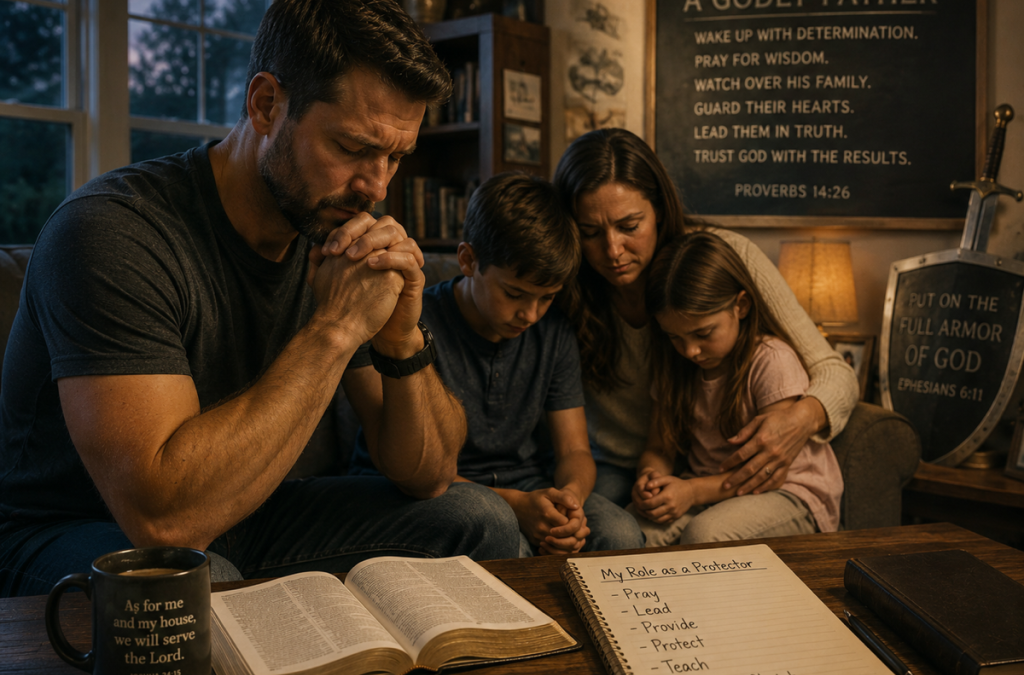
Protector – Biology tells us in a dangerous and uncertain world men must protect their families. That is primarily their responsibility, but of course the family will pitch in when necessary. Imagine Little House on the Prairie, 1970s version. It’s clear Michael Landon is the man and responsible for keeping his family safe.

Provider – This is probably the most contentious of the roles in an age of feminism. Girls are taught from a young age and indoctrinated into a career mindset as they get older. Few parents teach their daughters that aspiring to be a wife and mother should be their greatest aspiration. A career is fine as long as it never takes priority over her role as a mother. This, of course, has very much to do with the man’s stepping up to make sure his wife has that option because the family is not dependent on her income. The most difficult scenario is when the wife makes more money than the husband, and the husband is ok with that. He should not be. Depending on his wife’s income is a dereliction of his duty as a husband, and women have a hard time respecting such men.

Priest – The spiritual leader of the home is the husband and father. If he’s not a Christian, the wife has to take that role, but if he is, there is no excuse for him not taking the lead. What this means in practice will vary by household and the husband’s and father’s gifts, but faith is as much caught as taught. I was not a great spiritual leader when it came to family devotions and reading and praying with the kids, but I was always passionate about teaching them that Christianity is true. That was a constant theme of my comments, lectures, and teaching. Missing church was never an option, but we didn’t expect the church to raise our kids spiritually.

However any of this works out in any family, everything works better, more smoothly, when there is no doubt who the leader of the family is. If the husband abdicates his role, for whatever reason, dysfunction and suffering will follow. Don’t let that happen in your marriage or family, and you will be blessed.