
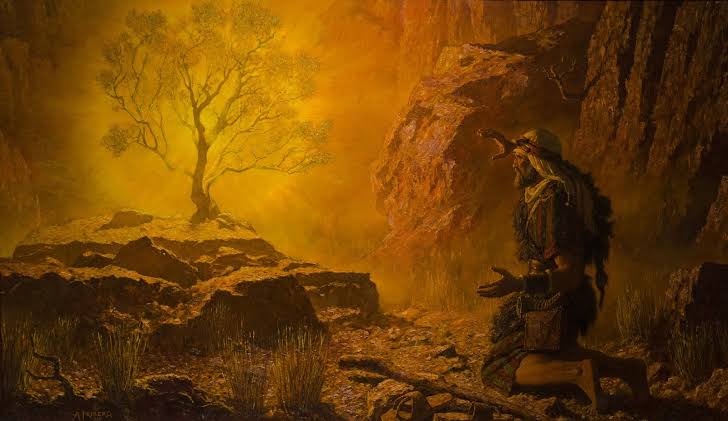
I heard someone on a podcast recently say that when a person has an encounter with the living God the result in a person’s life is not emotion, but changed priorities. That phrase struck me because when God transforms us spiritually, inwardly, from death to life, darkness to light, we see everything differently, or should. Previously, things that were important without God, no longer are, at least in the same way. Previously unimportant things, now become significant to us. At that moment, everything changes, and if it’s real, it will. No one can have a true encounter with the Living God and remain the same. Such an encounter obviously can and probably will include emotions, but too many Christians confuse emotions with something real just because they feel something. Whatever the feelings, changed priorities are a reflection of a changed life, the inevitable results of an encounter with the living God.
What prompted the discussion was Moses’s encounter with the burning bush, and the host explained that when something burns its molecular structure completely changes; it literally becomes a different thing, a transformation. I thought this was a great analogy because we are told in Scripture that, “our God is a consuming fire” (Heb. 12:29). We tend to read this as consumed up, as in there is nothing left after that, but fire always leaves ashes, the residue of that which is consumed. In other words, if we have an encounter with the living God it will change us. The reason it will have a transformational effect is because of what I call a radical relational reversal. Before Christ our relationship to God is one thing, one molecular structure, if you will, then after because of the fire who is God, the molecules are completely changed, rearranged into something different while remaining the same molecules, us. What surprises us is learning that the important relational change isn’t the one in us, but in God. In other words, it’s his changed disposition toward us that is the important thing, not ours toward him.
This can best be explained by the state of our relationship to God prior to our salvation. In our sin, our natural state from conception, God is our judge, jury, and executioner. Needless to say, that puts a bit of a damper on the relationship. Like Adam and Eve, when God shows up, we hide. The wages of sin, we’ll remember, is death, what God warned Adam would happen if he ate from the tree. When he did the death proved not to be instant physical demise, that would come later, but something even worse—spiritual death, complete and total alienation from God. The problem is God’s wrath toward us in our sin, not the state of our soul toward him. The relationship, the connection of human beings with God is life itself. As the Apostle John says of Jesus, “In him was life, and that life was the light of men.” Sin severed the relationship, and death was the result, spiritual and physical, along with all the other struggles and suffering existences brings in a fallen, sinful world.
What John, and the rest of the New Testament, tells us is that in Jesus the relationship can be put back together, as the great Christmas hymn says, God and sinners reconciled. When Christ said on the cross, “It is finished,” and the curtain in the temple was torn in two from top to bottom, the way was opened up to a relationship to God for sinful human beings. God’s wrath had been fully poured out on Christ, a frightful thing to contemplate, taking the penalty due our sin, and we receive Christ’s righteousness, earned by his perfect obedience to the Father in his life on earth. God as consuming fire would no longer consume us unto death, but the consuming would transform us unto life.
The Relationship Between the Holy God and Sinful Man
As modern secular people we don’t see a relationship to God as in any way problematic. We’re not all that bad, we think, and God should like us just as we are. The problem is that if God showed up as the consuming fire he is, we would instantly be a pile of smoldering ashes. Think Raiders of the Lost Art opening of the ark scene; not a pleasant experience. From early in God reestablishing his relationship to sinful human beings, he consistently communicates the danger of sinful man and holy God interacting, of thinking the one true living and Creator God is anything like the idols of the heathen nations. In fact, all the gods other than Yahweh are created in man’s image, rather than man created in God’s image.
Teaching humanity of the infinite divide between man and God, known as the creator-creature distinction, was the reason God decided in his plan of redemption to create a people for his very own where this message would eventually be communicated to the world. We know them as the Hebrew people, then eventually the Jews. Before he gets to the details of how this will work, we come to his revealing himself to Moses in the burning bush (Exodus 3). Here’s the passage explaining this very odd encounter.
Now Moses was tending the flock of Jethro his father-in-law, the priest of Midian, and he led the flock to the far side of the wilderness and came to Horeb, the mountain of God. 2 There the angel of the Lord appeared to him in flames of fire from within a bush. Moses saw that though the bush was on fire it did not burn up. 3 So Moses thought, “I will go over and see this strange sight—why the bush does not burn up.”
4 When the Lord saw that he had gone over to look, God called to him from within the bush, “Moses! Moses!”
And Moses said, “Here I am.”
5 “Do not come any closer,” God said. “Take off your sandals, for the place where you are standing is holy ground.” 6 Then he said, “I am the God of your father, the God of Abraham, the God of Isaac and the God of Jacob.” At this, Moses hid his face, because he was afraid to look at God.
Notice the bush itself isn’t burning, but the fire is coming from within the bush. In other words, the fire was separate from the bush, and not using the bush for fuel. We call this a theophany, or “God made manifest.” Since God is invisible, at times in redemptive history he makes himself visible so he can manifest himself to sinful creatures. All the gods of the ancient peoples were made visible to them in some way, in some kind of physical idol, so God had to make himself plausible as a divine reality to the Hebrews in some visible way, and fire was an important way do it, without making an image like the heathen gods. God’s people needed to understand that their God was nothing like any created thing because he was creator of all things, a radical, unheard of concept in the ancient world.
As for a burning bush that does not burn up, you have to imagine Moses was utterly perplexed that fire would not burn the bush. Then he hears his voice being called, twice, out of the bush. Fire speaks? Then God reveals something to him, and us, about this relationship of the holy God to sinful man—it’s dangerous.
God further reveals this danger by fire to the people of Israel later after they escape Egypt and it is terrifying. We read about it in Exodus 19 as the people come to Mount Sinai and God is telling them how they will become his people, and out of all the nations his “treasured possession.” In Deuteronomy 4 Moses reminds the people of this event and what it means for them, and he emphasizes the fire, mentioning it seven times. He wants them to remember they didn’t see any form, but only heard the voice as he declared his covenant to them, and gave them the Ten Commandments. It is from this chapter the writer to the Hebrews gets the phrase that our God is a consuming fire. Moses further reveals to us that he is “a jealous God,” taken from the first of the Ten Commandments, and because of that they shall have no other gods before him.
Then God begins the process of teaching his people, including us, of the vast gulf between him and we his creatures, that this relationship is not something to be taken for granted as if he were anything like us. The display on the mountain made that clear enough, but we’re forgetful creatures. So God has them build an intricate system giving them access to his presence, but only in an extremely limited way. Everything about the tabernacle they build in the wilderness, and then eventually in the Temple, tells us we need to be separate from this God for our own safety, but at the same time we need access because God himself is life and outside of him is only death and decay. His presence, then, is represented by the Holy of Holies, the inner sanctum where only one man as a representative for the people could come, and that only once a year, to make sacrifice for his and the people’s sins.
The New Covenant and the New Way to God
Breaking the Jewish people out of this conception of an inapproachably holy God would not be easy, but the point of God’s plan of redemption was to do exactly that, so he could be just, and the justifier of many. In other words, the relationship could be re-established, God and sinful man reconciled, while God remained who he is, a consuming fire. Only now, the fire would not consume but transform his people for his glory and their good. It would be the fulfillment of a 2,000-year long promise he made to Abram that through him all the peoples on earth would be blessed, and that means us!
Jesus gives us a hint of this early in his ministry when he teaches the disciples what we know as the Lord’s Prayer. For Jews at the time God as a loving father would have been inconceivable. Your father isn’t your judge, jury, and executioner. Your father doesn’t kill you if you get too close to him. Yet Jesus was teaching his disciples when praying to God to address him as Father. At the time this was radical. You have to imaging Jews at the time, which they all were, wondering if they heard Jesus correctly. As with much of the conundrum that was Jesus, it would have been completely unexpected. For all of Isreal’s history, God was never portrayed as a father figure, but as wholly other, a God to be feared, not like my dad who loved me and would die for me. In fact, as my Father, he did love me, and he did die for me! This would all become clear in due course, but it had to be confusing at the time.
We see the radical difference between the Old and New Covenant in Jeremiah 31. In the Old, God’s people were commanded to love God. In Deuteronomy 6 right after the Hebrews were told that God is one, what Jews call the Shama, they are given this command:
5 Love the Lord your God with all your heart and with all your soul and with all your strength.
The command is repeated six other times in Deuteronomy, but never again emphasized in this way. However, what love means in practice is reiterated throughout the Old testament because it means:
- obeying His commandments
- walking in His ways
- serving Him
- holding fast to Him
- refusing other gods
- listening to His voice
There is one minor problem sinful human beings had trying to love God like this—it’s impossible! Without God himself enabling us to do this, we don’t have a chance. Jesus, when asked what the greatest commandment in the law is, doubles down saying with his answer.
37 Jesus replied: “‘Love the Lord your God with all your heart and with all your soul and with all your mind.’ 38 This is the first and greatest commandment. 39 And the second is like it: ‘Love your neighbor as yourself.’ 40 All the Law and the Prophets hang on these two commandments.”
God gives us the answer to our dilemma in Jeremiah 31 as he reveals a new covenant coming that will be unlike the one he made with the generation he lead out of slavery in Egypt.
33 “This is the covenant I will make with the people of Israel
after that time,” declares the Lord.
“I will put my law in their minds
and write it on their hearts.
I will be their God,
and they will be my people.
34 No longer will they teach their neighbor,
or say to one another, ‘Know the Lord,’
because they will all know me,
from the least of them to the greatest,”
declares the Lord.
“For I will forgive their wickedness
and will remember their sins no more.”
The solution is the gospel! The good news of God taking our vile, sinful, rebellious hearts, and replacing all of that with his very law inscribed on our hearts and in our minds. When Jesus died, rose from the dead, ascended to heaven at the right hand of God, and then sent his Holy Spirit at Pentecost, we could now obey the greatest commandment. Loving God with everything in us was no longer a pipe dream filled with failure, but a reality of transformational blessing, our telos or purpose as created beings in God’s image finally fulfilled. Now as God’s living temple with his Holy Spirit living in us, it is not only possible to walk in obedience to his law, but also have affection for him as our Father. We’ve moved from justifiable condemnation to dearly loved children, as radical a relational reversal as there ever could be.
Recent Comments