
Conservatism, the Protestant Dilemma, and the Theocratic Element
This post was inspired by what was for me an eye opening piece at American Reformer by Timon Cline titled, “Can Protestants be Conservative?” I’ll explain what he means and lay out some of his arguments below, but this piece is really about setting up why Cline’s question is a perfect way to phrase the question and the dilemma it raises for we who espouse the Protestant faith. When I first saw the question it made no sense to me, but now it does, and hopefully before I’m done it will to you too. I encourage you to read his piece as well. He takes many of his arguments from a book published in 1962 by Clinton Rositer called, “Conservatism in America: The Thankless Persuasion.” I haven’t read it yet, but it will be interesting to devel into Rositer’s perspective on the development of modern conservatism and it’s rebirth after the World War II. Liberalism’s dominance after Roosevelt and the War was absolute, and conservatism thought something of a joke and not taken seriously by America’s cultural and political elites.
In order to make sense of Cline’s question, and set up the answer to it, we’ll first take a look at my journey through conservatism.
I’ve been a conservative since shortly after I “pulled the lever” for Jimmy Carter in my first presidential election in 1980. There’s a story behind that lamentable choice. As my name indicates, I’m Italian and grew up in a thoroughly Americanized Italian home and family. The two sides of my family couldn’t have been any different. My dad’s side was crazy, like every stereotypical over-the-top Italian family we’ve seen in movies or on TV: loud, boisterous, argumentative, especially when the alcohol flowed. By contrast, my mother’s side was as calm as a summer pond on a still day. My dad was born in Brooklyn early in the Depression, and his outlook on life in large part determined by it. Given Italian immigrants we’re almost all Democrats, they were a proud Roosevelt Democrat family. Italian also meant Catholic, and although my dad didn’t start out a faithful church goer, as I grew up he wouldn’t miss a Sunday Mass.
All this lead to my dad’s identity being rooted in three words I’d often hear him say: He was an Italian, Catholic, Democrat, and he would never change! And he didn’t. I went away to college in the fall of 1978 pretty much apolitical. I guess I was a registered Democrat, but didn’t think much about it. Of those three words my dad used, one was about to change. I became a born-again Christian not long after I arrived at Arizona State University, something that would not make my dad a happy camper. I couldn’t do much about the Italian part, but by the time of the 1980 election I would not be long for the Democrat word either. Given my ignorance I had no conviction one way or the other, but since I guess I was a Democrat, I should vote for the Democrat, and why Carter got my vote. He would be the last one. The morning after Reagan won I was in the student union watching Reagan’s news conference, and the more he talked, the more I realized I was probably a conservative Republican, and that’s how it all started. I didn’t know at that time I would have decades ahead of experiencing conservative futility and frustration, but I was all in.
My political journey really started when I came across Francis Schaeffer’s, The God Who Is There, sometime in 1980. Realizing my Christian faith applied to all of life, including politics, was a game changer for me. The campus organization I came to faith through was typical of a Pietistic kind of fundamentalism focused on “spiritual” things like Bible reading, evangelism, Scripture memory, lots of Scripture memory, and fellowship with other Christians. All that really counted was my relationship with Jesus, and the worldly stuff while maybe important, wasn’t a priority. Schaeffer began to change that, along with his once Christian and conservative son Franky. It’s through the latter that I learned about National Review Magazine and the Wall Street Journal editorial page. These became my teachers about the conservative movement, along with reading books that taught me what conservatism is. It all sounded great to me, but as time passed I noticed nothing seemed to change. The liberals continued their march through the culture, and we only seemed to conserve their gains, albeit maybe a little more slowly.
The Culture Wars and Conservative Futility
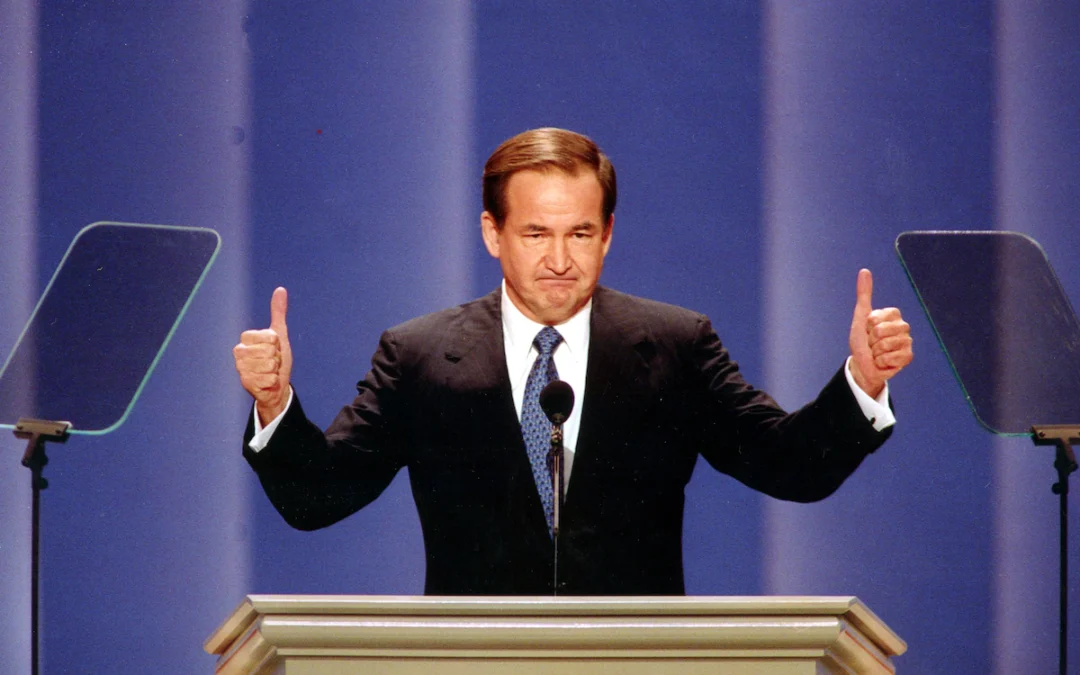
I’ll never forget watching Pat Buchanan at the 1992 Republican convention in Houston, and hearing the words “culture war” I think for the first time. For your average politically engage conservative, Buchanan was mostly an embarrassment. Bill Buckley, one of my conservative heroes, more or less accused him of being an anti-Semite. He had run for president against George Bush, but couldn’t gain any traction. The Bush campaign gave him a prime time slot to make his case for Bush, and his own vision for America. It’s one that looked increasingly prescient as the years wore on. It’s known as “The Culture War Speech,” which is a war mainstream Republicans wanted nothing to do with. What Buchanan understood, and Republicans didn’t, was that conservatives didn’t start the war. And what was most profound about his insight was that it wasn’t about culture per se, but about religion, about what Americans believed fundamentally about the nature of reality. A little more than halfway through the speech he lays out the case:
Yes, we disagreed with President Bush, but we stand with him for the freedom to choose religious schools, and we stand with him against the amoral idea that gay and lesbian couples should have the same standing in law as married men and women.
We stand with President Bush for right-to-life, and for voluntary prayer in the public schools, and we stand against putting our wives and daughter and sisters into combat units of the United States Army. And we stand with President Bush in favor of the right of small towns and communities to control the raw sewage of pornography that so terribly pollutes our popular culture.
We stand with President Bush in favor of federal judges who interpret the law as written, and against would-be Supreme Court justices like Mario Cuomo who think they have a mandate to rewrite the Constitution.
My friends, this election is about more than who gets what. It is about who we are. It is about what we believe, and what we stand for as Americans. There is a religious war going on in this country. It is a cultural war, as critical to the kind of nation we shall be as was the Cold War itself, for this war is for the soul of America.
That last paragraph was a planting-a-flag moment in American history, and a moment of clarity against the entire American political and cultural establishment, and they despised Buchanan for it. Around Reagan’s reelection in 1984 I got involved in Republican politics in California. I experienced even then how mainstream Republicans, who called themselves “moderates” looked down on we “social conservatives.” The 80s was the era of the Moral Majority, which inspired those pesky conservative Christians to become politically engaged, and the cultural elites from both sides of the political spectrum were none too happy about it.
The problem I didn’t quite see at the time, and what Cline exposes, is that the modern conservative movement is thoroughly secular. This doesn’t mean there were not deeply religious people involved, but that they bought into the myth of neutrality, that America’s liberty was based on a pluralism where Christianity had no more right to influence government policy than any other religion. Basically, and Cline points this out, modern conservativism was classical liberalism, an Enlightenment project that saw religion as a primarily personal issue, and religion in the public square as fundamentally divisive. America’s founders negotiated that tension, but given late 18th century America was thoroughly Protestant, and Calvinism dominant, Christianity informed everything about how the Republic was founded and governed.
I was not well versed on the history of conservativism or the conservative movement, having seen it as primarily a post-World War II phenomenon, but I learned from Cline it started well before that. Therefore, I assumed conservatives and conservatism was mostly on the side of we social conservatives because it sure sounded like they were. But as the 90s gave way to the 2000s and George W. Bush’s administration, I started to experience some cognitive dissonance. The 2006 midterm elections where Republicans got shellacked was like a gut punch. No matter what we do nothing changes, and the liberals and their progressive project marches on. Maybe conservatism slowed it down a little, but it almost seemed like conservatives and liberals were on the same page. I didn’t think that at the time, but suspicion was brewing up in me like a kettle on the boil. I concluded the reason we don’t get anywhere is that we ignore culture and think the answer is politics. So I went all in on the culture, but politics is important because as a wise older man once told me, it’s the distribution of power in a society.
After Obama was elected, the first Marxist president, the pessimism set in. I realized I probably wasn’t a conservative given their futility, but what was I? I thought about libertarianism, but that was a secular dead end. Maybe I was a classical liberal after all. I was hanging around some guys who embraced that moniker, but I realized it was too secular for me too, so now what? Trump! He reoriented everything for me, the very last person on earth I thought could do such a thing. At the time I had subscribed to National Review magazine, and had done so since the early 80s, and in February ’16 I got the infamous anti-Trump issue of the magazine in the mail. On the cover were big bold gold letters that stated, “AGAINST TRUMP,” and below the names of the contributors, a who’s who of the conservative movement. Some of since repented, but most of them got TDS so bad they could never recover. It was that day as I was trying to read some of it that I knew the conservative movement had been conning me all along, which is why I now call it, Con inc.
Conservatism’s Theocratic Element: Against Protestants
I finally came to understand that the fundamental problem with conservatism was that it bought into the secular myth of neutrality, that America, or any nation for that matter, could be governed without any overt political reference to God, and specifically the Christian God. Cline explains how this process of de-Protestantizing conservatism developed in the late 19th century with industrialization and waves of immigration, much of it Catholic. The changes coming after the Civil War were monumental as America was developing into an industrial world power. The religiously conservative rurally agrarian society prior was becoming an industrial city based country. As conservatism became less overtly Protestant, it became more classically liberal, or what Rossiter called “laissez-faire conservatism,” and thus more individualistic, libertarian, and secular. This was when conservatism lost its “theocratic element,” meaning there was no longer, according to Cline, “any positive moral, religious vision for society.”
The new conservatism would be more ecumenical, part of a “Judeo-Christian” tradition, less Protestant as it was in America’s first century. By the time of the development of the modern conservative movement, it became primarily a Catholic and Jewish driven movement. It wasn’t until the above mentioned Moral Majority that conservative Protestants declared their relevance again, but they were not exactly welcomed. Today we see this dynamic play out in movement conservativism’s aversion to anything smacking of “Christian nationalism.”
If you read the founding fathers you will find they were all, even the most supposedly Deistic among them, completely comfortable with the primacy of Protestant Christianity as the worldview and moral driver of the republic. When Adams said the following he was speaking about Protestant Christianity:
Because We have no Government armed with Power capable of contending with human Passions unbridled by morality and Religion. Avarice, Ambition, Revenge or Gallantry, would break the strongest Cords of our Constitution as a Whale goes through a Net. Our Constitution was made only for a moral and religious people. It is wholly inadequate to the government of any other.
This was axiomatic for the first hundred years of the Republic, but secularism slowly took over, and conservatism went right with it.
What was most revelatory for me was the transformation among conservatives of the role of government. I always assumed per Reagan’s quip, that the government that governs least governs best. Since liberty was now defined primarily in economic terms, minimalist government became the default conservative position. Cline explains it well:
The purpose of government was always stated in purely individualistic terms. This was the minimalist, nightwatchmen theory of the state. Government was merely the umpire there to call foul if the rules of the game were violated. The state was decided not an active instrument of leadership, and was certainly not charged with social happiness. The goal was to reduce government’s relevancy and size to such a degree that, as Grover Norquist would say, it could be drowned in a bathtub.
One of the things Donald Trump exposed, ironically enough, is the secular-Protestant divide in modern conservatism. Traditional (as we’d see them now) laissez-faire conservatives despise Trump. A robust executive who exerts moral leadership over the nation is not at all welcomed. This is why conservatism developed, as Rossiter termed it, “an intense cult of the Constitution” rising to the level of “a second holy writ.” Reading those words was shocking to me because I assumed that cult was the normal state of affairs. Cline counters:
Whereas the actual framers had been ambivalent about the Constitution as a pragmatic mode of governance, the new conservatives sacralized it. Now the parchment was “great and sacred,” and inviolate, immutable even. “In short, the Constitution was a closed book by which Americans must live henceforth and forever,” and this closed book was a “catalogue of limitations rather than a grant of powers.” In need of an interpretive key and inspirational hermeneutic, the Declaration of Independence was rediscovered as the philosopher’s stone.
This gave us a new clergy, men, and now women, in black robes, judges became the new high priests. As Cline aptly puts it, “The move was not to suggest a moral, directing power to government, but rather the divinity of absolute restrictions against such activity.”
What I discovered reading Cline’s piece is that the reason modern conservatism is a loser political philosophy is because while it lost “the theocratic element,” the left never did. They understand what conservatives forgot a long time ago: there is no morally neutral place from which to govern a society. The left is driven by a moral force that will not be stopped, while the secular right is powerless to stop them. That is, until Donald J. Trump showed us what conservatism could and should be. It’s crazy for me to write that sentence, let alone think that thought, but God used Trump to reveal what I’d been wondering about for a very long time, why Con Inc. proved to be a con. Once I discovered this I realized modern conservatism was just liberalism in a skirt, and Cline confirmed that.
Protestants are finally debating the “theocratic element” and breaking out of the secular trap. Nobody knows where this is going to go because it is a complicated subject and everyone has an opinion, but at least we’ve started a journey that had to be made. Conservative Protestantism needs to be back at the center of the conservative movement and American public life. It’s our American heritage and we need to fight for it.



Recent Comments