
Christian Nationalism is a completely worthless phrase; worse, it’s a distortion. Most of the time people use it as a dishonest rhetorical device to discredit any Christian who believes nations must be Christian. The assumption of those using it, never discussed or defended, or probably even thought through, is that we can and should have a secular nation, as if such a thing is even possible. Secularism is a religion; it is a faith, a belief system, a worldview. The main reason Christian Nationalism is unhelpful is because there is no single definition of it. It’s like a bucket people pour into it whatever they want, and that’s Christian Nationalism! It’s not because it doesn’t exist. It’s a figment of each user’s imagination.
Before we get to the meat of the discussion, it will be helpful to understand the history of the nation out of which could flow an “ism” attached to it. The modern nation-state is a relatively new phenomenon in the history of the world. It developed in the Christian West out of the Peace of Westphalia in 1648 in the aftermath of the 30-Years War. Prior to that nations were ill defined, and the concept of a sovereign geographic entity with its own political system and sovereign boarders didn’t exist. In world history prior to the Middle Ages, might made right, and whatever nation or state (modern concepts) had the most power, called the shots. Basically borders didn’t exist. Kingdoms and ethnic geographic entities existed to one degree or another, but boarders were malleable if they existed at all. That slowly began to change with the development of the Holy Roman Empire (greater Western Europe) after the rise of Charlamagne in 800 AD, but wouldn’t fully develop until after the Peace of Westphalia.
Once nations developed it wasn’t long before the word “nation” would define what a state is, and that it should demand supreme loyalty. The American and French Revolutions where the first “nationalist” movements where loyalty would no longer be to an empire or monarch, but to the nation itself. It further developed throughout the 19th century and into the 20th when the “ism” was added.
We must always be careful when “ism” is attached to a word. It means the concept has been turned into some kind of doctrine, theory, system, or ideology. It’s one thing to have a commune, but quite another to have communism. It’s one thing to have capital, but another to have capitalism. So, a nation is a geographic entity with recognized sovereign defensible boarders, while nationalism is some kind of ideology built around that nation.
The reason the word nationalism tends to distortion and is unhelpful is the undercurrent of Nazism. Remember they called themselves National Socialists defined by the blood of the German volk, or people. Only pure blood, white, Aryans were considered part of the volk and thus legitimate citizens in the state. After World War II, the word nationalism could never be fully divorced from this association. The critics of Christian Nationalism will throw around the phrase “blood and soil” as an epithet. They may as well be calling those who espouse Christians nations Nazis. The fact of the matter is that every nation is blood and soil to one degree or another which over time develops each nation’s unique culture. It’s when blood and soil become an “ism” like Nazism that problems arise.
We can’t leave this discussion without talking about a logical fallacy called begging the question. Today for most people that phrase means “raising the question,” but that’s only because it sounds like it should mean that. It comes from a Latin phrase, petitio principii, or assuming the starting point. It’s a form of circular reasoning. It is something in an argument or discussion that is assumed without having proved or argued for it, and it happens all the time. When you know what begging the question really means, you see it being done all the time, and in discussions of Christian Nationalism it’s almost a requirement! We’ll be exploring that question begging for the rest of the post. (I won’t defend the idea of a Christian nation here, but I described what that is in a piece earlier this year titled, “What Does It Mean to Baptize Nations?”
Christian Patriotism vs. Christian Nationalism
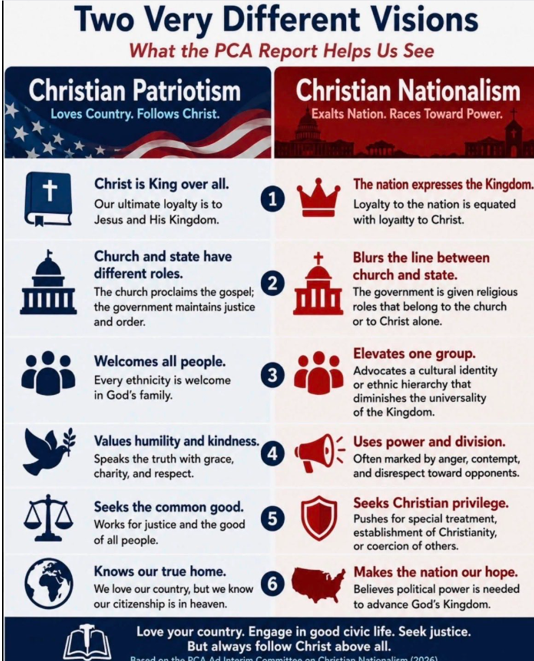
In a post on Twitter titled, “Two Very Different Visions,” we are supposedly seeing what, in the subtitle is, “What the PCA Report Helps Us See.” These visions are only in the writer’s imagination. The Presbyterian Church in America recently put together a study committee on Christian Nationalism and recently issued a report. This is one man’s version of the report, one that bears little resemblance to what is in the report.
The question begging starts with a bang. He claims that Christian Patriotism (CP) “loves country and follows Christ,” while Christian Nationalism (CN) “exalts nations and races toward power.” Those embracing CN are in effect guilty of idolatry. They can’t just love their country, they worship it. They also don’t follow Christ because they are most interested in power, presumably political power, as if that’s a bad thing. Are Christian nationalists even Christians in his book? Doesn’t seem like it. And this is just the beginning. Next he creates a chart comparing the two on six variables or metrics.
CP: Christ is king over all. Our ultimate loyalty is to Jesus and His kingdom.
CN: The nation expresses the kingdom. Loyalty to the nation is equated with loyalty to Christ.
Like all of them, this is a faulty and lazy comparison. Every person who believes nations should be Christian believes Christ is king over all. We all believe our ultimate loyalty is to Jesus and his kingdom. As for God’s kingdom, what does a nation expressing the kingdom mean? And why is that a bad thing? Is he saying we believe the nation is the kingdom? God’s kingdom can and must be expressed in the nation, but geopolitical entities like states are not to be confused with the kingdom. As I’ve written here previously, the kingdom of God is not identical to the church either. Lastly, I’ve never read or heard someone equate loyalty to the nation with loyalty to Christ. He is either assuming this from what he thinks he knows about them, or he’s being disingenuous, maybe both.
CP: Church and state have different roles. The church proclaims the gospel; the government maintains justice and order.
CN: Blurs the line between church and state. The government is given religious roles that belong to the church or to Christ alone.
I’ve yet to come across anyone who believes in Christian nations that doesn’t believe the church and state have different roles. Nobody teaches it or believes it. What they do believe, and this must be what he’s thinking, is that CNs believe God’s law should apply in every nation. The degree is to what extent, and among CNs there is considerable disagreement. Everything turns on what one means by “religious roles,” and there is considerable disagreement there as well. His assertion is as simplistic as it is inaccurate.
CP: Welcomes all people. Every ethnicity is welcome in God’s family.
CN: Elevates one group. Advocates a cultural identity or ethnic hierarchy that diminishes the universality of the kingdom.
What does “welcomes all people” mean? Does he think nations shouldn’t protect their boarders, that boarders should be wide open to let anyone in who wants to get in? Probably not, but this is another lazy formulation. He confuses “God’s family” with the nation, which I thought we weren’t supposed to do. There is a grain of truth to his second contention among some promoters of CN, but it has nothing to do with the universality of the kingdom. Again, the nation is not the kingdom but can and should be a reflection of it. Those who espouse CN do believe that culture and cultural identity are not infinitely malleable. Each ethnic people have a unique culture and that is the way it should be.
CP: Values humility and kindness. Speaks truth with grace, charity, and respect.
CN: Uses power and division. Often marked by anger, contempt, and disrespect toward opponents.
Power and division are not inherently sinful, and nor are they a contrast to humility and kindness. We should use the latter in advancing the former. That some who espouse CN act in ways inconsistent with the fruit of the Spirit only proves sinners sin and says nothing about CN.
CP: Seeks the common good. Works for justice and the good of all people.
CN: Seeks Christian privilege. Pushes for special treatment of establishing or coercion of others.
This might be the most egregious display of question begging in this list, and it is slanderous. We don’t seek the common good? Really? The reason nations need to be Christian is exactly for the common good. When God promised Abram in Genesis 12 that all peoples on earth would be blessed through him, the promise was fulfilled in Christ and proclaimed in the Great Commission. The gospel is the good news that all nations, or peoples, tribes in the Hebrew, would be blessed, not just the individuals within those nations. CN by its very definition is for the common good! It is not to work for injustice, which is what he is implying. Like I said, slanderous.
As for seeking Christian privilege, absolutely! He is assuming there is some neutral space in a society where all religions should be treated equally, and no one religion held up as superior to others. Christianity, however, claims exactly that! Some religion or worldview, and it’s ultimate faith commitments, will inform the laws and mores, the culture, of a nation. The only question is which one it will be. Those against CN think a neutral secular nation is a possibility, and pluralism and maximal religious freedom is possible. It is not—it’s a disaster. Witness America in the last 60 plus years.
The last distortion is that CN seeks to coerce others. That is a big fear of the anti-CN folks, and it is simply not true.
CP: Knows our true home. We love our country, but we know our citizenship is in heaven.
CN: Makes the nation our hope: Believes political power is needed to advance God’s kingdom.
These statements reflect the unfortunate mentality of the modern church steeped in Pietism. It borders on Gnosticism, and is most definitely influenced by it. He is referencing Philippians 3:20 where Paul says,
But our citizenship is in heaven. And we eagerly await a Savior from there, the Lord Jesus Christ.
In my Pietistic days I used to believe this meant we Christians were just wondering through the desert of this fallen world like the Hebrews wondering in the desert after they were rescued from slavery in Egypt. We’re just strangers and aliens in this world. In a way we are, but escape to our true home in heaven isn’t the point of this verse. Rather, it is Paul telling us that as the Philippians are citizens of Rome and are building an outpost of the Empire in Asia Minor, so we are citizens of heaven building an outpost of God’s kingdom here in this fallen world. The point of the Christian life is, Thy kingdom come, Thy will be done on earth as it is in heaven, not getting away from this earth to get to the kingdom in heaven. We are bringing heaven to earth! My next book which will be published later this year is all about this, and my hope is that we begin to change the church’s focus earthward to spread the blessing God promised us 4,000 years ago.
And lastly we come back to the slander. Those of us who believe a nation must be Christian most certainly do not make the nation our hope! Christ alone is our hope, which is why we insist the nation must be Christian and not secular or any other religion. As for political power, like anything else humans do, it will be used either to advance God’s kingdom and his righteousness, or Satan’s kingdom. There is no neutrality.
A Christian Nation and the Myth of Neutrality
Someone has said, rightly, that culture is religion externalized, and a nation’s government is a reflection of its culture. That means, no nation can be religiously neutral. Yet since the end of World War II there has been a presumption in the West that nations can be secular, which to them means a declaration of religious neutrality. That is, to put it plainly, an impossibility. A nation is made up of human beings, who in addition to Aristotle’s dictum that “man is by nature a political animal,” are also religious animals, but not in fact animals but beings made in God’s image. And if we can agree that a morally neutral human being doesn’t exist, putting them in a political community doesn’t all of a sudden make the product of their community morally neutral.
By the middle of the 20th century, secularism had so worked its deceits into the West’s cultural blood stream that cultural elites completely embraced the myth of neutrality. Christianity, and religious practice in general, was exclusively for people’s private lives, and a mythical Berlin Wall of separation between church and state became the new dogma that must be obeyed. In due course we got secular tyranny. This got so ridiculous that a school would no longer be allowed to display the Ten Commandments on its walls. Sadly, although this is changing, most conservatives and Christians buy into this myth. A couple years ago I even heard Larry Arnn, the president of Hillsdale College, say a Christian nation is an oxymoron. For the most part this is dogma among doctrinaire conservatives, and if moral neutrality is a myth, then it cannot be true.
It was Jesus himself who commanded us to create Christian nations. We remember that as the Great Commission, and what makes it great is that it isn’t just for individuals, but for the nations that individuals create. All authority in heaven and on earth had been given to Jesus, and because of that he told his disciples to, “make disciples of all nations.” In doing that they were to baptize them in the name of the Triune God and teach them to obey everything he commanded. As the individuals within the nations are brought to Christ they are to take that transforming power into everything they create cultural and politically. As I said in my post about baptizing nations, “nations are baptized when the nation, it’s worldview and value system, reflects Christianity as the aspirational guiding system of the country.” That is the task before us, to take the power of the gospel out of our homes and churches into everything we do that as God promised to the Patriarchs, the nations might be blessed.
Recent Comments