Man Shall Not Live by Bread Alone

Man Shall Not Live by Bread Alone

All Christians are familiar with these famous words from Jesus in Matthew 4 as he rejects the temptations of the devil. Jesus had been fasting for 40 days and nights, and with understatement Matthew says, “he was hungry.” So Satan, called “the tempter,” knowing the power Jesus has tells him since he’s so hungry, why doesn’t he just tell the stones to become bread, which he should easily be able to do if he’s the Son of God. Jesus is having none of this.

4 Jesus answered, “It is written: ‘Man shall not live on bread alone, but on every word that comes from the mouth of God.’”

Jesus is quoting from Deuteronomy 8 where Moses is telling the Israelites they need to “follow every command” Moses is giving them specifically so they “may live and increase and may enter and possess the land the Lord promised on oath” to their ancestors. He tells them the Lord was testing them in the wilderness to humble them, causing them to hunger and then feeding them with manna, a food nobody had ever seen before. He did that specifically to teach them “that man does not live on bread alone but on every word that comes from the mouth of the Lord.”

Notice the connection between living on “every word that comes from the mouth of God” to being blessed by God. God’s will for his people is that they “may live and increase” and enter his land of promise. We might metaphorically see this land as God’s kingdom rule Jesus brought to earth and our entering into it as God through his Holy Spirit saves us from our sins. But the key phrase in Moses’ exhortation is “possess the land.” When we possess something we own it, we live it, we experience and enjoy it. The only way to fully live and increase and possess the blessings of the Christian life is living on God’s word. Every word of God specifically to and for us has been inscripturated in what we call our Bibles, which in our day makes it very easy to live on.

As my kids were growing up, and I still do it as they’re adults, I would push this metaphor to help them understand why daily spending time in God’s word is so important. It is no coincidence that Moses and Jesus, God himself, compares his word, the communication that comes from his mouth, as food. Try living without food. It’s not easy. If you do it for too long, you die. Which is why we think about and obsess over food all the time. It’s a requirement for our continuing to exist. Why don’t we do that with God’s word, our Bibles? Simply, we don’t believe that. I want to try to convey here why we should.

The Transformational Power in The Word of God
We often refer to our Bibles as “the word of God,” the phrase itself coming from that word. The whole is a representation of its authority in our lives and over the world, visible and invisible, while each word is its living, practical power in our lives to overcome the world, the flesh, and the devil. Many of us are familiar with this passage in Hebrews 4:

12 For the word of God is living and active. Sharper than any double-edged sword, it penetrates even to dividing soul and spirit, joints and marrow; it judges the thoughts and attitudes of the heart.

If we eat God’s word, daily live on his every word, it’s going to reveal our deepest thoughts and attitudes, and bring them into conformity to God’s way of doing life, so we may live long and increase and possess the land. In other words, be blessed. An Old Testament passage that captures this without reference to the word is in Psalm 139:

23 Search me, God, and know my heart;
test me and know my anxious thoughts.
24 See if there is any offensive way in me,
and lead me in the way everlasting.

I would suggest that praying this without daily meditating upon God’s word will never allow us to truly live in the way Jesus is using the word, specifically quoting Moses and referring back to live long and increase and possess the land. If we truly want our lives blessed, in good times and bad, in joy and suffering, then it can only come in two-way communication with our living and Savior God, Scripture and prayer.

Jesus is also revealing something to us in his encounter with Satan about the spiritual reality Paul writes about in Ephesian 6:

12 For our struggle is not against flesh and blood, but against the rulers, against the authorities, against the powers of this dark world and against the spiritual forces of evil in the heavenly realms.

We’re not talking about mere psychology here, about learning good ideas and putting them into practice. We’re involved in a mystery, a spiritual reality, one we can’t comprehend, but in which we are involved nonetheless. The dynamic of God’s word and the power of the Holy Spirit within us means as Paul lays out in that passage, we can put on the full armor of God and, as he says, “be strong in the Lord and in his mighty power.” How we change, become different people, is not because of our will or choices or determination or discipline, but because of God. The power of transformation is in his hand, but all of those things are required. It’s fascinating to me as I look back in my life that I finally learned this liberating truth that living the Christian life is ultimately not up to me, but is a supernatural work of God in my soul.

Learning How To Live on Every Word That Comes from the Mouth of God
Back when I was in my 40s I went through a bit of a dry spiritual time, for a lack of a better way to put it. We still went to church every Sunday and I still brought my children up in the nurture and admonition of the Lord. I continued to defend the Christian faith every chance I got, including to our children, but had an encounter in 2009 that made me realize I wasn’t very good at it. I look back at this time as the beginning of my realization that I had been trying to live on bread alone, but I had no idea that’s what I was doing. I don’t remember how much or often I was reading my Bible, but I know it wasn’t daily. I am sure I was severely spiritually malnourished. I call it my plausibility insanity phase where Christianity, even though I believed it true like I had most of my life, just didn’t seem as real to me as it once did.

The change to becoming the full on Jesus Freak I am today started when I got a new car in 2009 that had an auxiliary jack. I decided I was going to start studying and learning apologetics again so I would get better at defending the faith. I bought a little MP3 player and started downloading recordings from talks and podcasts, which were just starting to grow at the time, and listened to those in the car or on EarPods when I was taking my daily walk. Somewhere around this time we also started attending a church called Christ Church of Oak Brook (we lived outside of Chicago), and in early 2012 we decided to become members. As a requirement we had to write a short overview of our testimony, and when I read that today I don’t recognize that person. I’ll quote from that letter:

When I first became a Christian my faith was so dynamic and fresh and exciting. After 10 years or so went by it seemed like any relationship goes after a period of time, not as intimate and real. I continued to go to church as our family grew, read the Bible and prayed here and there, but it was nothing like those early days. I suppose every relationship can’t always be novel and exciting, where it moves into a type of maturity that requires love that takes a decision and commitment. God doesn’t always seam “real,” but I can’t help but believe in a living God who is actually there. Creation compels me to continue to believe; I can understand why some people find believing in God and the veracity of the Christian faith hard to accept, but both the evidence for Christianity and the creator God always amaze me, and brings me real joy.

But it would be nice if I could capture more of those early days when God seemed so real, when my faith fired my imagination and drove me to seek God with all my heart.

I did capture those early days and I’m going to share my “secret” with you right here, right now.

Reading the Bible and Praying Every Day Changes Everything
At some point in 2012 I guess I’d gotten tired of this spiritual malaise, the plausibility insanity, and one day made a commitment to God that no matter how I felt, every morning I was going to read the Bible and get on my knees and pray. That, as I look back on it, changed everything; I’ve been doing it every day ever since, if not always praying on my knees. When the writer to the Hebrews says God’s word is “living and active,” he means it! I know it’s just ink on a page (or pixels on a screen), but there is power in them through the inspiration of the Holy Spirit in our hearts. It’s a mystery how we “live on every word that comes from the mouth of God,” but that is the only way we can truly live. The Apostle James tells us how we can make this powerful dynamic a reality in our lives (James 1):

25 But whoever looks intently into the perfect law that gives freedom, and continues in it—not forgetting what he has heard, but doing it—he will be blessed in what he does.

First, we are to look intently. It means, to look “in a fully engaged or determined way that shows strength of purpose.” This isn’t mere browsing like you’re looking over the news of the day; it’s serious business. Next, we are to “continue in it,” meaning do it consistently and persistently. Since we don’t eat food every once in a while, we should not eat God’s word only once in a while. That’s the whole point of the metaphor. And lastly, we are to do what it says. If we do this, James is telling us, we’ll know a freedom from the bondage to sin and meaninglessness, and that God will favor us, we’ll be blessed. That means as difficult and challenging as life can be we can have a life full of meaning, hope, and purpose. Life will actually make sense, instead of being a meaningless cosmic joke because all we are is atoms in motion, so much lucky dirt.

At church during the services we’ve been reading a couple questions from the Westminster Shorter Catechism, and recently we read question 90 which builds on the exhortations of James:

90. How is the Word to be read and heard, that it may become effectual to salvation?A. That the Word may become effectual to salvation, we must attend thereunto with diligence, preparation, and prayer; receive it with faith and love, lay it up in our hearts, and practice it in our lives.

Have you ever  read a story or seen a movie about a lost or hidden treasure that someone will move heaven and earth to find? That treasure is in our Bibles, and for those “who receive it with faith and love,” it will pay temporal and eternal dividends. Going back to the exhortations of Moses to the people of Isarael, if we do what James and the Westminster Divines say, treat our Bibles and God’s word as the precious, life giving resource they are, we will be able to truly “live and increase and enter and possess the land the Lord promised.” This land, this abundant life is what Jesus died to give us, the eternal, forever, spiritual, God-life, on this earth, in this fallen world, even in our fallen bodies living among fallen people.

God as a Consuming Fire: Transformation in the Christian Life

God as a Consuming Fire: Transformation in the Christian Life

I heard someone on a podcast recently say that when a person has an encounter with the living God the result in a person’s life is not emotion, but changed priorities. That phrase struck me because when God transforms us spiritually, inwardly, from death to life, darkness to light, we see everything differently, or should. Previously, things that were important without God, no longer are, at least in the same way. Previously unimportant things, now become significant to us. At that moment, everything changes, and if it’s real, it will. Noone can have a true encounter with the Living God and remain the same. Such an encounter obviously can and probably will include emotions, but too many Christians confuse emotions with something real just because they feel something. Whatever the feelings, changed priorities are a reflection of a changed life, the inevitable results of an encounter with the living God.

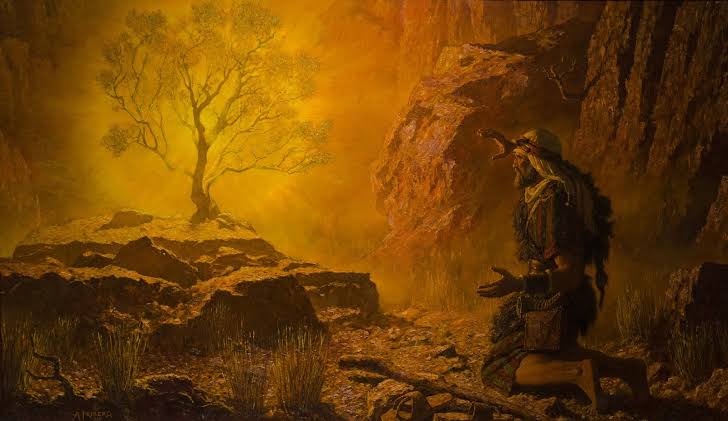
What prompted the discussion was Moses’s encounter with the burning bush, and the host explained that when something burns its molecular structure completely changes; it literally becomes a different thing, a transformation. I thought this was a great analogy because we are told in Scripture that, “our God is a consuming fire” (Heb. 12:29). We tend to read this as consumed up, as in there is nothing left after that, but fire always leaves ashes, the residue of that which is consumed. In other words, if we have an encounter with the living God it will change us. The reason it will have a transformational effect is because of what I call a radical relational reversal. Before Christ our relationship to God is one thing, one molecular structure, if you will, then after because of the fire who is God, the molecules are completely changed, rearranged into something different while remaining the same molecules, us. What surprises us is learning that the important relational change isn’t the one in us, but in God. In other words, it’s his changed disposition toward us that is the important thing, not ours toward him.

This can best be explained by the state of our relationship to God prior to our salvation. In our sin, our natural state from conception, God is our judge, jury, and executioner. Needless to say, that puts a bit of a damper on the relationship. Like Adam and Eve, when God shows up, we hide. The wages of sin, we’ll remember, is death, what God warned Adam would happen if he ate from the tree. When he did the death proved not to be instant physical demise, that would come later, but something even worse—spiritual death, complete and total alienation from God. The problem is God’s wrath toward us in our sin, not the state of our soul toward him. The relationship, the connection of human beings with God is life itself. As the Apostle John says of Jesus, “In him was life, and that life was the light of men.” Sin severed the relationship, and death was the result, spiritual and physical, along with all the other struggles and suffering existences brings in a fallen, sinful world.

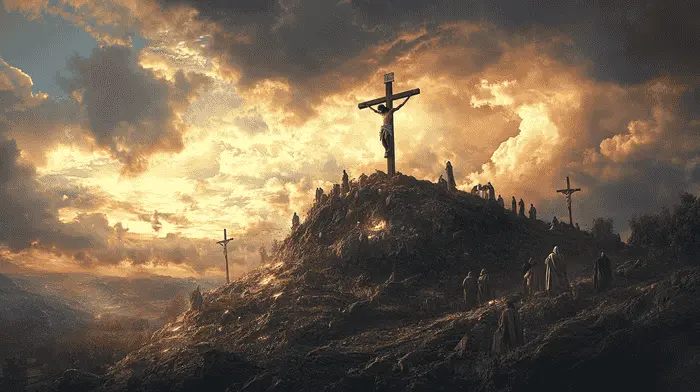
What John, and the rest of the New Testament, tells us is that in Jesus the relationship can be put back together, as the great Christmas hymn says, God and sinners reconciled. When Christ said on the cross, “It is finished,” and the curtain in the temple was torn in two from top to bottom, the way was opened up to a relationship to God for sinful human beings. God’s wrath had been fully poured out on Christ, a frightful thing to contemplate, taking the penalty due our sin, and we receive Christ’s righteousness, earned by his perfect obedience to the Father in his life on earth. God as consuming fire would no longer consume us unto death, but the consuming would transform us unto life.

The Relationship Between the Holy God and Sinful Man
As modern secular people we don’t see a relationship to God as in any way problematic. We’re not all that bad, we think, and God should like us just as we are. The problem is that if God showed up as the consuming fire he is, we would instantly be a pile of smoldering ashes. Think Raiders of the Lost Art opening of the ark scene; not a pleasant experience. From early in God reestablishing his relationship to sinful human beings, he consistently communicates the danger of sinful man and holy God interacting, of thinking the one true living and Creator God is anything like the idols of the heathen nations. In fact, all the gods other than Yahweh are created in man’s image, rather than man created in God’s image.

Teaching humanity of the infinite divide between man and God, known as the creator-creature distinction, was the reason God decided in his plan of redemption to create a people for his very own where this message would eventually be communicated to the world. We know them as the Hebrew people, then eventually the Jews. Before he gets to the details of how this will work, we come to his revealing himself to Moses in the burning bush (Exodus 3). Here’s the passage explaining this very odd encounter.

Now Moses was tending the flock of Jethro his father-in-law, the priest of Midian, and he led the flock to the far side of the wilderness and came to Horeb, the mountain of God. 2 There the angel of the Lord appeared to him in flames of fire from within a bush. Moses saw that though the bush was on fire it did not burn up. 3 So Moses thought, “I will go over and see this strange sight—why the bush does not burn up.”

4 When the Lord saw that he had gone over to look, God called to him from within the bush, “Moses! Moses!”

And Moses said, “Here I am.”

5 “Do not come any closer,” God said. “Take off your sandals, for the place where you are standing is holy ground.” 6 Then he said, “I am the God of your father, the God of Abraham, the God of Isaac and the God of Jacob.” At this, Moses hid his face, because he was afraid to look at God.

Notice the bush itself isn’t burning, but the fire is coming from within the bush. In other words, the fire was separate from the bush, and not using the bush for fuel. We call this a theophany, or “God made manifest.” Since God is invisible, at times in redemptive history he makes himself visible so he can manifest himself to sinful creatures. All the gods of the ancient peoples were made visible to them in some way, in some kind of physical idol, so God had to make himself plausible as a divine reality to the Hebrews in some visible way, and fire was an important way do it, without making an image like the heathen gods. God’s people needed to understand that their God was nothing like any created thing because he was creator of all things, a radical, unheard of concept in the ancient world.

As for a burning bush that does not burn up, you have to imagine Moses was utterly perplexed that fire would not burn the bush. Then he hears his voice being called, twice, out of the bush. Fire speaks? Then God reveals something to him, and us, about this relationship of the holy God to sinful man—it’s dangerous.

God further reveals this danger by fire to the people of Israel later after they escape Egypt and it is terrifying. We read about it in Exodus 19 as the people come to Mount Sinai and God is telling them how they will become his people, and out of all the nations his “treasured possession.” In Deuteronomy 4 Moses reminds the people of this event and what it means for them, and he emphasizes the fire, mentioning it seven times. He wants them to remember they didn’t see any form, but only heard the voice as he declared his covenant to them, and gave them the Ten Commandments. It is from this chapter the writer to the Hebrews gets the phrase that our God is a consuming fire. Moses further reveals to us that he is “a jealous God,” taken from the first of the Ten Commandments, and because of that they shall have no other gods before him.

Then God begins the process of teaching his people, including us, of the vast gulf between him and we his creatures, that this relationship is not something to be taken for granted as if he were anything like us. The display on the mountain made that clear enough, but we’re forgetful creatures. So God has them build an intricate system giving them access to his presence, but only in an extremely limited way. Everything about the tabernacle they build in the wilderness, and then eventually in the Temple, tells us we need to be separate from this God for our own safety, but at the same time we need access because God himself is life and outside of him is only death and decay. His presence, then, is represented by the Holy of Holies, the inner sanctum where only one man as a representative for the people could come, and that only once a year, to make sacrifice for his and the people’s sins.

The New Covenant and the New Way to God
Breaking the Jewish people out of this conception of an inapproachably holy God would not be easy, but the point of God’s plan of redemption was to do exactly that, so he could be just, and the justifier of many. In other words, the relationship could be re-established, God and sinful man reconciled, while God remained who he is, a consuming fire. Only now, the fire would not consume but transform his people for his glory and their good. It would be the fulfillment of a 2,000-year long promise he made to Abram that through him all the peoples on earth would be blessed, and that means us!

Jesus gives us a hint of this early in his ministry when he teaches the disciples what we know as the Lord’s Prayer. For Jews at the time God as a loving father would have been inconceivable. Your father isn’t your judge, jury, and executioner. Your father doesn’t kill you if you get too close to him. Yet Jesus was teaching his disciples when praying to God to address him as Father. At the time this was radical. You have to imaging Jews at the time, which they all were, wondering if they heard Jesus correctly. As with much of the conundrum that was Jesus, it would have been completely unexpected. For all of Isreal’s history, God was never portrayed as a father figure, but as wholly other, a God to be feared, not like my dad who loved me and would die for me. In fact, as my Father, he did love me, and he did die for me! This would all become clear in due course, but it had to be confusing at the time.

We see the radical difference between the Old and New Covenant in Jeremiah 31. In the Old, God’s people were commanded to love God. In Deuteronomy 6 right after the Hebrews were told that God is one, what Jews call the Shama, they are given this command:

5 Love the Lord your God with all your heart and with all your soul and with all your strength. 

The command is repeated six other times in Deuteronomy, but never again emphasized in this way. However, what love means in practice is reiterated throughout the Old testament because it means:

  • obeying His commandments
  • walking in His ways
  • serving Him
  • holding fast to Him
  • refusing other gods
  • listening to His voice

There is one minor problem sinful human beings had trying to love God like this—it’s impossible! Without God himself enabling us to do this, we don’t have a chance. Jesus, when asked what the greatest commandment in the law is, doubles down saying with his answer.

37 Jesus replied: “‘Love the Lord your God with all your heart and with all your soul and with all your mind.’ 38 This is the first and greatest commandment. 39 And the second is like it: ‘Love your neighbor as yourself.’ 40 All the Law and the Prophets hang on these two commandments.”

God gives us the answer to our dilemma in Jeremiah 31 as he reveals a new covenant coming that will be unlike the one he made with the generation he lead out of slavery in Egypt.

33 “This is the covenant I will make with the people of Israel
    after that time,” declares the Lord.
“I will put my law in their minds
    and write it on their hearts.
I will be their God,
    and they will be my people.
34 No longer will they teach their neighbor,
    or say to one another, ‘Know the Lord,’
because they will all know me,
    from the least of them to the greatest,”
declares the Lord.
“For I will forgive their wickedness
    and will remember their sins no more.”

The solution is the gospel! The good news of God taking our vile, sinful, rebellious hearts, and replacing all of that with his very law inscribed on our hearts and in our minds. When Jesus died, rose from the dead, ascended to heaven at the right hand of God, and then sent his Holy Spirit at Pentecost, we could now obey the greatest commandment. Loving God with everything in us was no longer a pipe dream filled with failure, but a reality of transformational blessing, our telos or purpose as created beings in God’s image finally fulfilled. Now as God’s living temple with his Holy Spirit living in us, it is not only possible to walk in obedience to his law, but also have affection for him as our Father. We’ve moved from justifiable condemnation to dearly loved children, as radical a relational reversal as there ever could be.

What Does It Mean to Baptize Nations?

What Does It Mean to Baptize Nations?

That’s a good question! At first I didn’t think so. I recently put up a post about Sphere Sovereignty, and someone responded on Twitter asking how nations are baptized. I gave a bit of a snarky answer. Then thinking about it I realized it’s actually a great question, and I apologized to the commentor for my snark. What am I taking about? It’s a passage in Matthew 28 every Evangelical Christian is familiar with, what we’ve come to call the Great Commission:

18 And Jesus came and said to them, “All authority in heaven and on earth has been given to me. 19 Go therefore and make disciples of all nations, baptizing them in the name of the Father and of the Son and of the Holy Spirit, 20 teaching them to observe all that I have commanded you. And behold, I am with you always, to the end of the age.”

For most of my Christian life, and that’s not a few years, I assumed like most Christians that when Jesus said to disciple nations he meant to disciple individuals in those nations. It would have never occurred to me that a nation as a nation, or nation qua nation as the scholars would put it, could be discipled. We don’t disciple America, Germany, or Lithuania, we disciple Mary, Bob, and Joe. Then a few years back I had an eschatological awakening, a red pill regarding how I think about “end times,” and it affected how I see the entire scope of redemptive history, past, present, and future. Now I realize discipling entire nations is exactly what Jesus had in mind, in addition to individuals within those nations. According to Matthew, he used the word that in Greek means nations, not individuals. Christians out not to try to explain that away, but rather try to figure out what Jesus meant, and then how to do it.

One way to do this is to see nations as corporate entities. Jesus speaks of “his church” which means both the individuals in it, and his church “body” corporately. Nations are made up of individuals, of course, but they also have corporate identities. The Lord repeatedly declares judgments or blessings on nations, and even towns like Jesus does in the gospels, which would affect every person in those nations even if each individual is not personally guilty or worthy of blessing.  So merely equating nations with individuals doesn’t work. It took my awakening about the study of the end of things to make me realize when Jesus said nations and not individuals he really meant nations.

Speaking of eschatology, the word means the study of end things, and we think that’s what it’s about, what happens at the end of history, the end of time. It is about that, but it’s much more about bringing the end into the present, and how we see the end influencing how we read history. I love the phrase N.T. Wright uses for this: “inaugurated eschatology.” To inaugurate means “to make a formal beginning of; initiate; commence; begin.” What Jesus accomplished in his first mission to earth, redemption accomplished, was then after his ascension applied to his church and this world at Pentecost.

In other words, eschatology is a comprehensive worldview that affects how we see everything. Other than that, it’s not really that important. That’s a bit of sarcasm for you who tend to the literal. It’s massively important, although most don’t realize it. I didn’t for most of my Christian life; I was an eschatological agnostic. I didn’t believe how we viewed the end mattered at all, one way or the other. Eschatology was something people argued and speculated about, and I had no interest in it. Then the red pill, postmillennialism, dropped out of the sky and crashed my eschatological indifference into a million little pieces, and down the rabbit hole I went!

I learned eschatology isn’t really about “end times” at all. That phrase I always put in quotes comes out of dispensationalism, a broadly Pietistic perspective that sees this world as evil, and the goal of the Christian life as getting away from it as much as one can, and also becoming more “spiritual” and less worldly in the process. I’m all for the latter, but eschatology is about bringing Christ’s fulfilled mission, how eventually everything will be in God’s kingdom, to earth. That means, according to Jesus, teaching them, the nations, “to observe all that” he had commanded. That doesn’t just mean the Sermon on the Mount, or other teaching we find in the gospels, but the entire word of God, all of it. Which brings us back to the question about baptizing nations and what that means.

Teaching Nations All that Jesus Commanded
When we ask a question about what something means, it’s often good to start with what it doesn’t mean. Depending on your baptistic convictions, Jesus wasn’t telling us to either sprinkle water over an entire country, or cover the entire nation in water. I think we can look at this both from a Presbyterian and Baptist perspective. For the former, baptism is a sign and seal of the covenant, of God’s promise to His people to save them from their sins (Matt. 1:21). In other words, baptism is a sacrament primarily about God’s faithfulness to which we are responding. For Baptists, it’s primarily about our confession of faith, a sign proclaiming to the world our trust in Christ as our savior. Let’s see how we can apply these to nations.

Both kinds of baptism require a confession, although Presbyterians believe the covenant community includes infants and children whose parents act as covenantal representatives for their children. They primarily confess God’s covenant faithfulness, while Baptists confess their faith in God’s saving work in Christ. Nations cannot be sprinkled or immersed in water, but the people in those nations can be, and the primary ethos of those nations, both culturally and in their governance, can confess God’s covenant faithfulness, and Christ as Savior and Lord. Even in complete heresy now, Great Britian confessed exactly these things when King Charles was coronated in 2023. The British Isles have been confessedly Christian for over a thousand years until the god of secularism seduced them after World War II. Now it’s just words, traditions.

So nations are baptized when the nation, it’s worldview and value system, reflects Christianity as the aspirational guiding system of the country. America was seen by its people for most of its history as a baptized confessionally Christian nation, even if the founders did not expressly state that in our founding document, the Constitution—they should have. Unfortunately, the secular strain of the Enlightenment had infected the thinking of many of the founders, and we got almost as good as it could have been. Of course, a baptized Christian nation must have a lot of baptized Christians, although it does not have to be a majority. I’ll explain why in a moment, but this quote from a book I’m currently reading, The Cousin’s War by Kevin Phillips, tells us just how religious, i.e., Christian, the colonies were in the run-up to the Revolution:

More material was printed in mid-eighteenth-century America about religion than about political science, history, and law combined, and even as the Revolution approached, devotional books outnumbered any single group.

Robert Curry in his book, Common Sense Nation says, “the Great Awakening prepared the way for the American Revolution in too many ways to be counted.” America was a Christian nation because it had many Christians who took their faith seriously. And it wasn’t just laymen. I have a book called, Political Sermons of the American Founding Era, 1730-1805, and it clocks in at 1596 pages! Pietism had yet to fully infect American Christianity as it would in the later 19th and 20th century, and Christians from every walk of life, including church leaders, believed their faith applied to every square inch of reality, including how they were governed. This affected not only Christians, but nominal Christians and those who didn’t embrace the Christian faith at all.

The Christian Plausibility Structure of a Nation
I used the word ethos above, that a society to be Christian, baptized as Christian, needs to have a Christian ethos. The technical definition of that word is, “the fundamental character or spirit of a culture; the underlying sentiment that informs the beliefs, customs, or practices of a group or society; dominant assumptions of a people or period.” The ethos informs the basic plausibility framework or structure of a nation. For something to be plausible it must be believable, credible, and the plausibility structure of a nation is that ethos that makes things seem a certain way, or just the way things are. We currently live in a secular nation with a secular ethos and plausibility structure, so most people think a woman killing her offspring is something that should be her “choice.” Sex outside of marriage is normal. Homosexuality is as natural and good as heterosexuality, and I could go on.

To be a Christian nation, that society must have a solid Christian plausibility structure. Even the non-Christians need to buy into and fully accept a Christian view of reality. Today, without knowing it, most Christians adopt the secular plausibility structure of our dominant secular culture. How can they not! It’s everywhere, all pervasive, in every screen, coming through every message in our education, news, law, government, advertisements, all of it is indoctrinating us into the secular worldview, the secular plausibility structure that this is just the way things are, the way they’re supposed to be. Watch pretty much any TV show and movie, and God isn’t the enemy, for the most part, he’s just irrelevant, persona non grata, doesn’t much matter at all. Making God invisible and irrelevant to life is some of the most powerful indoctrination of all. In most screen entertainment, God or Jesus only shows up in some kind of expletive. Or take government schools, what we call “public schools,” where over 50 million kids go five days a week. They are an anti-Constitutional establishment of religion, the secular religion. The indoctrination is the same, all the more powerful because God is a non-entity.

So, what’s the answer to the suffocating secularism that inundates us at every point of our lives? How could the culture ever change and become once again a culture that affirms God and Christianity as the driving force of the nation? First, that has to be a goal and determined project of every Christian, but must start first in the pulpits and among Christian leaders who need to teach cultural transformation as a biblical imperative. When we look at the bleak cultural landscape, it might appear like we’re trying to leap over the Grand Canyon; even with a running start we’re not getting very far. But Peter tells us we have everything we need to make it to other side:

3 His divine power has given us everything we need for a godly life through our knowledge of him who called us by his own glory and goodness. 4 Through these he has given us his very great and precious promises, so that through them you may participate in the divine nature, having escaped the corruption in the world caused by evil desires. (2 Peter 1:3, 4).

We immediately tend to read this as if it only applies to us personally, but it applies to nations as well because Jesus told us to teach them everything he commanded, and this comes directly from his word. Even as we plan and work and execute to the best of our abilities, the transformation of the culture as is the transformation of our lives, is a supernatural work of God. That’s why we pray as we work. What might that work look like?

The Culture Project
That was the name of a non-profit I started in 2008 after I realized that almost 20 years of conservative and Christian futility was because we had ignored the importance of culture in the transformation of our nation. We were so focused on politics figuring the culture would take care of itself. It most certainly will not! In the early days of my conservative political journey, which started with Reagan’s first election, I learned about conservative activist Mortan Blackwell who started an organization called The Leadership Institute. According to Wikipedia, its mission is to “increase the number and effectiveness of conservative activists” and to “identify, train, recruit and place conservatives in politics, government, and media.” I believed we needed to do this for the culture because until we win back the culture, nothing is going to change. As the late great Andrew Breitbart said, “politics is downstream from culture.” I believe that is true, to a degree.

I’ve learned since my early realization about the importance of culture, that culture can also be downstream from politics. Law shapes culture as well as reflects it, so if Christians want a godly society, being involved in politics is not an option either. It is politicians who pass laws that we are compelled to live by, and righteous laws will only ultimately be passed by righteous people, by those who fear God and obey his word. I’ll just give one example. In the 1970s California passed the first no-fault divorce law, which communicated to Americans that getting out of a marriage is no big deal, just a choice among many other choices. Soon no-fault divorce was normal throughout America, which led to broken families, and the misery and suffering that comes along with those; lives ruined for convenience.

But without the culture long term political effectiveness, which means governance from a conservative and Christian perspective, is like trying to run on ice with tennis shoes; you won’t get very far, and the harder you run, the more futile the effort.

I had a vision of The Culture Project as a kind of recruiting and mentoring enterprise that would identify young Christians and conservatives, and help them make careers in what I called “the cultural influence professions.” These are obvious—Hollywood and entertainment, media and journalism, education, law, etc. It never went anywhere because I’m not Charlie Kirk, but it is in fact what has to happen if we’re to really push back against the relentless assault of secularism. We can’t create a Christian plausibility structure or ethos, a Christian culture, by complaining or wishing upon a star. It also won’t happen automatically if more people become Christians, as if that will somehow turn into Christian cultural influence. It requires intention, planning, and execution, or focus and a lot of work. Not to mention, determination, resilience, and grit. It won’t be easy because secularists won’t just roll over and embrace the Christian message. We’re also fighting Christian secularists and Pietists who think cultural transformation is a waste of time. To them, we just need to preach the gospel and wait for Jesus to return.

The biggest obstacle to cultural transformation is this Pietism of a personalized Christianity that doesn’t see cultural influence as a biblical imperative. Like I said, it has to start from the top, but unfortunately most church leaders are Pietists, and Christianity for them is primarily personal not societal. Over the decades I’ve heard many prayers for cultural and political change, but few calls for Christians to actually do something about that. If we’re to obey Christ’s Great Commission mandate, we have to change it from being just about leading individuals to Christ and discipling them, to discipling entire nations, and teaching nations to obey everything he commanded.

The Power of the Gospel Revealed in Zechariah

The Power of the Gospel Revealed in Zechariah

My last post was my perspective on the Catholic faith from my Protestant perspective, and how much over the years I’ve come to appreciate it and see the nature of my faith in some ways more in line with theirs. This post, however, will highlight the significant differences in our understanding of the gospel. I’m not going to compare and contrast, but this will come from my Reformed perspective, which Rome at the Council of Trent declared heretical and anathema. Catholics aren’t so hard core today, for the most part, and they believe we Protestants are Christians too. There are, however, fundamental differences between the Reformed and Protestant understanding of how God saves His people from their sins, and I believe Zechariah highlights these differences.

There are numerous passages in Zechariah that reveal the gospel in the Reformed tradition of salvation being a monergistic work of God in the soul of man. First we’ll define monergism:

The word monergism comes from a combination of the Greek terms for “one” and “energy.” Combined, they mean “a single force.” When applied to salvation, monergism implies that God is entirely, completely, and solely responsible for any person’s salvation. This view contrasts with synergism (“a combined force”). Synergism suggests salvation is accomplished through a cooperative act of God and man.

I learned the phrase above from reading Charle Hodge’s Systematic Theology back when I was 24 and 25 years old and brand new to Reformed theology. He explained this most profound truth in the simplest statement: “Salvation is the work of God in the soul of man.” God does the work, we respond. By His almighty power, he calls us out of the grave spiritually as Jesus called Lazarus out of his grave physically, and guides us through life in holiness, service, and love. We call the former justification, and the latter sanctification, although having lived almost five decades as a Christian, I now call it the pain of sanctification.

Both of these, justification and sanctification, are the work of God to save His people from their sins (Matt. 1:21). He initiates and completes it all, and even our cooperation, our “working out our salvation with fear and trembling,” as Paul puts it, is the sovereign work of God. That eventually became apparent to me a bit later in this journey with Christ when the truth I Corinthians 1:30 hit me in a way I had previously not appreciated. Paul says:

It is because of him that you are in Christ Jesus, who has become for us wisdom from God—that is, our righteousness, sanctification and redemption.

First we are only in Christ Jesus because of God, because He sovereignly put us there. He chose us and put us “in him,” one of Paul’s favorite salvation phrases, “in Christ.” Jesus tells us the nature of our salvation in John 6:

44 “No one can come to me unless the Father who sent me draws him, and I will raise him up at the last day.

Jesus is confirming here all of Paul’s descriptions of our salvation, from God choosing us in Christ, to our justification, declared righteous because of Christ’s sacrifice, God’s making us holy, sanctifying us, setting us apart increasingly to Him, and our redemption, the resurrection of our bodies. It’s a package deal! All of it includes us, every part of what makes us human, emotionally, psychologically, our choosing, our failures, our wills, but none of it is ultimately up to us. I didn’t quote what Paul says in verse 31 right after he affirms the monergistic nature of our salvation:

31 Therefore, as it is written: “Let the one who boasts boast in the Lord.”

Paul is quoting from a passage in Jeremiah 9 in which the Lord is talking about boasting of our wisdom, strength, and riches, and now Paul is adding to that our very salvation.

Related to our salvation is another area where Hodge is helpful. He said that we tend to equate God’s “control” with human control, which requires coercion and destroys our free will. God, however, can “control” human beings without destroying or in any way distorting their humanity or agency. He is sovereign and God, almighty in every way, and how he does it we have no idea; we simply trust him that once he chooses us He will never let us go. As Paul says in Philippians 1, that God who began a good work in us “will carry it on to completion until the day of Christ Jesus.”

Monergism in Zechariah 3 & 4
Zechariah is given visions that point forward to a day when this salvation Paul declares will be fulfilled in Christ. It’s an amazing testimony to the power of God to save His people from their sins (Matt. 1:21). It is the most Messianic of the 12 minor prophets, and in that it is not unlike Isaiah. He lived not long after the Israelites had returned to Judah after their exile in Babylon in the early 500s BC into the early decades of the 400s prior to Ezra and Nehemiah rebuilding of the temple. It is a book of encouragement to give the Israelites strength to endure the troubles to come. Nothing they are planning to do will be easy, as is living a Christian life in a fallen world in a fallen body among fallen people always will be. We are always working against the gravity of sin, trudging up a mountain with that heavy backpack of sin, and we get a picture of that in chapter 3 as the scene is set up.

Joshua is the high priest at the time, not a coincidence the same name the Lord would give our Savior five centuries into the future. In Zechariah’s vision he is standing before the angel of the Lord and Satan himself. The devil is living up to his name, accusing Joshua, of what we’re not told. Then we see the Lord defend his high priest as he will one day the final high priest:

2 The Lord said to Satan, “The Lord rebuke you, Satan! The Lord, who has chosen Jerusalem, rebuke you! Is not this man a burning stick snatched from the fire?”

As Jesus says in John 10:10, the thief comes only to steal, kill, and destroy, and the accuser does it by accusing, by rubbing our sin in our faces as if God is incapable of saving us from our sins. To make the point, we’re told that Zechariah is dressed in “filthy clothes.” The word in Hebrew doesn’t just mean dirty, as if your toddler was out playing in the mud, but something much more disgusting. It means, “soiled (as if excrementitious).” To keep this family friendly, he is covered in crap, smelly, disgusting. That is what sin does to us. What does the Lord do with this “burning stick snatched from the fire”? Then we get a beautiful picture of the monergistic nature of our salvation from sin:

4 The angel said to those who were standing before him, “Take off his filthy clothes.”

Then he said to Joshua, “See, I have taken away your sin, and I will put fine garments on you.”

5 Then I said, “Put a clean turban on his head.” So they put a clean turban on his head and clothed him, while the angel of the Lord stood by.

Of ourselves, we can’t do anything about our filthy clothes. Only God Himself can have those taken off. And it’s not just that our sin is taken away like those clothes, but God Himself has us dressed in fine garments, the righteousness of Christ himself, enabled by the active and passive obedience of Christ in life, even unto death. As I heard Tim Keller say many times, Christ lived the life we should have lived, and died the death we should have died. Unlike Catholics, we believe that not only did Christ die for our sins, but his righteousness was given to us as well. We are as Luther put it in Latin, simul iustus et peccator, or simultaneously righteous and sinner. We are declared righteous before God, legally, yet we are still sinners. It is a forensic declaration because of the transaction, that actual ransom paid for us, on the cross. This is justification.

Then we see that this is only the start. The Lord charges Joshua to walk in obedience and keep his requirements. There is no room for antinomianism, or being lawless, in the Christian faith or life. We don’t continue to sin because we figure we’re forgiven. As Paul says in Romans 6, God forbid! We are saved from the slavery of sin, like the Hebrews were saved from slavery in Egypt, to live like them in obedience to the law, to righteousness. There are also material implications to a full orbed gospel, as we learn next:

10 “‘In that day each of you will invite your neighbor to sit under your vine and fig tree,’ declares the Lord Almighty.”

The phrase, “that day,” is a critical part of Zechariah’s prophetic power, which I’ll get to below, but we see here, and throughout the Old Testament prophetic declarations of salvation, that the blessings coming as a result are not only “spiritual,” but material as well. This is something Evangelicals either ignore or think has nothing to do with the gospel. God in his revelation, however, says differently. The Old Testament is an incredibly earthy document, focused on blessings in this life more than on the life to come. With Christianity we get both!

The Importance of “That Day” in our Salvation
This phrase is used 20 times in Zechariah to indicate the time in which salvation will come to God’s people, and it will be in one day, as we know in hindsight. Let’s look at some of the hopeful declarations the prophet gives to us.

Chapter 2:  
10 “Shout and be glad, Daughter Zion. For I am coming, and I will live among you,” declares the Lord. 11 “Many nations will be joined with the Lord in that day and will become my people. I will live among you and you will know that the Lord Almighty has sent me to you.

Chapter 9:
16 The Lord their God will save his people on that day
as a shepherd saves his flock.
They will sparkle in his land
like jewels in a crown.
17 How attractive and beautiful they will be!
Grain will make the young men thrive,
and new wine the young women.

Chapter 13:
“On that day a fountain will be opened to the house of David and the inhabitants of Jerusalem, to cleanse them from sin and impurity. 2 “On that day, I will banish the names of the idols from the land, and they will be remembered no more,” declares the Lord Almighty. “I will remove both the prophets and the spirit of impurity from the land.

9 The Lord will be king over the whole earth. On that day there will be one Lord, and his name the only name.

And it ends in chapter 14 with the final references:
20 On that day holy to the Lord will be inscribed on the bells of the horses, and the cooking pots in the Lord’s house will be like the sacred bowls in front of the altar. 21 Every pot in Jerusalem and Judah will be holy to the Lord Almighty, and all who come to sacrifice will take some of the pots and cook in them. And on that day there will no longer be a Canaanite in the house of the Lord Almighty.

The Old Testament is a powerful testimony of the sovereignty of God in salvation. The plan of redemption, of God saving His people from their sins since the fall has always been the work of God. He says to Adam and Even in Genesis 3:15:

And I will put enmity
between you and the woman,
and between your offspring and hers;
he will crush your head,
and you will strike his heel.”

In Hebrew crush and strike are the same word, but I like the NIV’s rendering because while Satan can do some damage, symbolically the heel, the seed of the woman, Christ, defeats and renders powerless the devil, symbolically the head. From that moment, history is a very slow beeline to the birth, life, death, resurrection, and ascension of Christ, redemption accomplished, to Pentecost, redemption applied.

The Gospel Fulfilled in Zechariah
There are two passages in the book that are amazingly specific about how this salvation to come is to be accomplished. In chapter 3 where we read about the Lord taking off Joshua’s filthy clothes and putting on fine garments:

8 “‘Listen, High Priest Joshua, you and your associates seated before you, who are men symbolic of things to come: I am going to bring my servant, the Branch. 9 See, the stone I have set in front of Joshua! There are seven eyes on that one stone, and I will engrave an inscription on it,’ says the Lord Almighty, ‘and I will remove the sin of this land in a single day.

Those reading Zechariah’s words for the next 400 years must have wondered how sin could be removed in only a single day. Mixing metaphors, the Lord tells us the servant will be a branch and a stone, and Jesus tells us (Matt.21 and Mark 12) quoting Psalm 118,

‘The stone the builders rejected
has become the cornerstone;
the Lord has done this,
and it is marvelous in our eyes’

Who did this? The Lord. We also learn something about the identity of this branch in Isaiah 11, one of the most glorious salvation chapters in the Bible. It starts with the Branch:

A shoot will come up from the stump of Jesse;
from his roots a Branch will bear fruit.
2 The Spirit of the Lord will rest on him—
the Spirit of wisdom and of understanding,
the Spirit of counsel and of might,
the Spirit of the knowledge and fear of the Lord—
3 and he will delight in the fear of the Lord.

This eventually leads to the suffering of the Lord’s servant in Isiah 52 and 53, where we read the gospel

5 But he was pierced for our transgressions,
he was crushed for our iniquities;
the punishment that brought us peace was on him,
and by his wounds we are healed.

Several hundred years later Zechariah echoes Isaiah in chapter 12:

10 “And I will pour out on the house of David and the inhabitants of Jerusalem a spirit of grace and supplication. They will look on me, the one they have pierced, and they will mourn for him as one mourns for an only child, and grieve bitterly for him as one grieves for a firstborn son.

In perfect biblical hindsight it becomes apparent just how true it was when Jesus said to his disciples after his resurrection: “Everything must be fulfilled that is written about me in the Law of Moses, the Prophets and the Psalms.” Or the two on the road to Emmaus, telling them, “what was said in all the Scriptures concerning himself.” The Bible has one author, Almighty God, and every bit of it points to Christ. In the immortal words of the Hallelujah Chorus which proclaim Christ sitting at the right hand of the Almighty:

The kingdom of this world is become
the kingdom of our Lord, and of His Christ,
and of His Christ;
And He shall reign for ever and ever,
King of kings, and Lord of lords.

Hallelujah!

God’s Provision in Jonah’s Life, and Ours

God’s Provision in Jonah’s Life, and Ours

I recently read through Jonah in one sitting, and yet again it reminds me why it’s one of my favorite books in the Bible. It’s got a kind of honesty about it that makes it endearing. You think, this guy is not unlike all of us! And the Bible makes no apologies for telling his story.

Speaking of the Bible, we call the different writings in our Bibles books, and the word bible, τὰ βιβλία in Greek, means a collection of books, but many of the “books” in our Bibles are very short. Jonah has only four chapters and is a quick but compelling read. It starts right away with action. God calls Jonah to go to Nineveh, and he runs away in the opposite direction! He doesn’t just walk, or saunter, or slither away, he runs! I love how honest the Bible is about human rebellion and sin amongst God’s own people. The portrayal of those people is not flattering to say the least, which is one reason the Bible has such verisimilitude and credibility. It reads real and seems real because it is in fact the accurate story of this people whom God has called to bring salvation to the world. Only, it doesn’t quite work out the way they envisioned it, Jonah being a prime example. To use a semi-vulgar word to express this, Jonah is pissed about God planning to have mercy on this pagan nation who are the sworn enemies of his people. 

What stood out to me this time through was the word “provided” in my NIV, used four times as the story rushes along. Some other translations use appointed. The Hebrew word has these meanings:

  1. (properly) to weigh out
    2. (by implication) to allot or constitute officially
    3. also to enumerate or enroll

In other words, God is calling the shots here. I like the word provided because it implies what is being supplied or made available is meant to help that person. It’s not just God telling us to do something because He said so. God commands us for our Good and His glory. As I was reading, Romans 8:28 leapt to mind:

And we know that in all things God works for the good of those who love him, who have been called according to his purpose.

And Paul is making sure we understand this isn’t speculation, isn’t something we wonder about or should have any doubt about, but something we know.

God’s Provision for Jonah
Jonah in his rebellion decides to run away from God’s express command, hitching a ride on a ship specifically to run “away from the presence of the Lord.” We’re familiar with the story, but it’s the little details that make it so powerful.

Not long into the journey a violent storm arises and threatens to wipe out the ship. As the crew is throwing things overboard to try to save the ship, Jonah goes down into the hold and of all things, falls asleep! The man was depressed. And why not. He knows this is God rebuking him for his choice. The men go down to get him and see he’s asleep and they are shocked. How in the world can this guy be sleeping at a time like this? Being ancient people they cast lots to see who’s to blame for the storm, and of course it falls to Jonah. When they ask who he is, and where he comes from:

9 And he said to them, “I am a Hebrew, and I fear the Lord, the God of heaven, who made the sea and the dry land.

He’s almost blasé. He obviously doesn’t fear this God enough. After he tells the men what he did, they are terrified. So when they ask what they must do to mollify this Creator God, he says to throw him into the sea. I’m sure they think this will only make this Creator God angrier, so they try harder to save the ship which makes the storm worse. Then despite their inclinations, they throw him overboard, and of course the storm calms immediately. Chapter 1 ends with telling us what happened to Jonah next:

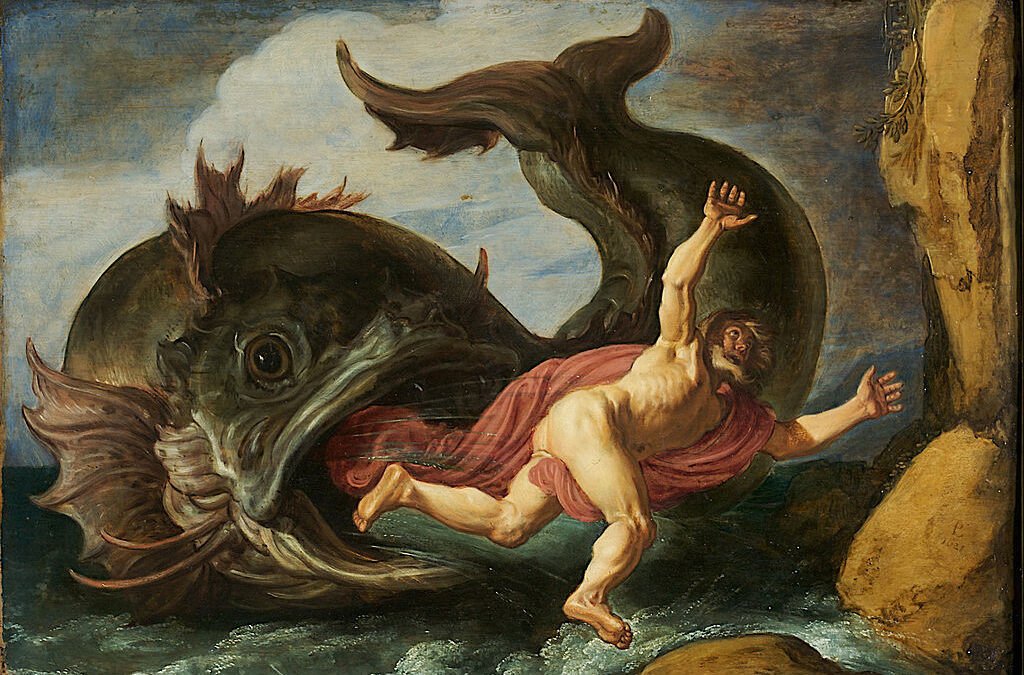
17 Now the Lord provided a huge fish to swallow Jonah, and Jonah was in the belly of the fish three days and three nights.

Ah the big fish. These is where the skeptics sign off. Surely this is metaphorical because nobody could live three days in the belly of a big fish like a whale. Impossible! As if anything is impossible with Almighty God, He who created everything out of nothing and controls every molecule by his infinite wisdom and power. Yet, the text doesn’t say Jonah was alive in the belly of the fish. I’ve always assumed he was until I came across this short video which lays out the argument that Jonah died. I always assumed he was alive because the text says that “Jonah prayed to the Lord his God from the belly of the fish,” and if he prayed he was alive. But when Jonah prays he says, “out of the belly of Sheol I cried, and you heard my voice.” Sheol is the realm of the dead. Also, Jesus affirms Jonah’s ordeal in the big fish as a symbol of his death (Matt. 12:40) and implicitly of his resurrection. If Jesus was dead while he was “in the heart of the earth,” so Jonah was dead in the belly of the great fish. As Jesus was brought back to life, so was Jonah. Either way, the story works as a picture of God’s ultimate redemptive plans in Christ.

God’s provision of a big fish for Jonah is meant to get his attention, something we sinners always seem to need if we’re going to finally quit running away. It works. Chapter 2 is Jonah’s prayer of lament and repentance after which the fish vomits him on to dry land. It seems kind of extreme that the Lord would have to put one of his own people through this, but as the great 19th century poem by Francis Thompson declares, He is The Hound of Heaven. The first stanza fits perfectly:

I fled Him, down the nights and down the days;
   I fled Him, down the arches of the years;
I fled Him, down the labyrinthine ways
   Of my own mind; and in the midst of tears
I hid from Him, and under running laughter.
             Up vistaed hopes I sped;
             And shot, precipitated,
Adown Titanic glooms of chasmed fears,
   From those strong Feet that followed, followed after.
             But with unhurrying chase,
             And unperturbèd pace,
     Deliberate speed, majestic instancy,
             They beat—and a Voice beat
             More instant than the Feet—
     ‘All things betray thee, who betrayest Me’.

To one degree or another, this is every Christian’s experience. Jesus was given his name because he came to save his people from their sins (Matt.1:21), and God’s plan of redemption would never be left up to his creatures. Somehow, some way, he will always “get his man,” or woman. But God’s “provision” for Jonah wasn’t done yet because Jonah was a reluctant convert. Chapter 3 starts with, “Then the word of the Lord came to Jonah a second time.” God is willing to give Jonah a second chance, and he’d best listen this time lest the big fish swallows him for good.

Jonah was reluctant because God was calling him to preach to Israel’s hated enemies, the Assyrians. It would only be a generation later that the Assyrians would wipe out the northern kingdom of Israel in 722 BC. That wouldn’t have surprised Jonah. So we can imagine him thinking, “Why in the world would the Lord want to have mercy on this people, on Israel’s enemies?” Jonah goes through the city for three days, as he was in the belly of the big fish, preaching God’s judgment to come, and to his horror they repent so God relents and doesn’t bring judgment upon them. I love to read Jonah’s response because it reads so real (4:1):

But to Jonah this seemed very wrong, and he became angry. 

God, how dare you have mercy on these people! They aren’t supposed to get a second chance. I read some time ago the kind of evil and horror the Assyrians were capable of, and Jonah’s response is not unreasonable, but his job isn’t to think, only to obey. Jonah tells us exactly what he feels:

2 He prayed to the Lord, “Isn’t this what I said, Lord, when I was still at home? That is what I tried to forestall by fleeing to Tarshish. I knew that you are a gracious and compassionate God, slow to anger and abounding in love, a God who relents from sending calamity. 3 Now, Lord, take away my life, for it is better for me to die than to live.”

Just kill me now! Then God’s provision kicks in again to try to get His message across to Jonah, that he has no right to be angry (4:4). Jonah goes outside of the city to see what’s going to happen to it, hoping God decides to bring calamity after all. As he’s there, God provides three things: a plant to grow and provide shade for Jonah which makes him “very happy”; a worm to eat the plant, no more shade; then a scorching east wind and hot sun so Jonah grows faint. Unhappy again, he hopes God would just take him out of his misery and kill him. As the king of the universe He should for his rank insubordination, but He is the gracious and compassionate God Jonah so despises.     

God asks him if he’s justified in being angry about the plant, one he had nothing to do with growing, and he says he is. Then he tells the Lord:

“And I’m so angry I wish I were dead.”

There’s no resolution in this little book, and the story ends with God asking him a rhetorical question. Jonah had nothing to do with the plant growing, nor did he with the great city of Ninevah. The Lord asks why He shouldn’t have concern for the people and even the animals of such a city. That’s it. Story over. 

God’s Provision in Christ
It’s fascinating that Jesus would use the story of Jonah to point to God’s ultimate sacrifice for the sins of His people, and his own brutal death and burial. As is the crucifixion, the story of Jonah is one of God’s mercy, something we find hard to comprehend exactly because it’s God’s mercy. Why would God have to do something so horrible just to have a relationship with His people? His judgment and ultimate justice requires it, but he decided to do it because of His mercy. As Paul says of the crucifixion, and Jonah could relate (I Cor. 1:23):

We preach Christ crucified: a stumbling block to Jews and foolishness to Gentiles.

All Christians believe God is sovereign, the king and ruler of the entire universe, of all things visible and invisible, but most Christians have a hard time believing He is sovereign over the salvation of His people. God choosing whom He will save doesn’t sit well with them, and that the Hound of Heaven never fails.

God, however, is a choosing God, not a God who waits for the choosing of his creatures to accomplish his redemptive plans. He chooses Noah, then Abram, then Jacob, Moses, and eventually David through whom He will bring about a Messiah who will be prophet, priest, and king. We see this choosing God in the story of Moses asking God to show him His glory (Ex. 33):

19 And the Lord said, “I will cause all my goodness to pass in front of you, and I will proclaim my name, the Lord, in your presence. I will have mercy on whom I will have mercy, and I will have compassion on whom I will have compassion. 

God is the one who decides who will get his mercy, and as with Jonah, to us it can often appear unfair. God’s nature is to be the one who initiates the relationship to save, and at that moment in history God chose to have mercy on the people of Ninevah.

None of us can conceive of why God would create a world in which he would allow a fall to happen, and thus have sin and death enter his perfect created world, but here it is. He told Adam, the day you eat of the tree I told you not to eat of it, you shall surely die. The moment he listened to his wife and took and ate some of the fruit, everything changed. In my study of philosophy and world religions, I discovered that the only plausible explanation for evil and suffering and sin is found in Judaism and Christianity, and this is it. God never had to create anything. Unlike Islam where God is a solitary monad, alone, in Scripture a Triune God is revealed who can have existed perfectly content without other beings, but he decided otherwise.

When He did create these beings, both angels and humans, they had to be genuinely free and able to chose obedience or rebellion. Any real relationship that isn’t robotic requires such choosing and the free will to choose. God being God knew the risk, and what would happen, but there was clearly no other way. The devil chose rebellion and treason first, then when God made man the devil was allowed to take man down with him. However God already had a plan for that, a provision if you will, and that was He Himself in the person of His Son becoming a man and being the required sacrifice for that rebellion and treason. It’s so bizarre yet strangely plausible enough to enable us to believe it with integrity. The evidence, historical, philosophical, textual, archaeological, personal is so overwhelming that after 2000 years over two billion people believe it. They agree with me and the argument of my book, Uninvented, that there is absolutely no way it could be made up, mere invention of the human imagination.

That’s where Jonah and the crucifixion and God’s provision in our salvation come in. Who could ever make up such stuff? The ancient pagan gods were not known for their mercy, to say the least. They had to be placated in all kinds of silly and horrific ways. Read the prophets. A big fish swallowing a man for three days who vomits him out so he can go preach repentance and mercy to his bloodthirsty enemies? Really? If you want someone to believe your story, you don’t make this one up. Then this same God coming Himself, becoming one of his creatures to take their place so justice could be done and the relationship restored? Seriously? No wonder Paul calls the cross foolishness to the Gentiles, the pagans, and a stumbling block to the Jews. It’s absurd! But true.

When Jesus said we are to love our enemies, he provided the first example by loving us, even unto death on a cross. I’m sure to Jonah that would have “seemed very wrong.” In the ancient world you didn’t love your enemies, you killed them! Who would say something so stupid? Jesus! Again, nobody in the ancient world makes up something like that. The concept of sacrificial love was unknown among ancient pagans, Greek or Roman or any other peoples. Jews alone among ancient peoples knew about “loving your neighbor as yourselves” (Lev. 19:18), but nobody could comprehend the Creator God becoming a man to love us! He Himself is our provision. Out of that provision flows true human flourishing and ultimate fulfillment, flows the fruit of the Spirit, love, joy, peace, patience, kindness, goodness, faithfulness, gentleness and self-control, material blessings in this life, and spiritual blessings forever more.

My Kingdom is Not of This World

My Kingdom is Not of This World

I can’t tell you the number of times I’ve read and heard this statement of Jesus as a reason for Christians to not engage in “the culture wars.” Doing this is in the old saying, like polishing the brass on a sinking ship. The implication, sometimes stated, sometimes assumed, is that this world belongs to Satan. For them, apparently, Satan is the king of this world. I’ll state my conclusion plainly up front: No he is not! As we’ll see, Satan was handed a kingdom he did not earn by Adam, and Christ came to take it back. We call this the gospel. For too long as a Christian when I heard or used the word “gospel,” I equated it with the salvation of souls, full stop. Sure, it has peripheral influences on the culture, but that was only a spillover from people being saved from their sins, as the theologians call it, soteriology.

Now, I see the gospel as a proclamation of salvation for the entire created order, starting with those who’ve embraced Christ as Lord and Savior, and God starting his reclamation and restoration project at his first coming. By contrast, the typical Pietist, fundamentalist, dispensational, Evangelical understanding of the state of this fallen world is that Christ will only fully clean it up at his second coming. Until then, Satan is more or less in control of this world, and the primary purpose of the gospel is to save people out of this world so they can go to heaven when they die. The world will get increasingly worse until Jesus finally comes back to save the day and set all things right. I used to believe this, more or less, but my embrace of postmillennialism a few years ago changed that. Let’s see how.

Satan Handed an Earth and a Kingdom
As we read in Genesis, God created the earth and everything in it “very good,” but something happened to ruin it. We’re all familiar with the story of the fall. God told Adam everything on earth belonged to him, but there was one tree from which he must not eat because when he does, he will “surely die.” We all know what death is on this side of the fall, but I always wonder what Adam made of those words. He had not yet seen or experienced death in any way, so I imagine it was an abstraction to him. Yet, he knew it must not be good. Maybe not fully understanding the implications of death is why Adam failed to protect the woman from the serpent, and Satan deceived her. We read in Genesis 3:

6 When the woman saw that the fruit of the tree was good for food and pleasing to the eye, and also desirable for gaining wisdom, she took some and ate it. She also gave some to her husband, who was with her, and he ate it. 7 Then the eyes of both of them were opened, and they realized they were naked; so they sewed fig leaves together and made coverings for themselves.

Notice what happens when the woman eats—nothing. Then she gives some of the fruit to Adam and when he eats what happens? Only then were the eyes of both opened, not before. Paul confirms it wasn’t what the woman did that caused the fall, but what the man did:

12 Therefore, just as sin entered the world through one man, and death through sin, and in this way death came to all people, because all sinned. . . . 14 Nevertheless, death reigned from the time of Adam to the time of Moses, even over those who did not sin by breaking a command, as did Adam, who is a pattern of the one to come. (Rom. 5)

22 For since death came through a man, the resurrection of the dead comes also through a man. 22 For as in Adam all die, so in Christ all will be made alive. (I Cor. 15)

Paul also tells us in Timothy (2:14) that it was the woman who was deceived, but in Adam’s tending of the garden and protecting his wife, he was a colossal failure. Where was Adam when the serpent was allowed to deceive the woman? Why was he not there to protect and defend her? Why was the serpent there in the first place? We can’t know the answers to these questions, but we do know from Genesis 2 that prior to Eve being created, man was given the charge to work and care for the Garden:

15 The Lord God took the man and put him in the Garden of Eden to work it and take care of it. 16 And the Lord God commanded the man, “You are free to eat from any tree in the garden; 17 but you must not eat from the tree of the knowledge of good and evil, for when you eat from it you will certainly die.”

He failed to “take care of it.”

Interestingly, the Lord says to Adam he would curse the ground, “Because you listened to your wife and ate fruit from the tree about which I commanded, ‘You must not eat from it’” He clearly had the option not to listen to her, and if he hadn’t there would have been no fall. The choice was his, and he blew it, big time. In the created order of things, God made it so that man has ultimate authority, and therefore ultimate accountability. It’s called federal headship, the basic idea being how one person represents and acts on behalf of a larger group, with the consequences of their actions being imputed (credited or charged) to those they represent. Our salvation from sin depends on this concept. Adam was the federal head for the human race through which sin came, and Christ was the federal head for his people he came to save from their sins (Matt. 1:21). Sin was imputed through Adam, and righteousness through Christ. Without the federal headship of Christ, we would die in our sins.

Thankfully, Christ was given a task from the Father, and he fulfilled it. We read in John 6:

37 All those the Father gives me will come to me, and whoever comes to me I will never drive away. 38 For I have come down from heaven not to do my will but to do the will of him who sent me. 39 And this is the will of him who sent me, that I shall lose none of all those he has given me, but raise them up at the last day. 40 For my Father’s will is that everyone who looks to the Son and believes in him shall have eternal life, and I will raise them up at the last day.” 

Another idea we get from the theologians captures what we read about here, the covenant of redemption. In the internal Triune purposes of God, the Father gave Jesus a task, “to save his people from their sins” (Matt. 1:21). Jesus didn’t come to save everybody, or to make salvation possible for all people, he came to make salvation actual for all those the Father has given him. This salvation accomplished by Jesus during his life of obedience unto death, his crucifixion, burial, resurrection, and ascension, started to be applied at Pentecost. His kingdom was now established on earth, his having been given “All authority in heaven and on earth,” (Matt. 28). The flag of the kingdom, like a warrior in battle, had been planted right in the midst of the enemy’s territory, and he would now commence through the power of the Holy Spirit among his people to establish the new creation (2 Cor. 5:17).

A Ruined Kingdom Restored in Christ
The NIV translation of the verse in 2 Corinthians is the most literal of the translations, and to me the most accurate. It says, “If anyone is in Christ, the new creation has come.” Other translations infer that the new creation Paul is referring to is the anyone, so it says, “If anyone is in Christ, he is a new creation.” That is true, but that gives people the impression this new creation is limited to saved, redeemed people. I used to think that. In fact, it is God’s eschatological kingdom (the final fulfillment happening at his second coming) breaking into this dark fallen world that previously belonged to Satan—it does so no longer. The Apostle Paul tells us that salvation is a package deal, us and the rest of creation together (Rom. 8):

18 I consider that our present sufferings are not worth comparing with the glory that will be revealed in us. 19 For the creation waits in eager expectation for the children of God to be revealed. 20 For the creation was subjected to frustration, not by its own choice, but by the will of the one who subjected it, in hope 21 that the creation itself will be liberated from its bondage to decay and brought into the freedom and glory of the children of God.

22 We know that the whole creation has been groaning as in the pains of childbirth right up to the present time. 23 Not only so, but we ourselves, who have the firstfruits of the Spirit, groan inwardly as we wait eagerly for our adoption to sonship, the redemption of our bodies. 24 For in this hope we were saved. But hope that is seen is no hope at all. Who hopes for what they already have? 25 But if we hope for what we do not yet have, we wait for it patiently.

Noticed how Paul connects “the glory that will be revealed in us” to the entire creation. Most Christians think we only got a very small down payment on this new creation at Christ’s first coming, and a wholesale change can only happen at his second coming. They believe this fallen ruined kingdom belongs to the devil and use the evidence of evil and suffering to claim it. So, when Christ tells Pilot his kingdom is not of this world it confirms what they believe. However, Christ did not say His kingdom is not in the world, but that it is not of the world—not that the kingdom is “not here,” but that it is not “from here.” The word “of” is a primary preposition denoting origin. This means the origin of Christ’s redeemed kingdom is not of this world because he came to redeem and transform it!  Once his mission was accomplished and fully realized in his ascension and Pentecost, his kingdom was officially in this fallen world, like a mustard seed and leaven (Matt. 13) taking it back from the devil.

We always read the text based on our assumptions, so when we read, “Who hopes for what they already have?” we assume we’re not going to get it until Christ returns at the consummation of all things at the end of time. But Paul wrote these words in the 50s AD, so Christianity and its influence in the world had been limited to parts of the Middle East and some of Europe, that’s it. Even there on a societal and cultural level, Christianity’s impact was minimal, but since then the gospel has gone throughout the entire earth and been utterly transformed by it. I do not limit the gospel’s reach just to human interaction, but to the imprint our actions and ideas and effort put on creation. Remember the dominion and cultural mandate given to Adam in Genesis 1:

26 Then God said, “Let us make man in our image, in our likeness, so that they may rule over the fish in the sea and the birds in the sky, over the livestock and all the wild animals, and over all the creatures that move along the ground. 

27 So God created man in his own image,
    in the image of God he created them;
    male and female he created them.

28 God blessed them and said to them, “Be fruitful and increase in number; fill the earth and subdue it. Rule over the fish in the sea and the birds in the sky and over every living creature that moves on the ground.”

As the second or last Adam, Christ came to fulfill this mandate, and at his Ascension and Pentecost he began to fulfill it through us, his church. Human interaction on a societal level has been transformed by the gospel, and this includes science and technology and knowledge of every sort that has had an impact on how we live. Trust me, none of us would want to live in the ancient world, and the kingdom Christ came to establish is the reason we no longer have to live in such a world.

The Practical Consequences of the Ascension
Lastly, because Jesus is now king with all authority in heaven and on earth dwelling with his people by the power of the Spirit of God, the gospel has gone forth to the nations and God’s kingdom is advancing. As a result, the devil is on the defensive. Until I embraced postmillennialism, I thought it was the church and Christians who were on the defensive, and I thought this because I effectively ignored the ascension for God’s redemptive plans on earth. We are living in the fulfillment of God’s promise to Adam and Eve to strike or crush the serpent’s head, his defeat fully realized at Christ’s ascension to the right hand of God. The world now belongs to Christ!

Many Christians living by sight and not faith see how horrible the world can be and conclude the devil is “the god of this world” (2 Cor. 4:4). The Greek often translated world is not cosmos, but aión or age. So Paul’s reference isn’t to the earth or God’s created order, but to the fallen world, the age of the devil’s reign on earth. Now, the devil is only the god of lost sinners, and God’s kingdom and Christ’s reign have been slowly taking over territory for the last two thousand years. That’s what the ascension means, the extension of Christ’s reign on earth and the advance of God’s kingdom. Our job as his body is to heavenize earth! When Jesus prayed to the Father, and taught us to pray, “Thy kingdom come, thy will be done on earth as it is in heaven,” I imagine the Father was inclined to answer Jesus’ prayer in the affirmative. The point of Jesus’s coming was to establish his kingdom on earth, not wait for thousands of years to establish it. The parables of the mustard seed and leaven tell us the advance and extent of the kingdom will slowly but surely extend to the entire earth and everything in it.

The problem most Christians have with that assertion is how seemingly inconsistent the advance is. But, as I always say, God is never in a hurry. When God promised Abram 4,000 years ago(!) that all the peoples on earth would be blessed through him, for 2,000 years(!) the promise seemed hollow. This is why a common refrain of Jews prior to Jesus’ coming was, “How long O Lord!” David seemed like the fulfillment, then it all fell apart. Then Israel ceased to exist, and when they came back to the land, they were oppressed for most of the next several hundred years. Then Jesus! This little band of men and women in an obscure outpost of the Roman Empire literally turned the world upside down! As the men in Thessalonica exclaimed, “These men who have turned the world upside down have come here also!” More like right side up, and I’m inclined to think we’re just getting started.