Jordan Peterson, Christianity, and the Human Psyche: It’s Complicated

Jordan Peterson, Christianity, and the Human Psyche: It’s Complicated

Jordan Peterson exploded on the scene six or seven years ago because he refused to bend the knee to woke orthodoxy. At the time he was a typical Canadian liberal, but the left drove him to the right. YouTube helped get his ideas into the mainstream, and his book, 12 Rules for Life: An Antidote for Chaos, released in 2018 made him a sensation. It was especially meaningful for young men who have had their masculinity emasculated by the woke leftist secular culture. In case you’re not familiar with him, Peterson is a clinical psychologist and ex-professor. A 2019 documentary about him is a good introduction to the man, what drives him, and the reaction to him.

The Covid tyranny, which was especially bad in Canada, was what drove Peterson to finally fully embrace conservativism. Like many of us, he’s been red-pilled. And like many ex-liberals (liberal in the classical sense, not the progressive perversion of it) he has been stunned by the leftist takeover of what used to be a politics that believed in liberty. He’s realized a cultural version of Marxism is now what drives the left side of the political/cultural spectrum. The video below is a discussion specifically about the trans insanity that dominates Western culture and education. I’m not writing about that specifically, only to give you a good example of how the man thinks, and why it’s appealing to me, and so many others.

Although not an orthodox Christian yet, as far as I can tell, he’s an extremely effective apologist for Christianity. He comes at everything from a deeply psychological and nuanced perspective, and more than most he realizes Christianity is the foundation of Western civilization. More than that, he argues it uniquely gives meaning to human existence in the deepest sense (which is a favorite phrase of his, as is technically). If you watch/listen to the video, you’ll see how he challenges his interlocutor’s agnosticism/atheism. She fails to realize the only reason she’s repulsed by the trans insanity is Christianity!

What makes him especially appealing to me is that he gets the complexity of human existence and the human psyche. In fact, he says that in the video, that it’s complicated. Christians, as well as human beings in general, are given to simplistic thinking in dichotomous terms, either/or, one way or the other, black or white. We are perfectly free to view people this way but it’s not an accurate assessment of the human beings we encounter throughout our lives. This dichotomous thinking also applies to what we think we know or the knowledge we have.

If we’re to love people as we’re commanded, it helps to realize and accept that life is terribly complicated and messy. As they’ve grown up, I’ve taught my kids that every person they encounter has a history, and they are who they are as they stand in front of them because of that history. They’re not being, and you pick the annoying trait, obstinate or frustrating or petty or domineering, just to annoy us. It’s who they are! God brings them to us to teach us how to love them, not to insist they love us. It’s amazing how easy that is to get that backwards.

Related to this, I’ve learned from Peterson how little I know about how human beings, how the human psyche works. It reminds me of what has become one of my favorite verses as I’ve grown older and realize the more I know, the more I know I don’t know. In I Corinthians 8:2, Paul tells us:

The one who thinks he knows something does not know yet know as he ought to know.

As I always make sure people understand when I quote it, this is not a call for skepticism or cynicism, that’s we can’t know, or have confidence in what we think we know. Rather because of what Paul says in verse 1, that we all have knowledge, it’s a call for epistemological humility, which most people tend to lack. We always think we know more than we actually know.

It took me decades to begin to understand how little I really know, and in light of the infinitude of knowledge (because it all comes from our infinite Creator God), that is vanishingly small. When I was a young know-it-all, I saw my knowledge as earth size, not infinite for sure, but pretty impressive. As time went on that shrank to the size of a basketball, then in due course a golf ball (to bring up bad memories), and finally a pebble. Now I realize it’s the size of an atom! Invisible to the naked eye; that’s how little I know.

Again, it’s very important to understand what I am not saying. I know a lot, more than the average bear, but what’s more important is what I don’t know. That allows me to hold on to the knowledge I do have lightly, if tenaciously. My convictions about what I think I know are as strong as they’ve ever been, but I realize I’m looking at one grain of sand from all the seashores and deserts of the world, and then that doesn’t really capture it. My conclusion? We know confidently in humility. Our knowledge is to be used in love to the glory of God, for our good, and the good of others.

On Dying Well and the Fear of Death

On Dying Well and the Fear of Death

Fear is endemic to the human condition in a fallen world, and everyone is afraid of death, as are all living things, animals, fish, birds, insects, all flee in fear of their demise. While their fear is instinctual, human beings can think about death. I’ve thought about it as long as I can remember, and in this I’m not unique. Look what the covid scam and the tyrannical response to it did to the entire world. The panic porn of the media, politicians, and government officials created a worldwide fear pandemic . . . of death.

I recently listened to an excellent discussion of this fear with J.P. Moreland, a philosophy professor, scholar, and apologist, who happens to be a friend and family member. Several years back, J.P. experienced severe panic attacks and depression, and went on to write a book about it called Finding Quiet: My Story of Overcoming Anxiety and the Practices that Brought Peace. It’s interesting listening to the podcast knowing all he went through to get to the other side. You’ll hear how it all comes down to trust, which in Greek (pistis) is translated often as faith and belief.

I’ve learned as I’ve gotten older and wiser, thank you God, that living in fear is not good, nor healthy, nor does it honor God. This doesn’t mean fear isn’t at times justified because fear is a natural God-given human response to threat. It also reflects the fact that death is unnatural and wrong, that it wasn’t an intended feature of God’s created reality until man messed it all up.

Everyone regardless of what they believe knows this, but it is only Christians and their Jewish forbearers who give us the reason why. If there is no God, if atheistic materialism is true, then death is in fact natural and there is absolutely nothing “wrong” with it at all, other than we just don’t prefer it. So, do I prefer death or life today? Well, sir, if you don’t mind, I think I’ll take life, just a little longer anyway. No, death is ugly and wrong and evil, and I don’t want it, ever! Thankfully, we don’t have to die! I’ll tell you why in a moment.

A saying related to this topic is without a doubt true: death makes cowards of us all. On the other hand, Jesus can make us courageous in the face of death. I’ve been learning this as I’ve grown older riding the freight train to the grave, and have grown to despise fear, whether it’s related to death or anything else. The reason for this loathing is not so much because it’s unpleasant to be fearful, which it most certainly is, but because it dishonors God. Fear, and its attendant worry, anxiety, and doubt, is also sin.

A family member recently shared with me a vivid metaphor for this sin. She said it’s like a cape which is always on your back ready to overcome you, like the proverbial sword of Damocles. I then asked her a question which surprised her: Have you ever repented for this? Her look was perplexity, like she was thinking, that’s a strange question. She hadn’t repented, nor had I until not too many years ago. Now I repent of it every day because I’m so easily knee-jerk fashion given to this sin. If we’re commanded to not fear, worry, or be anxious, then to have fear, worry, or anxiety is sin. Stop it! As we know, very much easier said than done, but it is nonetheless sin.

The amazing truth I’ve learned, the very hard way as is my wont, is that I don’t have to fear (worry, be anxious, etc.). It’s a choice. I am confronted with this either/or every time life does what life does, trust the Lord, or “trust” the circumstances. In our day we might say the choice is binary, 1 or 0, a fork in the road. If you haven’t had a lot of practice at this, it can be really hard, but as you build the trust muscle, making the choice to trust the Lord God Almighty gets easier. The freedom trust brings is hard to describe until you experience it. In a recent church service, our pastor quoted these verses from Psalm 112 that resonated with me:

He will have no fear of bad news;
his hearts is steadfast, trusting in the Lord.
His hearts is secure, he will have no fear;
in the end he will look in triumph on his foes.

The context is the man who “fears the Lord, who greatly delights in his commandments.” We can fear the Lord or fear our circumstances, which will it be? As we become aware of the dichotomy, that there is no middle ground, the choosing becomes easier somehow. Then we get to witness God work in us and in our circumstances. Thy will be done . . . .

Here is a little secret I’ll share. If we can’t give thanks for the circumstances (all of them), we don’t trust the Lord. I know, it ain’t easy!

As for death, I’ve found in that too it becomes easier to resist the fear, although never completely. For me, the successful resistance is rooted in Jesus’ words to Martha in John 11, which is really a challenge to us all. As her brother Lazarus lay in the tomb four days and having no idea Jesus was about to bring him back to life, he told her that her brother would rise again. She thought he meant at the last day as all Jews believed, but Jesus as he often did, said something completely unexpected:

25 Jesus said to her, “I am the resurrection and the life. Whoever believes in me, though he die, yet shall he live, 26 and everyone who lives and believes in me shall never die. Do you believe this?”

Remember pistis. Jesus isn’t saying do you intellectually assent to my position and ability to do this, but do you trust me. The Greek verb form John uses is important, the present indicative active, or actions that are currently being performed in the present; thus the challenge. This ain’t no one time thing, it’s an all the time thing. When the fear (doubt, worry, anxiety) hits (and the temptation to commit these sins in a fallen world in a fallen body among fallen people never ends) will we trust Jesus or not. That is the question.

Calvinism and the Inevitable Non Sequitur

Calvinism and the Inevitable Non Sequitur

I would wager that almost everyone coming across this lonely old blog post out on my very tiny corner of the windswept desolation of the Internet has some idea of what Calvinism is. Whether they are right or not is the topic I seek to address. Of course, being right isn’t everything, but it ain’t nothin’. As for non sequiturs, few have ever heard of it, let alone know what it means. The reason is the woeful state of education in America. Classes in formal logic are rare, and as a public-school kid, I certainly never learned it. The term is a basic logical fallacy, and the first two Brave search results were:

  1. An inference or conclusion that does not follow from the premises or evidence.
  2. A statement that does not follow logically from what preceded it.

The phrase is a Latin term for “nonsequential,” or literally “does not sequentially follow.” It is a fallacy committed when a conclusion does not follow logically from its given premise. Thus a non sequitur entails reasonings or premises that are irrelevant to a conclusion.

All sinners are given to logical fallacies, which would include all of us. They come naturally like sin itself, often knee-jerk reactions and thoughtlessly easy. Non sequiturs are especially easy and common fallacies. What have they to do with Calvinism, you may ask. Good question.

When I was first introduced to the theology of John Calvin, the great 16th century Reformer, at the tender age of 24, I instantly went into non sequitur overdrive, knee-jerk like. My first reaction was that if God choose me and I had nothing to do with it, then my choosing didn’t matter. I was, it seemed, no more than a robot. Why would I think such a thing? Well, because I instinctively assumed God’s choosing made my choosing irrelevant. Sure, it seemed like I chose, but if it wasn’t only my choice, then it wasn’t really a choice. Who says? I don’t know. I just . . . . assumed it. That is a non-sequitur.

Or take the gospel. We are saved by unmerited grace apart from the works of the law. All Christians believe that, Christianity 101, right? Yet, the Apostle Paul had to deal with gospel non sequiturs. Both Jews and pagans had a difficult time believing what we did had absolutely and completely nothing to do with our justification and acceptance by God. Paul directly addresses the non sequitur in Romans 6:

What shall we say, then? Shall we go on sinning so that grace may increase? By no means! We are those who have died to sin; how can we live in it any longer?

In other words, it doesn’t follow, logically, that because we’re saved by grace (and not in obedience to the law) that we can do whatever the hell we want. No! And Paul gives the very logical reasons why.

The biblical and other examples of this logical fallacy are manifold and common. Once you understand what it is, you become aware of how common it is, like when you’re shopping for a new car and decide on a model, suddenly you see them everywhere.

This sinful human tendency is especially common when it comes to Calvinism. The reason is because of the Calvinist focus on God’s sovereign grace. I remember listening to a lecture by the late great R.C. Sproul, and he said all Christians believe God is sovereign, except when it comes to his grace. Early on in my Reformed (a synonym for Calvinism) journey I realized how illogical this was. When Moses asks Yahweh to show him his glory, he doesn’t get fireworks, but instead the Lord replies:

“I will cause all my goodness to pass in front of you, and I will proclaim my name, the LORD, in your presence. I will have mercy on whom I will have mercy, and I will have compassion on whom I will have compassion.”

The glory of this God in whom we believe, his very essence, is to grant his sovereign kingly pardon to whomever he pleases. Full stop. It has absolutely nothing to do with the person being pardoned, a la the thief on the cross. Unlike an earthly king, however, our heavenly king then raises us spiritually from the dead (those born-again have as much say in their spiritual birth as any baby has in their physical birth), and transforms our heart of spiritual stone, to a heart of flesh.

When Calvinists assert this is all of God, completely and totally monergistic, our natural non sequitur response is, what about me? Don’t I have to do something? I mean, I have to believe, right? Of course we do, but does it follow that because we do believe, we have to power to do that? This would be a classic non sequitur, and one Calvinists are faced with all the time. Dead people don’t have the power to do anything. The blind don’t have the power to make themselves see, the deaf to hear, the lame to walk, or the dead come back to life. Jesus’ healing ministry is a spiritual metaphor for our spiritual helplessness and dependence on him for the double cure for sin.

The most prevalent non-sequitur is determinism: If God is sovereign and in control off all things, then human freedom is an illusion, we can’t be accountable, and we are no more than robots. This, however, isn’t Calvinism. The testimony of Scripture from beginning to end portrays God as sovereign and in control of all things, and man as free to choose. These are not mutually exclusive, nor do they contradict one another. How does this work? Who knows. If God and his ways were comprehensible to us, he wouldn’t be God. And most critics of Calvin and Calvinism have never actually read his works. There is nothing deterministic in them, but rather the thoughts of a man with an incredible heart for God and love for his people.

Jesus and Animal Sacrifice in the Old Testament

Jesus and Animal Sacrifice in the Old Testament

I recently read of Solomon’s dedication of the Temple in Jerusalem in 2 Chronicles 7, and the celebration was massive. Part of the process was a mass slaughter of animals for sacrifice:

Then the king and all the people offered sacrifices before the Lord. And King Solomon offered a sacrifice of twenty-two thousand head of cattle and a hundred and twenty thousand sheep and goats. So the king and all the people dedicated the temple of God.

Have you ever wondered what happened to all those animals? I figured a long time ago they would never waste the meat, and we’re told in the Pentateuch the Levites were given meat from the sacrifices to eat. But they could never eat the meat of all the sacrificed animals, especially during the high holy days. Archaeological exploration has found that animal sacrifice at temple powered ancient Jerusalem’s economy, and it “confirms visions of the temple depicted in historical Jewish texts and suggests the economic heart of the city was its slaughtering operation.”

Something struck me, though, as I thought about this sacrificial operation.

My son away at college recently called me about a strange story in Numbers that didn’t make any sense to him. I asked what the Old Testament is about? And he knows the right answer: Jesus! As we discussed the passage in light of the ultimate Old Testament biblical hermeneutic, it’s surprising how the strangeness of the passage no longer appears so strange. In the context of the redemptive history in the Lord Jesus and the gospel, many Old Testament passages don’t appear so strange. 

With this fresh in my mind, I asked myself the same question about the animal sacrifices in 2 Chronicles. Knowing the answer is Jesus is Christianity 101, and our primer is the book of Hebrews. All Christians of every theological stripe know Jesus is the atoning sacrifice for the sins of his people, or the propitiation, which means a sin offering by which the wrath of the deity shall be appeased. We see in the Old Testament sacrificial system a type of Christ’s atoning work turning away the wrath of God against our sin, only in him God’s wrath was fully and completely satisfied. As Jesus said on the cross moments before his death, it is finished.

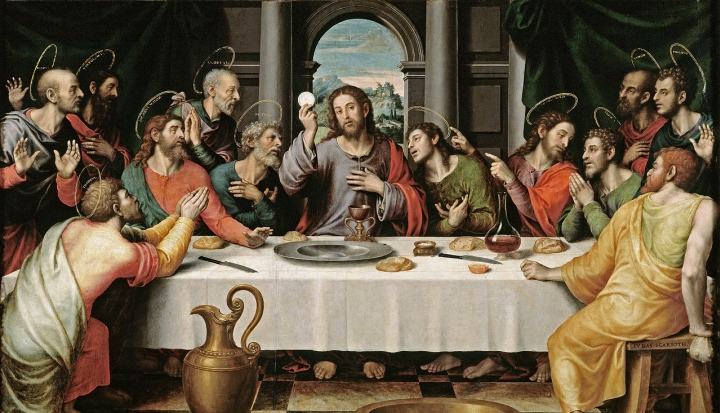
Again, this is basics, as the writer to the Hebrews might say, baby’s milk. But as I was reading about the sacrifices I thought, that’s a lot of meat for the people to eat! Then a phrase of Jesus very strange to first century Jews, but one we rarely think about today, came to mind: “eat my flesh.” In John 6 as Jesus is declaring he is the bread of life, he declares that his “flesh is real food.” Because of the last supper Jesus shared with his disciples we know this as communion where Jesus says of the bread, “this is my body.” There is also something mystical in partaking of his death as we eat and experience a real spiritual union with the Word of God that we might also partake in his resurrection.

What I had never done before in my 44(!) years as a Christian was connect the Israelites of the Old Testament eating the flesh of sacrificed animals to our eating the flesh of Christ. If the Old Testament is all about Jesus, it makes total sense, yet it never occurred to me until now.

As the meat of the sacrifice to atone for their sins sustained the Israelites as they ate, so the flesh of Christ we spiritually eat sustains us spiritually but in a very real way physically. Spiritual health, i.e., peace with God through our Lord Jesus Christ, has psychological and emotional effects which have real implications for our physical health. All those things we should not do because we fully trust in God, like worry, doubt, fear, anxiety, anger, etc., cause stress which dishonors our Almighty Savior God, and is not healthy.

This became even more clear to me later in 2 Chronicles 35 when under King Josiah the people celebrated the Passover in Jerusalem. It’s amazing how it echoes communion in the Lord’s Supper.

11 The Passover lambs were slaughtered, and the priests splashed against the altar the blood handed to them, while the Levites skinned the animals. 12 They set aside the burnt offerings to give them to the subdivisions of the families of the people to offer to the Lord, as it is written in the Book of Moses. They did the same with the cattle. 13 They roasted the Passover animals over the fire as prescribed, and boiled the holy offerings in pots, caldrons and pans and served them quickly to all the people. 14 After this, they made preparations for themselves and for the priests, because the priests, the descendants of Aaron, were sacrificing the burnt offerings and the fat portions until nightfall. So the Levites made preparations for themselves and for the Aaronic priests.

This is all a bloody business (thousands upon thousands of animals), which is what I always focused on as it is obviously connected to the blood of our slain Savior. But the Passover wasn’t just about killing animals to cover sin, but was about eating and being sustained by God’s mercy and grace in the eating. Remember the wages of sin? The only reason we are not a smoldering pile of ashes on the ground is because of his mercy and grace. As I often say, if our sin is akin to jaywalking, God’s forgiveness is not that big of a deal. If, on the other hand, it’s akin to genocide, that’s a whole other thing. 

That it is the latter, is the reason untold millions of animals had to die in order for us to understand the suffering and death of the Son of God. The only reason we don’t have to go through the bloody business of sacrificing animals today is because God himself in the person of Jesus of Nazareth died to set us free from sin and death. As I wrote recently, he is the double cure for sin!