
If you’ve been around a while you’re no doubt familiar with the “New Atheists” who fleetingly crossed the cultural firmament for a decade early in this century. There was nothing “new” about these “New” atheists because their arguments, such as they were, were as old and stale as moldy bread. They were cliché driven anti-Christian fanatics who gained shooting star fame, and then were gone. It’s amazing to have witnessed how popular they were, then in very short order they weren’t. Non-Christian belief in the form of atheism and agnosticism still exists, obviously, but there is a breed of what we might call the New-New Atheists, and they are very important for the re-establishment of Christian Western civilization.
We’ve been programmed to think because of the onslaught of secularism over the last hundred plus years that secularism is ascendent never to retreat, and Christian civilization in the West is a spent force never to be seen again. For most people this is axiomatic, but I beg to differ. I use the Berlin Wall as a metaphor far too often, but it fits. In the ‘80s almost everyone thought Soviet communism was if not eternal, close to it. Then, like the New Atheists, it was gone. Secularism, alas, will not go so fast, and rebuilding Christian Western civilization will not be so easy, but I am convinced it will happen, as I am arguing in my next book. Our New-New Atheists are a big step in that direction.
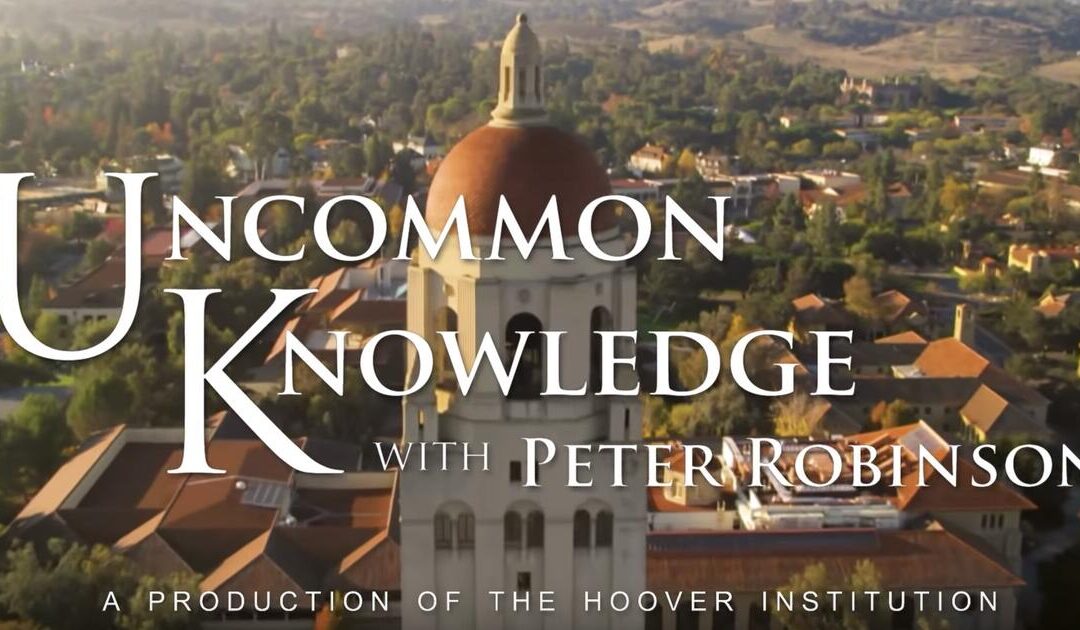
In case you’re not familiar Uncommon Knowledge with Peter Robinson, he does interviews of interesting people on interesting topics, and he’s very good at it. Speak ing of the Berlin Wall, he was a speech writer in the Reagan administration, and it was he who wrote Reagan’s tear down this wall speech, standing firm against all who said he should take that line out. Of the three gentlemen he’s interviewing about God’s existence, Stephen Myer is a Christian philosopher and author, and advocate for Intelligent Design. The other two are a couple of brilliant Brits. Douglas Murray is an author and political commentator, and Tom Holland is a scholar of the ancient world and the author of many books, his latest, Dominion argues that it is Christianity that gave us the modern world, and without it, a pagan world would be a very different and less hospitable place.
One of the things that stood out to me in the conversation was when Murray says, “I just don’t know.” And I think he repeats it several times. It’s a fascinating statement about the state of the man’s psychology. The issue, as it is for all atheists and agnostics, comes down to epistemology. In other words, how is it that we can “know” something. Is knowing even possible? He assumes he knows all kinds of things, but when it comes to God he just can’t “know.” This unnecessary dilemma so many face goes back to 17th century French Catholic philosopher Renes Descartes. He was trying to counter the growing skepticism of the age and attempted to prove that absolute certainty was possible. It is not! In fact, it is a fool’s errand, but his work put epistemology and the search for absolute certainty at the heart of intellectuals’ search for knowledge ever since.
Murray’s error, and Holland obviously suffers from it too, is that they believe they require some kind of knowing related to God that is different than all the other “knowing” of their lives. Any person who thinks clearly about these things (and given sin, that is not as easy as it sounds, Rom. 1:20) has to realize that all our knowledge requires faith, i.e., trust. I could prove this with one zillion examples, literally, but it isn’t necessary. Just think about it. Do we know anything with absolute certainty? Of course not. It isn’t even debatable. Which means faith, i.e., trust, is required for knowledge.
I use a phrase to make this point: there is no such thing as an unbeliever. You’ll notice throughout the conversation that Murray and Holland use faith as if it applies to other people but not them. The fact is every human being lives by faith, whether that is about metaphysical issues, like God’s existence, or should I trust the baby sitter with my child, or the doctor with my health, or the person selling me the car, and again, the examples are endless. Do I really know my wife loves me? I think I do, and there is plenty of evidence given she’s put up with me for 35 years, but I have to trust that she does. Or Do I even really know that I exist? Or do the solipsists have it right, that reality only exists in my brain? How do I know! Can I really be certain? Maybe my totally bizarre dreams I have every night are reality, and the daily mundane world I inhabit is the real dream.
Knowing isn’t so obvious after all, but atheists and agnostics delude themselves in thinking it is. Thankfully, we don’t have to have absolute certainty to know God exists, and that Jesus of Nazareth lived, died, and rose from the dead that we might have life eternal. Stephen Meyer knows this, and he’s brilliant. He’s far more persuasive than his two agnostic interlocutors.
Recent Comments