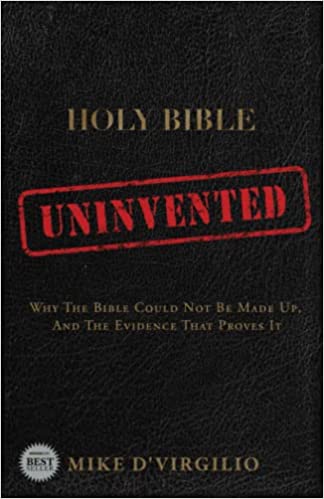
I was reminded last week of what a powerful Uninvented argument this is listening to a First Things podcast with Mark Bauerlein interviewing Dennis Prager on his book about Deuteronomy. Prager has written a series of books on the Pentateuch, the first five books of the Bible. Prager says that no ancient people, or modern people for that matter, would consistently make themselves look so bad. Starting around minute 23, he says one reason he believes in the divinity of the Torah is that there is no holy text in the world as critical of its group as the Old Testament is of the Jews. Non-Jews come out looking at least as good as the Jews, and often better. If Jews wrote the text and not God, Prager argues, they would have never depicted themselves so negatively. I could not agree more!
In apologetics this is called the criterion of embarrassment, and it’s all over the Bible, not just the Pentateuch. And it is a compelling argument for the historicity of the text. The idea is if something is embarrassing for what you’re trying to prove, you don’t include that, let alone make it up. I’m no scholar of the ancient world, but from all my studies I’ve learned the Hebrew-Christian record we find in our Bibles is completely unique among all ancient literature for just the reason, among many others. Ancient writers made their people look good. And it isn’t just this contrast that lends credibility to the biblical record. Knowing human nature, who makes up stories for the specific purpose of making themselves and their people look bad? And in this case really, really bad. I would argue human beings do everything they can to make themselves look good! Especially ancient human beings.
One of the reasons Prager’s comments struck me with such force isn’t because it confirmed what I argued in Uninvented, but because I’m reading through Jeremiah. You might remember that Jeremiah is known as “the weeping prophet.” The website Got Questions describes him this way.
Jeremiah was chosen by God before birth to be a prophet to the nation of Judah (Jeremiah 1:4–50). He spoke the words of the Lord during the reigns of Kings Josiah (2 Chronicles 36:1), Jehoiakim (2 Chronicles 36:5), and Zedekiah (2 Kings 24:18–19). Jeremiah grieved over the wickedness of his people and the impending judgment the nation’s sins had provoked. Jeremiah’s warnings went mostly unheeded, and he responded to Judah’s rebellion with tears of mourning (Jeremiah 13:17). Jeremiah has been dubbed “the weeping prophet” because of the often gloomy nature of his message and the grief he expressed for his people.
Gloomy indeed. He also penned the book of Lamentations which fits with his prophetic calling.
Most lay Christians don’t know that because of biblical criticism there has been a veritable world war against the veracity of the Bible for almost 300 years, and that has put Christians on the defensive. Because of the uninvented argument, it doesn’t have to be that way—the burden of proof is not solely on Christians. Skeptics and critics not only believe the bible is made up, merely fiction to one degree or another, but that it would have been easy for ancient Jews to make it up. They could not be more wrong, and we must insist when they make that claim to back it up. They are rarely challenged in this way, and if they are, their only response is assertion, well, it just is. That is not good enough.
The criterion of embarrassment is a formidable argument that adds to the credibility of biblical stories, and why they are very likely uninvented. The examples are practically endless because God is in the habit of never making his people look good. It would be one thing if it was a character here or there, but it’s almost all of them. As you read your way through your Bibles keep this in mind. Those portrayed are terribly flawed humans, and the writers never see the need to paper over their very human flaws no matter where they fit in the history of redemption. I’ll randomly pull out some examples to get you started if you haven’t been reading your Bibles with this in mind.
It is interesting that God himself doesn’t seem to be embarrassed by the world he created perfect and good going to hell in a handbasket in three chapters! Then immediately in the next one we read the story of the cold-blooded murder of Able by his brother Cain. It doesn’t get any better from there, yet God never sees the need to apologize for the mess he supposedly made of the world. For skeptics, the “problem of evil,” is an obstacle to believing the biblical witness is true. None of the biblical writers seem to think so, not one. In fact, Moses writing about the time of Noah says, “Now the earth was corrupt in God’s sight and was full of violence.” He says of Noah, that he “was a righteous man, blameless among the people of his time, and he walked faithfully with God.” After Noah and his family were saved from the flood, Noah got drunk and something very bad happened, although we’re not told exactly what.
Then we get to Abraham and Sarah, and God accredits his faith, or trust, in Him as righteousness, then what do Abraham and Sarah do? They don’t trust God! Ishmael is the result, and all kinds of problems throughout history go back to that sin. Moses, the ultimate prophet, and leader of the Hebrews out of the bondage of slavery in Egypt, comes off like a coward. Then once he leads the people out of Egypt the ungrateful Hebrews almost immediately rebel and worship a golden calf! Because of his sin, Moses doesn’t even make it into the promised land. Who makes up such a story about the greatest hero of their faith? I would argue based on the criterion of embarrassment, nobody!
The Israelites now enter the Promised Land of Canaan, and the narrative doesn’t present as fiction either once they arrive. During this period of approximately 400 years the Israelites were ruled by judges. To say the book of Judges is not a flattering portrait of the people of Israel would be a significant understatement. The theme of the book is found in these passages reiterated several times: “In those days there was no king in Israel; everyone did what was right in his own eyes,” and “The Israelites did evil in the eyes of the Lord.” What is the point of telling readers this? Am I to believe the skeptics who claim with certainty little or any of this is historical? Why record for all time your people are evil unless it was true, and that the history recorded in Judges had some larger purpose in redemptive history? The book ends with a story so shocking and horrific it’s hard to believe it’s in the Bible—an indication that the authors of the Old Testament wrote accurate chronicles of history.
When we get to the kings after David and Solomon, it’s almost all downhill from there. Eventually there’s a civil war, and Israel is split into two kingdoms, ten tribes to the north called Israel, and two tribes to the south, Judah. The prophets we read in our Old Testaments are during this period, and they did not have envious jobs. Nobody applied for that job, and the only plausible reason they spoke truth to power as they did was because in fact, the Lord commanded them to speak. It’s hard to imagine a people making up prophets who make their people look that bad. After the resurrection, we know why.



Recent Comments