
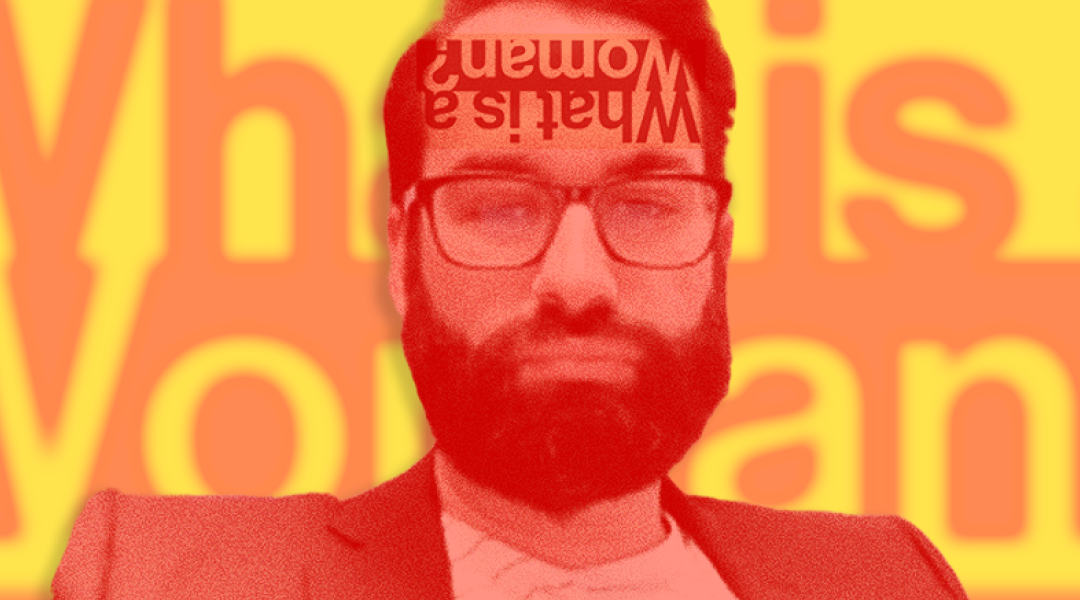
Matt Walsh, Voddie Baucham, The Trans Guy, and the Reality of Stigma
I stumbled on the video below about the drama surrounding Matt Walsh speaking brutal truth to some guy pretending to be a woman. You have to see this guy pretending to believe he is actually a sexy woman to believe it. Appropriate words fail when you encounter something so wrong. It’s like watching something so nauseatingly evil that you’re dumbfounded, literally struck dumb, unable to speak. Like watching old films from the end of WWII and the allies coming upon the death camps with piles of bodies, that kind of nauseating. What can you say about such a thing other than feel anger and disgust and a yearning for justice that feels like vengeance. No, I do not believe a transgender male pretending he’s a woman is in any way comparable to genocide. There are obviously gradations of evil, and while these two examples are significantly different on the scale, transgender sin is deeply evil and elicits in us revulsion, and it should!
The reason I decided to comment on this is because it’s a critical cultural moment for the church and America. I encourage you to watch the 13-minute video to better understand the issues I’m addressing. If you watch through to the end you’ll see a touching video of a girl who now wants to be called Mike reading a letter from her grandmother telling her she cannot do that because of Jesus, but affirming how much she still loves her. Walsh is the one who plays the video, so he’s not the heartless monster his critics say he is. Some of these critics while not saying he’s a “monster” do think his tone and words were unfortunate, not winsome, and basically counterproductive. I couldn’t disagree more because the two examples are apples and oranges: the dude playing the woman needs tough love, and the struggling young lady just needs plain old love, and guidance. This gets to the cultural issue.
The word stigma was dropped a long time ago as a remnant of a hostile and intolerant religious (i.e., Christian) past in America. The simplest definition:
An association of disgrace or public disapproval with something, such as an action or condition: synonym: stain.
Oh no, we certainly wouldn’t want to do that! Stigmatizing “the other” was so last century before we entered secular Utopia and became tolerant of others’ lifestyles in the 1960s. Now in American culture we’re tolerant of all lifestyle choices, and accept everyone for who they decide to “identify” as. Only, we’re not. Far from it. Let’s use a simple example of why this “narrative” is a lie.
What are the two most common criticisms of Christians? We hate homosexuals (we’re intolerant), now including trans people, and we’re hypocrites. Even though the first one is demonstrably untrue, and the second one is true of every human being (nobody lives up to their own standards let alone those of a perfectly holy God), what do these accusation do to Christians? Why, they stigmatize them! We’ve seen a growing phenomenon over the last several decades that has become as obvious as a Mount Everest in our midst. Those who are supposedly the most tolerant among us are the most blatantly intolerant people imaginable. It was not too many years ago when liberals were, well liberal. Here is one definition of the word liberal that makes one laugh out loud thinking we used to call these people liberals:
Favoring reform, open to new ideas, and tolerant of the ideas and behavior of others; not bound by traditional thinking; broad-minded. synonym.
The most narrow-minded bigots in America today used to be called liberals. They are more commonly called progressives now, but any honest person would call them communists. As ex-communist and leftist David Horowitz has accurately said, “Inside every progressive is a totalitarian screaming to get out.” This is an especially virulent form of communism, though, informed by a cultural form of Marxism, in popular parlance, wokism. This isn’t the old style communism a la Lavrenty Beria, Stalin’s hit man who had a penchant for shooting people in the back of the head, but a more subtle form of political murder. In 2023 we call this cancel culture. Another word for this? Stigma.
In the olden days in America, women who got pregnant out of wedlock (what an antiquated word that is!) were stigmatized. Now this is perfectly normal. When I was growing up the phrase, “living in sin” meant two people not married were living together, and people actually used it. If you used that phrase today to anyone under 40, they would have no idea what you’re talking about. Divorce was an embarrassing reality for some families. A man not having a job and living on the government dole was a disgrace. Those who lived on the street were bums, not “homeless people.” People who got drunk often were drunkards, now their alcoholics and supposedly have a disease. And I could go on.
Now, everything in America has become morally inverted. What was once stigmatized and considered immoral, is considered perfectly “normal,” and morally good. What is stigmatized is anyone who questions the morality of such things, those who do are considered intolerant; they must not be tolerated! Free speech, speaking what you think, is now considered by our progressive, woke cultural elites as “dangerous.” If it goes counter to the accepted moral standards of the woke cultural elites, it is hate. How convenient.
Which brings me to the video and Matt Walsh speaking brutal truth to cultural power to the trans guy who claims to be a sexy woman. What Walsh is doing it attempting to re-stigmatize what ought to be stigmatized. In the upside-down, inside-out world of progressive Alice in Wonderland, what should be stigmatized isn’t, and what should not be stigmatized is. There is no moral neutrality in the universe. The idea is a myth of the secular lie. Christians are especially susceptible to the lie because they often buy into the secular cultural stereotype of Christians as Big Meanies who hate “sexual minorities” or some such thing. Those in the video criticizing Walsh as a Big Meanie are blind or naïve, and have no wisdom about the brutality of spiritual warfare in a fallen world.
Which finally brings me to Voddie Baucham, the great Christian culture warrior. At 7:48 and 10:08 in the video, he tells us about the Eleventh Commandment Christian, a phrase I’d never heard before. These well-meaning Christians, he says, believe “that every problem in the world is a result of Christians not being nice enough.” Whenever the “controversial” topics around sex are brought up by Christians or Christian pastors, they die the death of “a thousand qualifications.” As an example, he uses Christian pastors preaching on adultery, and it’s spot on. Pastors would never qualify the evil of adultery so they don’t offend the adulterers in the audience, but on the topic of homosexuality, that’s a different story.
The importance of this cultural moment is that we have two choices as we encounter the cultural hostility to all things Christian the left hates, and that’s pretty much everything. We either call a spade a spade, even if some Christians think that’s “mean,” or the left will continue to try to stigmatize us out of existence. We must culturally re-stigmatize any sex outside of marriage, for example, among many other things. There is no “getting along” with the woke elite. As Ronald Reagan said about the Soviet Union when asked what victory would look like, he answered, “We win, they lose.” The mutually exclusive worldviews of cultural Marxism (wokeness) and Christianity cannot coexist.
The spirit of “the 60s” is at its cultural and political apex; it has no higher to go. But as I argued in my previous post, the fall of the left is inevitable because nothing built on lies can last. It is the examples of Matt Walsh and Voddie Baucham who show us the path to victory and the advance of the kingdom of God.



Recent Comments