Abraham Lincoln’s Thanksgiving Proclamation (1863)

Abraham Lincoln’s Thanksgiving Proclamation (1863)

he year that is drawing towards its close, has been filled with the blessings of fruitful fields and healthful skies. To these bounties, which are so constantly enjoyed that we are prone to forget the source from which they come, others have been added, which are of so extraordinary a nature, that they cannot fail to penetrate and soften even the heart which is habitually insensible to the ever watchful providence of Almighty God. 

In the midst of a civil war of unequalled magnitude and severity, which has sometimes seemed to foreign States to invite and to provoke their aggression, peace has been preserved with all nations, order has been maintained, the laws have been respected and obeyed, and harmony has prevailed everywhere except in the theatre of military conflict; while that theatre has been greatly contracted by the advancing armies and navies of the Union. 

Needful diversions of wealth and of strength from the fields of peaceful industry to the national defence, have not arrested the plough, the shuttle or the ship; the axe has enlarged the borders of our settlements, and the mines, as well of iron and coal as of the precious metals, have yielded even more abundantly than heretofore. Population has steadily increased, notwithstanding the waste that has been made in the camp, the siege and the battle-field; and the country, rejoicing in the consciousness of augmented strength and vigor, is permitted to expect continuance of years with large increase of freedom. 

No human counsel hath devised nor hath any mortal hand worked out these great things. They are the gracious gifts of the Most High God, who, while dealing with us in anger for our sins, hath nevertheless remembered mercy. It has seemed to me fit and proper that they should be solemnly, reverently and gratefully acknowledged as with one heart and one voice by the whole American People. 

I do therefore invite my fellow citizens in every part of the United States, and also those who are at sea and those who are sojourning in foreign lands, to set apart and observe the last Thursday of November next, as a day of Thanksgiving and Praise to our beneficent Father who dwelleth in the Heavens. And I recommend to them that while offering up the ascriptions justly due to Him for such singular deliverances and blessings, they do also, with humble penitence for our national perverseness and disobedience, commend to His tender care all those who have become widows, orphans, mourners or sufferers in the lamentable civil strife in which we are unavoidably engaged, and fervently implore the interposition of the Almighty Hand to heal the wounds of the nation and to restore it as soon as may be consistent with the Divine purposes to the full enjoyment of peace, harmony, tranquillity and Union.

In testimony whereof, I have hereunto set my hand and caused the Seal of the United States to be affixed.

Done at the City of Washington, this Third day of October, in the year of our Lord one thousand eight hundred and sixty-three, and of the Independence of the United States the Eighty-eighth.

By the President: Abraham Lincoln

William H. Seward,
Secretary of State

Ayaan Hirsi Ali’s Conversion: The Poverty of Atheism and an Eschatology of Hope

Ayaan Hirsi Ali’s Conversion: The Poverty of Atheism and an Eschatology of Hope

My next book, currently in the publishing process, has Great Awakening in the title. Those familiar with Western Christian history know that phrase refers to two periods of spiritual renewal and the spread of Evangelical Christianity in America and England. I believe we are in a third period of great awakening, thus the inspiration for the book. I loved being able to lay out my red pill journey which has also happened to millions of people since Trump came on the scene in 2015. If you are not familiar with the term red pill, watch this short clip from the 1999 hit movie The Matrix with Keanu Reeves and you’ll understand why the phrase is so apropos for our times. If you’ve never seen it or it’s been a while, I encourage you to watch it. The dialogue is nothing short of prophetic. Morpheus ends telling Neo, Reeve’s character, “All I’m offering is nothing more than the truth, nothing more.” This revealing of truth has been happening in the Western world for more than ten years and preceding Trump, who just happened to be the very unlikely man God used to trigger untold millions to their own red pill journeys to truth.

What Brought Ayaan Hirsi Ali to Christ
First, I was surprise this confirmed atheist had become a Christian, but reading her testimony, “Why I am now a Christian,” I was doubly blown away by her confirmation of the main thesis of my book. God is doing something amazing, something revealing, in our time amid all the chaos and suffering. In fact, all the turmoil and misery is allowing many people’s eyes to be opened, and not just to spiritual realities, although they are all connected to God. We pray they eventually embrace Jesus as the only one who can make sense of it all. Unfortunately, human beings must often endure suffering (physical, mental, emotional, relational, financial) to realize the truth of things beyond their own parochial interests.

Ayaan is an example of someone who didn’t become a Christian merely to go to heaven when she dies, although that was a significant motivation for her embracing Christ. If going to heaven when we die, and personal holiness, both of infinite importance, are all Christianity is, then it is a terribly impoverished and truncated view our transformational faith. I don’t think such a narrow kind of Christianity would have persuaded her of its truth. Rather, it was the magnificent breadth of what salvation from sin means in Christianity that grabbed her in spite of herself. She saw that it affects everything, spiritual, material, personal, cultural, societal, political, every single thing. What her story displays is the power of Christianity to transform not only individual lives, but lives lived in community as nations. This is why Jesus commanded the eleven disciples to “make disciple of all nations,” not just individuals.

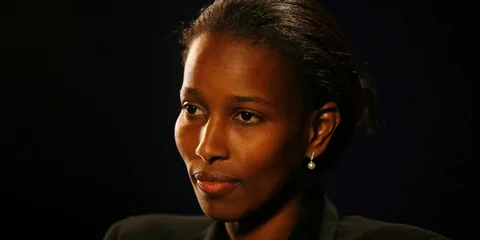
Who exactly is Ayaan Hirsi Ali? In case you don’t know of her, she describes herself as a, “Human Rights Activist & Author.” She grew up Muslim and, as she explains in the piece, got serious about her faith in 1985. The terrorist attacks on 9/11 shattered her Islamic worldview, and in due course she embraced the New Atheist kind of atheism, although she was not an arrogant blowhard like many of the New Atheists were. She was in the Dutch Parliament for a few years, and eventually moved to the United States and became a US citizen. In addition to being widely published in the media and an author, she has been employed by several conservative think tanks where she consistently defended Western civilization. 

When I saw the headline that she had become a Christian, I was very pleasantly shocked. I have what I call a “heathen prayer list” I pray over weekly. It has on it well-known atheists and non-Christians, among others, who God has placed on my heart to lift weekly before the throne of grace. Ayaan was not on the list, but her conversion gives me hope that my prayers are not uttered in vain. Here is what drove her to Christianity:

Part of the answer is global. Western civilisation is under threat from three different but related forces: the resurgence of great-power authoritarianism and expansionism in the forms of the Chinese Communist Party and Vladimir Putin’s Russia; the rise of global Islamism, which threatens to mobilise a vast population against the West; and the viral spread of woke ideology, which is eating into the moral fibre of the next generation.

We endeavour to fend off these threats with modern, secular tools . . . But we can’t fight off these formidable forces unless we can answer the question: what is it that unites us? The response that “God is dead!” seems insufficient. So, too, does the attempt to find solace in “the rules-based liberal international order”. The only credible answer, I believe, lies in our desire to uphold the legacy of the Judeo-Christian tradition. 

She then contends everything we value in modern Western society came from Christianity, citing Tom Holland’s wonderful book, Dominion. She adds:

Yet I would not be truthful if I attributed my embrace of Christianity solely to the realisation that atheism is too weak and divisive a doctrine to fortify us against our menacing foes. I have also turned to Christianity because I ultimately found life without any spiritual solace unendurable — indeed very nearly self-destructive. Atheism failed to answer a simple question: what is the meaning and purpose of life?

The Poverty of Atheism
Her final sentence understates the fundamental problem of atheism and the materialist (matter is all that exists) worldview: Atheism cannot answer any questions—not one. The only possible answer atheists can give for why anything is, is, just because. That’s it. Atheists have no idea, and cannot argue persuasively or logically, why anything happens or the way it happens. As I often say, if all we are is lucky dirt, mere matter in motion, then chance is the only explanation for everything. Atheists will often fall back on the “evolution of the gaps” argument. It is remarkable what they believe matter without purpose can do, what it can supposedly accomplish. When you read or hear them say evolution or natural selection does such and such, just put in the word God and the meaning is exactly the same. Only God doing or causing something is a far more plausible explanation because, well, he’s God! Biblical theism maintains God is the omnipotent, omniscient, omnipresent Creator and sustainer of the world, of all material reality. God has explanatory power, atheism by contrast has none, as Ayaan discovered.

We can expose the poverty of atheistic materialism on many levels. But before I briefly mention a few, it is important for those of us who want to defend the veracity of the Christian faith in a secular age that we understand everybody has a worldview, an understanding of the meaning of reality based on faith. In other words—everyone is religious. Everyone lives by faith regardless of if they practice something we would recognize as a “religion.” The question is, what do we have faith in, what do we trust, and is it justified true belief. The best we can get in this life is beyond-a-reasonable doubt faith (a very good reason to exercise humility toward people who do not share our faith), and Christianity is the only one that can get us there.

It is also imperative if we’re to effectively defend Christianity’s truth claims to know that for three hundred years starting in the so-called Enlightenment, and the resultant growth of secularism, Christianity has been on the defensive. Christians have done an admirable job in defense, but somewhere along the way the idea was accepted that Christians must defend their worldview and faith, while the atheist secularist skeptical sorts do not have that obligation. That became the default position in the secular nirvana of the modern age. There is, however, no default position that doesn’t require a defense. Every faith makes claims, and those claims need to be defended if people are to believe them. I used the phrase explanatory power above, which means the persuasive power of an explanation for something. In this case the question before us (and one we should ask ourselves, loved ones, and friends every single day) is what best explains reality, and everything in it. The materialist atheists are the ones who should be on the defensive because they have to defend the indefensible.

How does, for example, matter and chance explain morality, right and wrong, good and evil? It can’t; they just are. Where do these phenomena come from, these things that are deep within every human being? The only answer is that they don’t come from anywhere, they just are. We have to suck it up, deal with them the best we can, and move on. Or take meaning and purpose in life, what Ayaan calls a “simple question.” Mere matter and chance can give no answers to that, as she discovered. The only solution the atheist materialist can give is, make your own meaning and purpose and hope it’s enough. That doesn’t seem to be working well for the almost 50,000 people last year who killed themselves, and many more who likely tried. How about beauty? Chance doesn’t really satisfy as an explanation. Just compare a Jackson Pollack “painting” to a Rembrandt. It is difficult to call paint randomly thrown on a canvas beautiful, while the great Dutch genius Rembrandt’s work is breathtakingly beautiful. It leaves one in awe.

The Necessity of an Optimistic Eschatology
What Ayaan understood, and what attracted her to Christianity, is that she sees it as a totalizing life and worldview, as is every life and worldview. I recently wrote here, and often talk about, the myth of neutrality. When secularism came to dominant the once Christian West in recent decades, there was nothing to stand in the way of the dissolution brought about by the new paganism. Whatever worldview rules America and the West, it will have specific answers to ultimate questions just as Christianity has, including about meaning, morality, truth, justice, why we are here, and so on. In addition, and this is what Ayaan saw with her own eyes and experience, every worldview that informs a society and culture has consequences. If that isn’t Christianity, the results will not be good, as we see all around us.

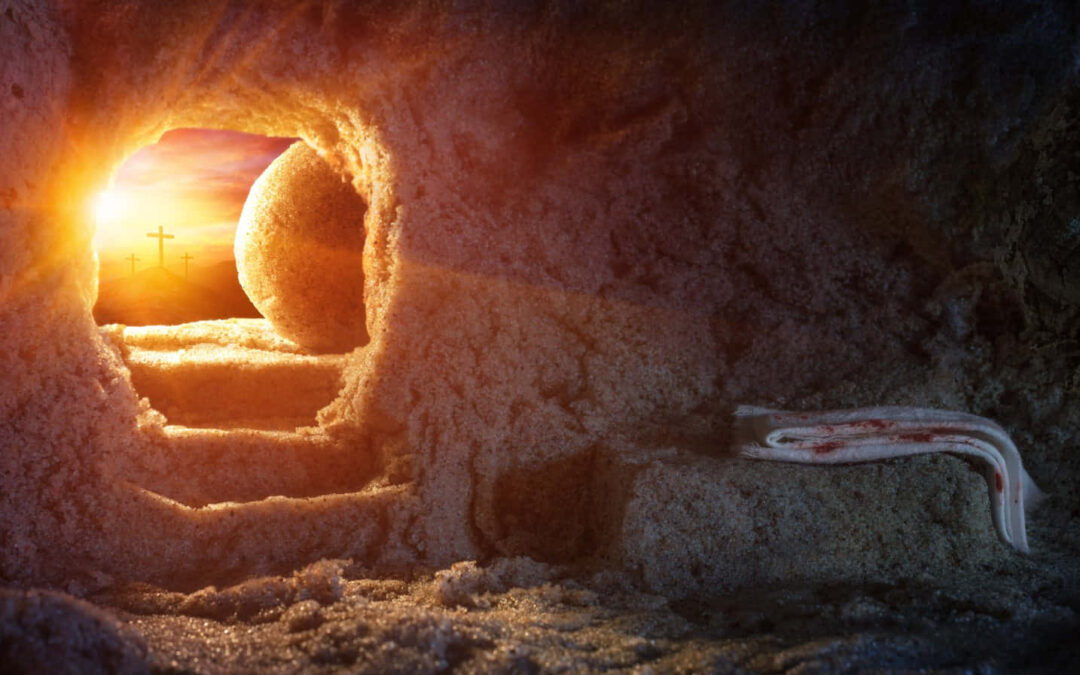
What Christianity brings to the societal table is the truth about the why of everything. It gives us the big picture answers and promises of God revealed in creation, Scripture, and Christ. Many conservatives think something called natural law and a vague theistic religiosity is enough to provide the foundational supports for civilization, but that won’t work. As Ayaan discovered, every blessing of the modern world came as a result of Christianity, and it can only be saved by Christianity. This won’t happen, however, without an eschatology of hope. Such a view of “end times” (i.e., eschatology) is only available on the view that Jesus came to win, to bring the kingdom of God to earth. The “end times,” or last days in biblical terms, started when Jesus rose from the dead and ascended to the right hand of God. 

Every Christian wants their faith to influence the culture, to bring righteousness and justice and peace, but few think it’s possible because they don’t have the theological framework that says such a thing can happen. I was one of these Christians not too long ago. I expected everything would inevitably get worse, then Jesus would return to save the day. Needless to say that’s not the best mindset for winning culture wars or political battles, both inevitable living life in a fallen world among fallen people in fallen societies. We are told throughout Scripture that Jesus came to destroy the works of the devil, and that Christianity will ultimately win in this world. This is not wishful thinking, but biblical affirmation. The Apostle Paul says this clearly in I Corinthians 15:25 that, “Christ must reign until he has put all his enemies under his feet.” Paul also said Jesus did this, “having disarmed the powers and authorities, he made a public spectacle of them, triumphing over them by the cross” Col. 2:15. He also tells us that Jesus ascended to the right hand of God, “far above all rule and authority, power and dominion, and every name that is invoked, not only in the present age but also in the one to come” Eph. 1:21. This is no pipe dream, but what God intended when he sent his Son to earth to strike the serpent’s head (Gen. 3:15) and redeem His creation. 

Such an eschatology of hope, what is called postmillennialism, is in my humble opinion, required if we are going to daily engage the battles for the soul of Christian Western civilization.


Notable Quotations-Strunk & White

Notable Quotations-Strunk & White

Up to this point the book has been concerned with what is correct or acceptable, in the use of English. In this final chapter, we approach style in its broader meaning: style in the sense of what is distinguished and distinguishing. Here we leave solid ground. Who can confidently say what ignites a certain combination of words, causing them to explode in the mind? Who knows why certain notes in music are capable of stirring the listener deeply, though the same notes slightly rearranged are impotent? These are high mysteries, and this chapter is a mystery story, thinly disguised. There is no satisfactory explanation of style, no infallible guide to good writing, no assurance that a person who thinks clearly will be able to write clearly, no key that unlocks the door, no inflexible rule by which writers may shape their course. Writers will often find themselves steering by stars that are disturbingly in motion.

 —William Strunk Jr. & E.B. White, The Elements of Style


Matthew Perry: What Does it Profit a Man . . . .

Matthew Perry: What Does it Profit a Man . . . .

The recent death and sad life of megastar Matthew Perry at 54 is a tale many of us can learn from. Unfortunately, most will learn the wrong lessons. Some will conclude that fame and wealth are bad things in and of themselves. They are not. They can be a huge blessing depending on the person. Others will see fame and wealth having destroyed Mr. Perry. There is some truth to that because he obviously couldn’t handle it, but no external circumstances cause anything. Almost four decades ago when I started my theological journey with Charles Hodge’s Systematic Theology, I learned something about money I had never considered. After all, I was only 24 at the time. Money, he said, is a reflection of character, it reveals who we really are, and it also allows us to develop better character as we earn more of it. That, of course, depends on our character, who we are (this article about his parent’s divorce is instructive why he was who he was). Those lacking good character, for whatever reasons, will tend to be corrupted by having considerably more money than required to meet their daily needs. Unfortunately, this seems to have been the case with Matthew Perry. I am not at any point addressing his eternal destiny, although the verse in my title always tends to be interpreted that way.

The Christian Understanding of Wealth
God declares that “wealth and honor” comes from Him (I Chron. 29). Fame is a kind of honor, but a distinctly modern phenomenon. Whenever we attain wealth and honor, or fame, we are confronted with a question: What are we going to do with it? Jesus put the rhetorical question this way:

 For what does it profit a man to gain the whole world and forfeit his soul?

Matthew Perry would have said, none at all. It destroyed him. But wealth (i.e., money and what it can buy) is an unqualified good in Scripture. You can’t get more unqualified than this (Deuteronomy 8):

17 You may say to yourself, “My power and the strength of my hands have produced this wealth for me.” 18 But remember the Lord your God, for it is he who gives you the ability to produce wealth, and so confirms his covenant, which he swore to your ancestors, as it is today.

But like any good, it can be perverted by sinners who don’t acknowledge it comes from Him.

As I argued recently, God wants to bless us. I would encourage you to read Deuteronomy 8 to see how this wealth-creating ability granted by God is in direct correlation to our obedience to Him. In other words, material blessing is baked into the salvific cake of God’s relationship to His people. This is sadly misunderstood by many Christians today, partly because we over spiritualize everything, and also mistakenly judge God’s good creation by those who abuse it.  (This is one reason, lamentably in my opinion, that almost all Evangelical churches serve only grape juice during Communion.)

Think about it. When you encourage and exhort your children to obey you, and punish them when necessary if they don’t, do you expect the outcome in their daily lives to be good? Do you not want them to flourish and thrive in this life? Of course you do. You specifically do those things because you want your children to have a better life, not a worse one. Why would it be any different with God and his people? It isn’t! Jesus confirms the analogy to our heavenly Father in Matthew 7:11:

If you, then, though you are evil, know how to give good gifts to your children, how much more will your Father in heaven give good gifts to those who ask him!

Yes, I know, life is “unfair,” and material blessing is not in the cards for some people. Just think about what appears to us the lottery of where someone is born. Nonetheless, the blessings of obedience to God, even trusting his goodness and love in suffering, always lead to a spiritual flourishing in our relationship to Him that cannot be determined by our circumstances. Not to mention, we are going to live forever with God in a resurrected body on a new heavens and earth!

Dualism and the Soul
In our tendency to over spiritualize is a kind of dualism, material/spiritual, earthly/heavenly, temporal/eternal. I want to suggest that we cannot neatly separate those, not in the least. That separating came as a result of the fall and man’s rebellion, and Jesus came to earth to bring them together, not further separate them. Let’s put it this way:

  • The material is the spiritual, and the spiritual is the material.
  • The earthly is heavenly, and the heavenly is the earthly.
  • The temporal is the eternal, and the eternal is the temporal.

There are many reasons we don’t think this way, but I believe ancient Greek dualistic assumptions are a primary cause. We can’t explore that here, but instead of seeing life fully integrated and wholistic in the omnipresent life of God, there are sharp distinctions like this in our minds.

Because we do this we automatically see the reference to losing or gaining souls as Jesus talking about going to heaven or hell. I don’t think he is. That’s an implication, but it’s much bigger than that. This dualism makes us think we are made up of two substances, body and soul, and when we die our soul goes to heaven to wait for our resurrected body. That could be true and I tend to believe that, but we can’t be sure. The New Testament only gives us the barest hints that it is, but ancient Hebrews and Jews of Jesus’ day as well, didn’t think this way.

So, what did Jesus and the first Jewish Christians mean by the word soul? I’m convinced it had a much more earthy, this life meaning, more Hebrew than Greek. The Greek influence in early Christian thinking came in the centuries that followed as the church slowly became increasingly Gentile. Certainly the Greek thought influenced how Jews saw the world given that the process of Hellenization (the influence of Greek culture) started when Alexander the Great conquered Judea over 300 years before Christ, but it would not change the fundamental character of Jewish thought. So instead of seeing what Jesus said dualistically, let’s look at it as a first century Hebrew/Jew might.

What is the Soul Biblically Speaking
The Greek word soul, psuché-ψυχή, is where we get our word psychology. The English automatically brings in the Greek dualistic assumptions by its meaning of mind, that our psyche is about what and how we think and why. That’s helpful to learn and understand, but it’s too narrow. Let’s see what the biblical ancient Greek meaning was according to Strong’s:

Usage: (a) the vital breath, breath of life, (b) the human soul, (c) the soul as the seat of affections and will, (d) the self, (e) a human person, an individual.

Further:

5590 psyxḗ (from psyxō, “to breathe, blow” which is the root of the English words “psyche,” “psychology”) – soul (psyche); a person’s distinct identity (unique personhood), i.e. individual personality.

5590 (psyxē) corresponds exactly to the OT 5315 /phágō (“soul”). The soul is the direct aftermath of God breathing (blowing) His gift of life into a person, making them an ensouled being.

This broad understanding of the word is critically important to understand if we’re to escape from the prison (chains) of dualism. Notice especially that soul is the unique identity of a person, their one of a kind personhood, who they are. That includes their body as much as everything that goes on inside them. It includes this life and the life to come.

I know this is heavy philosophy stuff, but bear with me. Even though I am probably a dualist, meaning I think we are body and soul, two distinct entities, I am also a monist in that I believe the two are inextricably bound to one another. Unfortunately, a very real separation occurred between the two, between us, who we are, our soul and our bodies, when mankind crashed and burned in the fall. It is helpful to understand the Apostle Paul’s theological perspective of the human body. He uses the word in Greek, sarx- σάρξ, over sixty times. It is a foundational part of his anthropology, or his understanding of the nature of man (anthropos in Greek). It is the principle of sin that inheres in us, in who we are. Not being a Greek dualist, Paul isn’t saying the flesh, our bodies are sinful and evil, but a principle of rebellion against God is part of who we are. We could say our souls, who we are, is infected with this sin principle.

I won’t go any deeper into this, but the point is that this sin principle ruins everything it touches in this life. The implications are not only eternal. All Christians know this, but given our Greek dualistic assumptions we’re always thinking eternal consequences are more important. Of course they are because, well, they are forever, and that’s a long time! But God is every bit as concerned with this life, with who we are in terms of who we are becoming, and the material implications for here and now. I encourage you to read Deuteronomy 8 and  Deuteronomy 11 where Moses lays out the blessings for obedience to God, and the opposite if we don’t. Despite what many Christians think, this was not just for Israel. He’s built his law into creation such that our relationship to him has real, substantive, material consequences one way or the other.

Christians sometimes have a hard time with this line of thinking as I used to because I thought of it like a kind of “prosperity gospel” position. I think Britannica defines this well in case you’re not familiar with the phrase:

It is also referred to as the “health and wealth gospel” or “name it and claim it.” Central to this teaching are the beliefs that salvation through Jesus Christ includes liberation from not only death and eternal damnation but also poverty, sickness, and other ills.

Well, it does! But there is nothing magical about this like I used to think. We are saved from sin unto good works. It is only in obedience to God’s law that he can bless us because that’s the way he made things to work! If we live our lives in obedience to the Ten Commandments the best we can, our lives will turn out a whole lot better than if we don’t.

Matthew Perry Loses His Soul
Unfortunately, Matthew Perry didn’t obey the ten commandments. As I said above, I can’t speak to the eternal aspect of his soul, but he clearly lost it in this life. Wanting the entire world, so to speak, apart from God, he got it. He lost his soul in the process, and his life for good at the young age of 54. His mistake was thinking something like the fame he craved could ultimately fulfill him, but he likely responded as many people do when they get it: is that all there is? As I’ve heard it said, idolatry is turning good things into ultimate things. Making an idol of fame, which drives so many in our secular culture, is a recipe for disaster. How that plays out in each individual’s life who achieves it depends on the person. For some who don’t place their ultimate worth in the idol, they can deal with it in a way that brings wisdom. Even at that, it is not easy.

We are in the middle of fascinating documentaries about two men, and one woman, who achieved massive wealth and fame and came out the other side better people through the pain and struggle that comes along with such success. One is about soccer superstar David Beckham (and his Spice Girl wife), and the other is Rocky, Sylvester Stallone, both on Netflix. Like Perry, they had their dreams come true beyond their wildest imaginations, and struggled to come to terms with it. It’s interesting to see the young Beckham with no tattoos, and the now 48 year-old with a bunch of them. To me those are a reflection of the struggle. He seems, though, to be a genuinely good bloke, as the Brits would say. Stallone too seems to have come out the other side a better human being.

What this means for their eternal soul we don’t know, but ultimately that’s the only thing that counts.

The Kingdom of God is Not Identical to the Church

The Kingdom of God is Not Identical to the Church

For all of my Christian life (over four decades), I tended to see the kingdom of God and the church as the same thing. In my mind there was no differentiation between the two. When Jesus prayed “Thy kingdom come, thy will be done on earth as it is in heaven,” I thought he was referring exclusively to the church because that is where kingdom values could grow and flourish among God’s redeemed, covenant people. Outside of that, not so much. The kingdom to me was something specifically “spiritual,” something that really couldn’t happen outside of the confines of God’s people. Out there was God’s common grace, as Jesus says, the sun shines and it rains on the just and the unjust. In my mind the “spiritual” kingdom of God had nothing to do with this fallen world which is passing away. I was wrong, but more on that in a minute.

I look back at this with a sense of irony because ever since I discovered Francis Schaeffer in college, I’ve been a big Christian worldview guy. I believed the Christian faith applied to all of life, and rejected any kind of sacred/secular distinction. As the great Dutch theologian Abraham Kuyper said, and I believed, “There is not a square inch in the whole domain of our human existence over which Christ, who is Sovereign over all, does not cry, Mine!” Yet there was a bifurcation in my mind, a fork in the road where God’s kingdom and the church went off in one direction, and the fallen world inevitably in the opposite direction. I now believe this is not the biblical understanding of the kingdom of God, the church, or the world. This goes back to my eschatological epiphany of a year ago August that entirely changed my perspective on what it is God is doing in history.

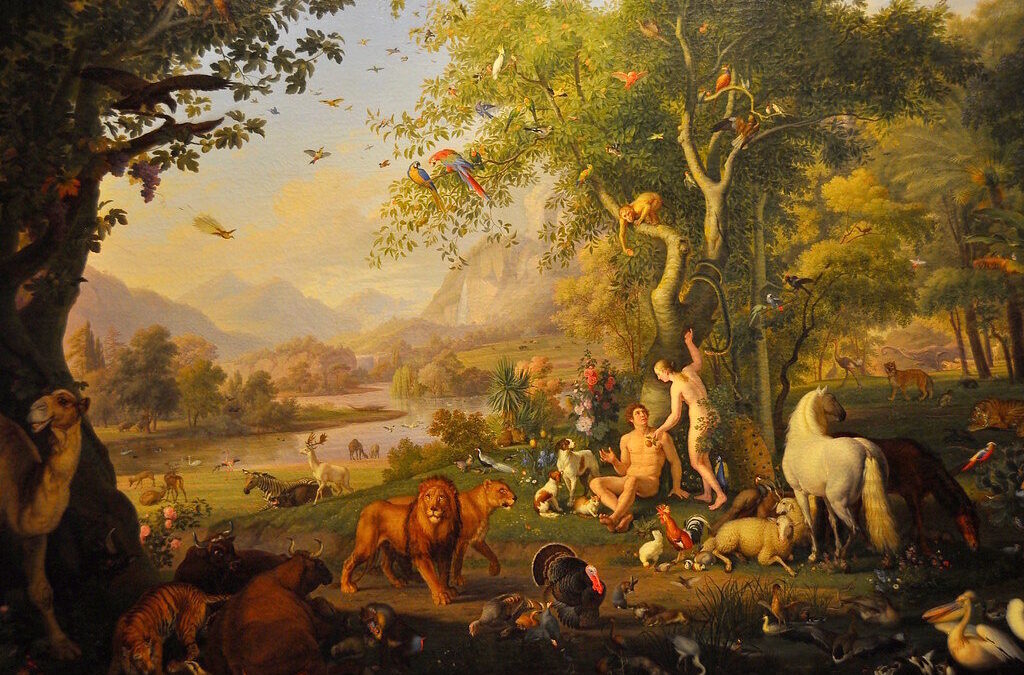
This is a big topic requiring far more space than a blog post can adequately address, but we can briefly focus on the first three chapters of Genesis to make the point. The entirety of redemptive history is found in these three chapters, creation, fall, and redemption, and they will help us see why the kingdom and the church are distinctive entities in God’s economy.

Creation and Fall
When God created the heavens and the earth he emphasized its goodness, that it was for His glory and the flourishing of man who was to exercise dominion over it. We call this the cultural or dominion mandate. We read His charge to Adam and Eve in Gen. 1:28 (KJV):

Then God blessed them, and God said to them, “Be fruitful and multiply; fill the earth and subdue it; have dominion over the fish of the sea, over the birds of the air, and over every living thing that moves on the earth.”

First let’s notice God’s desire for humanity, the apex of his creation: He wants them to be fruitful. When we look at a tree and see fruit on it, what do we think? There should be many things Christians think, but one is that bearing fruit is what trees do, it’s what they are made for, their telos or purpose. When God made man, male and female he created them, it was to bear fruit, it is what they were made for. It is critical to understand, though, that this is not solely referring to creating little humans, but bearing fruit in every area of our lives. God, as the book of Genesis makes very clear, wants to bless us, as I wrote about here recently. The word is used over 60 times in the book, the first of which is in this verse. Contrary to the devil’s lie, God is no big meany out to keep all the goodies for himself and make us miserable. Sinners easily believe that, but it’s not true. 

The secret to true happiness is found in this verse. The first is to have babies, if you are married and can. God is clear throughout Scripture, more babies, more happiness. It is our telos! One of the ways to unlock this secret is to become both less self-absorbed and self-obsessed, and marriage and babies will most certainly do that. 

Then, we are to subdue and have dominion, i.e., rule. What does that mean? A lot! God uses two different words for a reason. Subdue according to Strong’s means to “bring into bondage, force, keep under, subdue, bring into subjection.” Unlike Rousseau thought and his current secular leftist followers think, “nature” is not our friend. It must be brought into subjection—we call that civilization. Dominion or rule is more positional, in that it gives us the authority over creation to act as its rulers as God’s vice regents, His image bearers. We are Christ’s body on earth, so it is our responsibility to exercise dominion in his place, as he exercises it over all rulers and authorities and powers, both spiritual and temporal. The fall didn’t change God’s charge to man made in his image.

When Adam and Eve decided to trust the serpent rather than God, the creation with man fell into sin and death. At that moment, the creation didn’t transfer ownership to the devil. Psalm 124:1 tells us, “The earth is the Lord’s, and everything in it.” All he could do was pervert and distort what God created good, but he could not change the fundamental goodness of creation, of material reality. Modern Christians tend to think the dominion mandate doesn’t apply to us anymore, but it most definitely does. When you wake up every morning and fight to put bread on your table and a roof over your head, you are exercising the dominion mandate as God’s image bearer, and more importantly as a Christian.

Redemption
Jesus as the second Adam (1 Corinthians 15:45-49) fulfilled the covenant that Adam could not. What Adam lost, a world blessed by God without sin, Jesus came to redeem, and not just individual sinners, but the earth, creation itself. Thinking Christianity is primarily about dying and going to heaven misses the larger point, as Paul says in Romans 8:

18 I consider that our present sufferings are not worth comparing with the glory that will be revealed in us. 19 For the creation waits in eager expectation for the children of God to be revealed. 20 For the creation was subjected to frustration, not by its own choice, but by the will of the one who subjected it, in hope 21 that the creation itself will be liberated from its bondage to decay and brought into the freedom and glory of the children of God.

22 We know that the whole creation has been groaning as in the pains of childbirth right up to the present time.

In eternity, God promised the Son that this fallen creation, including man, would be given to him to redeem and restore (the covenant of redemption). This promise is given to God’s people in Genesis 3:14-15, where we learn the seed of the woman will crush the serpent’s head. There is nothing subtle or nuanced about crushing—it is total, it is absolute. Jesus accomplished this crushing by his life, death, resurrection, ascension, and reign at the right hand of the Father. This is already done; working it out is just details, of which you and I get to be intimately involved. We are, to put it bluntly in redemptive terms, in the crushing business! 

Sadly, most Christians don’t believe this, thus the salvation is dying and going to heaven focus. We think on a practical level that Jesus came to redeem our souls, and not so much the earth, creation, this material fallen world. Of course we know how it ends; Revelation 21 and 22 make that perfectly clear. But we are under the impression that the new heavens and earth comes down out of heaven as a one-time event, a complete rupture in the space-time continuum, old fallen earth out, new redeemed earth in. As I used to see it, the devil has the upper hand “down here” and basically wins the world war of material reality in a fallen world. When Jesus returns he cleans up the mess, puts the furniture back where it belongs, and we live happily ever after. The only problem with my previous perspective is that it was utterly wrong.

Christology as the Key to Church and Kingdom
The study of Christ, Christology, is seeking to understand his nature, who he is, and his mission, what he came to earth to accomplish. As we delve into him more deeply, we’ll see that we’ve been constricting his mission to a narrow sphere of existence we call “spirituality.” Modern Christians tend to live a dualistic existence, upstairs-downstairs, where the spiritual, eternal next-life stuff is more important than the mundane, material everyday this-life stuff. It is not. This is the bifurcation I mentioned above. 

Let’s say we do our morning Scripture reading and prayer, the “spiritual” part of our day, that’s one road, the most important road, by far. Then we go down the other road where the fork is, and it has a sign that says, “The Rest of Life,” and that’s what we do every day after our worship time with the Lord. Mind you I did not think this at all. I knew everything I did was “unto the Lord,” but my theology missed the mission of the Messiah, the Christ, Jesus now seated reigning at God’s right hand. Or course I knew he is there and interceding for me before the Father, wretched sinner that I am, but that’s just it. It was for me! What about the rest of creation? That, my friends, is a huge question, and our answer will determine how we look at life. The answer will broadly fall one of two ways: victory or defeat.  

I believed creation, the earth, will be redeemed at the end, but I missed that Jesus started redeeming and transforming it when he ascended to heaven and sent the Holy Spirit at Pentecost. This redemption Jesus accomplished and the Holy Spirit is applying, is a package deal, his people and his earth. Remember the crushing? That started 2,000 years ago. Adam lost his ability to rule, to exercise dominion, and Jesus gave it back. He is now exercising the dominion Adam forfeited through us! Does that sound strange to you? Not too long ago, it sure sounded strange to me. How does this actually work? We read about the authority Jesus was given when he was coronated as King at the ascension in several passages, including Ephesians 1:15-23, and Daniel 7:9-14. We further read that his reign is not only over the hearts of Christians, his people, but over his enemies and is happening now and until they are all defeated. We learn this in I Corinthians 15:25, and Psalm 110 says the same thing: 

For he must reign until he has put all his enemies under his feet.

These enemies are not just in our hearts and in our struggle to overcome sin, they are everything and everywhere in a fallen world. Keep in mind, Jesus is conquering his enemies through us his church until the final enemy, death, is destroyed at his second coming. The church is the staging ground, and from there  we are daily sent into the world to transform it.  It is a gradual thing, not a one-time cataclysmic event like I used to believe. And we’re only 2000 years into it, so we’re just getting started!

John the Baptist got the ball rolling when he declared: Repent, “for the kingdom of heaven has come near.” Jesus started his ministry with the exact same words. It is instructive to note the word kingdom, basileia- βασιλεία in Greek, is used over a hundred times in the gospels. The word church, by contrast, ekklésia- ἐκκλησία, is used three times in two verses in Matthew. You can come to your own conclusions, but something tells me we’ve ignored the kingdom of heaven and of God to the church’s and societies’  detriment. The ἐκκλησία was the assembly of citizens in the city-states of ancient Greece, those who helped govern and rule the Greek polis (i.e., city). In the same way, the church, this spiritual assembly, is to participate in the reign of Christ over the earth. The church has the authority to minister the word and the sacraments, and Christians go into the world extending Christ’s reign, advancing this kingdom of heavenly and Godly values, and building his church. Through His word and our words, not swords and violence, we bring the fruit of the Spirit, love, joy, peace, patience, kindness, goodness, faith, gentleness, self-control, and justice. In Hebrew this is called Shalom.

The devil doesn’t stand a chance. He’s already been crushed.

Next time you sing the Christmas carol, Joy to the World, think about the Lord is come, the Savior reigns:

3 No more let sins and sorrows grow,
nor thorns infest the ground;
He comes to make His blessings flow
far as the curse is found,
far as, far as the curse is found.