
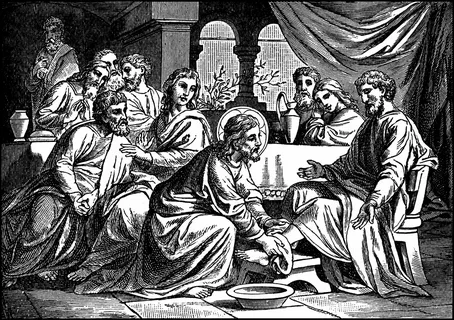
Of the many unexpected things Jesus did in his life, washing his disciples feet has to be up there among the most astonishing. I would add the most uninvented as well. Almost everything Jesus taught and did upended cultural and religious norms. The kingdom he came to bring to earth would be nothing like the kingdoms of this world built on power and force, but because of that it would have the power to transform those kingdoms. That is the point of the prayer he taught us, “Thy kingdom come thy will be done on earth as it is in heaven.” No longer would kingdoms be established and maintained solely by force and violence, but transformed by peaceful means of persuasion and service. This applies not only to geopolitical kingdoms, but anywhere rule is necessary for order and direction, be it a family or business or school, any organization. Direction, leadership, authority, and yes sometimes power displayed as force (e.g., government, military) are required for anything to run in harmony and symmetry, or else there is anarchy and dysfunction.
Jesus’ Foot Washing Object Lesson
Foot washing was not uncommon in the ancient world because people walked on dirt roads in sandals everywhere they went. Often it was used as a sign of hospitality when coming into someone’s home, but it was servants or slaves who did the foot washing. Never would someone of superior social status ever wash an inferior’s feet. That would have been, literally, inconceivable, as in nobody could imagine such a thing—Until Jesus did it. You can see this in the response of impetuous Peter when he sees Jesus begin to prepare the basin of water and start washing the other disciples feet. He is incredulous:
6 He came to Simon Peter, who said to him, “Lord, are you going to wash my feet?”
7 Jesus replied, “You do not realize now what I am doing, but later you will understand.”
8 “No,” said Peter, “you shall never wash my feet.”
Jesus answered, “Unless I wash you, you have no part with me.”
9 “Then, Lord,” Simon Peter replied, “not just my feet but my hands and my head as well!”
You gotta love Peter, so honest, and so wrong. Jesus gently rebukes him, and typical of Peter, he goes to the other extreme. Jesus replies that those who have had a bath, only need their feet washed. That meant something in the ancient context when baths and water were hard to come by, but in redemptive-historical context it is positively elegant. I read it as those belonging to Christ are justified, and as we walk along the sinfully dusty streets in a fallen world, we just need our feet cleansed with the water of sanctification. As Paul tells us in I Corinthians 1:30, Jesus is for us both our justification and sanctification.
Jesus, as he often did, is teaching through object lessons. He asks them if they understand what he’s done for them. It was a rhetorical question because he knew they were clueless, as they always seemed to be. Then he tells them:
13 “You call me ‘Teacher’ and ‘Lord,’ and rightly so, for that is what I am. 14 Now that I, your Lord and Teacher, have washed your feet, you also should wash one another’s feet. 15 I have set you an example that you should do as I have done for you. 16 Very truly I tell you, no servant is greater than his master, nor is a messenger greater than the one who sent him. 17 Now that you know these things, you will be blessed if you do them.
We’ll remember how the disciples argued among themselves who was the greatest, so Jesus figured they needed one final lesson in humility, and one they could never forget.
Why We Can Serve Others
What prompted me to write about this event was how Jesus prefaced his lesson. John tells us:
3 Jesus knew that the Father had put all things under his power, and that he had come from God and was returning to God; 4 so he got up from the meal, took off his outer clothing, and wrapped a towel around his waist. 5 After that, he poured water into a basin and began to wash his disciples’ feet, drying them with the towel that was wrapped around him.
It struck me that the reason Jesus was willing to act and be viewed as a lowly servant was because he knew who he was. Not only was he equal with God, what his enemies accused him of, he was God! And here he is doing something only a servant or slave would do. Jesus was giving us a glimpse into what it means to bring the kingdom of God or heaven into this fallen world. I will explore that more below. The point isn’t washing feet, although in the ancient world serving others may have taken that form, but serving others in general, and why we can do it. It is not just because we saw Jesus do it as our example—it’s much deeper than that.
This passage has profound theological meaning if we understand the radical nature of the gospel, what it says about us, and what it means for us. The gospel first transforms our heart from God-hating stone to God-loving flesh. Then by the power of the Holy Spirit transforms us so we can in turn transform our world. Jesus accomplished redemption for his people and the world, and at Pentecost the Holy Spirit began to apply it. The beginning of redemption starts in Genesis 3. Because of the fall, the serpent, Satan, the devil, will strike the heel of the woman’s seed (Christ and his church, his people), but Christ will strike the serpent’s head where real damage can take place. As we see the history of redemption wind its way through the Bible, we begin to understand the utterly tragic nature of sin, and the horrific consequences it leaves in its wake. We are sinners, guilty, justifiably condemned sinners. We are by nature enemies of God, in fact God haters. He died for us, so we can and must die for others—as I said, radical. But as Jesus said, only in dying to ourselves for him will we find true life.
How the Gospel Helps us Serve Others
What has this to do with serving others? Until we know that we are truly dreadful sinners, and that there is nothing good in us worthy of God’s acceptance, will we be able to love others in our service to them. But first we must understand who we are in Christ as saved sinners. Probably the most important and consequential verse in my Christian life relates directly to this discussion, and I referenced it above. It is in the first letter of Paul to the Corinthians where he is discussing the foolishness of the cross and the wisdom of God. Toward the end he says:
30 It is because of him that you are in Christ Jesus, who has become for us wisdom from God—that is, our righteousness, sanctification, and redemption.
The Him is God, and it is He that chooses us and puts us “in Christ Jesus.” It is God’s wisdom that in His presence He sees us as if we are Christ himself, positionally, justified (righteousness), and becoming in obedience more like Christ (sanctification). The reason this can all happen is because He purchased us in Christ to be forever HIs (redemption). The operative word in all this is obedience. What makes the gospel dynamic is obedience to the greatest commandment, love, which is the fulfillment of the law. As Jesus says, you will know the tree by its fruit. In this case, serving others is not an option, but done in obedience to God, and it is only in obedience to God that he can bless us. Notice how Jesus ends his object lesson: If you follow his example, you will be blessed. The lesson is a key that unlocks the door for Christians to bring the kingdom of God into this fallen world.
Serving Others Changes the World
I am convinced most Christians don’t understand the implications of the Lord’s prayer for the world. We tend to see the spiritual stuff for the church, and the fallen world beyond the scope of redemption, outside of God’s kingdom. I believe that is exactly wrong, but it was something I believed for over four decades of my Christian life. Now I see the entire world, literally, as the object of God’s saving work, not just individuals and their religious lives. The reason Jesus came to earth wasn’t just to save people’s souls, but through the process of transforming them he would bring his kingdom to earth as it is done in heaven, and thus transform the earth as well. That’s how radical the gospel is. When Jesus gave the charge to the eleven to make disciples of all nations, he was serious. And God the Father granted him “all authority in heaven and on earth” to accomplish specifically that. We are not doing this ourselves, brothers and sisters, God in Christ is doing it through us!
That means though the world is fallen, it is not irreparably so. Damaged and broken, it is not beyond repair. The darkness, the sin, the suffering are real, but not the end of the story. The kingdom comes slowly, often imperceptibly, like a mustard seed and leaven, but inevitably because Christ’s righteousness is more powerful than Adam’s sin. The victory of the cross and resurrection is a this world victory first, and only then a next world one. The ultimate transformation will take place when Christ returns, defeats death, and brings heaven down to earth to complete the transformation of his creation. I could write a book on this, and God willing I will, but one passage shows definitively that Christ’s reign and kingdom is not limited to a spiritual other worldly kingdom. In Ephesians 1:15-23, Paul is describing God’s “incomparably great power for us who believe.” This power is so great there is nothing to which it can be compared. I will quote a portion of verse 19 in Greek, the transliteration, and the modern English translation, because only in Greek can the incomparable be conveyed so well:
καὶ τί τὸ ὑπερβάλλον μέγεθος τῆς δυνάμεως αὐτοῦ εἰς ἡμᾶς τοὺς πιστεύοντας
Kai ti to hyperballon megethos tēs dynameōs autou eis hēmas tous pisteuontas
And what is the surpassing greatness of the power of Him toward us those believing
You’ll probably notice three English words we are familiar with that come from the three Greek words in the sentence: hyperbole, mega, and dynamite. The power, the dynamite of what God accomplished in Christ’s resurrection is hyperbolically mega. Words fail in conveying such power, but that’s as close as you’re going to get. Then Paul tells us what this power did:
Which he exerted when he raised Christ from the dead and seated him at his right hand in the heavenly realms, 21 far above all rule and authority, power and dominion, and every name that is invoked, not only in the present age but also in the one to come.
God’s incomparable power did two things: raise Christ and seat him at his right hand, the position of ultimate power and authority in the universe. We rarely mention that it is both of these, or that the present age comes first in Paul’s thinking. And the word Paul uses for exerted is where we get our word energy, in Greek, energeó-ἐνεργέω. This exertion, this energy is done by the same God who created everything out of nothing. That, my friends, is power! It is this same power that transforms us and our world, not us! And what does it take to turn on this energy through us? Washing feet!
Serving others is the magic that makes gospel love flow and compels sinful darkness to flee, and there are infinite numbers of opportunities to serve others every day of our lives. What keeps us from doing this? Augustine and Luther rightly said it is homo incurvatus in se, or sinful man being curved in on himself. Sinful us thinks what we want, what we think, what we do, what we have, what we accomplish, and just plain old we is more important than others. If we really believed others were more important than us, I suggest we would treat them not better than we would treat ourselves, but treat them as we would want to be treated. It’s called the golden rule, and Christ’s resurrection and ascension power is what enables us to do it. Give it a try and you’ll see how it can change your world.
Recent Comments