The Lord Himself is Our Salvation

The Lord Himself is Our Salvation

I’ve concluded over these four plus decades as a Christian talking and listening to many Christians, that no matter what tradition they come from or their theological convictions, they are all Calvinists. What I mean by that is they all realize, every single one of them, they can’t save themselves from their sins; it is God alone who has saved them and is saving them. It’s just too obvious to any honest person who has a real relationship with Christ through the power of the Holy Spirit, that they are sinners, hopeless, pathetic sinners in need of a Savior who actually saves, not a Savior who just makes salvation possible or theoretical. That is Calvinism. There is no need to try to figure out God’s sovereignty and free will. They’re both true and well beyond our ability to comprehend. Every Christian knows, every one of us, that “the Son of Man came to seek and to save the lost,” (Luke 19:10), and that he was given the name Jesus “because he will save his people from their sins” (Matt. 1:21). He will not try, he will.

This has become even more clear to me reading through the Old Testament again, now into Jeremiah. The message God is communicating loud and clear is the inability of God’s people to save themselves, the premise of the entire Calvinist theological system. Over and over God commands, and his people do the opposite. They are pathetic. As I wrote recently, the stories of the people of Israel have to be of God and true because no ancient people make themselves look so horribly bad unless it was true. And before we get all judgmental and feeling superior, those stories are about us! And deep down every true Christian knows it. The reason is because at Pentecost Jesus sent the Holy Spirit to “convict the world concerning sin and righteousness and judgment” (John 16:8). His job is to reveal to us the guilt of our sin and that we can’t save ourselves, that we need a Savior. I’ve never met a true Christian in my life who thinks they are their own Savior. I’m not too concerned about how they think that all works, unless they’re interested in my opinion. I just know if Jesus is their Savior, if they realize they can’t save themselves from their own sin, we’re on the same team.

From the very beginning when God promised the seed or offspring of the woman would crush the serpent’s head (Gen. 3), the plan was for God to save his people from their sins, not make salvation possible for all people. Since He saved me, raised me from the dead when I was at the bottom of the spiritual ocean, I trust His salvation. I couldn’t choose Him, He chose me. Therefore, my confidence is wholly in Him. No matter how wretched I am, I know He has saved me from my sins, all of them, past, present, and future. I am Israel! I like them get to the end of the story in Malachi, and then silence. Until the messenger comes and points to the One, the Lamb of God who takes away the sins of the world.

Isaiah points forward to Jesus as God our Savior in Isaiah 7. The Lord is telling King Ahaz to trust him to save them from their geopolitical enemy, and to ask Him for a sign. Ahaz refuses to “put the Lord to the test,” and the Lord rebukes him saying, alright then, I’ll give you a sign whether you ask for it or not!

14 Therefore the Lord himself will give you a sign: The virgin will conceive and give birth to a son, and will call him Immanuel.

When you read these few verses about this son they seem completely out of place, but God is always interspersing prophetic utterances about a spiritual salvation to come with geopolitical Israel. The name given to this son the virgin conceives means “God with us,” and we now know this was the Messiah Jesus who was God himself in human flesh. Jews would never, ever have interpreted the name that way. The Messiah had God with him, along side him in battle like any king—he would never be God himself. That’s why Jews don’t make up Jesus of Nazareth, the word made flesh.

Then in a brutal passage in Isaiah 63, verses 1-6, the Lord is proclaiming himself coming in judgment “mighty to save.” A salvation of wrath drenched in blood is a very strange salvation, as He says, “the day of vengeance.” That doesn’t make any sense until you realize in Christian hindsight that the spiritual salvation to come includes both judgment, wrath, and righteousness. Here the Lord tells us only He can pull that one off:

I looked, but there was no one to help,
I was appalled that no one gave support;
so my own arm achieved salvation for me,
and my own wrath sustained me.

Notice the past tense. In the eternal sovereign council of the Triune God this salvation has already been accomplished. His prophetic words through His prophets are as good as already done.

Then in Jeremiah 23 we get a glimpse into the full picture of the nature of this salvation when we read of a Righteous Branch. The Lord condemns “the shepherds who are destroying and scattering the sheep of” his pasture, and says He in effect will become their shepherd, of course pointing forward to Jesus, the good shepherd who lays down his life for his sheep. Then we read:

“The days are coming,” declares the Lord,
“when I will raise up for David a righteous Branch,
a King who will reign wisely
and do what is just and right in the land.
In his days Judah will be saved
and Israel will live in safety.
This is the name by which he will be called:
The Lord Our Righteousness.

No Jew could conceive that Yahweh himself would be the atonement, or propitiation, for our sins, even though Isaiah 53 gives a very strong hint of just that. And it isn’t only that he will pay the penalty for our sins, i.e., death, and take God’s wrath for us, but that he will be “our righteousness.” What does that mean?

I heard Tim Killer say many times, Jesus died the death we should have died, and He lived the life we should have lived. Jesus not only died for us, but He also lived for us. Just as our sin was imputed to Christ on the cross, his perfect sinless life was imputed to us as well. This is why the Apostle Paul says in I Corinthians 1:

30 It is because of him that you are in Christ Jesus, who has become for us wisdom from God—that is, our righteousness, sanctification and redemption.

This became the most important verse in my life after more than three decades as a Christian when I finally realized I am Israel! No matter how hard I try, no matter what I do, I can’t pull it off. I fail over and over and over again. I am, I know it’s shocking, a sinner! And being a sinner I sin, also shocking. Sinning is what sinners do. But we are born that way, all of us. Isn’t it obvious? This is what makes “The Lord Our Righteousness” so powerful.

Here is the realization I came to: I can never be more acceptable to God than I am in Christ my righteousness no matter what I do or don’t do. I used to think, sort of, that God would like me a little bit more if I did this or didn’t do that. Nope! And I found that the gratitude that flows out of this grace, this unmerited favor, makes me want to be more righteous! I’m just not very good at it, but I keep trying. So I repent daily, and thank God that I don’t have to save myself.


Nobody Wants to Die, But Nobody Wants to Get Old

Nobody Wants to Die, But Nobody Wants to Get Old

We recently visited relatives and spent some time with my wife’s mother and father who both live in elderly facilities, and also visited my mother who does as well. I don’t know how other people respond to being around a lot of older people, but it depresses me. Seeing people aging and their bodies having to endure the ravages of time is not something I can just blow off, like it has no implications for me and everyone around me. I know, they know, you know, we all know, they will be dead soon, but it’s not a pleasant topic to contemplate, so people, old and young alike ignore it. It’s even less acceptable to discuss openly, and if you do, people will think you morbid or negative.

For me, though, the topic is never far from my mind, and I have a story that is so indicative of that. When our granddaughter was about to be born (Jan. 22, 2022), I told my wife, “Just think, in 2100 she’ll be 78 years old!” And she replied, perfectly, “Can you just let her be born first!” It was hilarious. But as I told my daughter, who knows me very well, as soon as Eleanor was conceived, she was condemned to death. And given she isn’t shocked by my Woody Allen like obsession with death, she shook her head in lamentable agreement. But unlike the atheist Mr. Allen, for those of us who trust in the resurrection of Christ, death for isn’t the end, but only the end of the beginning of blissful life eternal with our Savior and all those who have preceded us in Christ. How do we know this? That’s a big question, but before I get to that, we need to establish that our mortality is something we need to think about all the time. I know, it’s a tough sell, but bear with me.

When I’m around much older people (I’m no spring chicken!), like in a retirement community, I don’t think about people much differently than if I’m in a restaurant in a chic part of Miami Beach, for example, where I’m surrounded by young, good looking “kids” in their 20s or 30s who are in great shape. It’s less depressing and easier to get sucked into the illusion that life isn’t a death sentence in such an environment, but it’s a lie, a bold-faced horrific lie that the devil uses to lead people to hell. I can hear Satan whisper in their ears, “Hey beautiful, hey, handsome, isn’t life great now? No need to worry about what happens after this life, get all you can, eat, drink, and be merry because, well, it’s fun!” I’m convinced most young people, I’d say prior to entering their 40s, are under the illusion that death happens to other people, not them. As Fraud argued, human beings cannot imagine their own deaths. It is, literally, inconceivable to us, unless that is, we are reminded of that fact, over and over and over again.

This widespread illusion in the modern world, or should I say delusion, is a “gift” of the secularism we’ve inherited since the seventeenth century Enlightenment. There have been many deleterious consequences of this movement in Western intellectual thought, but the most pernicious is related to epistemology, or how and what we can know. In our secular culture, thinking about or focusing on anything beyond this life is waste of time because, well, we really can’t know anything about it; we are bound, most people assume, to the physical world. This kind of thinking began to seep into the stream of Western thought with the work of Immanuel Kant (1774-1804). Simply put, Kant stipulated that there are two realms, one called the “noumenal realm,” and the other the “phenomenal realm.” The latter is material reality, the one we can know, while the former is the meta-physical realm (above, outside of the material), and beyond our ability to know. (Here is a great short video of R.C. Sproul describing how Kant paved the way for agnosticism, that we can’t really know, which is the faith choice of our age).

Given we are all drenched in a secularism that programs agnosticism into us from birth, most people figure why bother with that after life stuff; we can’t know it anyway, and it’s all guesses and “faith.” Which is why we need to remind ourselves, all the time, that death can find us at any moment. For example, no matter how well we take care of ourselves, what great shape we’re in, how perfect our bloodwork is, an airplane can fall on our house tomorrow, that’s it, we’re gone. Echoing Isaiah, the Apostle Paul says, “God gives all life and breath and everything else,” and he can take that breath anytime he pleases. So it’s best we approach life in humility and treat it as the precious gift it is, one for Christians that will continue forever, a life without pain, sorrow, sin, sadness or death. Yes, that is as inconceivable to us as our own deaths, but that is why faith (i.e., trust) is required, and there are an infinite number of reasons why this faith is justified.

In a recent post where I laid out some of the reasons that compel me to accept the trustworthiness of Christianity, I assert that “everyone lives by faith, which I define as  trust based on adequate evidence. I trust based on more than adequate evidence to me that Christianity is true.” The question is who and what will we trust. I trust the man who rose from the dead, who claimed he was “the resurrection and the life,” and that whoever believes in him will live even though he die, and whoever lives and believes in him “will never die.” Do you believe this? I do. And Isaiah 25 gives us a glimpse into what this promise will look like when it is fulfilled:

On this mountain the Lord Almighty will prepare
a feast of rich food for all peoples,
a banquet of aged wine—
the best of meats and the finest of wines.
On this mountain he will destroy
the shroud that enfolds all peoples,
the sheet that covers all nations;
    he will swallow up death forever.
The Sovereign Lord will wipe away the tears
from all faces;
he will remove his people’s disgrace
from all the earth.
The Lord has spoken.

In that day they will say,

“Surely this is our God;
we trusted in him, and he saved us.
This is the Lord, we trusted in him;
let us rejoice and be glad in his salvation.”

This is a program even Woody Allen should sign up for: no more death.


Point of View Radio Interview

Point of View Radio Interview

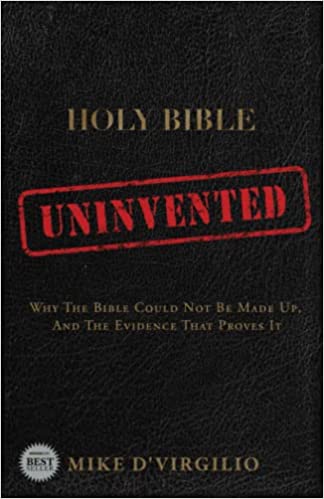
This was my first Uninvented radio interview, and it was a lot of fun. The poor interviewer, the host of the show, Kirby Anderson, butchered my name several times, but each time he said it after a break he got closer and closer, and the final time nailed it! It’s an occupational hazard having a name like D’Virgilio creates, and one I’ve enjoyed dealing with all my life. Like the Amazon review I just posted, having someone I don’t know rave about the book like Kirby does is thrilling, and humbling. I mean, I think it’s pretty good, but having that confirmed by others is a blessing of God. As the Holy Spirit says through King David, wealth and honor come from the Lord.

You can listen here, and I am on in the second hour that starts around minute 45, but there is a lot of good stuff prior to that.

My First Amazon 5-Star Book Review!

My First Amazon 5-Star Book Review!

Not to mention it’s my first written review on Amazon. I had sent the reviewer my book some time ago because he does reviews, and like others I had approached, he agreed to have me send him a book, but made no promises. That was a while ago, and when he finally got to it, he really seemed to like it, as you can see. I was very pleasantly surprised and gratified that someone I don’t know assessed its value just on the merits as they saw it. And he sees a lot of merits!

I am looking for more reviews, and would love them to be 5 stars, but any reviews will do, in case you might be so inclined to help out a poor struggling author. Hopefully, as more new people read it, they will see fit to share their thoughts on the book with others on Amazon, and if you’ve already read it, sharing yours would be very much appreciated as well. Here it is.

Snyder’s Soapbox

This is a great tool for strengthening a believer’s faith in the trustworthiness of the Bible.

Reviewed in the United States 🇺🇸 on March 15, 2023


As many of you know, I determine a book’s value in the individual’s home library primarily on a few factors. First of course, it must be doctrinally sound. Second, its message must be one that is valuable for rereading. Third, it must be an asset to lend out to others to read. I recently read a book titled, “Uninvented” by Mike D’Virgilio. I have several people send me titles they’d like reviewed, but most of them are self-published, poorly edited, and ill thought out. Their theology is usually a hot-soup-sandwich. I was pleasantly surprised by this book. It was none of those things. As a bonus, I can actually recommend it according to the criteria I previously discussed.


The book is an apologetic work in which D’Virgilio argues for the authority, and trustworthiness of the Bible as the actual word of God. He argues that its verisimilitude is potent evidence. Some might call that a circular argument, or an appeal to authority, but those arguments are null if the Bible is actually true. I’ve read other works with some of the same arguments for the trustworthiness of the Bible, but few with as many of them compiled together, and organized in such a way as to lend them to the work of strengthening the believer. If you are a Christian who has run into some arguments that have shaken your faith in the trustworthiness of God’s word, this book is for you. I highly recommend it. It is a brief work, but in its brevity lacks nothing significant for the intended work at hand.

Uninvented: What People Invent History Making Themselves Look Bad?

Uninvented: What People Invent History Making Themselves Look Bad?

I was reminded last week of what a powerful Uninvented argument this is listening to a First Things podcast with Mark Bauerlein interviewing Dennis Prager on his book about Deuteronomy. Prager has written a series of books on the Pentateuch, the first five books of the Bible. Prager says that no ancient people, or modern people for that matter, would consistently make themselves look so bad. Starting around minute 23, he says one reason he believes in the divinity of the Torah is that there is no holy text in the world as critical of its group as the Old Testament is of the Jews. Non-Jews come out looking at least as good as the Jews, and often better. If Jews wrote the text and not God, Prager argues, they would have never depicted themselves so negatively. I could not agree more!

In apologetics this is called the criterion of embarrassment, and it’s all over the Bible, not just the Pentateuch. And it is a compelling argument for the historicity of the text. The idea is if something is embarrassing for what you’re trying to prove, you don’t include that, let alone make it up. I’m no scholar of the ancient world, but from all my studies I’ve learned the Hebrew-Christian record we find in our Bibles is completely unique among all ancient literature for just the reason, among many others. Ancient writers made their people look good. And it isn’t just this contrast that lends credibility to the biblical record. Knowing human nature, who makes up stories for the specific purpose of making themselves and their people look bad? And in this case really, really bad. I would argue human beings do everything they can to make themselves look good! Especially ancient human beings.

One of the reasons Prager’s comments struck me with such force isn’t because it confirmed what I argued in Uninvented, but because I’m reading through Jeremiah. You might remember that Jeremiah is known as “the weeping prophet.” The website Got Questions describes him this way.

Jeremiah was chosen by God before birth to be a prophet to the nation of Judah (Jeremiah 1:4–50). He spoke the words of the Lord during the reigns of Kings Josiah (2 Chronicles 36:1), Jehoiakim (2 Chronicles 36:5), and Zedekiah (2 Kings 24:18–19). Jeremiah grieved over the wickedness of his people and the impending judgment the nation’s sins had provoked. Jeremiah’s warnings went mostly unheeded, and he responded to Judah’s rebellion with tears of mourning (Jeremiah 13:17). Jeremiah has been dubbed “the weeping prophet” because of the often gloomy nature of his message and the grief he expressed for his people.

Gloomy indeed. He also penned the book of Lamentations which fits with his prophetic calling.

Most lay Christians don’t know that because of biblical criticism there has been a veritable world war against the veracity of the Bible for almost 300 years, and that has put Christians on the defensive. Because of the uninvented argument, it doesn’t have to be that way—the burden of proof is not solely on Christians. Skeptics and critics not only believe the bible is made up, merely fiction to one degree or another, but that it would have been easy for ancient Jews to make it up. They could not be more wrong, and we must insist when they make that claim to back it up. They are rarely challenged in this way, and if they are, their only response is assertion, well, it just is. That is not good enough.

The criterion of embarrassment is a formidable argument that adds to the credibility of biblical stories, and why they are very likely uninvented. The examples are practically endless because God is in the habit of never making his people look good. It would be one thing if it was a character here or there, but it’s almost all of them. As you read your way through your Bibles keep this in mind. Those portrayed are terribly flawed humans, and the writers never see the need to paper over their very human flaws no matter where they fit in the history of redemption. I’ll randomly pull out some examples to get you started if you haven’t been reading your Bibles with this in mind.

It is interesting that God himself doesn’t seem to be embarrassed by the world he created perfect and good going to hell in a handbasket in three chapters! Then immediately in the next one we read the story of the cold-blooded murder of Able by his brother Cain. It doesn’t get any better from there, yet God never sees the need to apologize for the mess he supposedly made of the world. For skeptics, the “problem of evil,” is an obstacle to believing the biblical witness is true. None of the biblical writers seem to think so, not one. In fact, Moses writing about the time of Noah says, “Now the earth was corrupt in God’s sight and was full of violence.” He says of Noah, that he “was a righteous man, blameless among the people of his time, and he walked faithfully with God.” After Noah and his family were saved from the flood, Noah got drunk and something very bad happened, although we’re not told exactly what.

Then we get to Abraham and Sarah, and God accredits his faith, or trust, in Him as righteousness, then what do Abraham and Sarah do? They don’t trust God! Ishmael is the result, and all kinds of problems throughout history go back to that sin. Moses, the ultimate prophet, and leader of the Hebrews out of the bondage of slavery in Egypt, comes off like a coward. Then once he leads the people out of Egypt the ungrateful Hebrews almost immediately rebel and worship a golden calf! Because of his sin, Moses doesn’t even make it into the promised land. Who makes up such a story about the greatest hero of their faith? I would argue based on the criterion of embarrassment, nobody!

The Israelites now enter the Promised Land of Canaan, and the narrative doesn’t present as fiction either once they arrive. During this period of approximately 400 years the Israelites were ruled by judges. To say the book of Judges is not a flattering portrait of the people of Israel would be a significant understatement. The theme of the book is found in these passages reiterated several times: “In those days there was no king in Israel; everyone did what was right in his own eyes,” and “The Israelites did evil in the eyes of the Lord.” What is the point of telling readers this? Am I to believe the skeptics who claim with certainty little or any of this is historical? Why record for all time your people are evil unless it was true, and that the history recorded in Judges had some larger purpose in redemptive history? The book ends with a story so shocking and horrific it’s hard to believe it’s in the Bible—an indication that the authors of the Old Testament wrote accurate chronicles of history.

When we get to the kings after David and Solomon, it’s almost all downhill from there. Eventually there’s a civil war, and Israel is split into two kingdoms, ten tribes to the north called Israel, and two tribes to the south, Judah. The prophets we read in our Old Testaments are during this period, and they did not have envious jobs. Nobody applied for that job, and the only plausible reason they spoke truth to power as they did was because in fact, the Lord commanded them to speak. It’s hard to imagine a people making up prophets who make their people look that bad. After the resurrection, we know why.