Russell Moore’s American Evangelical Church Crisis and the Myth of Neutrality

Russell Moore’s American Evangelical Church Crisis and the Myth of Neutrality

If you don’t know who Russell Moore is, you’re not missing much. He used to be a big shot in the Southern Baptist Convention (SBC), and last year became the Editor-in-Chief of Christianity Today. He left the SBC amid some controversy in 2020 and eventually took over at Christianity Today. He’s a Christian, along with people like David French, leftist elite society loves. He writes for The Atlantic, The Washington Post, The New York Times, among other establishment organs of the approved secular cultural and political narratives. To say the least, he is not a fan of the MAGA movement thinking it’s infected the Evangelical church and as he argues has created a crisis for the church. He writes of this “crisis” in a July article in The Atlantic, and since my last two pieces were about “gospel losers,” I figured it would be important to continue the theme of the biblical contrast to such anti-cultural engagement Christianity.

Like the young pastor Poythress in my previous posts, Moore believes in a personal pietistic kind of Christianity, and thinks cultural and political engagement is poison to the true mission of the church. As with other people who think like him, he is good at setting up straw men (a logical fallacy) so he can mow them down. The Christians he criticizes are caricatures in his imagination. He condemns people like me, but what he says I believe is inaccurate and untrue. The straw man strategy is an effective way to get people who already agree with you to agree with you, which is why he writes for leftist publications, and Christianity Today has lamentably become one of those. He doesn’t know any populist-nationalist (MAGA) conservative Christians like me because if he did he couldn’t write pieces like this in good faith. I’m not going to go through the paragraphs like I did in my previous posts, but give a couple examples of his straw men and false choice assertions, and argue for the biblical position. Which, by the way, can be proved without doubt by the history of the church. Here is the very first paragraph:

The No. 1 question that younger evangelicals ask me is how to relate to their parents and mentors who want to talk about culture-war politics and internet conspiracy theories instead of prayer or the Bible. These young people are committed to their Christian faith, but they feel despair and cynicism about the Church’s future. Almost none of them even call themselves “evangelical” anymore, now that the label is confused with political categories.

I will assume he’s being honest here and not using this to simply make a rhetorical point. If it is true, he needs to talk to more young Evangelicals. And beware of anyone who uses the phrase “internet conspiracy theories” to discredit others. We’ve seen the last several years how the globalist deep state elites used this to try to stifle dissent and anything against the accepted “narratives.” You can see in the last sentence he embraces a personalized pietistic faith that shouldn’t get too involved in politics. He asserts a false choice typical of such thinking: it’s either “culture-war politics” or prayer and the Bible. It is not. Here is the most egregious straw many setup:

Some evangelical Christians have confused “revival” with a return to a mythical golden age.

Really? Can you give me some proof of this, Russell? He can’t because they don’t exist except in his imagination. He uses the word nostalgia four times in the piece to make his point, which only makes it weaker. As he says, “The idea of revival as a return to some real or imagined moment of greatness is not just illusory but dangerous.” I wonder how dangerous it really is when nobody actually believes it! I’ll quote two more sentences that show how committed his is to a personalized pietistic Christianity.

Nostalgia—especially of the sort wielded by demagogues and authoritarians—cannot protect religious faith, because it uses religion as a tool for worldly ends, leaving a spiritual void. The Christian Church still needs an organic movement of people reminding the rest of us that there’s hope for personal transformation, for the kind of crisis that leads to grace.

It doesn’t surprise me that Moore accuses those Christians he disagrees with as being “authoritarians.” Since the New Left arose in the 1960s they’ve used the “authoritarian” card to discredit and try to silence Christians who dare bring their faith into the public square. Unlike the leftists, Christians are supposed to leave their faith at home, and apparently Moore agrees with them. This is especially targeted at Christians who want their Christian faith and worldview reflected in how our nation is governed. That he is using leftwing rhetoric to discredit fellow Christians is reprehensible.

Lastly, he says the answer is “a commitment to personal faith and to the authority of the Bible.” He won’t get any argument from me there, but we mean something completely different by “personal faith.” The distinction of what “personal faith” is gets to the nature of the Christian faith and the heart of the issue. Pietism has been a disaster for the church and its influence in Western culture. This movement of 17th century German Lutheranism in due course influenced Evangelical Christianity in a way that divorced faith from life beyond the Christian’s personal piety. In other words, personal holiness and devotion, prayer, Bible study, church, etc. are such a priority that everything else pales in comparison. As you can see from Moore, even being concerned, or engaged in things like politics or “culture wars” distorts Christianity from what he thinks is its true purpose, personal transformation. The problem with this view is that it is not only not biblical, but an extreme distortion of the gospel. Cultural influence at every level, including politics, is baked into the gospel cake.

Christians in the first centuries of the church declaring “Jesus is Lord” was a loaded political statement. Unlike modern pietistic Christians, the ancient church knew there was no such thing as a “neutral” society. Someone had to be Lord, and it would be either Caesar or Christ. Many of these early Christians gave their lives because they understood the Christian faith was not at all just personal, but had ramifications for all of life. It wouldn’t be until the rise of the Enlightenment in the 17th century that secularism began its attack on Christian Western civilization which by the 20th century introduced the concept of neutrality, or as it is rightly called, the myth of neutrality. That Christians bought into, and still do, this myth has been a disaster for Christian cultural influence in the West over that last sixty plus years. Secularism reigns in our day, and because it does Christians who venture into the public square declaring God’s law and word as applicable to everything are attacked as “authoritarians,” among other epithets. As long as we accept our place at the pluralistic table and keep our faith respectfully private, we can occasionally scrape up some cultural crumbs to keep us happy. Russell Moore obviously agrees with the secularists.    

Jesus clearly said (Matt. 28:16-20) because he was given all authority that we are to go and make disciples of all nations, baptizing and teaching them to obey everything he commanded. This is also the same Jesus who said we are to live on every word that comes from the mouth of God (Matt. 4), and who declared that the entire Old Testament was about him (Luke 24). From the moment God called Abram out of Ur to make for himself a people (Gen. 12), the faith of His people had radical implications for all of life, both personal and societal. How could it not! Human beings live in communities, live as peoples, as nations, and some worldview, some ultimate source will be authoritative. In the West, which includes most of the world today, that source is either God in Christ revealed in His Word, or man. There is no in between, as badly as Russell Moore wants to think there is.

 

Gospel Losers: Teaching Christians How to Lose, Part 2

Gospel Losers: Teaching Christians How to Lose, Part 2

In my last post I vented about the badness of this piece by a young pastor, Justin N. Poythress: “How Evangelicals Lose Will Make All the Difference.” There was too much badness for just one post, so I continue here. His last section is titled, “Better Way,” so let’s see exactly what this way entails. He starts with a doozy:

Jesus tells his followers to take up their crosses, not their crowns (Matt. 16:24–26).

Indeed he does, but what has that to do with crowns, you ask? The young Pastor Poythress creates a false choice. If Jesus calls his followers to suffer in some way, then crowns, or winning, is somehow at odds with the suffering we are called to in Christ. But as I said in the previous post, suffering can take many different forms for the Christian. In fact, we suffer in a myriad of ways every day, psychologically, emotionally, at times physically. This is what I call the pain of sanctification. Sadly there are some Christians called to physical suffering for proclaiming their faith, as is the case in many places around the world today. That doesn’t mean, however, that such suffering is inevitable or the only calling of the Christian. Far from it. Here is the perspective of our Lord and Savior who sits at the right hand of the Father when he gave his followers what we call the Great Commission:

All authority in heaven and on earth has been given to me. 19 Therefore go and make disciples of all nations, baptizing them in the name of the Father and of the Son and of the Holy Spirit, 20 and teaching them to obey everything I have commanded you. And surely I am with you always, to the very end of the age.

Notice what comes before “Therefore.” We only go and make disciples of “all nations” because Jesus has been given “all authority in heaven and on earth.” What’s the point of Jesus saying he’s been given this authority if he’s sending out his disciples to lose? Did he intend when he said this that his disciples, those trained and instructed as his followers, could not win?  And as I often proclaim, Jesus didn’t say to make disciples of all people, of all individuals, but all nations, in the Greek ethnos-ἔθνος. Does the Christian influence coming from “teaching them to obey everything” he commanded them not apply to politics and issues of culture? To issues of the so called “culture war”? This was a war, by the way, we did not start. Do these questions not answer themselves? Is it not obvious? (Read Psalm 2 and Eph. 1:15-23 in case you’re not sure.)

Then following his crosses, not crowns declaration he states:

Though our faith may be increasingly marginalized and devalued in the West, losing cultural battles with grace, dignity, and love can persuasively display Christ’s cruciform beauty. Conversely, there’s nothing persuasive about chasing the perks of power.

What exactly is “cruciform beauty”? The word simply means in the shape of a cross. The problem with this statement is that it’s absurd. I know what he means, the Isaiah 53 sacrifice of the Messiah, Jesus of Nazareth, for our sin and reconciliation to our Creator. That is indeed beautiful. However, there is nothing beautiful about a cross. It was the most ugly, horrific, means of torture and death ever devised by sinful man. The cross is only part of the story. The other parts are Jesus’ life lived in perfect obedience to God making him able to grant us his very own righteousness (Rom. 3), his resurrection, victory over death itself, and most importantly, his ascension to be seated at the right hand of the Lord God Almighty. He earned the right to sit there and reign over all of creation, visible and invisible, to advance his kingdom on earth, to reverse the fall if you will, and build his church, conquering all his enemies until the final one is defeated, death (I Cor. 15:25).

Notice also there is supposedly something dirty about “power,” and the “perks” it conveys. It reminds me of certain legalistic Christians who think sex is “dirty.” Power like sex is a natural part of life, and everything depends on what we do with it. He seems to think if we’re seeking “power” we’re doing something inherently wrong, as he says:

Suffering because you’re harmful or obnoxious isn’t Christian faithfulness. Worse, desperately clutching for the instruments of power or elbowing to get a seat at the table sacrifices Christ’s cause to chaos.

Who exactly are these “harmful or obnoxious” people? Jerks on the Internet? And clearly this power he’s obsessed with is a dirty business and in no way has anything to do with Christ’s cause. I would say this is naïve, but it’s worse than that. He completely lacks wisdom about the nature of reality and sinful man, and life lived in societies full of fallen people.

Aristotle in his Politics said that man is a political animal because we live in communities and seek certain ends of our own good, and this can’t happen without power; the process of deciding what is allowed or not, and the means to enforce it. Simply, politics is the distribution of power, and Christians throughout all of history were intimately involved in it and didn’t think of it as beneath them.

Poythress gets to the heart of what makes his understanding so problematic.

This doesn’t mean Christian political savvy is thrown aside while we lie down and float away with the cultural tide. It does mean American evangelicals have a golden opportunity, even in years when it seems the sun is setting on our influence, to prove our hope is vested beyond the material and visible. We can chart for the next generation a trail of faithfulness that avoids bitter and reclusive cultural withdrawal on the one hand and vengeful scorched-earth behavior on the other.

This is typical of third wayism as if our choices are extreme withdrawal or behavior, or some middle way. To Poythress here is the “Better Way”:

As faithful evangelicals, we advocate for God’s ways and encourage our neighbors to follow them while leaving the results to God.

He assumes fighting for Christianity and truth in the public square means we’re not leaving the results to God. This is the typically condescending perspective of Christians who think they’re above it all. He seems to forget God uses people to accomplish things in this world even though ultimate results are always up to Him.

This mentality is an example of a typical artificial duality in overly spiritualized Christians. Joe Boot explains the problem in his little pamphlet For Mission:

[This] is an implicit and destructive duality that slices up reality into matter and spirit, nature and grace, secular and sacred, naturel and supernatural, time and eternity, higher and lower, with one area perceived as lesser or evil and the other as higher or good. This tendency has resulted in a radical separation of creation and redemption (where redemption is essentially for the higher story of existence), spiritual life and historical-cultural development and mutually reinforcing pattern of subservience to non-Christian culture/nature/secular on the one hand, and the abandonment of Christian culture-building (grace/sacred) on the other.

Boot calls this Churchianity, or those Christians who are “at best disinterested in Christ’s manifest Lordship over any other sphere of life or institution, and at worse are hostile to it.” Francis Schaeffer was warning Christians about this faulty understanding of Christianity back in the 1960s and 70s before the West had become completely secularized. He spoke out against such a dangerous duality that would completely impoverish Christianity’s influence in culture. Too many Christians ignored his warnings  and secularism, along with all its horrors, has won the day. It doesn’t have to be this way.


Gospel Losers: Teaching Christians How to Lose

Gospel Losers: Teaching Christians How to Lose

When I read the title of this peace I knew reading it would not be good for my blood pressure: “How Evangelicals Lose Will Make All the Difference.” And it was worse than I thought. That it was on the Gospel Coalition website surprised me not at all. There are so many logical fallacies and theological misunderstandings in it that it’s almost impressive. Let me take them one by one and see how far I get. The sheer badness of it may require more than one post.

Before I get there, that something like this can be written and believed by a large contingent of Evangelical Christians is depressing. I’m convinced part of the reason people think this way, and think it’s the biblical way to think, is because of faulty eschatology, but that’s not all of it. There are many dispensational premillennialist Pentecostal Christians I have more in common with in this regard than my Reformed brethren, and to say the least I do not agree with their eschatology. Most Christians believe losing “down here” is baked into the gospel cake. They are convinced suffering and loss of cultural influence are the only and inevitable hallmarks of the Christian life. They are not! Taking up our cross and following Jesus doesn’t mean Christians are called to being thrown to the lions or burned at the stake. We know that suffering and dying to ourselves takes many forms, and none of it is pleasant. Let’s see what our young pastor, Justin N. Poythress, thinks.

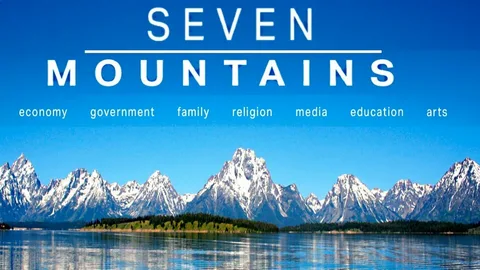
He is addressing something called “The Seven Mountain Mandate.” Some Christians believe a passage in Revelation is a call “to retake seven spheres (or mountains) of cultural influence: religion, family, government, education, media, arts/entertainment, and business.” Well, yeah, the Christian worldview addresses everything in life, including these broad areas, and more. Jesus in the Great Commission said his followers were to disciple nations. That has implications for all these things, and more. I’ll start with this: 

The perspective is ultimately built on a dual misunderstanding of Scripture and of Christ’s purposes in the world. 

Those are some pretty big things to misunderstand! Here is what he believes the Seven Mountain Mandate misses in the passage in Revelation:

The passage was intended as a picture of the spiritual battle waged through all history until Christ returns. It was intended to give Christians hope amid their suffering and cultural loss.

Well yes, it was. The Christians to whom the Apostle John was writing were often being perThe passage was intended as a picture of the spiritual battle waged through all history until Christ returns. It was intended to give Christians hope amid their suffering and cultural loss. secuted violently, some giving their lives for the gospel. But are all Christians in all geopolitical and cultural situations throughout history facing the same kind of persecutions? Is Poythress saying that’s just the inevitable lot for Christians and there is nothing we can do about it but learn to “lose gracefully”? And notice he does something typical of such thinking, he spiritualizes it. Christianity supposedly applies primarily to “spiritual” things, not the mundane issues of life lived in culture.

He then commits a colossal non sequitur (the conclusion doesn’t follow from the premise), among many in this short piece. However one interprets the passage in Revelation he asserts:

the conquering warrior is always the crucified Christ, not a sword-swinging church. 

It does not follow that just because the crucified Christ is indeed the conquering warrior, that the church can’t be swinging swords. We’re just supposed to sit back and take it? I guess, be nice and loving and not fight for truth or justice or righteousness or the honor of God? What does this even mean? He says after this:

Even if you’ve never heard of the 7M mandate (and its strange reading of Revelation), it can still be tempting to think Christ’s kingdom grows by “winning” cultural power and influence. If this is where we place our hope, it’ll be hard to stomach the losses.

This is a perfect example of his sloppy thinking. To his mind “winning” cultural power and influence is antithetical to Christ’s kingdom. Somehow Christians living out Kingdom values found throughout the gospels are not supposed to have “cultural power and influence.” Really? How was it that the Roman Empire eventually fell to the “cultural power and influence” of Christianity? Was that a mistake? Unbiblical? Something God never intended when he came to earth in the person of Christ? Why then did Jesus teach us to pray, “Thy kingdom come, thy will be done on earth as it is in heaven”? Maybe because God wanted us to bring the influence of heaven into the cultures in which we live? Just maybe? In fact, the very nature of God’s kingdom, the kingdom of heaven is to bring it “down” to earth, and when it grows it will always gain “cultural power and influence.” How can it not! You wonder how he and those who think like him interpret the parables of the mustard seed and leaven in Matthew 13. It sure seems that Jesus is saying that the influence of the kingdom of heaven grows inevitably and inexorably, and it cannot help but have influence in cultures.

The next sentence is even worse. Because we desire the gospel to influence the culture and have “cultural power” therefore we’re placing our hope in that and not Christ? Really? We can’t want Christ to be glorified and obeyed in the societies in which we live? That’s not Christian? Frankly, that’s insulting. Then he asserts we need to be concerned with how we are seen by the culture:

Evangelicals increasingly run the risk of being seen as sore losers in the culture war. Our inability to let go, to relinquish positions of public prominence and power, reveals a misplaced faith. Too often, we’ve entangled Jesus’s name with a political agenda, as mainline Christians did when they made the church into little more than a social club for liberal activism.

Oh my. I could do an entire post just about this! So it follows that if we want “cultural power and influence” and we have a tough time of it we’ll be sore losers? We’re supposed to glory in our losing? Really? He must think we aren’t aware that we live in a fallen world among fallen people in a fallen body. Losing and overcoming, and losing again, and overcoming, and losing again, and overcoming is called life! Personally or culturally. 

I wonder if the Apostles and the first generation of disciples cared about how they were “seen” by the Jews and Pagans of Rome. And the gospel calls us to “relinquish positions of public prominence and power”? Really? What kind of doormat theology is this! And he has the gall to compare those Christians, like me, who think our Christianity compels us to a certain political agenda to the liberal Christians of the early 20th century? Really? As you can tell, the old Italian blood gets boiling when I read such calumnies. For you youngsters, that word means insults. And everything about that paragraphs reeks of self-righteousness. He and his ilk think they are above such mundane matters as “the culture war.” I guess as I said above, fighting for truth or justice or righteousness or the honor of God is “misplaced faith.”

I’ve written here about Tim Keller’s unfortunate creating of a moral equivalence between left and right. I’ve heard this called “third wayism,” as if there is some middle way, a more gospel way, between the radical left and the radical right, as Keller said. In our day, there is no “radical right.” And everyone on the left, including most Democrat politicians, and the entire legacy media, are Marxists, thus by definition “radical.” The “culture wars” were started by the left against the right (conservatives) in the 1960s, and we decided to fight back. Now Christians like the young pastor Poythress want us to roll over and play dead because fighting back is “misplaced faith”? Apparently. 

There is much more fodder in the rest of the piece, so I’ll have to do that in another post.


Uganda Homosexuality Law Part 2

Uganda Homosexuality Law Part 2

In my previous post, using Uganda’s new anti-homosexuality law, I argued that Scripture is a legitimate source of authority for nations, that God’s law and rule (theonomy and theocracy) are something Christians should argue for in the public square, specifically regarding a nation’s laws. Everyone is religious; there is no such thing as an unbeliever, and the basis of any nation’s laws come from its fundamental religious (i.e., faith) commitments. As I argued, secular neutrality is a myth. All law comes from somewhere. Ignorant and unthinking people will say, “You can’t legislate morality,” when law is exactly that, legislated morality! So for Christians to say we can’t as Christians use Scripture as a basis for the laws of America is not only un-Scriptural, but self-defeating. It’s like going to fight a war but giving your most powerful and effective weapons to the enemy. Good luck! But it is critically important we realize in the culture wars in which we are engaged, that we are not in any way limited to Scripture in these battles. We have a powerful arsenal that complements Scripture. First is God’s created reality that corresponds to Scripture, and we have the One who made both, our Savior and God who sits at the right hand of the Almighty “far above all rule and authority, power and dominion, and every name that is invoked” (Eph. 1).

I critiqued an article by someone who wrote a piece at American Reformer about the Ugandan law, and I was critical because he stated it wasn’t established “from Scripture, let alone for theonomic or theocratic reasons.” He further contended the law was “an imminently reasonable position compatible with Christian doctrine and ethics, but knowable apart from divine revelation.” The implied assumption is that divine revelation isn’t necessary for such a law to be passed. How else would people know homosexuality is wrong, immoral, and destructive of a flourishing society? The author claims it is “reason, nature, and tradition.” The problem with such an argument is that it is only because of Scripture, verbal revelation of God’s being and will, that “reason, nature, and tradition” tell us homosexuality is immoral and destructive. The ancient Greeks, of whom we Westerners are quite fond, had “reason, nature, and tradition” as well, but not Scripture, and they thought homosexuality was just fine, not immoral in the least. For example, according to Wikipedia:

Pederasty in ancient Greece was a socially acknowledged romantic relationship between an older male (the erastes) and a younger male (the eromenos) usually in his teens.

Kinda blows the whole “reason, nature, and tradition” argument out the door doesn’t it. Why didn’t the ancient Greeks treat homosexuality like the Ancient Hebrews? Scripture! God’s divine verbal revelation. God used words to communicate how his creatures, who also use words, should live so they can experience maximal blessing and flourishing in life. Homosexual activity mitigates against that. God would not have put warnings against homosexuality in his law if it were otherwise.

Contrary to popular opinion, and our natural sinful hearts, God is not a cosmic killjoy. That was Satan’s lie to Eve, and she bought it. All the horror in life goes back to that fundamental lie that we cannot trust God’s character. God didn’t warn us against homosexuality because he didn’t want people attracted to others of the same sex not to have fun or experience romance. He did it because that lifestyle doesn’t lead to true human happiness and flourishing, but misery and unhappiness. Are there happy homosexuals? Of course, but exceptions never disprove rules. And on a societal level the acceptance of homosexuality contributes to the deterioration of the family, as is readily apparent in America. If a homosexual drenched America is such a happy place, why did almost 50,000 people die by their own hands last year? Because America has thrown God’s law under the bus. Rampant sex outside of marriage leads to the dissolution of the family. Dysfunctional families then lead to dysfunctional societies and eventually widespread despair. Human happiness and flourishing is the reason God says sex is only moral and good and blessed inside a marriage between a man and a woman.

As I said above, though, as Christians we are not limited to Scripture when we come to the public square. We must bring Scripture to the debate and never shy away from it, but we also have things compatible with Scripture confirming it: “reason, nature, and tradition.” Christians are not to be Biblicists, meaning we think Scripture is our only source of authority. It is our ultimate and final source, but God hasn’t limited his revelation to just the Bible, but to creation as well. As the Apostle Paul says (Rom. 1:20),

For since the creation of the world God’s invisible qualities—his eternal power and divine nature—have been clearly seen, being understood from what has been made, so they are without excuse.

The “they” Paul is referring to is all of us, every single human being. And note Paul’s assertion, that this revelation of God’s invisible qualities, who He is, is “clearly seen.” It cannot be mistaken for anything else than what it is, a manifestation of God’s “eternal power and divine nature” no matter how much people deny that. Prior to this Paul says people suppress the truth because of their wickedness, meaning they love their sin so much they’ll gladly delude and lie to themselves and believe their lies as if they were true. Thus we passed homosexuality a while ago now, and the lie de jure is that biological sex is not hardwired and can be changed any old time we feel like it. So to the “enlightened” among us, boys can become girls and girls can become boys, and men and women are not fundamentally different. The thing about truth, though, is that it can only be suppressed for so long then the lies start being exposed for what they are, lies.

We are in a wonderful time in history filled with opportunities because the lies are becoming so obvious even people who are not religious or political (“normies”) now realize it. What they don’t realize, however, is that the normalization of homosexuality over the last 40 years has led us to the point where the newest Supreme Court justice doesn’t know what a woman is. Think about that! Reason and nature (creation) tell us exactly what the Bible does about human sexuality. It’s obvious to anyone not previously indoctrinated that each part of the human body has a telos, a purpose, an end for which it was designed. Specific parts are clearly meant for sexual pleasure and procreation, and other parts are not. I won’t belabor the obvious, but when we live according to God’s design in creation, blessings follow, but when we flout them trouble and misery inevitably will. Reason also tells us when we look at all the sociological data over the last 50 years (ignorance is no longer excusable), intact families, husband, wife, kids, are by far the best environment for raising children into emotionally and psychologically healthy functioning adults. Today, sadly, most children grow up without a married mother and father, and we wonder why things are so screwed up. 

We must always remember, everything God commands is for His creatures to flourish as His creatures in His world, contrary to 300 plus years of Enlightenment lies carried into secular lies that morphed into liberal, Marxist, progressive, and leftist lies. This false narrative is well ensconced in the average person’s mind and they believe it. Sadly many Christians buy into it and hurl theocracy around as an epithet. For all of them, if Christians have too much say, too much political power, the country will turn into a version of The Handmaid’s Tale, a book about a Christian fundamentalist theocratic America which was sadly turned into hit show on Hulu. It’s those kind of lies and false narratives that we fight.

Is Uganda’s Anti-Homosexuality Law Christian? Is Theonomy?

Is Uganda’s Anti-Homosexuality Law Christian? Is Theonomy?

According to Christianity Today and Russel Moore it most certainly is not! Moore used to be the President of the Ethics & Religious Liberty Commission of the SBC and left there to become Christianity Today’s Editor in Chief last year. He also writes for left-wing publications like the Washington Post, The New York Times, Atlantic Magazine, and can be seen as a commentator on left wing cable outlets like MSNBC and CNN. So I wasn’t surprised he wasn’t a fan of a country banning homosexual activity via law. Many Christians, unfortunately, find such a thing positively abhorrent. It’s not easy to find commentary defending it, but I found one at LifeSite News, and there are others if you look. I don’t want to debate that here. Overall from a Christian perspective of course it’s a good thing, even if I might not agree with everything in the law. Christians, along with every other person in the Western world has been so indoctrinated in the pro-homosexuality agenda that even to question whether it should be legally allowed in society is beyond the pale. Positively un-Christian! And Uganda is now persona non grata among the “enlightened” nations of the world.

What I want to address here is God’s law and the secular myth of neutrality. I saw another piece about this at American Reformer with the title, “Why Russell Moore is Wrong About Uganda.” Knowing Moore has become a welcome guest in polite (leftist) society as the house “conservative Christian” drew me to that piece like a fly to light. The problem with the author’s disagreement with Moore is that it assumes as Moore does this secular myth:

Nowhere does the Ugandan Act argue against homosexuality from Scripture, let alone for theonomic or theocratic reasons. Moore has imposed this framework upon the issue because he determined beforehand it was wrong and had to find a pious and “biblical” reason for his Philippic. Instead, the Anti-Homosexuality Act argues from reason, nature, and tradition: it seeks to protect the Ugandan family from “internal and external threats”; it wants to preserve the “cherished culture” and the “legal, religious, and traditional family values” of the Ugandan people; and it wants to combat the “values of sexual promiscuity” being imposed upon them in order to protect “children and youth” who are “vulnerable to sexual abuse through homosexuality and related acts.” This is an imminently reasonable position compatible with Christian doctrine and ethics, but knowable apart from divine revelation. Any adult human who has not yet been indoctrinated into the Gay Cult should be able to understand these things.

The author, who goes by a pseudonym, argues for, or implies that basing a nation’s laws on Scripture is illegitimate. To him, something that is “theonomic or theocratic” is even more off limits than Scripture. What exactly do those two words mean? God’s law and God’s rule. Seems strange for a Christian to argue that Scripture and God’s law, His rule, is not a legitimate source for creating the legal code of a society. What is? According to the author, “Reason, nature, and tradition.” So, as Christians we’re supposed to set aside Scripture and God’s law and rule when we debate and legislate laws in society? Talk about fighting with one arm behind your back!

Most Christians in America today buy into the secular myth of neutrality, a metaphorically naked public square. The idea is that religion doesn’t have a legitimate, forbid an authoritative, role to play in public life, specifically government and law. Neutral comes from the Latin “neuter” meaning “neither one nor the other,” so it’s come to mean unbiased which it most certainly is not. In this illusory “neutral” place, secularism is the unbiased referee calling balls and strikes without that pesky Christianity getting involved and inevitably leading to theocracy and intolerance, and thus violence. Specifically verboten is citing Scripture as an authoritative source. If a Christian dares do such a thing, or God forbid, pun intended, a country like Uganda, cries of “theocracy,” Spanish Inquisitions, and Salem witch trials are soon to follow.

Christians must realize a religiously or morally neutral nation cannot exist, yet people like Russel Moore and the author at American Reformer believe it does. For the latter neutral sounding ideas like “Reason, nature, and tradition” are legitimate appeals in the public square or regarding the laws of a nation, but not Scripture or God’s law or rule. As he says, what is a legitimate appeal is whatever is “knowable apart from divine revelation.” Think about it. Here is a Christian telling us “divine revelation” is off limits when we’re arguing for what the laws of a nation should be. To me this is positively shocking. Yet most Christians who write and think about these things, including Evangelical “leaders” and most pastors, agree with him. The secular myth of neutrality has neutered them. Think about that as well. The word neutered comes from the same root as neutrality and can mean castrated. That’s what the church has done to itself in the modern age. The Christian church is a eunuch in Western culture! Powerless to make any real, substantive impact. No wonder everything is a disaster and a secular mess. When you take the salt and light out of a culture what do you get? Out of its government and its laws? We’re living in it.

Vishal Mangalwadi in his wonderful book, The Book That Made Your World: How the Bible Created the Soul of Western Civilization states an obvious truth too many Christians miss:

Every civilization is tied together by a final source of authority that gives meaning and ultimate intellectual, moral, and social justification to its culture.

Secular neutrality isn’t neutral because it can only have man as the “final source of authority,” and if it is man then it is not God. It’s one or the other. Francis Schaeffer wrote a book in 1981 that should be required reading for all Christians in the 21st century, A Christian Manifesto. In the first chapter he says our worldview determines what this “final source of authority” is, and in the West there are only two options. As he says, “these two worldviews are two total concepts of reality standing in antithesis to each other.” These two “total concepts” are diametrically opposed to one another and they inevitably produce different results. This was obvious in 1981, but it is indisputable now. We are living with the deadly fruit of secularism, and Christians are contributing to it.

The secular, although he doesn’t use that word, is “the idea that the final reality is impersonal matter or energy shaped into its present form by impersonal chance.” Those who embrace this view tell us we can’t bring our “religion” to bear upon issues of public policy. The Bible as a source or authority is not allowed, and Russel Moore and many Christian leaders agree. It’s no wonder the church in America is powerless when it comes to influencing the culture—it has mostly accepted the secular culture’s assumptions. That’s not good. As Christians we look around and bemoan how bad things are, but at the same time refuse to shamelessly declare God’s Word as the ultimate source of authority for all things, including our government and it’s laws.

Thank God for Uganda and it’s leaders who are willing to stand fast in the face of the criticism of the secularist woke globalist mob. They refuse to be intimated because divine revelation in Scripture is their north star, their final source of authority for the flourishing of their nation. It is supremely ironic that Africa which was not too long ago completely pagan and God-less is leading the way to advance God’s kingdom in the face of opposition from what was once the Christian West.


Christianity is Now Hate and Bigotry, and the Hope that Brings

Christianity is Now Hate and Bigotry, and the Hope that Brings

In case you weren’t aware of it, if you’re a conservative Christian, believe the Bible is God’s actual word of revelation to mankind and the truth about human sexuality, you’re a bigot filled with hatred for “sexual minorities.” Yes, no better than any garden variety racist. No better than the Klu Klux Klan burning crosses in your black neighbor’s yard. I’m sure this is not news to anybody. But among our cultural “elite” and the lunatic left (those currently running the United States government, all the organs of culture and corporate America) it is commonly accepted. The word Christian slips off their lips with a condescending smear, and to them we are second-class citizens in our supposedly enlightened queer nation. Leftists (what almost all liberals have become) started out playing the victims. Then they asked for tolerance, and got tolerance. Next they demanded acceptance, and got acceptance. Finally, they demanded celebration, and those who refuse to celebrate will be made to pay by the alphabet mafia. Welcome to 2023 America! And what a grand place it is.

I saw this clearly coming during the runup to some unelected judges in black robes on the highest court in the land re-defining marriage in 2015. A large section of the less diplomatic and careful left branded those who didn’t support gay “marriage” as bigots and haters. Those pushing this perversion of marriage at a legal and PR level on an ambivalent population we’re much more careful. They told blatant lies sweetened with honey that went down easily with the unsuspecting and ignorant. It’s all about tolerance, just letting homosexuals have the same rights as heterosexuals. How could anybody be against that? The more prescient knew it could never stop there, and once marriage was redefined and homosexuality completely normalized, the transgender insanity circa 2023 was inevitable.

I was reminded of this unpleasant reality not only because it’s so called “pride month” (which God says goes before destruction) and daily shoved in our faces, but also because I read this article about a women who was a big name in Hollywood, thus appropriately left wing most of her life, and who became a conservative and Christian and now “has her friends mystified.” That’s almost funny, and speaks to how insular the woke left is. They live in an echo chamber only ever encountering people exactly like them and dismiss as unworthy ideas they disagree with. Such people are also deeply self-righteous and judgmental. Anyone who doesn’t think like them is unclean and unworthy of respect. Conservative Christians are modern lepers to them, and it is such people who hold almost all positions of cultural and government power in America today.

All of this is stunning, but completely unsurprising to anyone who knows the history of Enlightenment rationalism that in due course rid the world of God and His word. Once that started happening it led inexorably to the suffocating secularism of the modern world with the help of Kant, Hegel, Marx, Darwin, Nietzsche, Freud, et al. The 20th century gave us progressivism, cultural Marxism a la the Frankfurt School, “the 60s” and the sexual revolution, so called, radical feminism, no fault divorce, and eventually it had to get to homosexuality and their “rights.” Marx’s two primary goals of perpetual revolution and his communist Utopia was to be realized by the destruction of the family and religion, i.e., Christianity. The woke left in our day, the cultural Marxists, are his progeny, and even though he would be surprised the economic version of Marxism he predicted failed, he would be pleased as punch at the cultural version that hasn’t. It’s creating all the chaos, confusion, suffering, pain, and misery he could have ever hoped for, the conditions for communism’s perpetual revolution.

The article I mentioned above is definitely worth reading because it’s instructive of just how deeply ingrained this pathology is on the secular left, and it is important to realize the threat they pose to everything that is godly, good, and right. The goal of their push for sexual perversion, and that includes any sex outside of a married man and woman, and erasing biological sex, is and always has been the destruction of the family. You can look at the writings of leftists since the 1930s and it’s all there. The difference today is that all vestiges of Christian leaven that once made Western civilization flourish and prosper and held back wickedness are gone. In addition, we have a generation of leftists in cultural and political power today who are effectively woke zombies who can’t help themselves. They are compelled by generations of very effective brainwashing to silence or destroy any who get in the way of cultural revolution, their greatest enemy being Bible believing conservative Christians. If you’re also white and male, you get to the top of the list.

This is the bad news which we all know. The good news that most fail to appreciate is that because zombies aren’t subtle, normal people, which is the vast majority of the population, are waking up to just how pathologically evil and abnormal all this is. For Christians, this reminds us of the fundamental irrationality of evil, and that it is built and sustained on the pretzel logic of lies. God’s created reality, as for God Himself, cannot be mocked, people reap what they sow. Sooner or later it will bring the consequences of God’s judgment which happens whenever His law is transgressed. But God’s judgment isn’t an end in an of itself—it is revelatory as well. In such an environment the ugliness of sin and man pretending he can be God contrasts powerfully with the beauty of God’s law and the gospel of His grace in Christ. We have the answer to all the chaos and misery! And it goes through the cross.

We have something to sell that’s attractive and it works! All of Christian history proves it. And it doesn’t just work in our private lives or in churches, but it works for entire civilizations. Many Christians, and all secular people, don’t realize that what turned the ancient pagan world where, in Thomas Hobbes words, life was nasty, brutish, and short, into the modern world where it generally is not, was Christianity. Without God’s word, and God’s law, the gospel and the Holy Spirit, there would be no rule of law, no hospitals, no human rights, no universal education, no science or technology, no capitalism and wealth, and all the blessings that can bring, and much more. Secular culture, however, paints Christianity and God’s law as constricting when it is the most liberating thing that’s ever existed, in fact the only thing!

I’m currently reading a wonderful book that makes this case by an Indian named Vishal Mangalwadi, The Book That Made Your World: How the Bible Created the Soul of Western Civilization. If you’re wondering what it is we’re trying to do in the so-called culture wars (and politics and everything else), you’ll find what that is in this book. We’re not just trying to save souls so people can go to heaven when they die. Rather, we’re part of Christ’s charge and mission to bring God’s kingdom on earth as it is in heaven. Before Jesus ascended into heaven to the right hand of God, he said all authority in heaven and on earth had been given to him, therefore go and make disciples of all nations, not just people. And this means, he says, teaching them everything he had commanded them. We need to get busy!