
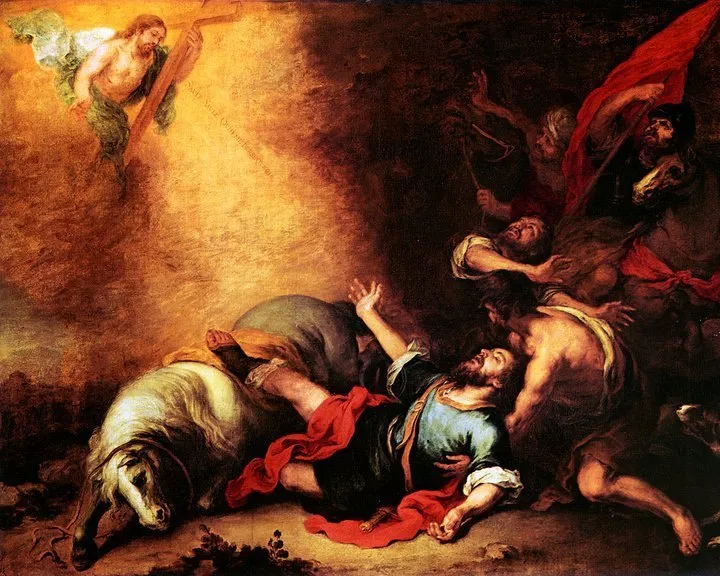
I wrote my book Uninvented because as I studied apologetics, the defense of the Christian faith, I consistently came across the argument that the Bible and the stories contained therein could not have been made up, were not mere human fiction as critics have insisted for several hundred years. The Apostle Paul is a powerful piece of the argument.
The Apostle Paul is probably the most influential figure in all human history (without Paul no one may have ever heard of Jesus). While some radical skeptics don’t even believe Jesus existed, nobody, not one historian or scholar would ever claim Paul did not exist. For an ancient, Paul was a voluminous writer, and ancient writers are much harder to dismiss. What we find in our New Testament is probably a small portion of his actual letters. The question isn’t whether the Apostle Paul existed, but most troubling for the skeptic is the question: how did Saul become Paul? Paul’s conversion is difficult for the skeptic to explain away. I once heard someone say how unlikely his conversion would have been. Not unlikely as in, wow, that’s surprising, but . . . . that just can’t be! He gave a couple examples of equally unlikely conversions. Imagine Winston Churchill becoming a Marxist. Or Hitler becoming a Jew. The Hebrew Pharisee Saul becoming the Christian Apostle Paul is every bit as inconceivable.
Paul’s conversion is the primary thing skeptics must explain away. For them, Jesus couldn’t have appeared to Paul on the road to Damascus because, well, Jesus was dead, and dead people don’t come back to life. Therefore, Jesus couldn’t appear to Saul, as he was then named. See how this works? But the radical conversion of Paul is one of the most well-attested facts of the ancient world, and nobody denies it, so it must be explained. Only the supernatural elements need to be, for the skeptic, explained away. I haven’t done any in depth study of those who engage in such anti-supernatural arguments for Paul’s conversion, but I’m confident they’d be even less persuasive than the anti-supernatural arguments for the empty tomb and the subsequent growth of the church. The only real option explaining away Paul’s conversion is psychological (Paul thought he saw the risen Jesus), and then engage in some Freudian or Jungian analysis of his upbringing and mental state, and heap conjecture upon conjecture. Or maybe they should just believe Paul’s own testimony (Gal. 1):
11 I want you to know, brothers, that the gospel I preached is not of human origin. 12 I did not receive it from any man, nor was I taught it; rather, I received it by revelation from Jesus Christ.
13 For you have heard of my previous way of life in Judaism, how intensely I persecuted the church of God and tried to destroy it. 14 I was advancing in Judaism beyond many of my own age among my people and was extremely zealous for the traditions of my fathers. 15 But when God, who set me apart from my mother’s womb and called me by his grace, was pleased 16 to reveal his Son in me so that I might preach him among the Gentiles, my immediate response was not to consult any human being. 17 I did not go up to Jerusalem to see those who were apostles before I was, but I went into Arabia. Later I returned to Damascus.
18 Then after three years, I went up to Jerusalem to get acquainted with Cephas and stayed with him fifteen days. 19 I saw none of the other apostles—only James, the Lord’s brother. 20 I assure you before God that what I am writing you is no lie.
Galatians is one of Paul’s “undisputed” letters, meaning scholars of even the most skeptical stripe are convinced Paul wrote it. Thus, we have a choice: either what Paul says here is true, and we believe his assurance, or he is lying. Those anti-supernaturalists, though, insist there is a third option. While Paul obviously didn’t see Jesus on that road, he wasn’t in fact lying because he thinks he is telling the truth. That whole “road to Damascus” experience only happened in his head, maybe with some natural explanation for bright lights and such, but Paul really, really thought he saw Jesus, thus he wasn’t lying.
The problem with this anti-supernaturalist reading is the historical record. The only reason we know this happened on a road to Damascus is because Luke records the event in Acts 9, and as a companion of Paul on his missionary journeys Luke likely got the story from the horse’s mouth, so to speak. We know he was a close brother and friend of Paul because they spent a lot of time together, as we learn from what are called the “we passages” in Acts where Luke moves from describing events in the third person, to the first person. For example, in Acts 16:10-17 Luke writes, “After Paul had seen the vision, we got ready at once to leave for Macedonia, concluding that God had called us to preach the gospel to them.” Paul also says of Luke in his letters that he was “the beloved physician” (Col. 4:14). He tells Timothy when he was in Rome, “Only Luke is with me” (1 Tim. 4:11). He also calls Luke one of his “fellow workers” (Phil. 1:24). Luke knew Paul as well as anyone, and there is nothing about what happened on the road to Damascus to suggest it was merely a psychological event in Paul’s brain. Here is how Luke describes what proved to be the greatest inflection point in human history (Acts 9):
Meanwhile, Saul was still breathing out murderous threats against the Lord’s disciples. He went to the high priest 2 and asked him for letters to the synagogues in Damascus, so that if he found any there who belonged to the Way, whether men or women, he might take them as prisoners to Jerusalem. 3 As he neared Damascus on his journey, suddenly a light from heaven flashed around him. 4 He fell to the ground and heard a voice say to him, “Saul, Saul, why do you persecute me?”
5 “Who are you, Lord?” Saul asked.
“I am Jesus, whom you are persecuting,” he replied. 6 “Now get up and go into the city, and you will be told what you must do.”
7 The men traveling with Saul stood there speechless; they heard the sound but did not see anyone. 8 Saul got up from the ground, but when he opened his eyes he could see nothing. So they led him by the hand into Damascus. 9 For three days he was blind, and did not eat or drink anything.
We’ll discuss the Saul of “murderous threats” below, but we’re again confronted with the perpetual question any Bible reader must answer: Is this historical? Did it happen, or not? The writers of the gospels, including Luke, were clearly attempting to write history. Without a question begging anti-supernatural bias, we are free to assess the evidence of the text itself, and not read our prejudice into it. With bias, we must conclude it’s made up. Without bias it is straightforward history of a supernatural event. It was also not Paul alone having the experience, but several others witnessed it. Something happened, and it happened instantly. In Damascus, the Lord appeared to a man named Ananias, and he told him to go and lay his hands on Saul to restore his sight. Ananias’ reply reflects the Saul everyone knew about, and the one they were expecting:
13 “Lord,” Ananias answered, “I have heard many reports about this man and all the harm he has done to your saints in Jerusalem. 14 And he has come here with authority from the chief priests to arrest all who call on your name.”
After being rebuked by the Lord for questioning him, Ananias goes to see Saul, and his sight is restored. It is difficult to explain what happened next unless it really happened:
Saul spent several days with the disciples in Damascus. 20 At once he began to preach in the synagogues that Jesus is the Son of God. 21 All those who heard him were astonished and asked, “Isn’t he the man who raised havoc in Jerusalem among those who call on this name? And hasn’t he come here to take them as prisoners to the chief priests?” 22 Yet Saul grew more and more powerful and baffled the Jews living in Damascus by proving that Jesus is the Messiah.
It would be like being in a worship service at a Jewish synagogue in Nazi Germany in the mid-1930s and seeing Adolf Hitler come waltzing in wearing a prayer shawl and yarmulke. There would be a lot of cases of severe whiplash. To see and hear Paul preaching about Jesus as the Messiah mere days after getting to Damascus was every bit as shocking as Hitler embracing Judaism. A mere hallucination can’t explain it. And nobody could make it up because it was Paul’s declaration of his conversion for the rest of his life. How best to explain it? God!
A Hebrew of Hebrews and Mission to the Gentiles
As for the “murderous threats,” the conversion of Saul is most plausibly explained by it happening exactly as Luke describes it. The reason is found in why he was so rabidly anti-Christian. Saul’s parents obviously had big plans for the young man, and he was sent from his hometown of Tarsus to Jerusalem to study under one of the great Rabbis of the day, Gamaliel. Known as something of a moderate, his pupil Saul most certainly would not be. Steeped in Judaism, it defined everything about him. In Paul’s own words we see him recount his Jewish bona fides in Philippians 3 and Acts 22. In the latter he then goes into detail about his conversion experience and encounter with Jesus of Nazareth. I imagine Paul recounted his coming face to face with the risen Jesus many times during his life, and every time he believed it was real. The only plausible explanation for his life and influence on world history is that his encounter with Jesus was indeed real, not a figment of his imagination.
What is every bit as radical and unexpected as Paul’s conversion was his teaching and missionary obsession. The reason for the latter was the former. Until Paul, religion had never been considered universal in scope. The Jews should have known better because God’s promise to Abraham was that through him, and thus Israel, all the nations of the earth would be blessed (Gen. 12). The Lord gave them an important hint through Isaiah (42:6, 49:6) when He said Israel would be “a light to the Gentiles.” By the time of Jesus, however, Jews wouldn’t even eat with Gentiles, let alone be a light and blessing to them. For the pagans it was the same but for quite different reasons. Martin Goodman explains why in Rome and Jerusalem: The Clash of Ancient Civilizations:
The sense of mission set Christians apart from other religious groups, including Jews, in the early Roman empire. The notion that it is desirable for existing enthusiasts to encourage outsiders to worship the god to whom they are devoted was not obvious in the ancient world. . . . On the contrary, it was common for pagans to take pride in the local nature of their religious lives, establishing a special relationship between themselves and the god of a family or place, without wishing, let alone expecting, others to join in worshiping the same god. Christians in the first generation were different, espousing a proselytizing mission which was a shocking novelty in the ancient world. Only familiarity makes us fail to appreciate the extraordinary ambition of Paul, who seems to have invented the notion of a systematic conversion of the whole world, area by geographical area.
Spoken like a true question begging anti-supernaturalist! We’re supposed to believe Paul “invented” this notion of converting the entire world all by himself? He made it up because of some non-supernatural “experience” as he was going to persecute the followers of “the Way”? Then he immediately starts proclaiming the message of those he was supposed to be persecuting? Not only that, but in doing so he goes against every cultural instinct of literally every single person in the world, Jew and pagan alike, including fellow followers of “the Way”? Somehow, he comes up with the notion out of nowhere that every person in the world needs to believe this? I don’t think so. A better, more believable, and plausible explanation is God!
The God ordained nature of Paul’s mission becomes more apparent when we understand the dynamic of the early Jewish church, and the intense struggle he had moving outside the bounds of Judaism. We see this played out in Acts and described by Paul in his epistles as he confronts the Judaizers. It’s difficult to imagine what would motivate Paul to invent an idea so against the religious expectations of the entire world without divine intervention. There are plenty of other examples of why it was so difficult for Paul to take the gospel beyond Judaism, both in Jerusalem with the other Apostles and on his missionary journeys. For the latter as he was speaking to Jews and they rejected the message, he told them he was going to the Gentiles and it made them furious.
On the Pagan side of the equation, what Paul was doing was equally as disturbing to them as it was to the Jews. Syncretism was the religion of the ancient pagan world, and to require someone to give up every allegiance for just one God or one religion was unheard of at the time, and deeply unpopular. Even though Jews rejected such Syncretism, they never had a vision or mission to turn all pagans into Jews. Christianity for Paul was world conquering or nothing, and Paul doesn’t invent that all by himself.
There is also the issue of Paul’s world transforming teaching which I can’t get into in any depth here, but will briefly mention broad areas of Paul’s teaching that radically contrast with his Jewish upbringing, and Jewish teaching of the time. These like his missionary zeal could never have been invented by Paul himself, or what would become the Pauline theology of Romans, Galatians, Ephesians, etc. It had to be revealed to him. The Messiah of Jewish expectation was not a sin-bearing redeemer who would be punished for the sins of his people. There is not even a trace of such an idea in pre-Christian Jewish literature. Where, then, would Paul have come up with such an idea if not in the Judaism he was raised and immersed in? It is not there. Another area of Paul’s teaching that was mind blowing and incomprehensible to Jew and Gentile alike is found throughout his letters, and can be summarized in these words from Galatians 3:28:
There is neither Jew nor Greek, neither slave nor free, nor is there male and female, for you are all one in Christ Jesus.
The implications of this verse turned every cultural assumption of every person in the ancient world upside down and inside out. It would have been positively ludicrous to even say such a thing at the time, let alone believe and try to live it. Yet, there was Paul teaching it throughout the Roman empire as the logical conclusion of God redeeming his people in Christ and saving them from their sin. It was so radical at that it can plausibly be argued no one at the time could have invented it on their own, and it was only that it was in fact true, and revealed, that it eventually transformed the world.
Recent Comments