
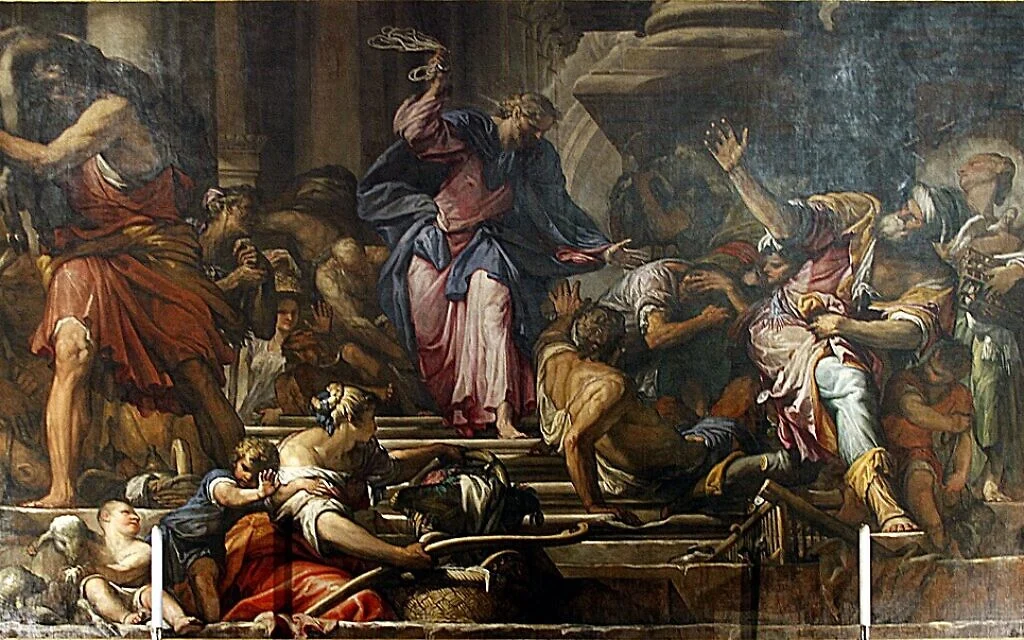
I’m currently writing a book about AD 70, which if you’re not familiar with that date, is why I’m writing the book. Every Christian should be taught the theological and redemptive-historical significance of the destruction of Jerusalem, which Jesus predicted in the Olivet Discourse (Matthew 24, Mark 13, Luke 21). I’m working on a chapter which I’ve titled, “Jesus’ War with the Jewish Religious Professionals”; they didn’t get along very well. One story I’m looking at in this contentious relationship is Jesus’ cleansing of the temple, its theological and redemptive-historical significance.
I discovered an interesting connection of the temple cleansing with the Old Testament from a sermon by Doug Wilson about Leviticus 14 where the Lord tells Moses and Aaron how they are to cleanse a house from mold after they enter the Promised Land. It’s fascinating how the Lord prefaces his instructions: “and I put a spreading mold in a house in that land.” Mold just doesn’t show up “naturally,” but God is sovereign even over mold! Sin and sinful human beings are under God’s sovereign control as well, not in any way we could understand or that mitigates personal responsibility, but nothing or no one happens outside of his dominion, that he in some way causes or allows; nothing surprises him.
We read of three significant redemptive-historical events in Matthew 21, Mark 11, and Luke 19: the Triumphal Entry, the cleansing of the temple, and Jesus cursing a fig tree. Jesus was teaching in the temple courts and the chief priests and elders confront him, ““By what authority are you doing these things?” they ask. “And who gave you this authority?” Jesus, as he often did, asked them a question, and he would only answer them if they would answer him:
25 The baptism of John, from where did it come? From heaven or from man?”
They don’t answer because they feared the people who consider John a prophet, so Jesus won’t answer them; but in fact he does in two parables targeting the religious leaders. The first is the parable of the two sons, only one who in the end does his father’s will. The other is the parable of the tenants. Jesus is declaring judgment upon the Jewish religious leaders, and by extension Jerusalem itself and the entire Jewish religious context, the Old Covenant, which will be carried out in AD 70.
It’s important to place those parables and the judgment Jesus is declaring through them in context. We are getting to the culmination of Jesus’ three years of ministry, and the case he is bringing against the Jewish religious leaders. Just prior, Jesus had entered Jerusalem for his final Passover week in the Triumphal Entry where the people were proclaiming him Messiah. From a prophetic perspective, Jesus is clearly proclaiming himself king of the Jews, and Matthew to emphasize it quotes Zecheriah 9:9 predicting Israel’s king will be coming riding on a donkey. Then as king he cleanses the temple. In The Life and Times of Jesus the Messiah, the great nineteenth century Jewish Christian convert, historian Alfred Edersheim, compares the first temple cleansing at the beginning of Jesus’ ministry (John 2) with the second one, and calls the latter a “final judicial sentence.” Some scholars think there is only one temple cleansing, and John has a different reason for putting it early in Jesus’ ministry, but I’m inclined to think there are two. John’s gospel was written later, and maybe he sees no need to address something that was already so well known among Christians.
The other reason I think it’s likely two is because a plausible connection can be made between the temple cleansing and the cleansing of a house in Leviticus 14. There was a very specific process If someone sees something like mold in his house, he must go to the priest who will inspect the house and it must be closed for seven days. If the mold spreads the stones must be taken out and discarded, and clean stones put in their place. Then we read:
43 “If the defiling mold reappears in the house after the stones have been torn out and the house scraped and plastered, 44 the priest is to go and examine it and, if the mold has spread in the house, it is a persistent defiling mold; the house is unclean. 45 It must be torn down—its stones, timbers and all the plaster—and taken out of the town to an unclean place.
In the initial cleansing in John 2 Jesus cleaned out the house, but when he came back three years later, the mold had returned so the house is unclean, and now it must be torn down, as indeed it will be, not one stone left on another. Here’s what Jesus says about the temple at the beginning of Matthew 24:
Jesus left the temple and was walking away when his disciples came up to him to call his attention to its buildings. 2 “Do you see all these things?” he asked. “Truly I tell you, not one stone here will be left on another; every one will be thrown down.”
Something unclean had defiled both the house and the temple, and since it is unable to be cleansed, the house, and the temple, must be torn down.
The Perversion of The Temple
The temple was the center of Jewish religious life. From the beginning of their inception as a people, the Hebrews, eventually called Jews during the Babylonian exile, were instructed by God to build a tabernacle where God’s presence would dwell with them. All the god’s of the ancient pagan peoples were visible in idols made by human hands. Nobody had ever heard of an invisible God, a God nobody could see, until the Hebrews were rescued by him from their slavery in Egypt. In Exodus 25-30 they were given very detailed instructions on how to build a portable tabernacle where God would dwell with his people; it would represent the visible presence of the invisible God on earth. Prior he had given them his law. He was building a unique people in the world, a holy people set apart for service to and worship of him.
Initially given the Israelites would spend 40 years wandering in the wilderness, the tabernacle would be torn down and reassembled each time to start the journey again and stopped. Once they crossed the Jordan and finally made it into the promised land it settled in Gilgal for a time near Jericho, and then to Shiloh for three hundred years during the time of the Judges, and after several other moves eventually during the time of David made it to Jerusalem. David wanted to build a temple honoring God so he would not dwell in what was basically a tent, but it was not to be. He was given instructions by God which he passed on to his son Solomon who built what we now know as the first temple. It was destroyed some four hundred years later in 586 BC by the Babylonians, and then when the newly called Jews (people from Judea) returned to Jerusalem they started to rebuild it, what came to be known as the second temple. That was finished later that century, and stood as is until Herod in about 20 BC greatly expanded and renovated it. Herod’s grand temple was one of the wonders of the world and the one standing when Jesus lived.
I provide this very brief history lesson on the temple to give us some sense of how important it was to the identity of the Jewish people as Jews. The tabernacle, where God dwelled among his people, once housed in a tent but now in this magnificent building, defined everything about them. Multitudes of Jewish people would stream to Jerusalem several times a year during the Jewish festivals to worship there, and it was inconceivable that it would not always be a presence among them, as indestructible as they were as a people. This was why the disciples of Jesus were so shocked when he told them it would be utterly destroyed, and why as we’ll see his predication lived on in the New Testament church
By the time of Jesus’ ministry, the holiness of the temple had been compromised, or how else could it be turned into a “den of thieves.” Edersheim says the buying and selling taking up much of the temple precincts during Passover was deeply unpopular with the people. He tells us the reason why:
The whole of this traffic—money-changing, selling of doves, and market for sheep and oxen—was in itself, and from its attendant circumstances, a terrible desecration; it was also liable to gross abuses.
The people were stuck and easily ripped off. There was a lot of business going on that week, and likely a lot of people being taken advantage of.
The temple complex is huge, covering about thirty acres divided into several different courts, or sections, with each court getting more restrictive about who could enter it. The largest part opened to everyone was called “the Court of the Gentiles,” and where the vendors set up shop. This is why Jesus in rebuking the Jewish leaders who have allowed this to happen quotes two Old Testament passages speaking specifically to his “judicial sentence” against the Jews (from Is. 56 and Jer. 7):
17 And as he taught them, he said, “Is it not written: ‘My house will be called a house of prayer for all nations’? But you have made it ‘a den of robbers.’”
Nations in Greek is ethnos, peoples, Gentiles, so non-Jews. They’ve basically shut out the Gentiles from coming close to God in the most holy season on the Jewish calendar, and Jesus is furious. In John as the disciples witness the first cleansing, they remembered what David said in Psalm 69, that “Zeal for your house will consume me.” All the way back to Abram in Genesis 12 the entire purpose of their religion was to bless all peoples on earth. So in addition to Jews being taken advantage of, the traders are keeping Gentiles from coming near to God on the holiest season of the Jewish year.
After he has declared his message to the masses, he’s with his disciples and gives a more symbolic picture of what’s to come in the withering of the fig tree. It was rich with leaves, but without fruit. Edersheim comments:
And the judgment, symbolically spoken in the Parable, must be symbolically executed in this leafy fig-tree, barren when searched for fruit by the Master.
Luke who doesn’t address this event, tells us that even before Jesus got to the city, he declared judgment and wept (Luke 19), predicting exactly what would happen in 40 years:
41 As he approached Jerusalem and saw the city, he wept over it 42 and said, “If you, even you, had only known on this day what would bring you peace—but now it is hidden from your eyes. 43 The days will come upon you when your enemies will build an embankment against you and encircle you and hem you in on every side. 44 They will dash you to the ground, you and the children within your walls. They will not leave one stone on another, because you did not recognize the time of God’s coming to you.”
Specifically, God coming to the Jewish nation in the person of Jesus of Nazareth.
God’s Judgment is Coming Upon the Jews
The Christian church was born into a temple dominated Jewish culture, and initially built in that environment as we see in Acts. It took the stoning of Stephen to force their vision beyond Jerusalem. As Luke tells us, “On that day a great persecution broke out against the church in Jerusalem, and all except the apostles were scattered throughout Judea and Samaria.” Many Jewish Christians had a difficult time seeing Christianity beyond their Jewish faith, as we also see in Acts. It would take something dramatic to finally break Christianity from Judaism, and Jesus spent his entire ministry warning the Jews, especially the Jewish religious leaders, that judgment was coming upon them. Nobody, until it happened, could fathom it would take the destruction of the temple to accomplish this. The Old Covenant and the old dispensation of relating to God would have to be ripped from them brick by literal brick. We read in Matthew 24 how the disciples were marveling at the grandeur of the temple, and Jesus burst their very substantial bubble:
2 “Do you see all these things?” he asked. “Truly I tell you, not one stone here will be left on another; every one will be thrown down.”
Then he gives a breakdown of how this will come to pass. You have to imagine they were incredulous. Surely, they must have thought, not the temple. But they all knew the first temple had once been torn down by the Babylonians 600 years previously, so it wasn’t a concept completely foreign to them, but still, it had to be shocking.
When we read Matthew 24 and the other passages in Mark and Luke about it, it’s clear Christians took Jesus’ warning seriously. I came across something making this point I hadn’t noticed before. I’ve read it many times over the years, but being like most Christians, AD 70 didn’t hold much theological significance for me as it now does. When Stephen is seized and brought before the Sanhedrin, he is accused of something indicating Jesus’ teaching about the temples’ destruction is something the early church took very seriously.
12 And they stirred up the people and the elders and the scribes, and they came upon him and seized him and brought him before the council, 13 and they set up false witnesses who said, “This man never ceases to speak words against this holy place and the law, 14 for we have heard him say that this Jesus of Nazareth will destroy this place and will change the customs that Moses delivered to us.”
They meant the temple. So by that time in the earliest days of the church it was common knowledge among the followers of Jesus. His predicting the destruction of the temple was so shocking, that people not only couldn’t forget it, but told other people about it. It would take many years after it happened for Christians to understand the full redemptive-historical significance of the fall of the temple. In Matthew 26 as he stands before the Sanhedrin, Jesus confirms what he’s been warning the Jews of for three years—he will be returning in judgment. The high priest asks Jesus if he is the Messiah, the Son of God, and he answers:
64 “You have said so,” Jesus replied. “But I say to all of you: From now on you will see the Son of Man sitting at the right hand of the Mighty One and coming on the clouds of heaven.”
To his interlocutor, Jesus had spoken blasphemy, and he would be right if he wasn’t in fact the Messiah, but he is. They all knew Jesus didn’t mean literal clouds because from their Old Testament framework, and Jesus’s, clouds were symbolic of judgment. Many Christians think Jesus is predicting his second coming, but he is telling the men listening to him that they will see this. And in forty years they will.
Recent Comments