Audio Book Chapter 5: Jesus: Too Popular to Make Up
- You Don’t Make Up a First Century Rock Star
- The Jewish Diaspora
- The Greek Language
- Roman Roads
- Memory


It has happened again, this time at a Christian grade school in Nashville. When I first heard about it, and it was reported a female was the shooter, that didn’t compute. Women are never mass shooters. Then I learned this:
Three adults and three children were killed and the shooter has been identified as a female, which has shocked many people. She was killed on the scene.
However, unfortunately, things turn even darker. The unconfirmed, but widely reported story is that the shooter is a biological female who identifies as a male. Her name is reportedly Audrey Hale.
The three children were nine years old, one the daughter of the pastor of a PCA church I believe was associated with the school. It is heart breaking and distressing. The Revolver piece I linked to above points out that people who suffer from gender dysphoria, or who are culturally bullied into it, are mentally ill. The woke left pushes the transgender mania as the civil rights issue of our time, and lives are destroyed, mentally, emotionally, and physically. But according to woke leftists, guess who the victim is in this tragedy? That’s a rhetorical question. There is reporting the shooter, who attended the school, was driven by resentment against Christianity. Supposedly she penned a manifesto the authorities have in their possession. We’ll see if they have the guts, and integrity, to release it. Resentment, anger, rage, hate, poison is what the left stokes 24/7, and not just against Christianity, but against any traditional value based on it, and anything associated with Christian Western civilization.
As I had finished this post I came across this video of Tucker Carlson on his show talking about how the trans movement is targeting Christians. It’s only nine minutes and I very much encourage you to watch/listen to it. It’s kind of shocking YouTube hasn’t deleted it.
I thought as I prayed for God’s comfort and grace upon that community, and repentance per Jesus himself as the proper response for those who don’t know him, I was angry. This didn’t used to happen in America! Then I thought of our church, which used to be a PCA church, calling for a prayer time last night. I appreciate that, and of course prayer is always necessary, but it’s not enough. I’ve heard our pastor and an elder/teacher disparage the so-called “culture wars,” and that always bothers me. Once in a sermon preaching on the importance of regeneration, the pastor said if we’re focused on the culture wars, we’re just rearranging the deck chairs on the Titanic. Frankly, that infuriated me. It does so even more now as more senseless violence cut short three precious children’s lives, and three adults in the prime of their lives. Christians lost the culture wars, this is what happens. When Christianity’s influence dominated American culture, “school shootings” did not happen.
The regeneration of the human soul and fighting for the health and flourishing of American culture are not mutually exclusive goals, and I would argue, naturally compatible. Culture wars are not a distraction, but modern conservative Evangelical Christians tend to over spiritualize everything. The great Francis Schaeffer’s life and ministry was dedicated to fighting against a two-story Christianity, the upper story or spiritual reality, and the lower story, the mundane stuff of everyday life. In this take, the upper story is the important area of life where we should focus on spiritual, eternal things. The lower story is not spiritual and thus less important. There is a long history to why we are tempted to view reality and culture this way, Schaeffer even goes back to Thomas Aquinas in the thirteenth century. Arguably, it was the Second Great Awakening in the nineteenth century when saving souls became divorced from Christianizing culture. In fact, the saving of souls should lead to a culture becoming more Christian, whatever culture it is, wherever it is.
The great lie of secularism, however, is the myth of neutrality, that there is a space in culture and politics where religious values are irrelevant, unnecessary, and must be only private because they lead to antagonism and violence. In case we haven’t noticed, all secularism seems to give us is antagonism and violence. Not to mention how secularism gave us progressivism which eventually embraced cultural Marxism that we now call wokism. For decades the left accused conservatives and Christians with being obsessed about sex, about what goes on in people’s bedrooms. That’s a lie. It’s the left that has been obsessed with sex for almost sixty years. From the so-called “sexual revolution” to no-fault divorce to gay “rights” to redefining marriage and now the evil insanity of the transgender mania, it’s always about sex for the left
At the 1992 Republican National Convention Pat Buchanan gave what came to be called “the culture war speech.” He had run against President Bush in the primary because Bush came from the moderate wing of the Party, what we used to call Country Club Republicans. Culture War issues embarrassed them, and Buchanan would have none of it:
Friends, this election is about more than who gets what. It is about who we are. It is about what we believe and what we stand for as Americans. There is a religious war going on in this country. It is a cultural war, as critical to the kind of nation we shall be as the Cold War itself. For this war is for the soul of America.
Even though Buchanan endorsed Bush, that wing of the party mocked and ridiculed Buchanan, along with Democrats and their media allies. Guess which word was used most against Buchanan? Divisive. Because he simply identified what had been a fact for decades, a worldview-religious war in this country, he was the bad guy, a narrow-minded religious bigot.
Less than seven years later we had the first of what has come to be called mass school shootings at Columbine High School in Colorado in April, 1999. According to that ABC news piece I linked to,
If a mass shooting is defined as resulting in the death of four or more people, not including the perpetrator, 175 people have died in 15 such events connected to U.S. schools and colleges.
Buchanan was mocked and ridiculed by American elites on the left and right, but he was absolutely correct: the contest in which we are engaged is for the soul of America. As he says, this culture war is about the kind of nation America shall be. It will either be a Christian nation, as we once were, or we will be a nation where we have to fear for the lives of our children every day we send them to school. There is no in between.
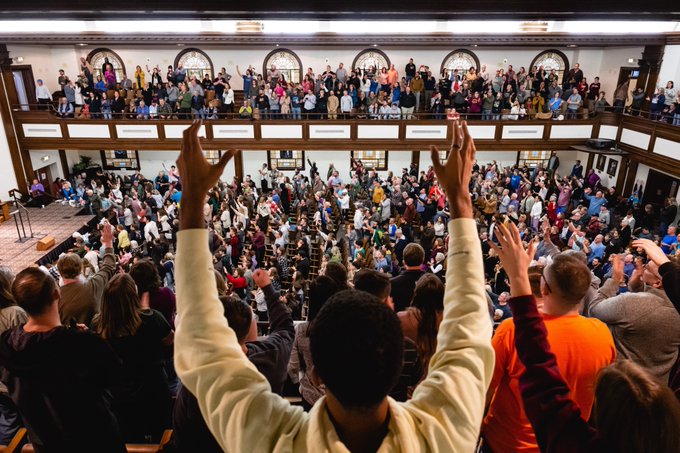
There has been a lot of news recently about a revival at Asbury University, a Methodist school in Kentucky. In The American Conservative, Rod Dreher asks, “An extraordinary movement of the Holy Spirit at a Kentucky college chapel — is it for real?” By real he means “visceral experiences of the presence of God,” and he thinks as many do that this is a movement of the Holy Spirit and is real. I would tend to agree because I don’t feel qualified to determine whether what someone says is God moving in their being is real or not. But that is not my question here. I’m more interested in what revival accomplishes in the place in which it happens. I guess the question really is, is revival merely a personal religious experience, or does it have cultural implications. The answer should be obvious, but for many Christians it probably isn’t.
If we go back to the first great revival in history, and I’m not talking about the first Great Awakening in America in the 18th century, there were societal transforming implications. I’m speaking about the revival that started at Pentecost when God poured out his Holy Spirit because Jesus had accomplished redemption for his people and ascended to the right hand of God, according to the Apostle Paul, “far above all rule and authority, power and dominion, and every name that is invoked, not only in the present age but also in the one to come.” He also said Christ “must reign until he has put all his enemies under his feet.” That means in this life, in this fallen world among fallen people in societies filled with such people.
If we go back to that first great revival we see the beginning of the transformation of Western civilization from fully pagan to Christian in seed form. We might even say mustard seed form. It took almost 300 years until the conversion of Constantine the Great for paganism to begin its slow demise as the dominant worldview in the West. By any measure, a modern person would have to agree the world produced by Christianity is far superior to the ancient pagan world. Historian Tom Holland, not a Christian, wrote a book about this called Dominion. The subtitle makes the point: How the Christian revolution remade the world. That is what a revival does, it remakes the world. What does that look like? Read Holland’s book and you’ll find out. The spiritual war against paganism goes back to Yahweh calling Abram out of Ur of the Chaldeans, and the Lord making a holy people for himself in Israel. God’s promises to Abraham would ultimately be fulfilled in Christ 2000 years later, and now His holy people is us!
When “the last days” came upon us with Christ’s life, death, resurrection, and ascension, the war against paganism broke out of a small geographical area in the Roman Empire to encompass the entire earth. When that phrase “last days” is used, most Christians go right to Paul in I Timothy 1:
But mark this: There will be terrible times in the last days. 2 People will be lovers of themselves, lovers of money, boastful, proud, abusive, disobedient to their parents, ungrateful, unholy, 3 without love, unforgiving, slanderous, without self-control, brutal, not lovers of the good, 4 treacherous, rash, conceited, lovers of pleasure rather than lovers of God— 5 having a form of godliness but denying its power. Have nothing to do with such people.
Then they look at our culture and conclude this must be the last days Paul was referring to, and it is! But these indications of the last days have been with us in all recorded history. Have people gotten any better or worse in the last several thousand years? Obviously sinful human beings are every bit as sinful today as they’ve always been. But “last days” from a redemptive-historical perspective is the advance of God’s kingdom and the building of Christ’s church by the power of the Holy Spirit. We find prophetic descriptions of that throughout the Old Testament, but we find it defined in two important passages in the New. One is in the first Christian sermon given by Peter at Pentecost in Acts 2:
16 No, this is what was spoken by the prophet Joel:
17 “‘In the last days, God says,
I will pour out my Spirit on all people.
Your sons and daughters will prophesy,
your young men will see visions,
your old men will dream dreams.
18 Even on my servants, both men and women,
I will pour out my Spirit in those days,
and they will prophesy.
The other is the first few verses of Hebrews:
In the past God spoke to our ancestors through the prophets at many times and in various ways, 2 but in these last days he has spoken to us by his Son, whom he appointed heir of all things, and through whom also he made the universe. 3 The Son is the radiance of God’s glory and the exact representation of his being, sustaining all things by his powerful word. After he had provided purification for sins, he sat down at the right hand of the Majesty in heaven.
And Paul tells us in Ephesians 1 what Jesus is now doing at God’s right hand, ruling
far above all rule and authority, power and dominion, and every name that is invoked, not only in the present age but also in the one to come.
These are the last days we inhabit. And Paul points out that the purpose of Christ’s rule is the Father placing all things under his feet appointing him to be head over everything for the church. As I often say, God is moving in a mighty way to advance his kingdom and build his church. These are two different things working in symbiosis for the good of God’s people and His glory. So real revival apart from the personal salvation and experience of individuals is going to change the culture in which it happens. Not immediately, but in due course. In addition to the mustard seed metaphor I linked to above, Jesus also used the metaphor of levin in a very large batch of dough. The influence and manifestation of both grow slowly but inevitably.
That inevitable growth is what we as God’s people are part of, and the result of true revival. When God gave man, male and female, and the first Adam, the dominion mandate, they failed. Whereas the last Adam most certainly did not. Christ is now taking dominion of His world through His body, which is in and through us by the power of the Holy Spirit (Zech. 4:6). That means our Christianity influences everything we do, literally every single thing. From how we make a living, to how we raise a family, to how we do art, music, politics, business, law, science, health and medicine, entertainment, architecture, education, farming, gardening, everything. And there is no culture war that is not spiritual war. Our pastor once said those focused on the culture war are rearranging the deck chairs on the Titanic. He isn’t alone in such sentiment, and he could not have been more wrong.
Christ came to save not just individuals so they could go to heaven, but the world itself, and people in it for a very specific reason. I’ll leave you with the Apostle John in Revelation 5:9-10 who tells us what that is:
9 And they sang a new song, saying,
“Worthy are you to take the scroll
and to open its seals,
for you were slain, and by your blood you ransomed people for God
from every tribe and language and people and nation,
10 and you have made them a kingdom and priests to our God,
and they shall reign on the earth.”
Recent Comments