“Unbelievable” Podcast, Apologetics, and Christian Conversions

“Unbelievable” Podcast, Apologetics, and Christian Conversions

I had my biggest show biz break earlier this week appearing on the Unbelievable Podcast with Justin Brierly. Promoting a book as a “nobody” author without a “platform” is a formidable challenge. Zillions of people write books and are trying to get noticed, so not having a “name” makes the game especially difficult. I’m convinced Uninvented is unique enough to justify the attention of a “somebody,” and I’ve prayed and worked to that end. One prayer has been to have someone with a big platform appreciate the book and give it some attention. Unbelievable is certainly a big platform given it’s maybe the longest running apologetics podcast in existence. I think Justin told me he started in 2004, and in the podcasting world that’s positively ancient! In apologetics circles everyone knows Justin and Unbelievable.

(In case you’re not familiar with the reference of the podcast title, it comes from a catchy 1990 pop tune of the same name.)

The reason I’m writing about it now (before the episode comes out) is because it got me thinking about apologetics and Christian conversions. If you’re not familiar with the podcast, Justin created a niche by often having two people with different perspectives on things having a respectful dialogue. He’s a very good facilitator, doesn’t act like a cheerleader for the side he may be on, and asks solid questions. He certainly demonstrated this in our conversation. I’ve never been a fan of apologetics debates, whether it’s the atheist against the Christian, or the Calvinist verses the Arminian, etc., but Unbelievable never felt like a debate platform to me. Rather it’s more like two people who may disagree just having a conversation with someone helping it along. No wonder it’s lasted so long.

Regarding the topic of apologetics and converting people, and as I state in Uninvented, I don’t see apologetics primarily as something to convert non-Christians, although it is of course used by Christians to help people see the veracity of Christianity. Rather I see it as a ministry for building up the faith, i.e., trust, of the saints in their God and Savior. The verse from which we get the English word apologetics is I Peter 3:15,

But in your hearts set apart (sanctify) Christ as Lord. Always be prepared to give an answer to everyone who asks you to give the reason for the hope that you have. But do this with gentleness and respect . . .

The word reason in Greek, ἀπολογία-apologia, means a verbal defense, specifically like what a lawyer does in a court of law. The words, “everyone who asks you” has always stood out to me. There are several ways to take this, but at the least it assumes our Christian life is so apparent to those we interact with that they’re prompted so ask us about the reason for our hope. It doesn’t apply to incognito Christians. Our faith should be so apparent to those we interact with that they might be motivated to ask us why we’re different. To them there is something about us that doesn’t seem “normal.” I like to think of it as being a little annoying for Christ as I try to throw out hints to people I interact with. It all depends on the relationship and the situation, but our relationship with Jesus has to be something that compels us to want to do this.

What I know, though, whether it’s on the Unbelievable podcast, or in any other interaction with a non-Christian or a Christian, is that nothing I say in and of itself will make any difference whatsoever. The transformation of the human heart is God’s business, not the power or persuasiveness of my words. I’ve learned this lesson six ways from Sunday; meaning it takes me a lot of failure to learn my lessons, but God is patient with clueless sinners like me. As with all sanctification, it’s painful but gratifying beyond description. It’s hard to describe, especially for one who for many years was deluded in thinking my words did have the power to change another person, how freeing it is to know I have literally zero power. That it’s all God. And being a convinced Calvinist, I mean literally all. I have a printout of these words from Zachariah 4:6 pinned to my bulletin board to remind me that it’s all him in all things:

“Not by might nor by power, but by my Spirit,” says the Lord Almighty.

I can hear the non-sequitur forming in some of your minds: then doesn’t this mean what we do and say doesn’t matter? If it’s all God, some think, then what we do doesn’t matter. Oh yes it does! God’s sovereignty, his rule over all things, never precludes human agency and responsibility. I’ve found in knowing and trusting God’s sovereign power is incredibly freeing. The results are not up to me, but the work and obedience, that is. Thy will be done should always be our final prayer.

Regarding apologetics, few Christians are good at it, and I was one of those for much of my Christian life. I’ve always been zealous to want to spread and defend the faith, I just didn’t work at it. But in 2009 I had a turning point. In an encounter with a co-worker, I did a terrible a terrible apologetics job and I was embarrassed, although my interlocutor wouldn’t have seen it that way. I was ashamed of myself, so I decided to dive in and learn how to defend the faith. I was delighted to discover a wealth of resources were now available that were not there in the over two decades since I had studied apologetics. Podcasts were a growing phenomenon and I listened to everything I could find, and there was a seemingly endless supply of books and website articles as well. I was amazed how little I knew and set about to rectify that.

As the Lord commands us to defend the reason for the hope that we have, he has graciously provided us with a faith that can be defended with integrity; we have the advantage of knowing Christianity is true! It only requires a commitment on our part to put in the effort to acquire that knowledge and develop the skills to use it. It doesn’t mean we have to know everything, and often the best strategy isn’t transmitting knowledge but just asking questions. Most people we will interact with have no idea what they believe or why they believe it. When we do, God may use us to bless others to advance his kingdom and build his church.

 

Interim Census Bureau Report Shows Red States on a Roll

Interim Census Bureau Report Shows Red States on a Roll

When we moved from Illinois to Florida in June 2017 one of the first things I noticed was how many cars had out-of-state license plates. It was remarkable. I’d never seen anything like it. What is even more remarkable is that it hasn’t changed! When my wife and I are driving together I’m always pointing out cars from everywhere but Florida. I don’t know if it’s been all 50 states, but if not it’s close. I’ve even seen Hawaii and Alaska! I learned at one of our county GOP meetings earlier this year that 1,100 people a day are moving to Florida, and something like 80 percent are moving to the greater Tampa Bay area where we live. It’s funny to hear the locals complain about the annoyances that come from a growing population, but I was born and raised in southern California, and we lived in the Chicago area for 17 years, so the crowds don’t bother me so much.

There is, however, something to be learned from this phenomenon that speaks to the dynamics of the times in which we live. I came across this piece that most Americans know is a fact even if they don’t know much: “Interim Census Bureau Report Shows Red States on a Roll.” Here are a some takeaways from the report:

Even with possible fudging, the Census Bureau’s latest interim report shows that Blue states are losing population while Red states are gaining population.

As in the old divide between Communist East Germany and the free West Germany created by Konrad Adenauer after World War II, people migrate towards freedom. In the wake of the great Wuhan Pandemic lockdowns, it is no surprise that more people chose to move. Unlike Germany, there is no wall to prevent internal migration within the United States toward freer states.

The South is now the largest population area in the U.S. The Northeast and Midwest lost population “due to negative net domestic migration.”

Both Red and Blue states appear to be doubling down on their governing strategies. Red states are increasing job opportunities, while Blue states look increasingly to the federal government to bail them out of the mess caused by fleeing taxpayers.

Over the last five years many told me these people coming from blue states like California and New York were going to turn red states blue. Nope! I intuitively knew that wasn’t the case given the reasons we left Illinois, in addition to the weather, had to do with the Democrat dysfunction in Illinois. And this was when Florida was still considered a “tossup” state and could go either way. Had 30,000 people voted differently for governor in 2018, Ron DeSantis would not have been governor and Florida would have turned into a Covid hellhole like other blue states. Thank God it didn’t!

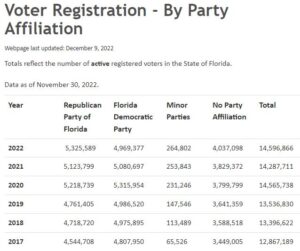
Since we moved here I heard about the growing Republican registration advantage over Democrats which proved my intuition was correct. As you can see from the chart, when we moved here the Democrats had a 250,000 plus advantage, now it’s Republicans 350,000 plus! That is amazing, and speaks to the genius of the Founding Fathers of the great American republic (it is not a Democracy).

Given the challenging times in which we live it’s easy to be a David Doomer or Negative Nellie or Debbie Downer. It often appears all lemons with no lemonade, glass definitely half empty, if that. I choose not to see things that way because of God’s providence, and that America’s founding and blessings are not an accident. All of America’s Founders and the founding generation, even those many claim were Deists, believed America’s birth was ultimately God’s doing. It was absurd anyone could possibly think these poor little colonies could be any match for the mighty British Empire. In a book I recently read, The Indispensables, this mindset was put well:

“The madmen of Marblehead are preparing for an early campaign against his Majesty’s troops,” scoffed a Loyalist newspaper in early 1774, skeptical of the idea that Americans could threaten the most experienced and skillful military professionals on the planet at the time.

We tend to look back at America’s founding as inevitable, but it only was in God’s mind. From a human perspective it looked impossible. For this reason the 56 men who signed the Declaration of Independence thought they were very likely signing their death warrant. Benjamin Franklin captured the frightening reality of the moment with his statement on the signing, “We must all hang together, or most assuredly, we will all hang separately”

But they didn’t hang, and via that Declaration and the Constitution in 1787 gave us the most incredible experiment in republican government in the history of the world. In effect, the red migration is a continuation of that experiment that I believe will allow it to continue for generations to come. Doomers think I’m nuts and it’s already over given what’s happened in the last two years, but I very much beg to differ.

There are many reasons for my optimism, but one is the nature of the republic the Founders created seen in this red migration. The concept known as federalism gives Americans an escape valve. The way such a valve works in a container is when pressure builds up to a dangerous level (as in a steam boiler) it opens automatically to let out steam; the states are that escape valve.

The struggle at the founding of America was how to get 13 separate sovereign colonies to unite to form one government. Some founders wanted a stronger central government, and others stronger state governments. The latter group was more influential initially given how skeptical all the founders were about centralized power in government, and the first governing document of the United States of America, the Articles of Confederation reflected that. Adopted in November 1777, it proved to not work very well in practice. This gave the Federalists the leverage to create a new constitution with a stronger Federal governement which was ratified on September 17, 1787.

States for most of American history had a large measure of sovereign power, but over time as the Federal government grew states allowed their constitutional prerogatives to languish. Thankfully, what the Founders created still works pretty much as intended, and as the Federal Leviathan has become increasingly tyrannical, people in blue states are not putting up with it. Even red areas of blue states have gotten fed up and are voting to succeed from those states.

Back in the ‘80s during the Reagan era a line became famous among conservatives: Being a liberal means never having to say you’re sorry. No matter how much misery and destruction progressive leftist policies create progressive leftists double down and push more such policies. It seems tens of millions of Americans have had enough of it and are voting with their feet. Thankfully that makes it much less likely they’ll have to “vote” with their guns.


This Thanksgiving Make Thanksgiving a Habit, For the Rest of Your Life

This Thanksgiving Make Thanksgiving a Habit, For the Rest of Your Life

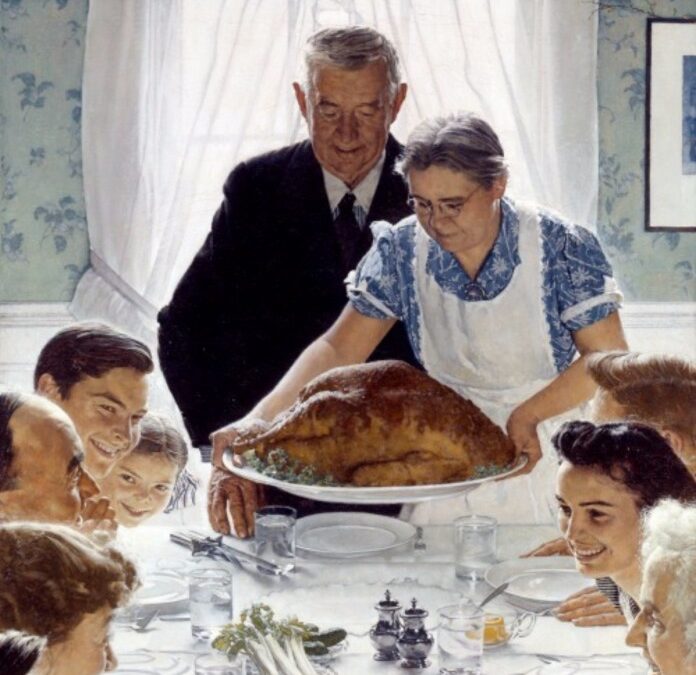
Thanksgiving is a good reminder we ought to give thanks, and ought to do it 365 days a year, literally. As I grow older, the more I realize how central thanksgiving is to the vibrant Christian life, and how naturally we are given to un-thankfulness. Complaining is so much easier because naturally (i.e., sinfully), we live by site and not by faith (i.e., trust in God). We look to circumstances as sovereign, not the Sovereign God who is in control of all things. We look to them for succor and comfort, not God. It’s a fool’s errand because our circumstances will never be enough to give us what we think we are looking for. The irony is we have no idea what that is! Augustine tells us that would be God:

You have made us for Yourself and our hearts are restless until they find their rest in Thee.

Then we do something even more ridiculous, we look to other people for fulfillment. If you want a recipe for disappointment, look to other human beings to fulfill you. Whether it’s other people or circumstances, we will be disappointed. That’s life in a fallen world among fallen people in a fallen body. Something I’ve emphasized to my kids as they were growing up is a slightly different version of a quote I got from The Princess Bride, one of our family’s favorite movies: Life is disappointment, highness. Wesley says pain, but it’s all the same (the short version or the longer version). Life will never live up to our expectations. That is when it’s most important to give thanks.

Normally, when I’m lecturing others, or myself, about the necessity to give thanks, I quote the Apostle Paul in I Thessalonians 5:18. In a direct command he tells us to “Give thanks in all circumstances; for this is God’s will for you in Christ Jesus.” This doesn’t leave much room for ingratitude, or its corollary, complaining, or whining, or moaning, or grumbling. It tells us the key to a thankful heart is found “in Christ Jesus.” To be truly grateful, and give thanks because we are in fact thankful, we must understand the gospel.

In Ephesians 5, Paul confirms in an even more far-reaching way that our gratitude, our ability to give thanks, needs to be rooted in Christ and the gospel. The context is living “as imitators of God,” which means we walk, or live, in love. No problem, right? Piece of cake. Unfortunately, this goes against every natural sinful inclination we have, so it’s anything but easy. However, God in Christ, in the gospel, makes it possible. Paul explains the gratitude mentality we ought to have and how it becomes doable,

giving thanks always and for everything to God the Father in the name of our Lord Jesus Christ.

Adding “always and for everything” to “all circumstances” doesn’t leave much wiggle room. Paul’s use of “the name” points to the significance of the meaning of Jesus being our Lord and Messiah, our Savior and king. And he is not just our personal Savior and Lord. We too easily tend to individualize what he accomplished, as if it were mainly about us. It is, of course, but he is also the Savior of the world, and as Paul says in Ephesians 1, raised from the dead and seated at God’s right hand “far above all rule and authority and power and dominion, and above every name that is named.” All this for us! His church. That is the name in which we can and ought to give thanks.

The gospel is deeply personal, and cosmic, which is why we no longer have to look to our circumstances as the key to our fulfillment or happiness. Saved from God’s wrath because of our sin, we are now reconciled to him, and can love him by loving others. The more profound this saving is to us, meaning the more we know how rotten we are, the easier it is to love others. We have no choice; we love because he first loved us. Then knowing that Jesus has all authority and power in the universe over all things, means we can trust that God works all things “for the good of those who love him, who have been called according to his purpose.” There’s all again. I think we’re getting the picture.

All applies to the cosmic piece as well. Prior to his ascension to the right hand of the Father, Jesus said all authority in heaven and on earth had been given to him, therefore go. Paul promises us that “the creation itself will be liberated from its bondage to decay and brought into the freedom and glory of the children of God.” As we begin to understand the entire picture of the gospel in all it’s personal and cosmic ramifications, developing the daily, even minute by minute, habit of giving thanks, is really not hard at all.

Give thanks to the Lord, for he is good;
his love endures forever!

Jordan Peterson, Christianity, and the Human Psyche: It’s Complicated

Jordan Peterson, Christianity, and the Human Psyche: It’s Complicated

Jordan Peterson exploded on the scene six or seven years ago because he refused to bend the knee to woke orthodoxy. At the time he was a typical Canadian liberal, but the left drove him to the right. YouTube helped get his ideas into the mainstream, and his book, 12 Rules for Life: An Antidote for Chaos, released in 2018 made him a sensation. It was especially meaningful for young men who have had their masculinity emasculated by the woke leftist secular culture. In case you’re not familiar with him, Peterson is a clinical psychologist and ex-professor. A 2019 documentary about him is a good introduction to the man, what drives him, and the reaction to him.

The Covid tyranny, which was especially bad in Canada, was what drove Peterson to finally fully embrace conservativism. Like many of us, he’s been red-pilled. And like many ex-liberals (liberal in the classical sense, not the progressive perversion of it) he has been stunned by the leftist takeover of what used to be a politics that believed in liberty. He’s realized a cultural version of Marxism is now what drives the left side of the political/cultural spectrum. The video below is a discussion specifically about the trans insanity that dominates Western culture and education. I’m not writing about that specifically, only to give you a good example of how the man thinks, and why it’s appealing to me, and so many others.

Although not an orthodox Christian yet, as far as I can tell, he’s an extremely effective apologist for Christianity. He comes at everything from a deeply psychological and nuanced perspective, and more than most he realizes Christianity is the foundation of Western civilization. More than that, he argues it uniquely gives meaning to human existence in the deepest sense (which is a favorite phrase of his, as is technically). If you watch/listen to the video, you’ll see how he challenges his interlocutor’s agnosticism/atheism. She fails to realize the only reason she’s repulsed by the trans insanity is Christianity!

What makes him especially appealing to me is that he gets the complexity of human existence and the human psyche. In fact, he says that in the video, that it’s complicated. Christians, as well as human beings in general, are given to simplistic thinking in dichotomous terms, either/or, one way or the other, black or white. We are perfectly free to view people this way but it’s not an accurate assessment of the human beings we encounter throughout our lives. This dichotomous thinking also applies to what we think we know or the knowledge we have.

If we’re to love people as we’re commanded, it helps to realize and accept that life is terribly complicated and messy. As they’ve grown up, I’ve taught my kids that every person they encounter has a history, and they are who they are as they stand in front of them because of that history. They’re not being, and you pick the annoying trait, obstinate or frustrating or petty or domineering, just to annoy us. It’s who they are! God brings them to us to teach us how to love them, not to insist they love us. It’s amazing how easy that is to get that backwards.

Related to this, I’ve learned from Peterson how little I know about how human beings, how the human psyche works. It reminds me of what has become one of my favorite verses as I’ve grown older and realize the more I know, the more I know I don’t know. In I Corinthians 8:2, Paul tells us:

The one who thinks he knows something does not know yet know as he ought to know.

As I always make sure people understand when I quote it, this is not a call for skepticism or cynicism, that’s we can’t know, or have confidence in what we think we know. Rather because of what Paul says in verse 1, that we all have knowledge, it’s a call for epistemological humility, which most people tend to lack. We always think we know more than we actually know.

It took me decades to begin to understand how little I really know, and in light of the infinitude of knowledge (because it all comes from our infinite Creator God), that is vanishingly small. When I was a young know-it-all, I saw my knowledge as earth size, not infinite for sure, but pretty impressive. As time went on that shrank to the size of a basketball, then in due course a golf ball (to bring up bad memories), and finally a pebble. Now I realize it’s the size of an atom! Invisible to the naked eye; that’s how little I know.

Again, it’s very important to understand what I am not saying. I know a lot, more than the average bear, but what’s more important is what I don’t know. That allows me to hold on to the knowledge I do have lightly, if tenaciously. My convictions about what I think I know are as strong as they’ve ever been, but I realize I’m looking at one grain of sand from all the seashores and deserts of the world, and then that doesn’t really capture it. My conclusion? We know confidently in humility. Our knowledge is to be used in love to the glory of God, for our good, and the good of others.

On Dying Well and the Fear of Death

On Dying Well and the Fear of Death

Fear is endemic to the human condition in a fallen world, and everyone is afraid of death, as are all living things, animals, fish, birds, insects, all flee in fear of their demise. While their fear is instinctual, human beings can think about death. I’ve thought about it as long as I can remember, and in this I’m not unique. Look what the covid scam and the tyrannical response to it did to the entire world. The panic porn of the media, politicians, and government officials created a worldwide fear pandemic . . . of death.

I recently listened to an excellent discussion of this fear with J.P. Moreland, a philosophy professor, scholar, and apologist, who happens to be a friend and family member. Several years back, J.P. experienced severe panic attacks and depression, and went on to write a book about it called Finding Quiet: My Story of Overcoming Anxiety and the Practices that Brought Peace. It’s interesting listening to the podcast knowing all he went through to get to the other side. You’ll hear how it all comes down to trust, which in Greek (pistis) is translated often as faith and belief.

I’ve learned as I’ve gotten older and wiser, thank you God, that living in fear is not good, nor healthy, nor does it honor God. This doesn’t mean fear isn’t at times justified because fear is a natural God-given human response to threat. It also reflects the fact that death is unnatural and wrong, that it wasn’t an intended feature of God’s created reality until man messed it all up.

Everyone regardless of what they believe knows this, but it is only Christians and their Jewish forbearers who give us the reason why. If there is no God, if atheistic materialism is true, then death is in fact natural and there is absolutely nothing “wrong” with it at all, other than we just don’t prefer it. So, do I prefer death or life today? Well, sir, if you don’t mind, I think I’ll take life, just a little longer anyway. No, death is ugly and wrong and evil, and I don’t want it, ever! Thankfully, we don’t have to die! I’ll tell you why in a moment.

A saying related to this topic is without a doubt true: death makes cowards of us all. On the other hand, Jesus can make us courageous in the face of death. I’ve been learning this as I’ve grown older riding the freight train to the grave, and have grown to despise fear, whether it’s related to death or anything else. The reason for this loathing is not so much because it’s unpleasant to be fearful, which it most certainly is, but because it dishonors God. Fear, and its attendant worry, anxiety, and doubt, is also sin.

A family member recently shared with me a vivid metaphor for this sin. She said it’s like a cape which is always on your back ready to overcome you, like the proverbial sword of Damocles. I then asked her a question which surprised her: Have you ever repented for this? Her look was perplexity, like she was thinking, that’s a strange question. She hadn’t repented, nor had I until not too many years ago. Now I repent of it every day because I’m so easily knee-jerk fashion given to this sin. If we’re commanded to not fear, worry, or be anxious, then to have fear, worry, or anxiety is sin. Stop it! As we know, very much easier said than done, but it is nonetheless sin.

The amazing truth I’ve learned, the very hard way as is my wont, is that I don’t have to fear (worry, be anxious, etc.). It’s a choice. I am confronted with this either/or every time life does what life does, trust the Lord, or “trust” the circumstances. In our day we might say the choice is binary, 1 or 0, a fork in the road. If you haven’t had a lot of practice at this, it can be really hard, but as you build the trust muscle, making the choice to trust the Lord God Almighty gets easier. The freedom trust brings is hard to describe until you experience it. In a recent church service, our pastor quoted these verses from Psalm 112 that resonated with me:

He will have no fear of bad news;
his hearts is steadfast, trusting in the Lord.
His hearts is secure, he will have no fear;
in the end he will look in triumph on his foes.

The context is the man who “fears the Lord, who greatly delights in his commandments.” We can fear the Lord or fear our circumstances, which will it be? As we become aware of the dichotomy, that there is no middle ground, the choosing becomes easier somehow. Then we get to witness God work in us and in our circumstances. Thy will be done . . . .

Here is a little secret I’ll share. If we can’t give thanks for the circumstances (all of them), we don’t trust the Lord. I know, it ain’t easy!

As for death, I’ve found in that too it becomes easier to resist the fear, although never completely. For me, the successful resistance is rooted in Jesus’ words to Martha in John 11, which is really a challenge to us all. As her brother Lazarus lay in the tomb four days and having no idea Jesus was about to bring him back to life, he told her that her brother would rise again. She thought he meant at the last day as all Jews believed, but Jesus as he often did, said something completely unexpected:

25 Jesus said to her, “I am the resurrection and the life. Whoever believes in me, though he die, yet shall he live, 26 and everyone who lives and believes in me shall never die. Do you believe this?”

Remember pistis. Jesus isn’t saying do you intellectually assent to my position and ability to do this, but do you trust me. The Greek verb form John uses is important, the present indicative active, or actions that are currently being performed in the present; thus the challenge. This ain’t no one time thing, it’s an all the time thing. When the fear (doubt, worry, anxiety) hits (and the temptation to commit these sins in a fallen world in a fallen body among fallen people never ends) will we trust Jesus or not. That is the question.

Jesus and Animal Sacrifice in the Old Testament

Jesus and Animal Sacrifice in the Old Testament

I recently read of Solomon’s dedication of the Temple in Jerusalem in 2 Chronicles 7, and the celebration was massive. Part of the process was a mass slaughter of animals for sacrifice:

Then the king and all the people offered sacrifices before the Lord. And King Solomon offered a sacrifice of twenty-two thousand head of cattle and a hundred and twenty thousand sheep and goats. So the king and all the people dedicated the temple of God.

Have you ever wondered what happened to all those animals? I figured a long time ago they would never waste the meat, and we’re told in the Pentateuch the Levites were given meat from the sacrifices to eat. But they could never eat the meat of all the sacrificed animals, especially during the high holy days. Archaeological exploration has found that animal sacrifice at temple powered ancient Jerusalem’s economy, and it “confirms visions of the temple depicted in historical Jewish texts and suggests the economic heart of the city was its slaughtering operation.”

Something struck me, though, as I thought about this sacrificial operation.

My son away at college recently called me about a strange story in Numbers that didn’t make any sense to him. I asked what the Old Testament is about? And he knows the right answer: Jesus! As we discussed the passage in light of the ultimate Old Testament biblical hermeneutic, it’s surprising how the strangeness of the passage no longer appears so strange. In the context of the redemptive history in the Lord Jesus and the gospel, many Old Testament passages don’t appear so strange. 

With this fresh in my mind, I asked myself the same question about the animal sacrifices in 2 Chronicles. Knowing the answer is Jesus is Christianity 101, and our primer is the book of Hebrews. All Christians of every theological stripe know Jesus is the atoning sacrifice for the sins of his people, or the propitiation, which means a sin offering by which the wrath of the deity shall be appeased. We see in the Old Testament sacrificial system a type of Christ’s atoning work turning away the wrath of God against our sin, only in him God’s wrath was fully and completely satisfied. As Jesus said on the cross moments before his death, it is finished.

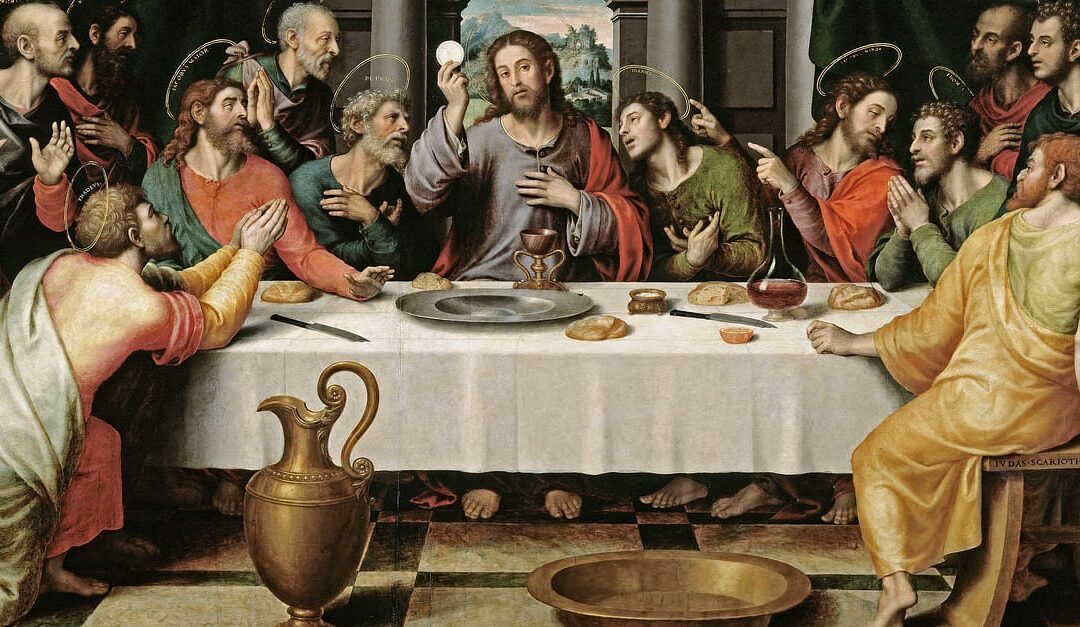
Again, this is basics, as the writer to the Hebrews might say, baby’s milk. But as I was reading about the sacrifices I thought, that’s a lot of meat for the people to eat! Then a phrase of Jesus very strange to first century Jews, but one we rarely think about today, came to mind: “eat my flesh.” In John 6 as Jesus is declaring he is the bread of life, he declares that his “flesh is real food.” Because of the last supper Jesus shared with his disciples we know this as communion where Jesus says of the bread, “this is my body.” There is also something mystical in partaking of his death as we eat and experience a real spiritual union with the Word of God that we might also partake in his resurrection.

What I had never done before in my 44(!) years as a Christian was connect the Israelites of the Old Testament eating the flesh of sacrificed animals to our eating the flesh of Christ. If the Old Testament is all about Jesus, it makes total sense, yet it never occurred to me until now.

As the meat of the sacrifice to atone for their sins sustained the Israelites as they ate, so the flesh of Christ we spiritually eat sustains us spiritually but in a very real way physically. Spiritual health, i.e., peace with God through our Lord Jesus Christ, has psychological and emotional effects which have real implications for our physical health. All those things we should not do because we fully trust in God, like worry, doubt, fear, anxiety, anger, etc., cause stress which dishonors our Almighty Savior God, and is not healthy.

This became even more clear to me later in 2 Chronicles 35 when under King Josiah the people celebrated the Passover in Jerusalem. It’s amazing how it echoes communion in the Lord’s Supper.

11 The Passover lambs were slaughtered, and the priests splashed against the altar the blood handed to them, while the Levites skinned the animals. 12 They set aside the burnt offerings to give them to the subdivisions of the families of the people to offer to the Lord, as it is written in the Book of Moses. They did the same with the cattle. 13 They roasted the Passover animals over the fire as prescribed, and boiled the holy offerings in pots, caldrons and pans and served them quickly to all the people. 14 After this, they made preparations for themselves and for the priests, because the priests, the descendants of Aaron, were sacrificing the burnt offerings and the fat portions until nightfall. So the Levites made preparations for themselves and for the Aaronic priests.

This is all a bloody business (thousands upon thousands of animals), which is what I always focused on as it is obviously connected to the blood of our slain Savior. But the Passover wasn’t just about killing animals to cover sin, but was about eating and being sustained by God’s mercy and grace in the eating. Remember the wages of sin? The only reason we are not a smoldering pile of ashes on the ground is because of his mercy and grace. As I often say, if our sin is akin to jaywalking, God’s forgiveness is not that big of a deal. If, on the other hand, it’s akin to genocide, that’s a whole other thing. 

That it is the latter, is the reason untold millions of animals had to die in order for us to understand the suffering and death of the Son of God. The only reason we don’t have to go through the bloody business of sacrificing animals today is because God himself in the person of Jesus of Nazareth died to set us free from sin and death. As I wrote recently, he is the double cure for sin!