Jordan Peterson has become one of the most effective apologists for Christianity in the 21st century. This is quite something to say about a man who has yet to embrace a version of Christianity we might consider orthodox. His wife is a strong Catholic Christian, and his daughter embraced an Evangelical version of Christianity last year. I’m not sure what Peterson would say today about his faith status, but he’s far closer to the Christ of Scripture than he has ever been.
What makes him so effective is his background as a clinical psychologist and scholar. He can see deeply into the nature of things on a psychological level that I have found fascinating and instructive for my own Christian worldview. He’s so attracted to Christianity because of its explanatory power, although I’ve never heard him use this phrase. Simply put, Christianity explains the nature and structure of reality far better than any other faith or worldview, which gives it its psychological power both on an individual as well as a societal level (because societies and cultures are filled with people!). He would probably agree with the ex-atheist CS Lewis who said:
I believe in Christianity as I believe the sun has risen, not because I see it but becasue by it I see everything else.
This is wonderfully apparent as he takes down atheist Sam Harris. The lack of explanatory power of the atheistic materialist worldview could not be more apparent in these short exchanges. The juxtaposition is powerfully compelling for the plausibility and power of Christianity. Dr., Steve Turley does a terrific analysis of the interaction between the two, and it is well worth a watch/listen. As my wife tells me, Peterson is not an easy listen, but he’s worth a careful one.
When I turned 60 years old (I still have a hard time imagining such a thing), my wife and daughter gave me a print of Arnold Friberg’s painting of George Washington kneeling in the snow at Valley Forge next to his great white stallion. That was July of 2020, and I had no idea at the time how important that print would become to me. Recently I came across a video of Friberg describing his inspiration for the painting, which he was commissioned to do for the Bicentennial of the Declaration of Independence in 1976:
You’ll remember that summer. We were in the midst of “two weeks to flatten the curve,” which would turn into two years of the Covid nightmare of worldwide government overreach. Looking back, it’s hard to fathom what happened, and I’m convinced it can only ultimately be explained one way:
12 For our struggle is not against flesh and blood, but against the rulers, against the authorities, against the powers of this dark world and against the spiritual forces of evil in the heavenly realms.
This is a well-known verse among Evangelicals like me, and when evil gets to an incomprehensible level to normal people, this is the most plausible explanation. We all know what such evil looks like, but the response to Covid was a horrific example, the consequences of which we will be living with for a long time. I’ll come back to this verse in Ephesian 6 in a moment.
Then, after four years of Trump Derangement Syndrome (TDS), another form of incomprehensible evil happened in the presidential election of 2020, which was egregiously, blatantly stolen. You know this is an incontrovertible fact, and I am talking epistemological certitude like knowing the sun rises in the west, because to the media, Big Tech, and Democrats (and far too many Republicans), this is the opinion that dare not be uttered. Then to add insult to injury, we witnessed a quintessential FBI false flag operation, the January 6 “insurrection.” If it really was an insurrection, it was the worst one ever!
Then since the fraudulent president was installed in the White House on January 20, we discovered he really was not the “centrist” he claimed in the campaign, but was committed to finally fulfilling Barack Obama’s dream of fundamentally “transforming the United States of America”:
Americans are now seeing in real time what a disaster Obama’s radical leftist agenda is for the country, and they don’t like it.
I bring these things up not to litigate them here, and whether we agree with each other on the details, or my conclusions, isn’t important. I’m only sharing my response here, and why it’s been life changing for me.
After the election was stolen, God mercifully directed me to Steven Bannon’s War Room, which I’ve watched pretty much daily ever since. I, and millions of others inspired by the MAGA message, were deeply depressed. All I could think is, they got away with it! How could something like this happen in the United States of America! Bannon, thankfully, got me out of the fetal position, and to mix metaphors, talked me off the ledge. Then J6 happened, and that was even more depressing, but that’s when Bannon really shined and in effect started a movement to take back our country from the deep state leftist cabal.
Again, I am not interested in debating any of this, but I do believe those who disagree with me on my overall assessment will agree with me that we are in a definitional moment in American history. None of this would have happened if Trump hadn’t won in 2016, but it’s about far more than him. So, the question for Christians is, what now. This is where I come back to Ephesians 6. Almost all Christians, including me until very recently, quote this verse out of context, and I’m not talking about that chapter, even though the first nine verses point to the larger context. We can’t read verse 12 outside of the context of chapter 1. Paul is praying for the Ephesians (a prayer we should use to pray for those we love all the time), and references God’s “incomparably great power for us who believe.” Then he says:
That power is the same as the mighty strength 20 he exerted when he raised Christ from the dead and seated him at his right hand in the heavenly realms, 21 far above all rule and authority, power and dominion, and every name that is invoked, not only in the present age but also in the one to come. 22 And God placed all things under his feet and appointed him to be head over everything for the church, 23 which is his body, the fullness of him who fills everything in every way.
Boy, how we really don’t believe this. It’s pathetic, actually, and I’m as guilty as anyone. You know why we’re commanded in Scripture to trust God, not worry, “not be anxious about anything,” and “give thanks in all circumstances”? Because of Christ’s kingly rule over all things! If we really trust him, we will have perfect peace. I don’t know about you, but I haven’t quite achieved perfection yet. As long as we live in fallen bodies, in a fallen world, among fallen people, we have to trust him to sanctify us toward that perfection, but it ain’t easy!
But I digress. Back to the painting.
I believe, as did the Founders, that God in his providence allowed America to be founded, and I’m convinced he is bringing us through its re-founding. This is a huge topic for a book I’m working on, but believing this to be true, every morning when I pray, I pray for our country and look at that print. As I talk with God, telling him of my conviction, I fervently pray it would come true. Having a granddaughter now seems to make the stakes a little higher.
We seem to forget the odds against the American colonies in their endeavor to gain political independence from the mighty British Empire. The leaders of “the rebellion” were willing, in the closing words of the Delcaration, “with a firm reliance on the protection of Divine Providence” to give their lives, their fortunes, and their sacred honor to the cause. There are millions of Americans today willing to give their all to our little rebellion. From the merely human perspective the Founders had absolutely no chance. The odds are far better for our fight against the secular progressive administrative state, including the secular culture that promotes and worships it. We often can’t see beyond out own winter at Valley Forge, but God in his sovereign almighty power can also bring us to victory to re-found this blessed republic of the United States of America.
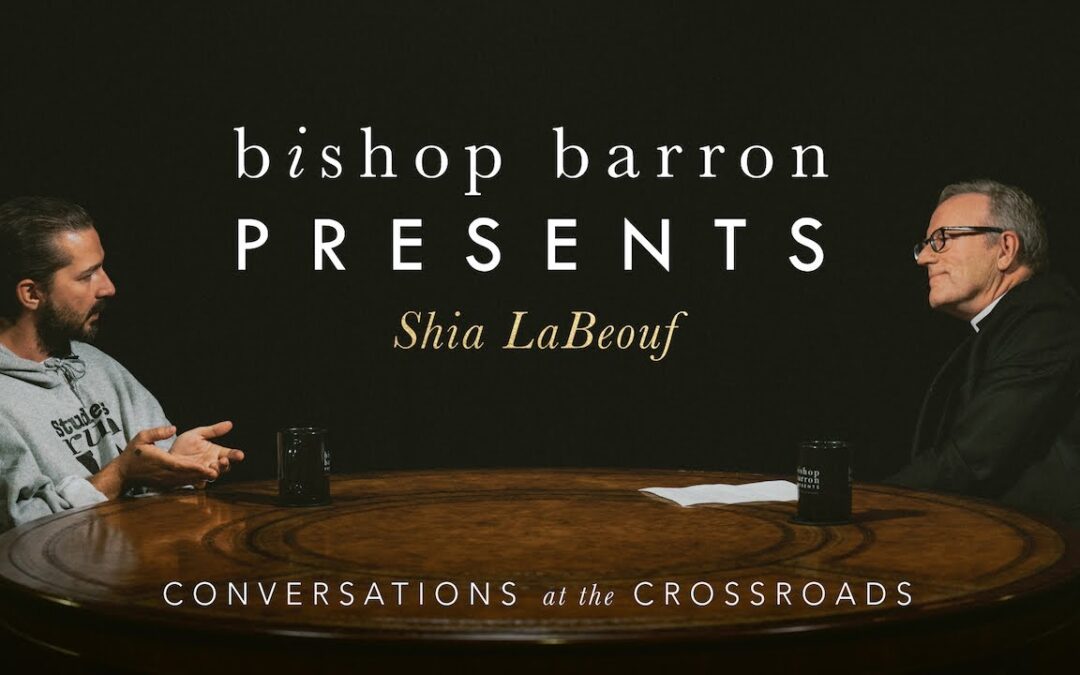
God has given us another powerful cultural moment for truth in a most unlikely conversion to Christianity. The other moment I’m referring to happened a few years back in the most unlikely conversion to Christianity of Kanye West. In this case actor Shia LaBeouf has become a Christian of the Catholic variety. If you haven’t seen this discussion with Bishop Barron, it’s well worth the time.
A few years back I started listening to testimonies, and it’s been one of the best things I’ve ever done. The creative ways God uses to save his people from their sin is endlessly fascinating to me, and yet more evidence that he is real, and that Christianity is true. Human psychology alone can’t explain it, only God in Christ can.
I was raised Catholic, but when I was 18 became a “born-again” Christian and rejected my Catholic upbringing. For several years in my ignorant youth, I was virulently anti-Catholic, then over time I began to learn about serious Catholics I respected and my attitude toward Catholicism changed. I led my younger cousin to Christ, who had also been a nominal Catholic, but years later he went back to his Catholicism. He tried to convince me that Rome was the true church, but while open to listening to him, his arguments were never persuasive. However, I know God works through the Catholic church and Christians who embrace it, and this troubled young man is a beautiful example of it.
As I’ve grown older in life and my faith, I’ve realized that God works through people who I may think have the “wrong” theology. In doing this, I don’t think they are any less wrong than I think I’m right, but it just matters less to me than it used to. A passage in Paul’s letter to the Corinthians has become more meaningful to me as I realize how little I really know. In chapter 8 Paul writes:
Now about food sacrificed to idols: We know that “We all possess knowledge.” But knowledge puffs up while love builds up. 2 If anyone thinks he knows something he does not yet know as he ought to know. 3 But whoever loves God is known by God.
There is a lot to unpack here, but Paul gives us a perfect perspective on our knowing, in philosophical terms epistemology. This can be a deep and complex conversation and has taken much time and argument in modern philosophy (from Descartes in the 17th century to today), but put simply we can know things. Verse two is not a call to skepticism, that we can’t know, but a call for epistemological humility. True knowledge is possible, but our knowing is always limited because we are finite creatures. And most importantly, our knowing is not the important part of the equation, but God knowing us. We tend to get that very backward.
So, as a convinced Reformed Christian, aka Calvinist, I can still appreciate this discussion between a new Catholic Christian, and a very knowledgeable Catholic Bishop. God’s sovereign power and amazing creativity in bringing his people to himself, i.e., saving them from their sins (redemption applied he accomplished on the cross), never ceases to amaze me. I think Calvin and his followers got it right, that God’s sovereignty applies to his grace as it does to every other part of his character. When you hear Shia LaBeouf’s conversion story I think you’ll agree.
In cast you are not familiar with what’s going on in the American in-justice system under the current regime in Washington, DC, you need to be. It is horrific, sad, and mostly infuriating. It’s almost inconceivable such things are happening in the United States of America, almost. In case you are not familiar with the word Gulag:
[It is a] system of Soviet labor camps and accompanying detention and transit camps and prisons that from the 1920s to the mid-1950s housed the political prisoners and criminals of the Soviet Union. At its height, the Gulag imprisoned millions of people. The name Gulag had been largely unknown in the West until the publication of Aleksandr Solzhenitsyn’s The Gulag Archipelago, 1918–1956 (1973), whose title likens the labor camps scattered through the Soviet Union to an island chain.
Right here in the good old US of A, the Biden justice department is persecuting political prisoners; that is not supposed to happen in America. And this is far bigger than Donald Trump, regardless of what you think of the man.
If you only get your news from legacy media, you will not know that the January 6, 2021 “insurrection” was a setup by the FBI, and other government actors to take down Donald Trump and discredit the entire MAGA movement. In case you doubt that incontrovertible fact, I would encourage you to go to Revolver News and read and listen to what the facts in fact show to be truth. The corruption of our most powerful law enforcement agency is stunning, as is the entire supposed justice system that runs it.
In case you doubt me, and even if you don’t, I implore you to listen to an interview by Daniel Horowitz did on August 22 with Joseph McBride, a lawyer representing some of the J-6 defendants. The title says is all: “The Sickening Persecution of January 6 Defendants.” From the description:
After today’s show, there will be no doubt we are indeed living in the Fourth Reich. I show how at a time when violent criminals are getting off with a slap on the wrist, those accused of political crimes are being subjected to torture. We are joined by Joseph McBride, one of the lead attorneys for some prominent January 6 defendants, who offers a riveting but sickening presentation about the torture of J6 defendants at the hands of federal and D.C. officials. This was a setup from day one, and the government used it to weaponize law enforcement, the legal system, and society against anyone who doesn’t subscribe to their pagan fanaticism. Which is why the same people not only excuse but even encourage real violent criminals, anarchy, and the breakdown of societal order.
You will learn why Gulag is an apt analogy. They may be getting away with this in the short run, but God in his mercy and grace is revealing the leftist Democrat thugs perpetrating this evil for what they are, and in due course real justice will be done.
I recently finished reading Kuyper’sLectures on Calvinismfor the first time. If you’re not familiar with the man, I’ve put a brief bio below. The reason I’m posting this extensive quote is because when I read it, it blew me away. The lectures were given in 1898 at the seminary my wife and I attended, Westminster in Philadelphia. What astounded me was his prophetic prediction the 20thcentury, and how the coming destruction was well under way by the end of the 19thcentury. He saw with an amazingly astute moral clarity, the rise of a noxious secularism, and the sad and bloody demise of Christian Western civilization in the 20th century. As he lived through World War I, he experienced the beginning of the end in his lifetime. Reading him is not easy, but it is very much worth the effort.
________________________
After this manner, then, we in Europe at least, have arrived at what is called modern life, involving a radical breach with the Christian traditions of the Europe of the past. The spirit of this modern life is most clearly marked by the fact that it seeks the origin of man not in creation after the image of God, but in evolution from the animal. Two fundamental ideas are clearly implied in this:
that the point of departure is no longer the ideal or the divine, but the material and the low;
that the sovereignty of God, which ought to be supreme, is denied, and man yields himself to the mystical current of an endless process a regressus and processus in infinitum.
Out of the root of these two fertile ideas a double type of life is now being evolved. On the one hand the interesting, rich, and highly organized life of University circles, attainable by the more refined minds only; and at the side of this, or rather far beneath it, a materialistic life of the masses, craving after pleasure, but, in their own way, also taking their point of departure in matter, and likewise, but after their own cynical fashion, emancipating themselves from all fixed ordinances. Especially in our ever-expanding large cities this second type of life is gaining the upper hand, overriding the voice of the country districts, and is giving a shape to public opinion, which avows its ungodly character more openly in each successive generation.
Money, pleasure, and social power, these alone are the objects of pursuit; and people are constantly growing less fastidious regarding the means employed to secure them. Thus, the voice of conscience becomes less and less audible, and duller the luster of the eye which on the eve of the French Revolution still reflected some gleam of the ideal. The fire of all higher enthusiasm has been quenched, only the dead embers remain. In the midst of the weariness of life, what can restrain the disappointed from taking refuge in suicide? Deprived of the wholesome influence of rest, the brain is over-stimulated and over-exerted till the asylums are no longer adequate for housing the insane.
Whether property be not synonymous with theft, becomes a more and more seriously mooted question. That life ought to be freer and marriage less binding, is being accepted more and more on an established proposition. The cause of monogamy is no longer worth fighting for, since polygamy and polyandry are being systematically glorified in all products of the realistic school of art and literature. In harmony with this, religion is, of course, declared superfluous because it renders life gloomy. But art, art above all, is in demand, not for the sake of its ideal worth, but because it pleases and intoxicates the senses.
Thus, people live in time and for temporal things, and shut their ears to the tolling of the bells of eternity. The irrepressible tendency is to make the whole view of life concrete, concentrated, practical. And out of this modernized private life there emerges a type of social and political life characterized by a decadence of parliamentarism, by an even stronger desire for a dictator, between pauperism and capitalism, whilst heavy armaments on land and on sea, even at the price of financial ruin, become the ideal of these powerful states whose craving for territorial expansion threatens the very existence of the weaker nations.
Gradually the conflict between the strong and the weak has grown to be the controlling feature of life, arising from Darwinism itself, whose central idea of a struggle for life has for its mainspring this very antithesis. Since Bismarck introduced it into higher politics, the maxim of the right of the stronger has found almost universal acceptance. The scholars and experts of our day demand with increasing boldness that the common man shall bow to their authority. And the end can only be that once more the sound principles of democracy will be banished, to make room this time not for a new aristocracy of nobler birth and higher ideals, but for the coarse and overbearing kratistocracy of a brutal money power.
Nietzsche is by no means exceptional, but proclaims as its herald the future of our modem life. And while the Christ, in divine compassion, showed heart-winning sympathy with the weak, modern life in this respect also takes the precisely opposite ground that the weak must be supplanted by the strong. Such, they tell us, was the process of selection to which we, ourselves, owe our origin, and such is the process which, in us and after us, must work itself out to its ultimate consequences.
Abraham Kuyper(1837–1920) was one of the most extraordinary individuals of his time. A prolific intellectual and theologian, he founded the Free University in Amsterdam and was instrumental in the development of Neo-Calvinism. He was also an active politician, serving as a member of Parliament in the Netherlands beginning in 1874 and serving as Prime Minister from 1901 to 1905.
At this intersection of church and state, he devoted much of his writing towards developing a public theology. His passion was to faithfully understand and engage culture through a Christian worldview. The most famous example is his articulation of the doctrine of common grace. His work has influenced countless others, including Francis Schaeffer, Cornelius Van Til, and Alvin Plantinga.
I recently wrote a piece about a young man who “de-converted” from Christianity, and in it I made this assertion: “the burden of proof is on everybody!” Non-Christians attack Christianity while assuming Christians are the only ones who need to defend their beliefs. That has been the secular assumption for the last several hundred years, and by the 20th century it became the default position of secular Western culture. And we as Christians all too often play the part, accepting the assumption of the critics. We need to understand everyone, every single person, lives by faith. All people are fundamentally religious, which is one of the reasons I dislike referring to Christians as “believers” and non-Christians as “unbelievers.” There is no such thing as an unbeliever!
The question is, who’s faith is most credible, most plausible, makes the most sense, is most logical, and has the evidence to back up its claims. When secularism became the default plausibility structure of Western civilization, a world devoid of God became the most credible and plausible worldview, and made the most sense for most people (whether God exists or not is irrelevant because as I always say, there are very few philosophical atheists). Whatever they believe, most people are practical atheists, they live as if God didn’t exist.
Western culture in its many varied forms drives practical atheism, be it in education, media, entertainment, government, etc. One example from popular culture makes the point. In most of the shows and movies we watch, all in some way deal with the fallen human condition, which is why they can be so entertaining. However, most leave out the most important piece of the puzzle: God! It’s like going to the beach in the middle of the Sahara Desert; uh, there’s something missing. I can’t watch a TV show or movie where God is ignored without shouting, you’re missing the God part!!! They want me to believe human nature as we find it, as it’s being dramatized on screen, just is, no explanation required. I’m to believe, and assume, no higher answer exists to the continual conundrums that make up the human drama? Mere matter cannot explain it. As Blaise Pascal put it in his Pensées:
What kind of freak is man? What a novelty he is, how absurd he is, how chaotic and what a mass of contradictions, and yet what a prodigy! He is judge of all things, yet a feeble worm. He is repository of truth, and yet sinks into such doubt and error. He is the glory and the scum of the universe!
Man’s greatness and wretchedness are so evident that the true religion must necessarily teach us that there is in man some great principle of greatness and some great principle of wretchedness.
As Christians we believe man became a freak, and displays such greatness and wretchedness, because he rebelled against his Creator (Genesis 3). No other religion or worldview or philosophy can explain why human beings are the way they are, why we are the way we are. Most don’t even try. That man is “the glory and the scum of the universe” just is. Deal with it. No, I won’t. I want to know not just that we are the way we are, but why. What Paul describes in Romans 7 captures it perfectly: why do I do what I don’t want to do, and don’t do what I want? I know how Paul feels:
What a wretched man I am! Who will rescue me from this body of death?
He gives us the answer:
Thanks be to God, who delivers me through Jesus Christ our Lord!
We might call this the apologetic from human nature. I am more confident Christianity is true because human nature is what it is, exactly the way we’ve known it for thousands of years.
As I wonder sometimes if my Christian faith is justified, if it’s true, and not a colossal multi-thousand-year scam, I always realize if it isn’t, some other alternative must be, has to be. Unlike agnostics and practical atheists, I can’t delude myself into thinking there is no non-religious sphere of existence. Some neutral place where faith is not required. So, doggone it, I need to know why man is such glory and scum, and how he get that way! Lucky dirt cannot explain Hamlet, for example, so please explain to me what can.
The beauty of the consideration of the alternative, is that in addition to being one of the most powerful strategies in Christian apologetics, it is essential for our own personal trust that Christianity is true and real and worth living and dying for. It forces us, and others, to defend the alternatives to Christianity, whatever the issue might be. We don’t just decide not to believe in Christian position X, and then believe in nothing. When we reject X, we must believe in Y, or A, B, C, D, or any other letter of the alphabet. And in case you weren’t aware, there are no in between letters in the alphabet.
It’s rather simple, really, and doesn’t require a theology degree, or masters in apologetics. If someone says they don’t believe in Christian letter R anymore (or Christianity), then we simply ask what they do believe. Then we ask, why do you believe that’s true? Then we wait. We’ll find most people have no idea why they believe what they believe, or that they even believe anything at all! They, like most every secular person, think belief is for religious folks, and since they’re not religious they’ll wonder, why you’re asking them what they believe.
For us, it works the same way. Doubt is a normal part of existence for finite creatures, and those who don’t doubt are not normal. Have you ever met someone who is six trillion on the certitude scale? It’s annoying. For instance, I might wonder if “nature” really is created by God, so I consider the alternatives. Atheistic materialism? Pantheism? Can you think of another alternative? Genesis 1 is far more plausible, especially as we continue to learn about the infinite complexity of creation. Another example is the Bible. Is it God’s inerrant, sufficient, authoritative Word to mankind? I wrote a book called Uninvented to argue that the only alternative, that it is made up, is not the least bit plausible. No matter what the topic is, the alternative to Christianity is not the least bit plausible. Ex-Atheist C.S. Lewis got it right:
I believe in Christianity like I believe the sun has risen not because I see it, but because by it I see everything else.




Recent Comments