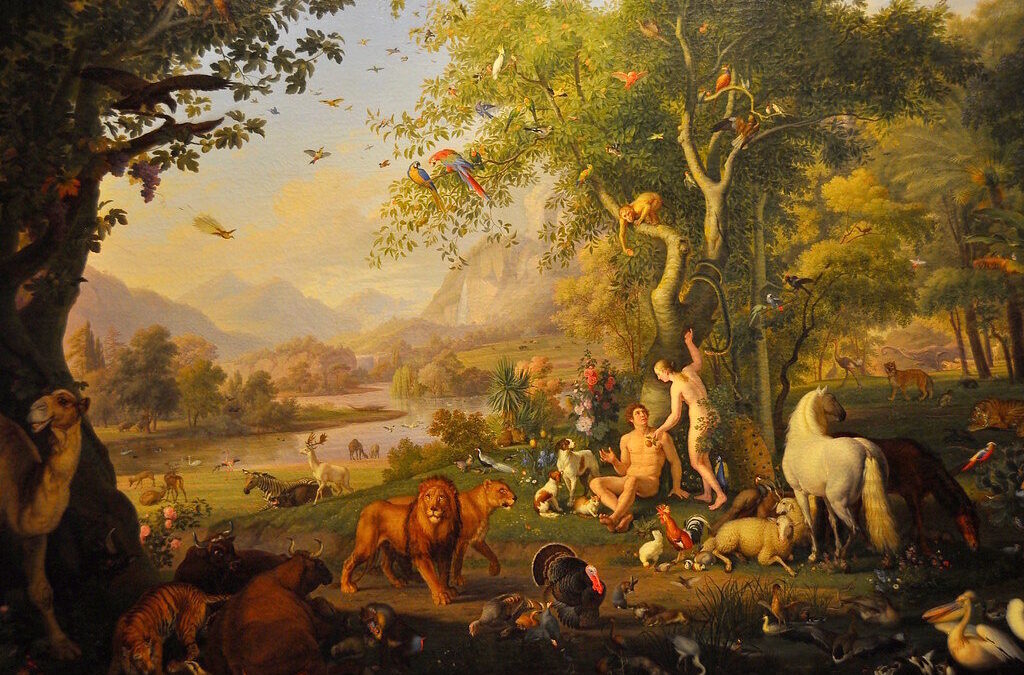
In Our Secular Culture Use the Word Creation, Not Nature

In Our Secular Culture Use the Word Creation, Not Nature

I’m planning on writing a book down the road called, There is No Such Thing as an Unbeliever: Faith in a Secular Age. One of the most pernicious things secularism has allowed “unbelievers” to get away with is pushing the notion that there is such a thing as an unbeliever, that belief or faith is only for ostensibly religious people. Christians have played into the secularists’ hands by using the biblical word “believer,” a word that should never be used in the modern secular context, but Christians do this all the time. In most modern versions (i.e., not KJV) it’s used about 20 times, but it was unproblematic in a world in which everyone believed in the divine, but in the last two or three hundred years it is very much problematic. This is an unfortunate habit most Christians don’t realize they need to break. I now call people either Christians or non-Christians, or whatever faith they embrace, like atheism or Hinduism, etc., not believer or unbeliever.

Because of the rise of secularism in the period we’ve come to refer to as the Enlightenment, which has in fact brought us suffocating darkness, we must also be very careful about using the word Nature. I recently read a wonderful little book called, History in English Words by Own Barfield. The name sounded vaguely familiar to me, and I recalled he was a friend of C.S. Lewis and part of the Inklings, an informal literary group. Starting at Oxford in the late 1920s, the first three members were Lewis, Barfield, and J.R. Tolkien. That is quite the start to any group. In the book, Barfield discussed how words change their meaning over time depending on cultural circumstances. One such word he discusses is natural or nature, which as the Enlightenment developed in the 17th century completely changed its meaning to how we think of it today. The change of this word indicates a massive worldview shift in what used to be called Christendom:

At the beginning of the seventeenth century we first find the word Nature employed in contexts where medieval writers would certainly have used the word God.

Think about that shift. We might accurately describe it as plate tectonic, the earth literally moving under the feet of the meaning of words affecting how we see and interpret the world. It is a complex symbiotic relationship of life lived among human beings and how their perceptions are formed—how they see reality. There is never a simple one-to-one correlation in the meaning of words and culture as much as we might like to think there is; words and their meaning are as complex as human beings.

The Influence of Newton on the Rise of Secularism
Sir Isaac Newton (1642-1727), one of the most brilliant men in history, and a devout Christian, would be surprised that his physics paved the way for the destruction of Christendom. Needless to say that was not his intention, but the devil is very good at what he does, lying to distort our understanding of God’s perfectly good creation, and everything else. Remember, the fall didn’t make God’s “very good” material world bad, a Platonic gnostic notion, but distorted us in our relationship to it. Thus, Newton developed a cosmology that made creation appear to be like a machine, a clock, and once God set it in motion there was no need for him to be involved. In fact Barfield’s next to last chapter is titled, “Mechanism,” and in it he writes:

[w]e should have to look deeper than all this for the true causes of a change of outlook as rapid and emphatic as that which swept through the last century. If we did so, we should probably discern, as one of the most efficient, that vivid sense of orderliness and arrangement which had grown up during the eighteenth century, the reverence for Reason, and especially for Reason reflected in the impartial laws which govern the working of Nature. To minds thus attuned direct intervention by the divine at any one point in the natural process could only seem like an intolerable liberty; and feeling as well as thought began to revolt at the conjuring-tricks apparently reported in the Gospels.

Newton did not believe this at all because he believed God not only created material reality, but He also sustains it at every moment. Without the “direct intervention by the divine at” every point, the so called “natural process” could not even exist. There is nothing in that sense that is at all “natural” about it.

You’ll notice that Barfield writes reason with a capital R to indicate not merely a God-given mental faculty, but reason having turned into rationalism—big difference. Rationalism gave man the impression that Satan was right, that he could become like God, knowing good and evil. Newton was only a baby when modern philosophy and secularism got is most substantial push with another Christian, French philosopher and mathematician René Descartes (1596-1650). He is most famously known for his phrase in Latin, cogito ergo sum, or I think therefore I am. That, brothers and sisters, gave up the game, even though as a pious Catholic that wasn’t his intention either. We have two choices in the reality God created. We can either start with us, or with God. One leads to disaster, the other to life and flourishing; Jews call it shalom, a kind of ubiquitous peace in which everything works as God intended it to work. Descartes, Newton, and many others, eventually lead to Darwin and the plausibility of a God-less universe in the minds of intellectual elites in the West.

Throughout the 18th century it was far too controversial to come right out with atheism, but in due course materialism became the dominant worldview of Western elites. Initially this was called Deism, the idea that God was a cosmic watchmaker who got it all started and sat back and let it roll. In Aristotle’s phrase, God was the “first mover,” who basically pushed the first domino and forever it goes. Once we get to the middle of the 19th century the intellectual and worldview playing field was set up for Darwin, who made plausible the idea that everything came to be the way it is based on “natural laws.” All we know is that the fittest somehow survive by some inexorable process, or laws, that “science” supposedly shows us is true.

The Doctrine of Creation, Not the Doctrine of Nature
Here is where we come to the contrast between creation and nature, and why as Christians in secular culture we need to always use the former and retire the latter. At least as long as the world remains driven by a secular view of reality. Nature as most people use the word today has the image of something running by itself and coming into existence by chance. Going back to William of Ockham (1285-1347), the Christian West slowly decided that it was a good thing to get rid of the concept of telos, or purpose, in nature. There were convoluted philosophical reasons in the battle over the idea of telos between Plato and Aristotle among Catholic intellectuals, but when Newton came along telos was slowly getting ushered out the back door—Darwin gave it the final kick in the behind to rid the Western intellectual house of it once and for all. Clocks, no matter how complex they are, run just fine without the messy idea of telos having to be introduced. “Nature” like a giant cosmic clock is no different. Creation, however, is an entirely other thing.

In Genesis 1, we are told God created everything according to its kind; the word is used 12 times in the chapter. I think maybe God was trying to make a point. Each kind has its own end, its own purpose, its telos. This is built into the creational order, the way God made things to be. The material world is only “natural” in that it is the nature of the way He created it to exist. But our secular world drenched in Darwinian assumptions sees in nature something that exists independent of God. In effect, nature is a product of chance. The problem with chance, however, is that it cannot create anything. Everyone knows this, of course, but indoctrination and brainwashing are powerful means to delusional ends. Yet we are all given to such secular delusions because secularism is the cultural air we breathe, which is far more dangerous than second hand smoke.

This is why Christians need to consistently remind themselves, their families, friends, and anyone who will listen, that we are not products of chance, not products of mindless, purposeless material processes. We are, as David said, fearfully and wonderfully made, as is everything in creation. We are not merely lucky dirt! But using the word nature or natural allows people, including us, to think we are. Not too many years ago I realized how easy it was for me to be seduced by the lies of secularism, and that some things are “natural.” For Christians, however, there is no distinction between natural and supernatural. C.S. Lewis points out that Mary’s conception by the Holy Spirit was no more miraculous than any other woman’s conception. Sadly, I had never really considered that. Undoubtedly, he’s right! Is not a new being’s creation utterly miraculous? Are we really supposed to believe the process of creating a new life is solely “natural?” Nothing in all of creation is “natural” because all things are created and sustained by the word of God’s power!

Many Christians tend to think of doctrine as dry, boring stuff. But without it all we have is puzzle pieces and no idea how they fit together into the bigger picture. The doctrine of creation is such a big, huge, beautiful picture. It tells us that we are dependent, contingent beings; in every way imaginable creatures who are not self‑sufficient. The rebellious human heart we inherited from Adam and Eve, on the other hand, tempts us to deny that it is God who gives us “life, breath, and everything else.” Grounding our perspective in this essential dependence on God for literally every breath opens us to the significance and wondrous meaning of all things.

The Importance of Wonder and Amazement
We’ve all heard the saying that familiarity breeds contempt. Since we are material beings who swim in a material universe, like fish swimming in water, it is easy to lose the wonder of it all, to get lost in the urgency and intrusion of the now. We must learn and teach others around us to wonder. We must fight the constant tendency to take reality for granted, and lose the amazement at how bizarre life really is. Just contemplate for a moment your existence, your consciousness, the you-ness of you. How weird is that! The ancient Greeks argued that philosophy begins in wonder, and if we are not constantly marveling at the amazing complexity and beauty of nature, and of existence itself, we are doing something wrong. We must have an abiding amazement, even astonishment, at God’s astounding creativity to help us break through the banal and apparent predictability of it all.

A good example in my life is the human body. Two and a half years ago I started a journey learning about health. Listening to very smart and knowledgeable people talk about the human cell, for example, is breathtaking. To think the cell could be a product of “natural” selection and some kind of random merely material process is absurd in the extreme. In Darwin’s day they thought the cell was some kind of blob, and not what in fact it is, an infinitely complex information processing system that allows living things to live. There is only one possible explanation: God! I listen to health oriented podcasts a lot, and often hear people describe “mother nature” as doing such and so, or something “evolving” over millions of years. Baloney! That drives me nuts.

I had a wonderful example recently of someone who in spite of her Darwinian worldview couldn’t help seeing God in the human cell. I had a discussion with a woman who owns a company called Beam Minerals. I discovered her on Dave Asprey’s podcast back in May of 2021, which got me started on my health journey. As she was describing what the cell does to optimize our health or destroy it depending on our lifestyle, she was getting an amazed look and sound at the stunning complexity of it all. I said, God is the only explanation for it. And she got this strange look on her face and said something along the lines of, “I still believe in evolution,” not very convincingly, “but the complexity is just too much to be a coincidence.” Bingo! I wish I could have pushed the conversation toward Jesus, but I put a pebble in her shoe and pray she will be fully opened to God in Creation in due course.

Here’s the lesson and exhortation: Let Creation remind us that we are part of something bigger, much bigger, and more meaningful than our own often petty worries and desires. We are part of God’s grand narrative to redeem all creation!


 

Calvin and the Three Uses of the Law

Calvin and the Three Uses of the Law

In the last year I’ve come into a new understanding and appreciation of God’s law, and it’s been a thrilling journey. Up until August of last year when I had what I call an eschatological awakening, I looked at God’s law much the way almost all Evangelical Christians do. It was kind of an Old Testament thing, whereas Jesus came in a sense to supersede the law so we would no longer be condemned by not fulfilling it. It’s not that I thought God’s law was irrelevant, but I didn’t think of it much at all. It did its job bringing me to Christ, and now I live by grace and the Holy Spirit guided by God’s word. This, however, is only one aspect or use of the law as I’ll explore below. For example, one passage among many that gave me this impression is in Romans 3. Paul seems to imply God’s law is no longer necessary, although I would never have said that:

21 But now apart from the law the righteousness of God has been made known, to which the Law and the Prophets testify. 22 This righteousness is given through faith in Jesus Christ to all who believe.

Reformed theology had given me an appreciation of God’s law. I knew it reflected God’s character, who he is, and it is as perfect as he is. I’d read Psalm 119 many times in my Christian life, the longest chapter in the Bible, and every verse but two mentions some variation of the greatness of God’s law. I believed it all, but nonetheless, God’s law was never a focus for me. Now it is—all the time.

I was prompted to write this because I recently went to the Baptist church my son attended (he’s since gotten married and now lives across the state), and the pastor made a statement that made me cringe. He said, “The Ten Commandments are not your friend.” I screamed out in my mind, you are wrong! He then went on to contrast the law with being under grace, as if they are mutually exclusive. He doesn’t seem to realize that God’s law has more than the one use of condemning sinners and driving them to Christ. We might think this is some esoteric theological debate like scholastic theologians in the Middle Ages arguing about how many angels can dance on the head of a pin, but for me it changed my perspective on everything. It was like watching food coloring drop into a glass of water—soon it changed the color of everything.

Calvin and The Three Uses of The Law
Not long ago I learned this idea came from John Calvin, and I recently came across his explanation of it in the preface to his commentary on the book of Isaiah:

Now, the law consists of chiefly three parts: first, the doctrine of life; secondly threatening and promises; thirdly, the covenant of grace, which, being founded on Christ, contains within itself all the special promises.

The three are numbered differently and described in various ways, which I will do below, but all three are relevant for all time until Christ returns. Here is how Calvin describes the perpetual relevance of God’s law:

To make this matter still more clear, we must go a little farther back, to the law itself, which the Lord prescribed as a perpetual rule for the Church, to be always in the hands of men, and to be observed in every succeeding age.

So contrary to the pastor mentioned above, the Ten Commandments (the law) is indeed our friend, and our guide for life. We’ll go through each use and see what the implications are for us and our world.

Instead of the narrow view I used to have, I now realized Christ’s mission affects not only how we live, but how we see the church’s mission in this fallen world. Negatively, the purpose of the gospel is not only to go to heaven when we die and achieve personal holiness. That is an entirely too constricted understanding of the Christian faith, as if it’s implications were solely personal. Not only are the implications societal, impacting every area of life in which people interact, but that is the purpose for which Jesus came when he accomplished redemption. He came to save and transform the entire world, not just us! Jesus taught his disciples to pray, “Thy kingdom come, thy will be done on earth as it is in heaven” for a reason. He gave the Apostles the Great Commission to disciple the nations because he expected that to get done. An accurate understanding of God’s law will help us to obediently contribute to Christ’s mission.

The Three Uses of The Law Distinguished
Since they come in no particular order, let’s start with the use we’re most familiar with:

1. The Law Condemns Us – One of the purposes of the law is to condemn sinners. Some have called this the law as a mirror because when we see ourselves in it, it is not a pretty sight. In fact, the closer and longer we gaze into this mirror, the worse we look. Most of us don’t feel so bad about ourselves when we compare ourselves to other sinners, and we often feel quite superior to those wretches. When we look at God’s perfect law, by contrast, we can’t feel superior to anyone. That’s the point. Paul’s two great letters regarding the essence of salvation, Romans and Galatians, have over 50 and almost 30 references to the law in them, and most are in reference to this first use. The law is meant to show us our inadequacy, and highlight our need for a Savior who fulfilled the law in our place. The danger, as Paul indicates more than once, is thinking that if we obey the law we will gain acceptance before God, that the law becomes a means to save ourselves. I won’t spend anymore time on this use because it’s one all Evangelical Christians are familiar with. Unfortunately, we tend to think it’s the only use.

2. The Law Restrains Evil – This is the civil use of the law necessary for civilizations to exist, and where I will spend the most time because it’s the most contentious. The law in the civil realm has no power to make bad people good, but keeps them from fulfilling their evil desires on innocent people. This use is where we Reformed types get into a bit of a tussle. It gets bloody sometimes, and I’m in the distinctly minority position, for now (that’s called positive thinkin’!). Those who are not Reformed tend to think we are absolutely nuts, even dangerous.

Natural Law/Common Grace verses God’s Revealed Law-Word
The primary distinction in our understanding of the law comes between Old Testament Israel and the New Covenant Church. Most Christians believe that God’s civil law to Isarel was abrogated when Israel ceased to exist and Jesus ushered in a new kingdom. I do not believe that because God’s law and the gospel are not in any way at odds. It is always and everywhere for all time a reflection of His being, and He calls all to obedience to it if they are to experience His blessing and true human flourishing. If they don’t, the results will always be bad. On societal law we keep the badness to a minimum through the common law, which developed over a thousand years going back to King Alfred the Great of England in the 9th century. King Alfred based his law on the Ten Commandments.

Most Christians and conservatives, by contrast, believe we can have a basically secular society, and natural law or common grace is enough to keep society’s dark impulses in check. This doesn’t work because God’s revelation, and thus the knowledge of how fallen human beings are to live in harmony with other sinners, is not limited to creation. God has also revealed His will in his word, the Bible, and in Christ. Jesus commanded discipling the nations to include, “teaching them to obey everything” he commanded them. This means a nation if it is to be obedient to God and experience his blessings, it must be affirmingly a Christian nation. America was founded as a Christian nation, and that is how Americans saw themselves until well into the 20th century. The Supreme Court affirmed as much in 1892 in a case providentially titled, Church of the Holy Trinity v. The United States:

These, and many other matters which might be noticed, add a volume of unofficial declarations to the mass of organic utterances that this is a Christian nation.

Today, most Christians, let alone non-Christians, would accuse me of trying to make America into a theocracy, apparently a scary proposition. In their minds when they see or use that word, they don’t see what it means, a society ruled by God, but the Christendom of Medieval Roman Catholicism and the Spanish Inquisition, or the Salem witch-trials, or in a modern fictional horror story, The Handmaiden’s Tale. In other words theocracy equals tyranny. R.J. Rushdoony counters these spurious claims:

Theocracy is falsely assumed to be a take-over of government, imposing biblical law on an unwilling society. This presupposes statism which is the opposite of theocracy. Because modern people only understand power as government, they assume that’s what we want.

Those who misunderstand theocracy think secularism is the only means to liberty, except the evidence doesn’t back that up. All we need is to open our eyes. Secular societies inevitably lead to tyranny exactly because of what Rushdoony said. Modern people think government is sovereign, and the individual and the family is limited. Christianity and God’s law, by contrast, sees government as limited, and the individual and family as sovereign. We either bow down to power, or we bow down to Christ. There are no other options on a societal level.

The key words Rushdoony uses are “imposing” and “unwilling.” All secularists, be they religious or not, believe if we bring Christianity and God’s law into the public square, we will be “imposing” our faith and it’s moral values on others. Believing this, skeptics of an ignorant type make the statement, “You can’t legislate morality,” which is like saying, you can’t cook food; food is what you cook, as morality is what you legislate. The only issue is whose morality, and from whence it comes. As we see clearly, the secular leftist state is tyrannically imposing its morality, the latest example being transgenderism enforced by the state. Talk about “imposing” law on an “unwilling” society! Few people in Western societies are secular progressive absolutist woke leftists who believe sex is merely a social construct changeable at will, yet the woke have no problem imposing their policies on an unwilling society. That’s the way it works—no neutrality, God’s law, or man’s.

The difference is God’s law is the “law of liberty” (James 1:25, 2:12). When Jesus proclaimed “liberty to the captives” in Luke 4:18 quoting Isaiah 61:1, he wasn’t proclaiming liberty from the law of God, but the liberty coming from obedience to it. As the Apostle Paul states in I Timothy 1, “the law is good if used properly,” and it “conforms to the gospel concerning the glory of the blessed God.” It will be either God’s law or the will to power of paganism. Liberty was established in Christian Western civilization because Christians affirmed God’s laws as normative for the nations. It’s either God and liberty, or secularism and tyranny or anarchy, the logical conclusion of man’s law without God.

Secularism is a jealous god, and it will have no other gods before it which is why a proper understanding of theocracy is so important. Christians must understand something the Christians of the first three centuries of the church understood all too well: “Jesus Christ is Lord” is a political statement. If they refused to confess Caesar as Lord they were seen by the Roman state as a threat to its absolute power. This is exactly where we are in the twenty-first century West. It is Jesus as Lord, or the state as Lord. My goal is to persuade Christians to simply be open to the concept of the law of God in Christ as the only Christian option against secular totalitarianism.

3. The Law is our Moral Guide – Finally, because we are saved by grace doesn’t mean we become antinomians, or against law. We do not use our liberty in Christ, as Paul argues in Romans 6, to go against God’s law, i.e., sin; the reality is exactly the opposite. When our hearts are transformed from spiritual stone to flesh ( Ezk. 36:26), we go from being God’s enemies (Rom. 5:10, Col. 1:21), his implacable foes, to his beloved children. The transformation includes our affections. We now want to obey and please him, and are distressed when we don’t. His law is our delight, holiness our aspiration, and our chief desire in life is to please Him. What ties God’s law together is the beautiful bow of love, as Jesus taught us, the greatest commandment.


Ayaan Hirsi Ali’s Conversion: The Poverty of Atheism and an Eschatology of Hope

Ayaan Hirsi Ali’s Conversion: The Poverty of Atheism and an Eschatology of Hope

My next book, currently in the publishing process, has Great Awakening in the title. Those familiar with Western Christian history know that phrase refers to two periods of spiritual renewal and the spread of Evangelical Christianity in America and England. I believe we are in a third period of great awakening, thus the inspiration for the book. I loved being able to lay out my red pill journey which has also happened to millions of people since Trump came on the scene in 2015. If you are not familiar with the term red pill, watch this short clip from the 1999 hit movie The Matrix with Keanu Reeves and you’ll understand why the phrase is so apropos for our times. If you’ve never seen it or it’s been a while, I encourage you to watch it. The dialogue is nothing short of prophetic. Morpheus ends telling Neo, Reeve’s character, “All I’m offering is nothing more than the truth, nothing more.” This revealing of truth has been happening in the Western world for more than ten years and preceding Trump, who just happened to be the very unlikely man God used to trigger untold millions to their own red pill journeys to truth.

What Brought Ayaan Hirsi Ali to Christ
First, I was surprise this confirmed atheist had become a Christian, but reading her testimony, “Why I am now a Christian,” I was doubly blown away by her confirmation of the main thesis of my book. God is doing something amazing, something revealing, in our time amid all the chaos and suffering. In fact, all the turmoil and misery is allowing many people’s eyes to be opened, and not just to spiritual realities, although they are all connected to God. We pray they eventually embrace Jesus as the only one who can make sense of it all. Unfortunately, human beings must often endure suffering (physical, mental, emotional, relational, financial) to realize the truth of things beyond their own parochial interests.

Ayaan is an example of someone who didn’t become a Christian merely to go to heaven when she dies, although that was a significant motivation for her embracing Christ. If going to heaven when we die, and personal holiness, both of infinite importance, are all Christianity is, then it is a terribly impoverished and truncated view our transformational faith. I don’t think such a narrow kind of Christianity would have persuaded her of its truth. Rather, it was the magnificent breadth of what salvation from sin means in Christianity that grabbed her in spite of herself. She saw that it affects everything, spiritual, material, personal, cultural, societal, political, every single thing. What her story displays is the power of Christianity to transform not only individual lives, but lives lived in community as nations. This is why Jesus commanded the eleven disciples to “make disciple of all nations,” not just individuals.

Who exactly is Ayaan Hirsi Ali? In case you don’t know of her, she describes herself as a, “Human Rights Activist & Author.” She grew up Muslim and, as she explains in the piece, got serious about her faith in 1985. The terrorist attacks on 9/11 shattered her Islamic worldview, and in due course she embraced the New Atheist kind of atheism, although she was not an arrogant blowhard like many of the New Atheists were. She was in the Dutch Parliament for a few years, and eventually moved to the United States and became a US citizen. In addition to being widely published in the media and an author, she has been employed by several conservative think tanks where she consistently defended Western civilization. 

When I saw the headline that she had become a Christian, I was very pleasantly shocked. I have what I call a “heathen prayer list” I pray over weekly. It has on it well-known atheists and non-Christians, among others, who God has placed on my heart to lift weekly before the throne of grace. Ayaan was not on the list, but her conversion gives me hope that my prayers are not uttered in vain. Here is what drove her to Christianity:

Part of the answer is global. Western civilisation is under threat from three different but related forces: the resurgence of great-power authoritarianism and expansionism in the forms of the Chinese Communist Party and Vladimir Putin’s Russia; the rise of global Islamism, which threatens to mobilise a vast population against the West; and the viral spread of woke ideology, which is eating into the moral fibre of the next generation.

We endeavour to fend off these threats with modern, secular tools . . . But we can’t fight off these formidable forces unless we can answer the question: what is it that unites us? The response that “God is dead!” seems insufficient. So, too, does the attempt to find solace in “the rules-based liberal international order”. The only credible answer, I believe, lies in our desire to uphold the legacy of the Judeo-Christian tradition. 

She then contends everything we value in modern Western society came from Christianity, citing Tom Holland’s wonderful book, Dominion. She adds:

Yet I would not be truthful if I attributed my embrace of Christianity solely to the realisation that atheism is too weak and divisive a doctrine to fortify us against our menacing foes. I have also turned to Christianity because I ultimately found life without any spiritual solace unendurable — indeed very nearly self-destructive. Atheism failed to answer a simple question: what is the meaning and purpose of life?

The Poverty of Atheism
Her final sentence understates the fundamental problem of atheism and the materialist (matter is all that exists) worldview: Atheism cannot answer any questions—not one. The only possible answer atheists can give for why anything is, is, just because. That’s it. Atheists have no idea, and cannot argue persuasively or logically, why anything happens or the way it happens. As I often say, if all we are is lucky dirt, mere matter in motion, then chance is the only explanation for everything. Atheists will often fall back on the “evolution of the gaps” argument. It is remarkable what they believe matter without purpose can do, what it can supposedly accomplish. When you read or hear them say evolution or natural selection does such and such, just put in the word God and the meaning is exactly the same. Only God doing or causing something is a far more plausible explanation because, well, he’s God! Biblical theism maintains God is the omnipotent, omniscient, omnipresent Creator and sustainer of the world, of all material reality. God has explanatory power, atheism by contrast has none, as Ayaan discovered.

We can expose the poverty of atheistic materialism on many levels. But before I briefly mention a few, it is important for those of us who want to defend the veracity of the Christian faith in a secular age that we understand everybody has a worldview, an understanding of the meaning of reality based on faith. In other words—everyone is religious. Everyone lives by faith regardless of if they practice something we would recognize as a “religion.” The question is, what do we have faith in, what do we trust, and is it justified true belief. The best we can get in this life is beyond-a-reasonable doubt faith (a very good reason to exercise humility toward people who do not share our faith), and Christianity is the only one that can get us there.

It is also imperative if we’re to effectively defend Christianity’s truth claims to know that for three hundred years starting in the so-called Enlightenment, and the resultant growth of secularism, Christianity has been on the defensive. Christians have done an admirable job in defense, but somewhere along the way the idea was accepted that Christians must defend their worldview and faith, while the atheist secularist skeptical sorts do not have that obligation. That became the default position in the secular nirvana of the modern age. There is, however, no default position that doesn’t require a defense. Every faith makes claims, and those claims need to be defended if people are to believe them. I used the phrase explanatory power above, which means the persuasive power of an explanation for something. In this case the question before us (and one we should ask ourselves, loved ones, and friends every single day) is what best explains reality, and everything in it. The materialist atheists are the ones who should be on the defensive because they have to defend the indefensible.

How does, for example, matter and chance explain morality, right and wrong, good and evil? It can’t; they just are. Where do these phenomena come from, these things that are deep within every human being? The only answer is that they don’t come from anywhere, they just are. We have to suck it up, deal with them the best we can, and move on. Or take meaning and purpose in life, what Ayaan calls a “simple question.” Mere matter and chance can give no answers to that, as she discovered. The only solution the atheist materialist can give is, make your own meaning and purpose and hope it’s enough. That doesn’t seem to be working well for the almost 50,000 people last year who killed themselves, and many more who likely tried. How about beauty? Chance doesn’t really satisfy as an explanation. Just compare a Jackson Pollack “painting” to a Rembrandt. It is difficult to call paint randomly thrown on a canvas beautiful, while the great Dutch genius Rembrandt’s work is breathtakingly beautiful. It leaves one in awe.

The Necessity of an Optimistic Eschatology
What Ayaan understood, and what attracted her to Christianity, is that she sees it as a totalizing life and worldview, as is every life and worldview. I recently wrote here, and often talk about, the myth of neutrality. When secularism came to dominant the once Christian West in recent decades, there was nothing to stand in the way of the dissolution brought about by the new paganism. Whatever worldview rules America and the West, it will have specific answers to ultimate questions just as Christianity has, including about meaning, morality, truth, justice, why we are here, and so on. In addition, and this is what Ayaan saw with her own eyes and experience, every worldview that informs a society and culture has consequences. If that isn’t Christianity, the results will not be good, as we see all around us.

What Christianity brings to the societal table is the truth about the why of everything. It gives us the big picture answers and promises of God revealed in creation, Scripture, and Christ. Many conservatives think something called natural law and a vague theistic religiosity is enough to provide the foundational supports for civilization, but that won’t work. As Ayaan discovered, every blessing of the modern world came as a result of Christianity, and it can only be saved by Christianity. This won’t happen, however, without an eschatology of hope. Such a view of “end times” (i.e., eschatology) is only available on the view that Jesus came to win, to bring the kingdom of God to earth. The “end times,” or last days in biblical terms, started when Jesus rose from the dead and ascended to the right hand of God. 

Every Christian wants their faith to influence the culture, to bring righteousness and justice and peace, but few think it’s possible because they don’t have the theological framework that says such a thing can happen. I was one of these Christians not too long ago. I expected everything would inevitably get worse, then Jesus would return to save the day. Needless to say that’s not the best mindset for winning culture wars or political battles, both inevitable living life in a fallen world among fallen people in fallen societies. We are told throughout Scripture that Jesus came to destroy the works of the devil, and that Christianity will ultimately win in this world. This is not wishful thinking, but biblical affirmation. The Apostle Paul says this clearly in I Corinthians 15:25 that, “Christ must reign until he has put all his enemies under his feet.” Paul also said Jesus did this, “having disarmed the powers and authorities, he made a public spectacle of them, triumphing over them by the cross” Col. 2:15. He also tells us that Jesus ascended to the right hand of God, “far above all rule and authority, power and dominion, and every name that is invoked, not only in the present age but also in the one to come” Eph. 1:21. This is no pipe dream, but what God intended when he sent his Son to earth to strike the serpent’s head (Gen. 3:15) and redeem His creation. 

Such an eschatology of hope, what is called postmillennialism, is in my humble opinion, required if we are going to daily engage the battles for the soul of Christian Western civilization.


Uninvented: Reading A Biblical Text Theologically and Apologetically

Uninvented: Reading A Biblical Text Theologically and Apologetically

Given we live in an utterly secular age it is important for the sustenance of our faith that we learn to read biblical texts through apologetic lenses. The inspiration for my book Uninvented came from a growing conviction I developed as I studied apologetics that the Bible itself was a testimony to its own veracity. The question before us is always the same: could this be made up or invented. Remember that biblical critical scholars for several hundred years affirmed that it could be. In fact, they seemed to think making it up so easy they never saw the need to defend their position. To them their anti-supernatural bias wasn’t a bias at all but the obvious position of enlightened “scientific” scholars. Nope, it was bias plain and simple. Before they even got to the text they assumed miracles can’t happen and the biblical concepts of revelation and inspiration can’t be real. This apologetics orientation applies to the theology of the text as well.

I didn’t focus on how the theology did that, but I’m sure an entire book could be written just about that. I hadn’t even thought about such a thing when I initially had the idea for writing the book. I was going to call it Psychological Apologetics, because how the people portrayed thought and acted reflected how real people think and act. The text has verisimilitude in a way no ancient text could have had given there was no such thing as fiction in the ancient world. The Bible reads like straight ahead history and we have only two choices when we come to the text: Either it is true or it is not. In the history of scholarly biblical criticism I referenced, many scholars have wanted to have it both ways. They take some of what Jesus said and did as having actually happened, and some as made up depending on the whim of the scholar. If we don’t accept that the Bible is the inspired work of one Divine author, then on what basis do we accept any of it as authoritative? To me, such an approach is arbitrary and completely worthless. In the title of the great Frank Sinatra song, it’s either all or nothing at all.

The Problem of the Partial Jesus
In the book I call this a partial Jesus, and he’s a real big problem for those scholars, as well as anyone else who only wants a piece of Jesus. This would include Christian heresies like Islam and Mormonism, but also other religions like Hinduism and Buddhism, not to mention Judaism from whence Christianity sprang. I quote Jewish historian Geza Vermes in the book, and he loves certain parts of Jesus, but ignores those parts, for example, where Jesus declares himself to be the divine Son of God who is the only way to the Father (John 14:6). Which brings me to the apologetics of the theology of the Bible. Jesus is the easiest and most obvious example of this, but we find this theological verisimilitude everywhere. I was again reminded of this when I read this passage in Luke 9:

23 And he said to all, “If anyone would come after me, let him deny himself and take up his cross daily and follow me. 24 For whoever would save his life will lose it, but whoever loses his life for my sake will save it. 25 For what does it profit a man if he gains the whole world and loses or forfeits himself? 26 For whoever is ashamed of me and of my words, of him will the Son of Man be ashamed when he comes in his glory and the glory of the Father and of the holy angels.

The Greek word translated life, psuché- ψυχή, is where we get our word psychology. It’s often translated soul, and means the essence of who we are as persons, all that makes us specifically unique as us, you and me. Modern Christians tend to interpret these verses as Jesus referring to eternal life, what happens to our souls after death, but I think Jesus is referring to something much larger in scope. How many people throughout history have metaphorically gained the whole world, yet are empty and miserable. Such people often ask—Is that all there is? They thought the entire world, everything their hearts could have desired given to them, would be enough to finally satisfy the longing in their being. It wasn’t, and isn’t. I believe Jesus is speaking primarily to this, to life in this fallen world, with the heavenly life to come gravy on the turkey.

The theological genius of this passage and it’s apologetic power comes from its counter intuitive message. If we really want what the whole world could never give us, it’s in somehow denying ourselves, metaphorically taking up the worst instrument of death and torture ever devised by man, and following Jesus. Who says such things! Certainly not the great moral teacher so many of those scholars and religions have said He is. In the words of the great trilimma made famous by C.S. Lewis, Jesus is either a lunatic, a liar, or Lord. There simply are no other choices. And there are myriad examples of Jesus saying things like this throughout the gospels. We are confronted with a stark, binary choice when we encounter the Jesus we find there: He is either who he said he was, the divine Son of God come from heaven to be the Savior of the world, or he was not. If it is in fact the latter, he has to have been the most diabolically evil person who ever lived. All of his life would then have been a fraud meant to deceive people into believing something that was not true.

Coming back to the passage, when we really grapple with what Jesus is declaring, it gets even crazier. The choice before us is more stark, more binary, and the implications profound beyond words to capture. He’s saying if you want true fulfillment and purpose and hope and joy and excitement and everything you think the world can give you, it’s all to be found in Him! The extra added bonus, the cherry on top if you will, is that we get to live forever in a resurrected body on a redeemed earth where there will be no more suffering, tears, and death. In light of this passage, we can better understand what Jesus is saying in the John 14 passage:

I am the way and the truth and the life. No one comes to the Father except through me.

We Evangelicals are entirely too familiar with this passage to be as utterly blown away by it as we should be. Anyone who wants a partial Jesus needs to be confronted with this passage. If it is true, then He is Lord and Savior. If is not, burn the Bible and run away from it as fast as you can. It is simply either/or. Anything else is, as my father often said, BS.

Theological Apologetics in Redemptive History
The apologetics power of passages like this must not be seen in isolation, as if the argument begins and ends with the trilemma, or the binary choice we are all confronted with when encountering Jesus. What makes the theological apologetic so powerful is seeing it as a thread woven together from the first verse of Genesis to the last verse of Revelation. The thread of the theological history of redemption weaves together a glorious tapestry of such stunning beauty it would be absolutely impossible to be the mere product of human imagination and ingenuity.

I often marvel at God’s revelation in creation where we sees God’s invisible qualities made visible in material reality (Rom. 1:20). The more science and knowledge advances, the more it is obvious the insane complexity could only be a product than of an Almighty personal God. The only proper response is doxology and dumbfounded silence in the face of such majesty. The inscripturated word of that same God in our Bibles is even more amazing to me than that! Written over 1500 years by 40 or so authors primarily in two languages into 66 so called books, and yet it has a continuity that is breathtaking. The only plausible explanation is one divine author.

The entirety of the history of redemption is found in the first three chapters of Genesis: creation, fall, redemption, and consummation. In the words of that wonderful Crosby, Stills, Nash & Young song written by Joni Mitchell, it’s all about getting “back to the garden.” And we’re not talking about Woodstock. God created everything good, very good, and he placed the apex of his creation man, in the center of the garden, paradise, which was then promptly ruined by that man. God of course knew this would happen and He had a plan, revealed to us in chapter 3. He’s letting Adam and Eve know they blew it big time, but that their rebellion, and ours, is not the end of the story. Outlining the curse that came as a result, He says to the serpent:

15 And I will put enmity
between you and the woman,
and between your offspring and hers;
he will crush your head,
and you will strike his heel.”

In this one verse is encapsulated all the ugliness in the entire history of the world, and the answer to that ugliness. It is this cosmic drama that plays out so compellingly in our Bibles, and makes it read so real. At the heart of the drama is conflict, one every human being knows exists. There is something profoundly wrong with this world, and us, and we all feel in the depths of our beings there must be an answer. And guess what? We know what it is! Why in the world do we mostly keep it to ourselves? Don’t do that! Be a little annoying for Jesus, and you my just find someone else who’s looking for the answer you’ve found.


Education and the Myth of Neutrality

Education and the Myth of Neutrality

I use the phrase, “the myth of neutrality” here from time to time when addressing issues related to culture and politics. It also very much has to do with how we educate our children in America. This myth is the fruit of the secularism bequeathed to us by the Enlightenment, and which completely smothered the Christian West in the latter half of the 20th century. This mythical idea is as simple as it is deceptive: public life in a pluralistic society where there are many different religions and beliefs must be neutral with regard to ultimate questions, e.g., the meaning of life and death, sin and salvation, God, heaven and hell, the basis of morality, etc. The problem is that we can’t, not a single one of us, be neutral regarding these questions, ever. This applies both to our personal lives and our lives lived in society with other people, including government. Yet this myth has been accepted for a hundred years or more by most Americans, and sadly most Christians as well.

The opportunity to discuss this comes from the approval for a Catholic charter school in Oklahoma in June. Immediately we saw headlines like this: “Oklahoma’s Religious Charter School Aims to Break Church-State Separation.” Oh the horror! It isn’t just liberals, leftists, and libertarians who oppose such a thing, but many conservatives as well. This piece at Current addresses the intrepid David French who thinks the Oklahoma ruling is a threat to religious freedom. It’s shocking that someone who claims to be a conservative (although a Trump-MAGA hating one) and a Christian could be so historically ignorant, but French fits the bill. Everyone knows Thomas Jefferson came up with the phrase “a wall of separation between church and state” in a letter to Baptists in Danbury, Connecticut, which has come to mean the separation of religion or Christianity from the state.

Regardless of what the secular Jefferson thought it meant, life in America never reflected an impenetrable wall of separation until the mid-20th century. As examples, for most of American history there were sabbath laws, and sodomy was a felony in all 50 states as recently as 1962. The foundation of law in America had always been the Bible and the Christian worldview, but after World War II cultural elites were intent on replacing Christianity with secularism. A significant part of that mission was the Supreme Court  Emerson v. Board of Education decision in 1947 which effectively made secularism the established religion of the United State of America. Christianity and the Bible would no longer be allowed in American “public” schools. In 1962 it was made “official” when the Supreme Court struck down the right for children to pray in schools. Now all would be made to worship at the altar of secularism, and religion’s influence would be confined to the home and church.

In spite of Jefferson’s predilections, America’s founders believed deeply in the importance of religion and education, and to that end the Continental Congress in July 1787 passed The Northwest Ordinance in which they stated:

Religion, morality, and knowledge, being necessary to good government and the happiness of mankind, schools and the means of education shall forever be encouraged.

Religion to the Founders meant Christianity, and its morality and knowledge was necessary to good government and a happy populace. In other words, civilization and the success of American government depended on education and the influence of Christianity. It didn’t follow, however, that encouragement meant government control of education given the Founders’ deep suspicion of human nature and government power. Yet, over time “public” education came to mean government education subsidized by taxpayers controlled by the government. From a Christian perspective there should be no such thing as “public” education let alone government education. J. Gresham Machen put this presciently in his 1934 Education, Christianity and the State:

Every lover of human freedom ought to oppose with all his might the giving of federal aid to the schools of this country; for federal aid in the long run inevitably means federal control, and federal control means control by a centralized and irresponsible bureaucracy, and control by such a bureaucracy means the death of everything that might make this country great.

Who can argue with this after 89 years of hindsight. And it looks like Machen might be encouraged by a political and cultural movement to Make America Great Again.

R.J. Rushdoony in his 1961 book, Intellectual Schizophrenia: Culture, Crisis and Education further makes the point:

The public school is now unmistakably a state school, and its concept of education is inevitably statist. This is apparent in various ways. First of all, education has ceased to be a responsibility of the home and has become a responsibility of the state. . . . the state still claims sole right to determine the nature, extent, and time of education. Thus, a basic family right has been destroyed and the state’s control over the child asserted.

It cannot be both state and family, only either/or. And this is not just an argument for liberty over against government tyranny, but a fundamentally religious question. American public schools are the establishment of a secular religion in the guise of religious neutrality. Joe Boot in The Mission of God explains:

We can clearly see . . . that neither the structure within which we educate, nor the purpose for which we educate, nor the content by which we educate, can be neutral.

Doug Wilson states why this an indisputable fact in The Case for Classical Christian Education:

Education is fundamentally religious. Consequently, there is no question about whether a morality will be imposed in that education, but rather which morality will be imposed. Christians and assorted traditionalists who want a secular school system to instill anything other than secular ethics are wanting something that has never happened and can never happen.

He further asserts that public or “common schools were going to be the means by which the entire progressive agenda was ushered in.” Progressive in the twenty-first century is nothing like the early progressives imagined, but in hindsight it’s easy to see how secular progressive education paved the way for the current takeover of education by cultural Marxists.

Does this mean that what we know as “public education” needs to be “abolished,” to borrow from Marx? Yes! School choice may be a good stopgap measure to take away some of the monopoly power of the government, but it is only temporary. It follows from the biblical imperative of the familial responsibility of educating our children, that it must be completely private and divorced from government at any level. Government money always brings with it government influence. Education is a worldview enterprise, and in America parents should be free to decide in what worldview they want their children educated. Parents should pay for their own children’s education and not forced via taxes to pay for others.                                                                 

What that looks like and how we get there I don’t know. I only know this should be the objective of any Christian who understands the incompatibility of Christianity with any other worldview in the educating of children. In the meantime as we work toward this, I believe that charter classical schools are a critical means to challenging the secular progressive monopoly on education. The ideal is classical and Christian, but even charter “public” classical schools are a powerful weapon against secularism. They reject the postmodern relativism of secularism, and teach that there is objective goodness, beauty, and truth rooted in history and the classical and biblical texts of the Western tradition. The ultimate responsibility for the children’s faith and worldview is the parents, but a classical education will at least not indoctrinate them into the dogmatic secularism of the current cultural and government American elite.


Calvin Coolidge on the 4th of July

Calvin Coolidge on the 4th of July

In 1926 in the early days of the rise of progressivism in America, President Calvin Coolidge gave a 4th of July address on the 150th anniversary of that blessed day. It’s worth reading the entire address, but I’ve pulled out two sections that indicate he understood in some sense a “fundamental transformation of America” was under way, in President Obama’s infamous words. We are now on the other side of that transformation and we see just how ugly it can be. Let us take his words to heart, and pray and fight like the patriots who bequeathed this great country to us, that God grants us again that liberty under God which so many fought and died and lived for.

About the Declaration there is a finality that is exceedingly restful. It is often asserted that the world has made a great deal of progress since 1776, that we have had new thoughts and new experiences which have given us a great advance over the people of that day, and that we may therefore very well discard their conclusions for something more modern. But that reasoning cannot be applied to this great charter. If all men are created equal, that is final. If they are endowed with inalienable rights, that is final. If governments derive their just powers from the consent of the governed, that is final. No advance, no progress can be made beyond these propositions. If anyone wishes to deny their truth or their soundness, the only direction in which he can proceed historically is not forward, but backward toward the time when there was no equality, no rights of the individual, no rule of the people. Those who wish to proceed in that direction cannot lay claim to progress. They are reactionary. Their ideas are not more modern, but more ancient, than those of the Revolutionary fathers.

He concluded:

We live in an age of science and of abounding accumulation of material things. These did not create our Declaration. Our Declaration created them. The things of the spirit come first. Unless we cling to that, all our material prosperity, overwhelming though it may appear, will turn to a barren scepter in our grasp. If we are to maintain the great heritage which has been bequeathed to us, we must be like-minded as the fathers who created it. We must not sink into a pagan materialism. We must cultivate the reverence which they had for the things that are holy. We must follow the spiritual and moral leadership which they showed. We must keep replenished, that they may glow with a more compelling flame, the altar fires before which they worshiped.