We Can Rejoice in Our Sufferings

We Can Rejoice in Our Sufferings

Christianity is the strangest thing, and one of the reasons I believe it’s true. Everything about it seems to be counter to everything I am. For some of us it takes a while, and some of us a very long while, to admit that is sin, and that we are sinners by nature at war with God. Because of this Christianity is counter intuitive to us. Everything about it seems upside down. That makes sense, though, because in a fallen world everything is upside down from the way it was created and supposed to be. We shouldn’t be surprised, then, because to counter the distortion of reality coming from sin, of course it seems upside down to us. Take Paul’s exhortation to rejoice in our sufferings. Really?

When I recently read Romans 5 all this was bubbling around in my mind. The very last thing I want to do when I’m suffering is rejoice. My typical response is to whine, moan, and complain. I don’t like suffering, so how in the world am I going to rejoice in it? It doesn’t feel good, whatever that suffering might be as I perceive it. Here is what Paul says:

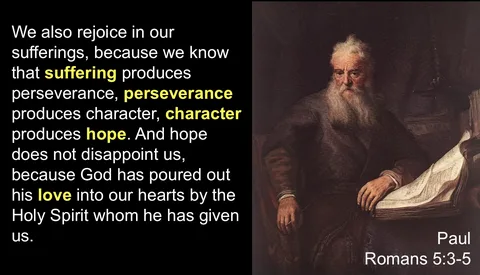
Therefore, since we have been justified through faith, we have peace with God through our Lord Jesus Christ, through whom we have gained access by faith into this grace in which we now stand. And we boast in the hope of the glory of God. Not only so, but we also rejoice in our sufferings, because we know that suffering produces perseverance; perseverance, character; and character, hope. And hope does not put us to shame, because God’s love has been poured out into our hearts through the Holy Spirit, who has been given to us.

Whenever we see the word therefore, we must ask what it is there for. In chapter 4 Paul is explaining how Abraham’s trust in God’s promises was credited to him as righteousness. He compares Abraham’s trust in God to ours who trust in Christ “who was delivered up for our trespasses and raised for our justification.” That same trust that we are not right with God, that our sins, or trespasses, have been forgiven and guaranteed by Christ’s resurrection, means we can now have peace with God through Christ. It also means in that peace we no longer have to be controlled or defined by our circumstances, even if that includes suffering. Easier said than done, as we all know.

The Apostle Paul’s Life of Rejoicing
If we think our circumstances are the key to happiness, joy, fulfillment, or peace of mind, we are in for a miserable life. Having experienced seven decades of life, and counting, I can report that will never happen. And when our idea of perfect circumstances does show up once in a while, life plays a cruel joke on us, and we find getting everything we thought we wanted doesn’t fill the void after all. The reason is that only one thing can bring true satisfaction, and that is God Himself in Christ in our right relationship to our Creator. The Apostle Paul tell us what “the secret” of true contentment is:

11 I am not saying this because I am in need, for I have learned to be content whatever the circumstances. 12 I know what it is to be in need, and I know what it is to have plenty. I have learned the secret of being content in any and every situation, whether well fed or hungry, whether living in plenty or in want. 13 I can do all this through him who gives me strength. (Phil. 4)

Because of secularism, the cultural air we breathe, people are obsessively focused on the here and now, but it offers cold comfort when the “stuff” hits the fan. Wait till you see all the “stuff” that hit Paul’s fan, and maybe we’ll think twice before complaining about pretty much anything. If we think we have it tough, let’s compare our lives with the Apostle Paul’s, this man who literally changed the world and brought untold blessings to now billions of people. Remember, if it wasn’t for the Apostle Paul nobody would likely have ever heard of Jesus. This is what God allows to happen to the most consequential man in human history:

 I have worked much harder, been in prison more frequently, been flogged more severely, and been exposed to death again and again. 24 Five times I received from the Jews the forty lashes minus one. 25 Three times I was beaten with rods, once I was pelted with stones, three times I was shipwrecked, I spent a night and a day in the open sea, 26 I have been constantly on the move. I have been in danger from rivers, in danger from bandits, in danger from my fellow Jews, in danger from Gentiles; in danger in the city, in danger in the country, in danger at sea; and in danger from false believers. 27 I have labored and toiled and have often gone without sleep; I have known hunger and thirst and have often gone without food; I have been cold and naked. 28 Besides everything else, I face daily the pressure of my concern for all the churches. 29 Who is weak, and I do not feel weak? Who is led into sin, and I do not inwardly burn?


30 If I must boast, I will boast of the things that show my weakness. (2 Cor. 11)

How did Paul endure all this and remain content “whatever the circumstances”? He tells us earlier in 2 Corinthians chapter 4, it is through the promise of the resurrection. Speaking of the treasure we have, “the light of the knowledge of God’s glory displayed in the face of Christ,” he says it is in us as jars of clay. It’s a powerful passage and he concludes with this:

16 Therefore we do not lose heart. Though outwardly we are wasting away, yet inwardly we are being renewed day by day. 17 For our light and momentary afflictions are achieving for us an eternal glory that far outweighs them all. 18 So we fix our eyes not on what is seen, but on what is unseen, since what is seen is temporary, but what is unseen is eternal.

If all the physical and mental sufferings Paul endured are “light and momentary afflictions,” what in the world am I complaining about! Quite the contrary, Paul tells us suffering does something good in us, thus we can rejoice in it.

The Benefits of Suffering
As I typed those words I thought to myself, that sounds absurd; but it’s an absolutely Christian idea. There have also been plenty of non-Christians, and philosophies and religions, who agree, but they don’t have anything to anchor those benefits: the perspective of my being in a reconciled relationship as a sinner to my holy Creator God. Not to mention our Savior and Lord who was a suffering servant. In the post-Christian West, however, suffering is to be avoided at all costs. Because they have their feet firmly planted in mid-air, secular people enjoy their lives only to the degree they are devoid of suffering and struggles. One of our most popular greetings, “How’s it going?” reveals this. Have you ever regretted asking someone this as they complain about all the woes in their life? Me too.

This is why a long time ago I changed my answer to that question. First, as I taught our children, nobody really cares how we’re doing—people care about themselves not you! Back in the 1990s my wife and I were active in the Amway business. (You youngsters probably don’t know what that is). Part of the vibe of the business was positive thinking. We were exposed to an author and motivational speaker named Charlie “Tremendous” Jones who wrote a book called, Life is Tremendous! He took the name because when people would ask him how he’s doing, he would always say, “Tremendous!” Ever since I do the same, but I use the word terrific. It’s amazing when I do that how most people perk up in surprise, often saying how refreshing that is, or asking why. It’s a great opportunity to bring up Jesus! I also consider it an act of service and blessing so they encounter the blessings of God through me. I smile, look them in the eyes, affirm their existence, and thank them for their service. I love doing that! Unfortunately, it is a rare commodity nowadays. Why isn’t everyone like that? All Christians should be, but the answer is circumstances, in which secular people live and move and have their being, instead of God.

As we saw above, Paul tells us the benefits of suffering come from turning us into different people. This change in who we are is true for non-Christians as well, as it is for Christians who are not walking intimately in communion with their Savior. Suffering affects us and alters how we see everything, and most importantly God. As an example, I will tell you about young Luna, 22, who has cut my hair the last three times at Great Clips. It was a wonderful experience being able to share the hope of God in Christ because I knew from our previous interaction that she’s not a Christian. I asked her this time if she believed in God, and she hesitated. She said she believed more in the universe, that God is a force. I asked her why, and basically it came down to life is hard. How could there be a personal God, she seemed to be saying, when there’s so much suffering. I said, at least with a personal God you can complain to him, but to an impersonal universe, not so much. Not to mention, the world is full of persons, so it makes sense God would be personal. She’s going on the heathen prayer list.

Christian Suffering Transforms the World
The Christian approach to suffering doesn’t mean we’re stoics, and that suffering is to be endured as if it wasn’t suffering. No, it’s called suffering for a reason because in it we suffer, we feel pain and sorrow, and expressing those emotionally is part of the deal. In itself suffering is not good, but a reflection of living in a fallen world among fallen people in a fallen body. It is okay to get frustrated and angry and wonder why. As we experience these unpleasant things, we then need to go to the throne of grace and give thanks for all of it. That can obviously be very difficult to do, but we must do so in obedience to God. In I Thessalonians 5 Paul tells us what that obedience looks like:

16 Rejoice always, 17 pray continually, 18 give thanks in all circumstances; for this is God’s will for you in Christ Jesus.

Because we’re sinners and suffering is hard and unpleasant, we will not be able to do this consistently, but that’s what repentance is for. After we repent, then we pray for that endurance that produces character. That word in Greek means to be proved through testing and to remain true. In other words, we are not fair weather Christians when the going gets tough. We refuse, like Job, to curse God and die. When we remain true to our Lord and Savior, we will have hope, and as Paul says, hope does not put us to shame. That word in Greek is interesting. It literally means, to curse vehemently, a verb variously translated as shame, disgrace, bring to shame, put to utter confusion, frustrate. Once we’ve developed the character produced in us by suffering, the experience of suffering, no matter what kind of suffering it is, has no power any longer to do these things to us. We call that liberty! It won’t surprise us that this passage where Paul makes this declaration in 2 Corinthians 3 (verse 17) is about hope. We are no longer slaves to our circumstances! Even when they involve suffering.

Of the many things Christianity brought to the world, among the most powerfully transforming was this endurance in the face of suffering. Along with love and service, it changed the world from the ancient pagan world into the modern world. Caesars and all the tyrannical leaders of the world ever since fear Christians who refuse to submit to their tyranny. They have no power over Christians because death for us, as terrifying as it is, it not the end, but only the end of the beginning, for forever. Something that scares all tyrants are these words of Jesus:

Do not be afraid of those who kill the body but cannot kill the soul. Rather, be afraid of the One who can destroy both soul and body in hell.

Most of us are familiar with the horrible persecution Christians had to periodically endure for three centuries until Constantine converted to Christianity in 313. While we as Christians love and affirm life, it is not in any way ultimate to or for us. Our hope is in God alone, in the resurrection of our bodies because we have a resurrected Savior. That, brothers and sisters, is the only true and ultimate source of liberty, and it transforms wherever it goes.

Does God Do Miracles Today? He Most Certainly Does!

Does God Do Miracles Today? He Most Certainly Does!

That’s kind of a trick question because the moment you see or hear the word miracles you think of, well, miracles! You know, the stuff Jesus did in the gospels and the Apostles in Acts, mostly having to do with physical healing. This post, however, is not about those kind of miracles. I have something much more profound in mind. Do I have your curiosity yet? Well, keep reading.

The reason for this post, and it’s been brewing for a while, is a conversation I had earlier this year with some family members. They asked me if I believed God still did miracles today, and so the discussion went down the physical healing rabbit hole. In one way it’s a silly question. If God is God, then of course he can and does heal, and he does things out of the ordinary from what would happen in the regular course of events. I don’t remember exactly the way the conversation went, but any talk of miracles of a physical kind must start with a biblical, redemptive-historical perspective.

The Nature and Purpose of Biblical Miracles
Biblical miracles are not magic. Their purpose is never to display raw power but to move forward God’s redemptive purposes in history. That’s why they are so rare in biblical history, which might surprise those who’ve never read the Bible. Miracles cluster around three significant redemptive periods, each affirming the message that God works in history to save His people. The first is the Exodus, and the events surrounding it. Another six or seven hundred years would pass before miracles occur again in Israel with the rise of the first prophets, Elijah and Elisha in the 9th century BC. One might think the prophets who follow performed miracles as well, but that was not the case. Even John the Baptist, the great forerunner of the Messiah who is compared to Elijah, did not perform miracles. It seems he would be the perfect person to utilize miracles to support his message, and an invented John the Baptist likely would have, but what we read in the gospels is real history of the real Baptist—no miracles. The third cluster of miracles would surround the greatest miracle worker in biblical history, Jesus of Nazareth, and his first followers.

There was nothing in Israel’s history close to the voluminous miracles performed by Jesus and the Apostles, so we are compelled to ask why. Remember that no Jew in the first century expected anything but a super-human Messiah, but human, nonetheless. They were looking for a king like David to overthrow their latest oppressors, the Romans. Their self-conception going back to the Exodus was that Jews are not slaves or servants of any earthly power, and the indignity of their Roman conquerors was unbearable. They had no choice but to suffer, until, that is, the long-awaited Messiah came to liberate them. They weren’t interested in some itinerant Jewish preacher healing people. As popular as that made Jesus in a time before the healing arts and knowledge of our day, it wasn’t enough to prove he who he said he was. Yet, ironically, it was the miracles that gave him credibility, and most importantly authority. The latter word is critical for a discussion of miracles. We’re not discussing whether God can perform miracles or not. That is not relevant to the discussion because we all know that that’s part of God’s job description. The question given miracles were so rare in redemptive history is, what were they for, what was their purpose, and do miracles today have the same purpose.

The ultimate miracle, Jesus coming back to life after being brutally tortured and killed on a Roman cross, was what earned him the ultimate authority in the universe. He himself tells us so in the Great Commission, that “all authority in heaven and earth” had been given to him. He ascended to sit at the right hand of God to exercise that authority, but he gave that authority in his name and power to the Apostles and prophets to build the foundation of the church. As Paul tells us in Ephesians 2:

19 Consequently, you are no longer foreigners and strangers, but fellow citizens with God’s people and also members of his household, 20 built on the foundation of the apostles and prophets, with Christ Jesus himself as the chief cornerstone. 21 In him the whole building is joined together and rises to become a holy temple in the Lord. 22 And in him you too are being built together to become a dwelling in which God lives by his Spirit.

The purpose of the miracles was to establish the foundation, and once it was established there was no need to continue the miracles. After the Apostles died there is no record of individuals performing such miracles in the church in the following centuries. That miracles were unique to the Apostles is also clear from reading through Acts and seeing specifically how God used Peter and Paul’s miracles to give authority to the messengers and the message. Once that authority was inscripturated there was no longer a need for specific individuals to display God’s healing power in such a way.

The purpose of this post, however, isn’t to fully argue this case but to explore miracles far greater than physical healing.

Love is the Drug I’m Thinking Of
I hope that title makes you laugh because you can hear the song in your mind as soon as you read it. That most definitely is not the love I’m thinking of. The greatest miracle, and to me one that proves without a doubt God exists, is when two sinners love one another. That is miraculous! One definition of a miracle is doing the impossible, and there is nothing more impossible than when a self-centered sinner loves another self-centered sinner. But what exactly makes this love so seemingly impossible? Well, that depends on what we mean by love.

The love of God in Christ has nothing to do with what our secular world means by love because that love is driven by feelings, and biblical love is not. Worldly love is easy because it is oriented to the fulfillment of self, while biblical love is self-sacrificial. And to add biblical insult to injury, biblical love is a command and we love others in obedience to God like it or not. As Christians we don’t have a choice. In Romans 13 , Paul says it is a debt we owe, and that to God. We can see the difference in the Greek word most often used for love in the New Testament, agape-ἀγάπη, or love which centers in moral preference. That simply means right action for the good of the other. Because it is fundamentally a choice, biblical love is a verb, a word that expresses an action, an occurrence, or a state of being. The feeling is ultimately irrelevant. In fact, true love happens when we don’t feel like it and don’t want to do it. I have a couple stories from my past about how I learned that the hard way.

When I was in college I was involved in a Christian campus ministry. One Saturday we went to a swap meet to try to sell stuff and share the gospel. When I was ready to go back to school at the end of the day, the head of the ministry, an older guy probably in his thirties at the time, said he wanted to go back with me. I didn’t realize he had an ulterior motive—my sanctification. Mike was a guy who could be blunt and had eyes that looked right through you. He could be intimidating. Pulling no punches he comes right out and says, “You’re not a very nice person to be around. You always want people to think like you, and you make them feel bad if they don’t.” And words so related. I was devastated. That night back in the dorm I experienced what is called a dark night of the soul. I told God not only can I not love people; I also don’t want to! At that moment this Christianity thing felt impossible, and I didn’t think I could do it. Thankfully, that was a Saturday, and the next morning I went to church. Whether it was in the sermon or a verse I read, God said something along the lines of, Of course, you can’t do it, but I can do it through you! I remember an instant change from despair to hope.

The next lesson came after I’d graduated from seminary and was working at a small Christian liberal arts college in their communications department. I was 28 at the time, and worked with a young lady who was terribly annoying. At some point I started complaining to God, well, it was more like whining. I’d had several jobs previously where I worked with women who were annoying, and I asked God why yet again I have to work with another person who is so annoying. As the saying goes, if you don’t want to know, don’t ask. And I could swear I heard a voice say out loud, “To teach you how to love her, ya moron!” Well, maybe not the last part, but it would have been fitting. Of course that is what love is for. It doesn’t have much value when we love people who are easy to love. I’m not sure those people exist, but you get the idea.

I’ve used this story many times over the years telling friends and family what they don’t want to hear. Not one ever said, thank you for sharing that. I can’t wait to love! One especially precious moment happened when I told this to a young family member as he was dealing with another difficult relative. He was lying on the floor on his back, and he started shaking his head saying over and over, no, no, no! Basically just like me, I don’t want to! Well, I told him, if you’re a follower of Christ you don’t have a choice. It is important to understand, though, that this kind of divine love is not demeaning; we don’t become doormats, but it allows us to have relationships that flourish in a way they never could when self is the central focus of our lives. It is impossible love made possible, and it transforms lives wherever it goes.

The Radical Death-Life in Christ
The main reason I wrote this post now was because of recently reading Romans 8. Paul explains how there is no condemnation for those who are in Christ Jesus because through Christ Jesus the law of the Spirit of life has set us free from the law of sin and death. He goes on to explain what it means to share in Christ’s death to sin because we no longer live according to the flesh but to the Spirit. Here is how this works:

Those who live according to the flesh have their minds set on what the flesh desires; but those who live in accordance with the Spirit have their minds set on what the Spirit desires. The mind governed by the flesh is death, but the mind governed by the Spirit is life and peace.

In the past I related passages like this to morality, but never connected it to love. If you think about it, though, what our flesh desires, the sin principle that lives in us, desires our self-fulfillment. It’s all about me! That is why it always leads to death, and not life and peace. When Jesus commanded us to love our enemies, he showed us what that meant by dying for we who were his enemies. He also said following him in his example would be equally as difficult:

23 And he said to all, “If anyone would come after me, let him deny himself and take up his cross daily and follow me. 24 For whoever would save his life will lose it, but whoever loses his life for my sake will save it.

I want to suggest for your consideration that this has far more to do with loving other sinners than it has to do with being a good moral person, as important as that is. Sin is ultimately relational, first with God, then us, then others.  In Romans 12:1 Paul tells us because of God’s mercy to us, we are to offer our bodies as a living sacrifice, which is holy and pleasing to God. And he adds something amazing. Doing this is our reasonable, rational, logical service or worship of God. It makes total sense logically in light of everything He has done for us in Christ. We are then compelled to love others. And when you read verse 2 you will see he will tell us how we are to do it, even if much of the time we’re not quite sure. Paul tells us, though, we can “test and approve” what that is.

So, when we interact with someone who absolutely drives us up the wall, that is when the loving rubber meets the road. It applies to the mildly annoying people as well. That’s when we must take up our cross die to our flesh and ask ourselves, or better the Lord, how in the world do I love this person! And also repent that we just don’t want to. Then get on with it. Just remember it will not be easy. That is how you know it is true love.


The Hound of Heaven-Francis Thompson (1859–1907)

The Hound of Heaven-Francis Thompson (1859–1907)

I’m bummed out that I was born AP, After Poetry. I don’t think that was 1960 yet, the year of my birth, but I’m confident the slide away from poetry in American life was well underway by then. The only real experience I had of it growing up was rock n’ roll music, the poetry of my youth. Outside of that, poetry left me dry. As I grew older and came to learn how indispensable poetry was in the history of the human race, I wanted to enjoy it. Unfortunately, I could never make myself do so. I glimpsed the beauty from afar, the allure, but couldn’t quite grasp it. It would always leak through my fingers before I could taste its sweetness. Since it’s not a normal part of our lived lives anymore, it has to be taught, practiced, and experienced to be appreciated. The Hound of Heaven by Francis Thompson written in 1898 would be a very good poem to start with.

I was recently on a podcast sharing my testimony, and I used the phrase hound of heaven several times because it so perfectly captures my reluctance to embrace Christ, and not only initially. It also wonderfully communicates God’s sovereign persistence that Jesus will have those he came to save (Matt. 1:21). I see the poem through much of my Christian life as God was slowly but surely sanctifying me whether I liked it or not. As a Christian of the Reformed, Calvinistic persuasion, I am convinced God saves His people to the uttermost, from the beginning of the journey to the end. We haven’t a chance to get away—the Hound always wins. As Augustus Toplady wrote in the timeless hymn, Rock of Ages, Jesus is the double cure for sin; we are saved from God’s wrath and made holy or pure. In theological terms we call that justification and sanctification. It’s a package deal.

I’ve listened to a lot of testimonies over the last several years, and my experience with the Hound of Heaven is not unique. I’m even reading a book now with the fascinating title, Coming to Faith Through Dawkins: 12 Essays on the Pathway from New Atheism to Christianity. Fleeing the Hound of Heaven seems to be the normal state of affairs for Christians to one degree or another. We’re persistent little sinners, and breaking the habit of wanting to be our own God is not easy; it comes to all of us like water running down a hill. I’m currently reading the last essay of a young woman who tried to get to truth through the New Atheism and psychedelic drugs for six years. Some people are really committed to getting away. About those years she writes,

All of it had left me here, crawling toward the cross, protesting and begging for some other way, some other rescue for the hell of my own creation than “this Jesus person.” . . .

Now that’s a serious commitment! Whatever the nature of our attempted escape, God is bigger than our sin and rebellion. He is creative and powerful enough, and loves us enough in his Son, that he uses our sin to coax us to fall in love with Him. Whatever form that coaxing takes, I guess that’s kind of up to us; not sure how all that works. Regardless, it’s a breathtakingly beautiful thing to behold in oneself as it happens, and joyfully amazing to witness it in others. God’s creativity is ever amazing in how he woos His people to Himself.

Christians experiencing the Living God like this, the existential dynamic of a real omni-everything being demonstrably in their lives, is possibly the most powerful apologetic for the Christian faith. Mere psychology and made up human ideas do not do this, cannot do this. Something merely coming out of the human brain does not have this power over such a prolonged period of time over so many different kinds of people, in every language and every socioeconomic strata of every kind of society. We won’t be surprised this was the plan all along. God’s promises to the Patriarchs was always to the nations, to people, as John says in Revelation, “from every nation, tribe, people and language.” It’s a beautiful tapestry only the Living God could weave, and finish!

Let’s do a little amateur exegesis on the first stanza of the poem.

I fled Him, down the nights and down the days;
I fled Him, down the arches of the years;
I fled Him, down the labyrinthine ways
Of my own mind; and in the mist of tears
I hid from Him, and under running laughter.
Up vistaed hopes I sped;
And shot, precipitated,
Adown Titanic glooms of chasmèd fears,
From those strong Feet that followed, followed after.
But with unhurrying chase,
And unperturbèd pace,
Deliberate speed, majestic instancy,
They beat—and a Voice beat
More instant than the Feet—
‘          All things betray thee, who betrayest Me.’

We could park on these words for days to mine the meaning of each of these evocative phrases for our own lives. Several years ago I realized I hadn’t actually ever read the entire poem, so I printed it out and kept it beside my bed to read before I retired. Each time through I felt I could relate to Mr. Thompson more. I also felt the power poetry must have had for previous generations.

I too fled, in too many ways to count, in days and years and confusing ways. I had to look up the word labyrinthine, although I know what a labyrinth is:

The adjective labyrinthine describes something that is as confusing, complex, or maze-like as a labyrinth. This could be an actual maze, a city, or even a convoluted idea. The word comes from the Greek labyrinthos, the structure built to contain the mythological Minotaur. In the story, Daedalus did such a good job making the building labyrinthine that he nearly couldn’t find his way out.

How perfect is that! We get so confused in our fleeing that we feel like we’ll never find our way out. I mean, it looked so clear when I took that turn; that way seemed so right to me. Alas, as God tells us, “There is a way that seems right to a man, but in the end it leads to death” (Prov. 14:12).

Of my own mind; and in the mist of tears
I hid from Him, and under running laughter.

Who has ever fled from God when God was actually after them, and enjoyed it? We flee God’s word because it’s too convicting to think about. Our own rebellious thoughts are too sweet that even in the midst of tears we’ll try to convince ourselves things are happy and fine. Instead of turning around and repenting, we speed up thinking true fulfillment lies somewhere else other than the Hound chasing us.

          Up vistaed hopes I sped;
And shot, precipitated,
Adown Titanic glooms of chasmèd fears,
From those strong Feet that followed, followed after.

I think I’m going up, and all I do is accelerate down. Life is scary and challenging enough with God, but without Him? Thompson is using big, massive images to convey what it’s like to really get our wish and have God just leave us alone. Even as we’re running away and getting more miserable, we flee. I’ve heard it said that evil is irrational, and indeed it is. We think it will give us what we want, long for, but it gives us just the opposite, and yet we go in for more. Mind you, this doesn’t have to be an active rebellion like our drug addled friend above. Ignoring God and His word, pursuing whatever our own selfish interests might be, will do just fine—for many rebellion looks like apathy.

Thankfully, these “big Feet” relentlessly follow us, and as I often say, God is never in a hurry:

          But with unhurrying chase,
And unperturbèd pace,
Deliberate speed, majestic instancy,

Even in our salvation (justification and sanctification) he works methodically at His own pace because only He knows perfect timing and every single thing about us. For Thompson, these “big Feet” represented something deep inside him he could not deny no matter how far he fled:

They beat—and a Voice beat
More instant than the Feet—
‘All things betray thee, who betrayest Me.’

At some point in this journey of escape from God, all those things that promised to fulfill the God shaped vacuum in us leave us cold and empty. It’s a betrayal because they promise so much, and deliver so little. As Tim Keller often said, idolatry is turning good things into ultimate things, and all idols eventually lead to destruction.

I won’t explore the next stanza, but read it and experience the beauty and truth and see if you can relate. The entire poem is worth the effort, and maybe it will kindle a desire to have more poetry in your life.

          I pleaded, outlaw-wise,
By many a hearted casement, curtained red,
Trellised with intertwining charities;
(For, though I knew His love Who followèd,
Yet was I sore adread
Lest having Him, I must have naught beside).
But, if one little casement parted wide,
The gust of His approach would clash it to.
Fear wist not to evade, as Love wist to pursue.
Across the margent of the world I fled,
And troubled the gold gateways of the stars,
Smiting for shelter on their clangèd bars;
Fretted to dulcet jars
And silvern chatter the pale ports o’ the moon.
I said to Dawn: Be sudden—to Eve: Be soon;
With thy young skiey blossoms heap me over
From this tremendous Lover—
Float thy vague veil about me, lest He see!
I tempted all His servitors, but to find
My own betrayal in their constancy,
In faith to Him their fickleness to me,
Their traitorous trueness, and their loyal deceit.
To all swift things for swiftness did I sue;
Clung to the whistling mane of every wind.
But whether they swept, smoothly fleet,
The long savannahs of the blue;
Or whether, Thunder-driven,
They clanged his chariot ’thwart a heaven,
Plashy with flying lightnings round the spurn o’ their
feet:—
Fear wist not to evade as Love wist to pursue.
Still with unhurrying chase,
And unperturbèd pace,
Deliberate speed, majestic instancy,
Came on the following Feet,
And a Voice above their beat—
‘Naught shelters thee, who wilt not shelter Me.’


The Christian Life of Repentance

The Christian Life of Repentance

Martin Luther nailed his world-changing 95 Theses to the church door in Wittenberg on October 31, 1517. Writing in Latin to engage clergy in debate about the propositions, not to start a Reformation, it was translated into German and because of Guttenberg’s press soon spread all over Europe and started a spiritual and cultural conflagration. Whether or not Luther intended it to be the most important, the first thesis certainly is:

When our Lord and Master Jesus Christ said, “Repent” (Mt 4:17), he willed the entire life of believers to be one of repentance.

The longer I’m on this journey with Jesus the more I understand how true this is. There was a time in Jesus’ ministry when he was eating with “tax collectors and sinners.” The religious professionals didn’t like that one bit, so Jesus said to them, “It is not the healthy who need a doctor, but the sick. I have not come to call the righteous, but sinners.” Here we see the essence of the Christian life. Those who think they’re doing fine, who see themselves as morally healthy, will see no need for a Savior. On the other hand, those who have a conscience beset by doubt about their own moral worth know they need something. Whether that brings them to a Savior is God’s work.

When reading this passage in Luke 7 recently I was struck by repentance as almost a Continental Divide in the human heart:

29 All the people, even the tax collectors, when they heard Jesus’ words, acknowledged that God’s way was right, because they had been baptized by John. 30 But the Pharisees and the experts in the law rejected God’s purpose for themselves, because they had not been baptized by John.

Luke doesn’t tell us here what the baptism of John meant, but in chapter 3 says it was a “baptism of repentance.”

Before we explore that, we need to understand that repentance doesn’t save someone, as if being sorry for our sins somehow makes us acceptable to God. Prior to his conversion, Luther basically thought it did. Catholic teaching calls it the Sacrament of Penance, and Luther took it to mean he needed to pay for his own sins through self-inflicted suffering. Mercifully, God saved him from himself and triggered the Reformation as he was studying and teaching the book of Romans. He came across this verse in chapter 1:

17 For in the gospel the righteousness of God is revealed—a righteousness that is by faith from first to last, just as it is written: “The righteous will live by faith.”

The proverbial lightbulb when on for Luther, and the direction of Western civilization changed in that moment. He realized no matter how sorry he was, no matter how much repentance or penance he engaged in, he could never make himself righteous before God. The righteousness of God, he now knew, could only be had by faith, by trust, not by works. All of a sudden he saw the good news! We Evangelicals who are all about the gospel sometimes fall into this trap. We’ll tend to think the more I feel sorry for my sin, the worse I feel about it, acknowledge how worthless and horrible a sinner I am, the more God will like me, or something like that. God doesn’t forgive us, though, based on how sincere our confession or repentance is, but because of Christ. Thus the Apostle John writes in I John 1:9:

If we confess our sins, he is faithful and just and will forgive us our sins and purify us from all unrighteousness.

I’ll never forget hearing Chuck Swindoll preach on this verse saying because God is just he has no choice; he has to forgive our sin when we confess. Our feeling of remorse isn’t the issue. Because of what Christ accomplished for us in his life, death, resurrection, and ascension, God in His justice has to forgive us. Do we feel horrible and guilty for our sin? Of course, or we should, but that’s not the thing. The reason God forgives us is His integrity not how sorry we are. We simply look to the cross and we know.

Theologically, this is based on a covenant, a promise, the eternal Triune God made with Himself prior to creating the world—it is that which determines our salvation, not us. This is known as the covenant of redemption. When the creation fell into sin through man’s rebellion, God promised He would save it by giving a people to the Son who would save them (election in biblical terms). After Jesus accomplished redemption for His people (Matt. 1:21), he ascended to His coronation as king in heaven sitting at the right hand of the Father, and from there sent His Holy Spirit to apply the redemption He had accomplished on earth. Here is where we get back to the passage in Luke 7 and consider the meaning of repentance.

What Came First, The Chicken or the Egg
Those who were baptized by John having repented of their sins were able to “acknowledged that God’s way was right.” Those who did not, who “rejected God’s purpose for themselves,” could not acknowledged that God’s way was right. They were unable to do so because they refused to repent and be baptized. This is the proverbial chicken and egg question. What came first, the change of heart toward God then the repentance, or repentance then change toward God? Of course, you can’t have one without the other; no chicken no egg, no egg no chicken. You need both. Looked at theologically, though, man is dead in his sin (Gen. 2:17, Rom. 6:23, Eph. 2:1) and so by sinful nature it is impossible for him to repent. Thankfully, Jesus gave us the answer to the chicken and egg question about sinful human beings and salvation in his discussion with Nicodemus in John 3. The pious Pharisee told Jesus he must be from God because of the miracles he was doing and

Jesus replied, “Very truly I tell you, no one can see the kingdom of God unless he is born again.”

The phrase translated born again can also mean from above or from heaven. Nicodemus is appropriately confused as are most people who encountered Jesus, and he asks him how such a thing can be. Jesus answers that this happens by being born of the Spirit, that’s how one is born again, born from above. So repentance comes as a result of God’s working in our hearts, it does not cause God to work.

This is consistent with what Jesus also says later in John’s gospel about the mission of the Holy Spirit when Jesus sent him after he has ascended to the Father (John 16):

And when he comes, he will convict the world concerning sin and righteousness and judgment: concerning sin, because they do not believe in me; 10 concerning righteousness, because I go to the Father, and you will see me no longer; 11 concerning judgment, because the ruler of this world is judged.

The Greek word convict is a harsh one, unpleasant to all we sinful human beings: to reprove, rebuke, discipline, expose, show to be guilty. His job is to reveal to us our guilt so we admit we have need of Savior. When we understand this, truly grasp our desperate state, we will repent, we can’t help but repent. The Holy Spirit exposes us for what we truly are, unworthy sinners before a holy God, rightfully condemned. Non-Christians have a hard time accepting this dynamic because it seems as I said, harsh. Why can’t God just be more accepting? They think of God as love, meaning he’s just a nice old man who forgives, forgets, and accepts everyone for who they are. He can’t do that because he is holy and just. Even secular non-Christians know they can’t even live up to their own standards, so what makes them think they can live up to the standards of a holy God? Sin!

We Christians, however, are indwelled by the Holy Spirit, and know to the depths of our marrow that we are wretched, hopeless sinners without God’s intervention in Christ. He will not let us forget or ignore our sin either, which is why I John 1:9 is so important in the Christian life of daily repentance. I begin my prayer time every morning with two things, thanksgiving and repentance, which always seems to lead to doxology, to praise and worship. We can’t help as we grow in our understanding and knowledge of God to continually marvel at His mercy and grace. Indeed, the sicker we realize we are when we come to the spiritual hospital, the more able we are to fulfill the greatest commandment to love Him and other sinners. He who is forgiven much, Jesus said loves much.

Lastly, let’s look at the Greek word for repentance, metanoia-μετάνοια, meaning a change of mind. It is clear from Luke repentance is primarily about a change of mind regarding our relationship to God, not so much about what we think of as right and wrong, good and bad. The first temptation of Satan to man was to question the character of God with the question, who gets to be God. Repentance says God is God and I am not. Kind of obvious, I know, but we’re stubborn little sinners who don’t easily give up our pretensions to godhood. Confession to Him daily that He is God and I am not, is a good way to start every day. As John and Jesus both said introducing his work, repent for the kingdom of heaven is near.


What Does “work out your salvation with fear and trembling” Mean?

What Does “work out your salvation with fear and trembling” Mean?

I’ve wondered all my Christian life why God tells us in His word that we are to “work out our salvation with fear and trembling.” I thought we were saved by God’s grace, His unmerited favor, that we’ve been saved from God’s wrath through Christ who “paid it all,” and as He says through Isaiah, “the punishment that brought us peace was upon him, and by his wounds we are healed.” I thought “there was now therefore no condemnation for those who are in Christ Jesus,” and that “since we have been justified through faith, we have peace with God through our Lord Jesus Christ.” Not only all this, but we know that “perfect love casts out fear. For fear has to do with punishment, and whoever fears has not been perfected in love.” And lastly, although I could add a lot more, Christ Jesus is “our righteousness and sanctification and redemption.” All of this is my understanding of the gospel, and doesn’t seem to jive with what Paull tells us in Philippians 2:

12 Therefore, my dear friends, as you have always obeyed—not only in my presence, but now much more in my absence—continue to work out your salvation with fear and trembling . . . .

Even though Paul continues this with, “for it is God who works in you to will and to act according to his good purpose,” he is still connecting that with “fear and trembling.”

My framework for understanding the gospel, the good news, starts with Genesis 3 after the fall when the Lord comes walking in the garden “in the cool of the day,” and because Adam and Eve have disobeyed Him they hide. They now knew they were naked and were ashamed, so they hid from their Creator. That alienation, the desire to hide or run away from God has been dealt with once for all on the cross, and everything I said about the gospel is true, yet Paul still says our redeemed and reconciled relationship to God through Christ should be characterized by “fear and trembling,” and that we need to “work out our salvation” with this attitude. Until not too long ago this confused me, but it shouldn’t have. I’ll just chalk that up to my ignorance and dullness of heart and mind. I never thought God should now be my best buddy since I’m “saved,” but I couldn’t quite imagine why Paul would use these words.

There are probably many reasons “fear and trembling” is appropriate in our relationship to our God and Savior, but most simply it comes down to He is God and we are not. I know that’s anti-climactic, but it’s true. Read through the Old Testament and see how God teaches His people how they are to relate to Him. Moses says in Deuteronomy 4:24 and 9:3 that Yahweh, Israel’s God, is a “consuming fire.” Moses experienced this directly because when he asked God to show him His glory, the Lord said, “no one may see me and live.” The tabernacle the Israelites were instructed to build included the Holy of Holies where God symbolically dwelled, and it was protected by a great curtain. Only one man ceremonially cleansed, and that only once a year, could enter without being instantly killed. We might say for sinners, holiness kills. That’s kind of a good reason for “fear and trembling,” don’t you think? Or maybe we take this relationship for granted? I’ll give you the answer: Yes we do. We’re sinners, and we’re always fumbling and stumbling around trying to get this thing right. We often don’t. That’s why Jesus being our righteous and sanctification is such incredibly, insanely, wonderfully good news!

Another reason for “fear and trembling” is that we are born-again into a spiritual cosmic drama with consequences beyond our imagining. This is extremely serious business. As Paul says, “our struggle is not against flesh and blood, but against the rulers, against the authorities, against the powers of this dark world and against the spiritual forces of evil in the heavenly realms.” This evil exists in the hearts and minds of every human being, including our own, thus we seek first He who is “far above all rule and authority, power and dominion” and alone is able to “deliver us from evil.”

As good Protestants we know none of our striving means we earn our salvation by what we do, but taking our relationship with our holy Creator God through Christ for granted is a grave error, one we too often make. It is important to understand our salvation from sin into this reconciled relationship is just the beginning. That’s the reason Jesus commands us to “seek first the kingdom of God and His righteousness.” Not second, third, or twenty-eighth, but first. If His kingdom and His righteousness, His Word, living according to His law, is not first in our lives in terms of priority, something’s wrong. What does that mean, though? Clearly it doesn’t mean giving it the most time because for most of us we have to earn a living and raise our families, not to mention enjoy the life and people God has given us. But I suggest it’s giving it the most thought, the most focus, the highest priority in all our seeing and perceiving of life as we live it. We live in a God-drenched reality, and every square inch of it, every millisecond of time, is His. So we see God in all things! As C.S. Lewis said, he believed in Christianity as he believed the sun had risen, not because he sees it but by it he sees everything else.

Paul’s exhortation that we “work out” our salvation in this way convicts most of us as lazy Christians. The Greek word Paul uses for that phrase means, strangely enough, to work! To “effect by labor,” to “achieve.” The Christian life takes effort! In several letters Paul compares it to being an Olympic athlete, and that we are to run the race with the kind of effort it takes to win the prize. It’s unfortunate most Christians know more about their careers, occupations, and hobbies than their Christian faith. That makes some sense given we spend eight or more hours a day at it, but those are not the most important things in our lives. God in Christ is! And Jesus said God’s word should be every bit as important to us as food, “For man shall not live on bread alone but on every word that comes from the mouth of God.” All of us should be theologians, which simply means the study of God. We should also be apologists, meaning we know not only what we believe but why we believe it, and then competently be able to defend it. That all takes effort! I’ll end this with the Apostle Peter’s words explaining “working out” our salvation (2 Peter 1):

His divine power has given us everything we need for a godly life through our knowledge of him who called us by his own glory and goodness. Through these he has given us his very great and precious promises, so that through them you may participate in the divine nature, having escaped the corruption in the world caused by evil desires.


For this very reason, make every effort to add to your faith goodness; and to goodness, knowledge; and to knowledge, self-control; and to self-control, perseverance; and to perseverance, godliness; and to godliness, mutual affection; and to mutual affection, love. For if you possess these qualities in increasing measure, they will keep you from being ineffective and unproductive in your knowledge of our Lord Jesus Christ. But whoever does not have them is nearsighted and blind, forgetting that they have been cleansed from their past sins.


10 Therefore, brothers, make every effort to confirm your calling and election. For if you do these things, you will never stumble, 11 and you will receive a rich welcome into the eternal kingdom of our Lord and Savior Jesus Christ.


Zechariah 3 – Joshua, Sin, and Rich Garments for Rich Living

Zechariah 3 – Joshua, Sin, and Rich Garments for Rich Living

This short chapter is one of the most powerful and revelatory in all of Scripture. Zechariah prophesied during the time of Judah’s restoration after the exiles had returned from their seventy years in Babylon and were rebuilding the temple in Jerusalem, around 520 to 470 BC. I’ve always been impressed by the presentation of the unique and unmistakable portrayal of the gospel in this chapter, and in how few words it’s done. It unmistakably magnifies God’s grace and mercy, but something else stood out to me in this specific period of learning in my life, something flowing out of God’s mercy and grace: our obedience and the blessings flowing from it. In other words, we are saved unto good works. The forgiveness of our sins and restoration of our relationship to our Creator God should manifest itself in the life we live, and transformed lives will transform the world.

In the past I always focused on the gospel side of the implications represented, we might say the Protestant side. Our understanding is that Jesus’ death on the cross was a substitutionary atonement for our sin: because he paid the price, death, for our sin, and by faith (i.e., trust) we are legally granted his righteousness before God. This was always a challenge for Christianity because sinful human beings will often jump to the non sequitur; since we’re saved by grace it doesn’t matter if we sin. The Apostle Paul had to deal with this because it’s an ever present temptation as we read in Romans 6:

What shall we say, then? Shall we go on sinning so that grace may increase? By no means! We who died to sin; how can we live in it any longer?

“By no means” can be translated as may it never happen, never be born, never come to be. It should be literally unimaginable to us. Alas, we are still sinners so sin will happen, but that is why Christ is our righteousness, sanctification, and redemption (I Cor. 1:30), yet there is never any excuse for sin. This struggle highlights another focus of this chapter, the spiritual war we are part of, but more on that in a minute. First, the gospel presentation here is just too good not to review.

It is no coincidence the story is about Joshua or Yeshua (Jesus’ name), the High Priest who was the first man chosen to be the High Priest for the reconstruction of the Temple. He is in the process of being accused and condemned by Satan and is portrayed wearing “filthy clothes.” There is an historical reason for that given the exiles had recently returned from Babylon and Temple worship was just getting started again. The important thing is that the Lord commands these be taken off, and he’s told: “See, I have taken away your sin, and I will put rich garments on you.” The Lord does this pointing forward with three Messianic references. The first is by sending “the Branch,” a common Messianic reference in the prophetic writings. There is also a stone with “seven eyes” (all seeing, all knowing), and then the final reference, the Lord Almighty will “remove the sin of this land in a single day.” Which is also clearly a Messianic reference, one the Jews could never conceive happening in the way it actually did. It is only exactly the way it did happen that gives us hope that our sin has been removed, and we have been clothed with “rich garments” of righteousness.

What I love about how God presents the gospel in this chapter is the direct connection between being granted His righteousness, His call to obedience, and the implied blessings that results if we “walk in His ways.” Once the clean garment is put on Joshua, the angel of the Lord gives him this charge:

This is what the Lord Almighty says: “If you will walk in obedience to me and keep my requirements, then you will govern my house and have charge of my courts, and I will give you a place among these standing here.”

In the prophets there is often more than one meaning in a text, which is clearly the case here. While this is spoken to the High Priest Joshua in that historical moment, it is also spoken to our High Priest Jesus of Nazareth who obeyed the law perfectly for us, and now governs all of God’s house, all of creation from God’s right hand.

Then after the sin of the land is removed in “a single day” we’re told:

10 “‘In that day each of you will invite your neighbor to sit under your vine and fig tree,’ declares the Lord Almighty.”

God forgives our sin so we can be reconciled to Him, our Creator. Out of that reconciliation flows a changed heart that slowly (sanctification) orients our lives from self to God and others, thus the greatest commandment encompassing all the law and the prophets, love the Lord your God with all your heart, soul, and strength, and love your neighbor as yourself. God changes our affections to desire the right things, as Augustine said, He gives us right ordered loves.

God want to bless us, but He will not bless sin. This is why Paul in Ephesians 5 talks about the fruit of the Spirit—love, joy, peace, patience, kindness, goodness, faithfulness, gentleness and self-control—because exhibiting these traits to others, and ourselves, will bless us, make us happy, fulfilled, make life truly enjoyable and compelling. Compare it to the “acts of the flesh,” and there is no comparison. If you want to be miserable, do those things. This is all fleshed out, so to speak, in the context of an unimaginable, to us, cosmic spiritual war.

The Lord of Hosts

Notice the one who is making all this happen is The Lord Almighty, translated in other versions as the Lord of Hosts or the Lord of Armies. Yahweh, our God is the God of war! In fact, this adjective is the most common associated with Yahweh in the Old Testament, used upwards of 280 times. But God doesn’t wage war as the world does because the war, as Paul tells us in Ephesians 6:12 is “not against flesh and blood, but against the rulers, against the authorities, against the powers of this dark world and against the spiritual forces of evil in the heavenly realms.” We also see Christ conquering evil in Revelation with a “sharp, double-edged sword” coming out of his mouth. And the writer to the Hebrews tells us, “For the word of God is alive and active. Sharper than any double-edged sword, it penetrates even to dividing soul and spirit, joints and marrow; it judges the thoughts and attitudes of the heart.”

We get a glimpse of our Lord or Hosts in the first two verses of this chapter with Satan accusing and the Lord defending this man, Joshua the High Priest, who is “a burning stick snatched from the fire.” No matter how pathetic we are, He goes to war for us. But that requires, as Jesus says, seeking first his kingdom and His righteousness through daily prayer and time in His Word (for man shall not live on bread alone but on every word that comes from the mouth of God), daily repentance and thanksgiving, and obedience to his law. As the Lord says to Joshua, “walk in obedience to me and keep my requirements,” and He will bless our efforts as pathetic as they may be. He wants us to live as richly as the garment of righteousness he’s placed on us.