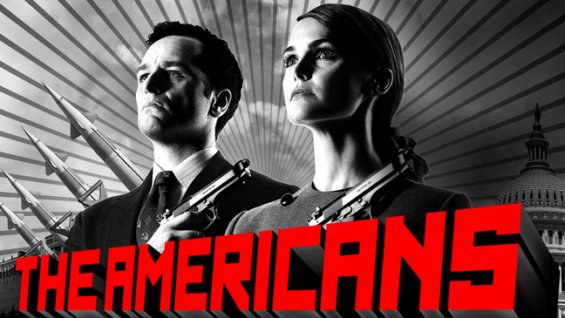
The FX show The Americans is set in the Reagan era Cold War 80s. Two Soviet intelligence agents, Keri Russell and Matthew Rhys, pose as a married couple to spy on the American government. They didn’t know each other prior to meeting in America, and are tasked with living a completely normal suburban American life, helped along with their two kids who have no idea mom and dad are agents of America’s sworn enemy.
For those too young to remember life in a Cold War world, The Americans an excellent pop culture introduction to the time. For those old enough to remember, it’s a great nostalgia trip. And for those who like solid drama with a lot of moral ambiguity, there’s plenty of that too.
The reason I wanted to write something about the show isn’t to necessarily promote it, although for adults not squeamish about television portrayals of sex and violence it’s well worth the time. Rather, I came across a piece at an online (generally liberal) publication called Vox that affirms one of the central tenants of my book about keeping your kids Christian: “The Americans has always been a show about faith.” Having watched the show over four seasons, it is about anything but “faith,” as most Americans would understand the term; i.e. it’s not about religion. A liberal version of Christianity is part of the show, but the show itself if focused on two communists who are atheists. When I read the piece I was pleasantly surprised by the case the author was making: Everyone lives by faith.
In my previous post I wrote about the word of the year, “post-truth,” and how the triumph of the subjective makes assertions of Christianity as true, or anything as true for that matter (outside of scientific claims), problematic for many of our neighbors. The cultural obsession with the self, reflected in various ism’s (relativism, scientism, skepticism, postmodernism), has lead to people believing that the self is the ultimate authority on everything it surveys. In such a cultural milieu it won’t surprise us that our latest adult generation in the West, those called millennials, are considered the most narcissistic generation ever.
The ancient myth of Narcissus is about a youth who spurned suitors, and then became so taken with the beauty of his image reflected in water that he dies (or kills himself) because he realizes he can never obtain the object of his desire, himself. Though ancient Greek and Roman pagans had no revealed knowledge (i.e., the Bible) of the fallen nature of man, it was clear to many of them that the obsession with the self was endemic to human nature and ultimately self-destructive.
I saw this title at the Intellectual Takeoutwebsite, and was instantly curious. Two of the first three chapters of my book are on truth and epistemology, so I’m a big believer that philosophy is not exactly tangential to keeping our kids Christian. Most Americans, Christians included, think philosophy is only relevant to pointy headed intellectuals, with no bearing on everyday life. These people would be wrong.
Everyone has a philosophy, whether they know it or not, or think through it or not. Most Americans, Christians included, uncritically swallow the philosophical assumptions of our secular culture, and live out their implications in their daily lives. How and what we think about things could not be more profound or practical, which makes the average Christian’s ignorance of these four scary horsemen lamentable. They were originally given this designation by a philosopher of education named Robert Maynard Hutchins in 1951, and they’ve only become more entrenched in the culture since. The brief descriptions from the piece relate to their consequences for education: (more…)
Darwinists are fond of saying that evolution is a “fact.” Maybe, but facts are not self-explanatory. Most people who believe in evolution as an undirected, material process of random mutation driven by natural selection, are sincere and think the “facts” compel us to believe this. Unfortunately for them, there is much disagreement about the “facts,” not that you’d know that from elite Western cultural institutions like education and the media. In a recent piece at Evolution New and Viewsabout a new book by long time journalist Tom Bethell, Darwin’s House of Cards, the introductory paragraph gets it right:
The popular media’s attitude on evolution mixes several elements: loathing for the large part of the public that doubts the Darwinian narrative, preening at its own (presumed) superiority in grasping science, and a fawning reverence for evolutionary biologists. Added to this is an unwillingness to weigh the evidence for themselves, offering the excuse that the experts must know best, so why bother? Veteran journalist Tom Bethell’s new book offers a marvelous implicit rebuke on each of these points, but on the last in particular.
Charlie Brown: Isn’t there anyone, who knows what Christmas is all about?!
Linus: Sure Charlie Brown, I can tell you what Christmas is all about. Lights please?
And there were in the same country shepherds, abiding in the field, keeping watch over their flock by night. And, lo, the angel of the Lord came upon them, and the glory of the Lord shone round about them! And they were sore afraid. And the angel said unto them, “Fear not! For, behold, I bring you tidings o great joy, which shall be to all my people. For unto you is born this day in the city of David a Saviour, which is Christ, the Lord. And this shall be a sign unto you: Ye shall find the babe wrapped in swaddling clothes, lying in a manger.” And suddenly, there was with the angel a multitude of the Heavenly Host praising God, and saying, “Glory to God in the Highest, and on Earth peace, and good will toward men.
That’s what Christmas is all about, Charlie Brown.
Over the years I’ve read a variety of things about Charles Darwin’s faith and his so called struggle with it, as if he was truly ambivalent about it. The deeper he got into his theory of evolution, the story goes, the more his faith gave way to doubt and eventually to nothing. A short letter by Darwin was sold at auction affirming he in fact did not believe in the Bible or in Jesus Christ as the Son of God, and I guess for some this was news.
[T]his is only news if we have accepted the usual stories—indeed, myths—about Darwin’s alleged struggle between faith and doubt. The usual story we’ve been fed is that he was a faithful Bible-believing Anglican until he discovered incontrovertible evidence for evolution on his 1831-1836 journey on the HMS Beagle (mythical option 1), or until spiritually broken by the death of his beloved daughter Anne (mythical option 2).
The truth is that Darwin’s unbelief was a family inheritance, as was his adherence to a godless account of evolution, reaching back through his father, Robert, to his grandfather, Erasmus. Charles could have written that letter long before he ever set foot on the Beagle.



Recent Comments