
Sep 20, 2017 | Epistemology - Trust

One of my great frustrations in our secular age is how the concepts of “faith” and “belief” are communicated and understood. Too many Christians unknowingly acquiesce in using these terms that bias the cultural conversation against Christianity. What do I mean?
An article at The Veritas Forum is a great example. The title tells the tale: “The Dilemma of Faith in a Secular Age.” What does this assume? That “faith” and secularism are two separate concepts and have nothing to do with one another. The writer of the piece, unfortunately, accepts the dichotomy of “faith” and secularism as if they had nothing to do with one another—they do. She gives only one indication that all people struggle with what they believe when she says that “believers and non-believers alike struggle with doubt about whether our beliefs are indeed the right ones.” But using the terms “believers” and “non-believers” assumes that some people believe and others don’t, which plays into secularist hands.
The author writes about a poet who “has frequently written about this sense of being caught between belief and unbelief.” Again, the assumption is that such a thing “unbelief” exists—it doesn’t. In fact, every human being, regardless of whether they are “religious” or not, is fundamentally religious, i.e., they live by faith. It is crucial that we as Christians, and Christian parents, realize this.
Our secular Western culture tries to convince us that only “religious” people need faith—this is simply not true. At the level of presuppositions, all human beings are equal. Everyone has limited knowledge, therefore everyone lives by faith to one degree or another. The question is, which “faith” makes the most sense of reality as we find it, and which has the best evidence to make a claim on our allegiance. These questions must be at the forefront of raising kids in the 21st century West.
Thus the “the secular objectivity double standard.” The culture teaches in ways large and small, overtly and covertly, that those who are “believers,” i.e., religious folk, need “faith” and thus can’t be objective about things. Those who are “non-believers” it is assumed don’t need “faith,” and thus can be objective about things. To put it in technical terms, that’s a bunch of hooey!
The question on a level cultural playing field isn’t who has faith and who doesn’t, but who has the best justification for the faith that they have. Christians so easily buy into the notion that we’re the ones who must defend our beliefs, while the atheist, agnostic, or apathetic (the “triple A’s”) don’t have anything to defend—they do. As I’ve taught my children, if you learn how to skillfully ask questions, you’ll find that most of the triple A’s have no idea why they believe what they believe, or even what they believe. You’ll find that they can’t reason themselves out of a box, and yet they demand faultless evidence and logic from Christians, and when we provide it, they deny what it plainly says.
The implication of this double standard is that it allows people to move from one faith, Christianity, to another, all the while deluding themselves that they are moving from religion to non-religion. Technically they may not be “religious” in that they don’t go to church, but they still have a worldview based on faith commitments. The young lady, Lindsay, who inspired me to write the book is a great example. Leaving Christianity for agnosticism doesn’t means she left religion, or “faith” for some view of reality that doesn’t require faith. Every view of reality requires faith.
Jul 9, 2017 | Epistemology - Trust

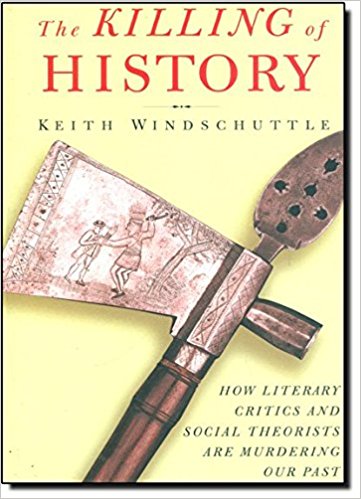
The Killing of History needs to be read by every Christian who cares about defending our faith in a hostile secular culture. This from the Amazon introduction tells us why:
For 2,500 years, since the time of Herodotus and Thucydides, historians have sought to record the truth about the past. Today, however, the discipline is suffering a potentially lethal attack from the rise to prominence of an array of French-inspired literary and social theories, each of which denies that truth and knowledge about the past are possible. These theories claim the central point on which history was founded no longer holds: there is no fundamental distinction between history and myth or between history and fiction.
If truth and knowledge about the past are not possible, then Christianity is not possible. Christianity is rooted in historical claims, but just as important as these claims are is the assumption that underlies them, that we can have real, objective historical knowledge. As Christians we claim we can know what happened in the past, even thousands of years in the past, with a reasonable degree of certainty. While our knowledge of the past is never exhaustive, it is real, and on it we can depend. Not so, claim these theorists.
(more…)

May 29, 2017 | Culture, Epistemology - Trust

Given I’m a fan of popular culture, and a student of it’s influence on, and reflection of, the worldview of the people in that culture, I was very eager to read a piece titled Questioning the Gods: How TV’s Tackling Belief and Religion. The article perfectly captures a certain epistemology that is at the heart of how people understand the world in our secular, post-modern relativist culture.
When Keeping Your Kids Christian gets published, you will see that I’m a big fan of identifying assumptions within the culture, in discussions with others, and in our own thinking. Unexamined assumptions are an epidemic today. While everyone knows what assumptions are, most people don’t think they have any! Many Christians think this way too. But once we learn to question assumptions, many things become clear that once seemed opaque. As we uncover hidden assumptions we clarify thoughts and arguments to see if the logic holds up under scrutiny.
(more…)

May 23, 2017 | Epistemology - Trust

In researching, reading, and thinking about writing a book about keeping my kids Christian, I was kind of surprised to discover how important questions of epistemology began to emerge. I even decided to write an entire chapter on epistemology—in a book on raising kids! I can understand why a lot of Christians would think that’s a bit nutty, in many cases because they wouldn’t even know what epistemology is. I’m hoping in some small way that my book might help change that. Every Christian in our postmodern, relativistic, secular age needs to know not only what epistemology is, but how important are the implications for their faith.
Simply, epistemology is the study of how we know what we know, and it has been vigorously debated among philosophers in Western civilization since at least Rene Descartes (1596-1650). The reason religious faith is so problematic in the modern West is because skepticism about metaphysical ideas and historical facts is the default epistemology of the culture. Which is why I was so surprised when I saw an article at the reliably liberal and secular NPR website titled, “Skepticism about Skepticism.” I instantly thought of a quote by C.S. Lewis in his book Christian Reflections (p. 164) (more…)

Feb 5, 2017 | Epistemology - Trust

On a recent trip home to see family and friends, I got into interesting conversations with two gentlemen who are self-described agnostics. I realized something as I thought about these conversations. My interlocutors seemed to believe they could not know the religious stuff I was talking about with any certainty, so why bother with it at all. As we talked it hit me: Their objection to Christianity is rooted in epistemology! They probably wouldn’t even know the word, but there is it nonetheless.
(more…)

Feb 3, 2017 | Epistemology - Trust

In my last post, I defined faith, correctly, as trust based on adequate evidence, contrasting it with our secular, postmodern culture’s definition as what you need when there isn’t enough evidence. Big difference. In this post I will take a brief look at how we experience faith and doubt in daily life, and in our relationship with God. While the objects are different, the nature of the thing remains the same. Religious “faith” and everyday “faith” are the same because absolute certainty doesn’t exist, and we must act, or not, based evidence presented to us.
(more…)


Recent Comments