Aug 18, 2019 | Epistemology - Trust
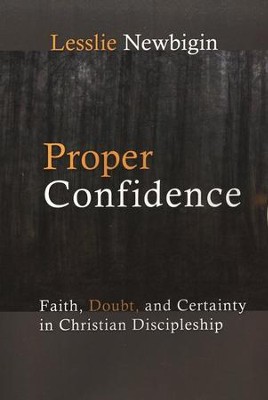
My last post was on the faith and doubt, and how both are part of what it means to be human. The concepts are not specifically religious, and apply to all human being, religious or not, contrary to secularist assertions. Similar assertions, in effect, have implications for how we think about the concept of certainty as well. A recent article at The Gospel Coalition about a book by the late Lesslie Newbegin opened my eyes to how important this is. Since I wrote my book, I’ve experienced push back from some Christians who almost seem offended at the confidence I have in my faith, and that I can confidently pass on that confidence to my children. Now I know why: We’ve all accepted the epistemological presuppositions of the Enlightenment, and confuse confidence with certainty. Let me explain.
(more…)

Aug 11, 2019 | Epistemology - Trust
My last post on Harris was on plausibility structures and how they create a reality that seems real to people, whether it is or not. Twenty first century plausibility secular structures are also important to the issue of doubt. Christians at a disadvantage in these discussions because doubt is assumed to be a one way street: Christians either believe (have faith) or doubt; if they doubt they no longer believe, if they believe they don’t doubt. This way of looking at faith and doubt puts Christians on the defensive because it assumes that belief and doubt are uniquely religious, in this case Christian, things. It takes about 10 seconds to realize this is ridiculous, yet Christians too often talk and write as if such secular assumptions are true.
(more…)

Jul 27, 2019 | Epistemology - Trust
My wife and I watched a documentary on Netflix the other night about these three great German thinkers who have shaped the modern world in innumerable ways, most of them harmful. I couldn’t help thinking as I watched about the great divide in human existence between God revealing himself and Truth to us, and human speculation. It’s one or the other, my friends. Without seeking and accepting the former, the latter is all we have. When I was much younger a cultural phenomenon called the Rubik’s Cube was all the rage. It’s a 3-D puzzle that is very difficult to solve, but it is solvable. Reality without revelation is not, a completely unsolvable Rubik’s Cube.
(more…)

Jul 20, 2019 | Epistemology - Trust
Depending on your age the events of one or all of these dates are seared into your memory. You can see in your mind exactly where you were, what you were doing, and how you responded when you heard or saw what happened. I’m old enough to remember two of the three dates. Even not quite nine, I remember distinctly walking into a neighbor’s house just as the lunar module was going to be landing on the moon. I can see the people in the house sitting on sofa and chairs watching the grainy black and white footage of the lunar surface on a small TV. As an adult, the events of 9/11 are obviously more distinct in my memory. The emotions I felt, still palpable. For those old enough to remember the Kennedy assassination on November 22, 1963, the traumatic events of that day would scar a generation.
(more…)

Jul 8, 2019 | Epistemology - Trust
So much of life comes down to epistemology, what can we know, how we know, if we can know. It’s unfortunate that so few Christians realize this, or have ever come across the word. This is important because the credibility of Christian truth claims in the postmodern, post-Christian secular West rest on questions of knowing. The default epistemological stance of our age is skepticism; the hole is the thing, not the doughnut. And whether Christians are aware of it or not, this skepticism affects us too. My passion is to teach Christians to know that we can know! Beyond a reasonable doubt.
(more…)

May 11, 2019 | Culture, Epistemology - Trust
I was recently listening to the late great R.C. Sproul talk about a very large problem for atheists (agnostics as well because they are practical atheists). Since atheists are materialists (the material is all that exists, there is no God or spiritual reality), they must argue that meaning is possible in a purely material universe. The way Dr. Sproul put it is that atheists claim we spring from a meaning-less universe, and we are hurling toward a meaning-less oblivion, and he asks, can it be possible to find true meaning between these poles of meaning-lessness? Good question. The atheists answers blithely, of course we can! Not so quick.
(more…)

Recent Comments