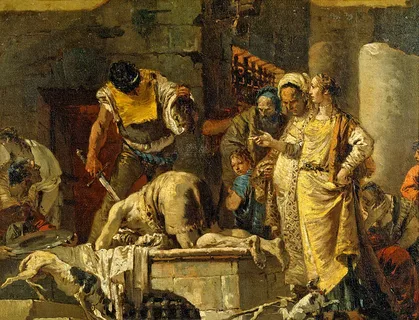
Uninvented: John the Baptist Beheaded—You Don’t Make That Up!

Uninvented: John the Baptist Beheaded—You Don’t Make That Up!

We read of John’s beheading in Matthew 14:1–12 and Mark 6:14–29. Matthew’s account is more concise, while Mark gives us much more detail, as his consistent with Mark. He covers fewer events in Jesus’ life, but gives more details of those he does address. Christians believe what we read in our Bibles are actual historical events that happened in space and time, not mythical or fictional stories. What Christians often don’t know, however, is how extra biblical literature confirms that. John the Baptist is a good example. We learn a lot about his life and ministry from first century Jewish historian, Josephus. One thing neither Matthew nor Mark tell us is the name of Herodias’ daughter who asked for John the Baptist’s head on a platter, and got it! Many Christians know the name, though, Solome. We only know that because of Josephus.

Apart from Josephus, John’s life and death also give us evidence of the historicity of the gospels from an Uninvented perspective. He could never have been invented because of first century Jewish Messianic expectations, something biblical critics (i.e., those in the scholarly profession of biblical criticism) ignored for two hundred years. It wasn’t until the 1970s that the Jewish nature of Jesus’ world became a topic of scholarly study. This is critically important because a Jewish Jesus would in my opinion have been impossible to make up, and the life and death of John is a good example why. No Jew at the time expected the 400-year-long awaited Messiah to be like Jesus, not his personality, or teaching, or miracles, or his life, and most certainly not his death. This is all part of the reason the Jesus we read about in the gospels confused everyone. As I call him in the book, the conundrum that was Jesus.

Right out of the gate, John gets Jesus right and wrong. In Matthew 3, prior to meeting and baptizing Jesus, John preaches these fiery words:

11 “I baptize you with water for repentance. But after me comes one who is more powerful than I, whose sandals I am not worthy to carry. He will baptize you with the Holy Spirit and fire. 12 His winnowing fork is in his hand, and he will clear his threshing floor, gathering his wheat into the barn and burning up the chaff with unquenchable fire.”

In John’s first century Jewish mind the messiah was coming to pronounce judgment on Israel’s enemies    and basically wipe them out. The Jewish people had been under various oppressors’ thumbs for almost 800 years by the time of Christ, first the Assyrians, then the Babylonians, then various other kingdoms, and finally the Romans at the time John and Jesus came on the scene. The Messiah they expected would be a king, a military conqueror in the mold of the great King David. John is proclaiming judgment against Israel’s enemies because that’s what the Lord’s Anointed (Messiah in Hebrew or Christ in Greek) was coming to do. All the kings of Israel were anointed, and thus the Lord’s Messiah, which is why all first century Jews were expecting a king, not a suffering servant a la Isaiah 53. I use the word “all” intentionally. Not a single Jew in the first century connected Isaiah 53 with the coming Messiah.

There was nothing in Jewish literature of the intertestamental period (between OT and NT) that would lead anyone to think a Messiah like Jesus was coming. Jewish historian Geza Vermes says in his book, Jesus the Jew, that “neither the suffering of a Messiah, nor his death and resurrection, appear to have been part of the faith of first century Judaism.” Nineteenth century Jewish Christian Alfred Edersheim in his book, The Life and Times of Jesus the Messiah, concurs: “There is one truth which, we are reluctantly obliged to admit, scarcely any parallel in the teaching of Rabbinism: it was that of a suffering Messiah.” In the 400 years from Malachi to John a connection of the suffering servant of Isaiah 53 to a crucified Messiah never emerged. J. Gresham Machen writes, “[T]here is not the slightest evidence that the pre-Christian Jews interpreted Isaiah 53 of the vicarious sufferings of the Messiah, or had any notion of the Messiah’s vicarious death.”

Which brings us to John’s gospel to see how the Baptist got Jesus wrong and more right than he knew. In the previous passage in Matthew, John was right that Jesus was coming in judgment, just not a judgment he could have ever imagined. How Jesus would defeat sin and death, and begin to conquer all the suffering in this fallen world was inconceivable to first century Jews. Yet this passage in John 1 very much seems to relate to what we read in Isaiah’s message about the suffering servant: 

29 The next day John saw Jesus coming toward him and said, “Look, the Lamb of God, who takes away the sin of the world! 30 This is the one I meant when I said, ‘A man who comes after me has surpassed me because he was before me.’ 31 I myself did not know him, but the reason I came baptizing with water was that he might be revealed to Israel.”

I’ve heard this passage interpreted as related to Isaiah 53 several times over the years, recently in a sermon. The problem with that interpretation is that it’s wrong. If you read commentaries on this verse, most of them will take what I call the facile interpretation, that John is declaring Jesus as a sacrificial lamb a la Isaiah 53:7. The first time this occurred to me was in 2017 hearing the pastor at our church make this connection. Having been immersed in apologetics by this time for eight years I thought to myself, “There is no way John could have known that Jesus as the Messiah would die for our sins.” I had learned about Jewish Messianic expectations, and how unexpected Jesus was. Even after Jesus rose from the dead some of his disciples refused to believe he could be the Messiah. It is only in theological hindsight because of Jesus telling us the entire Old Testament is about him, that we know Jesus was indeed the lamb of Isaiah 53.

John, however, had the same expectations as every other Jew in the first century because when he was in prison he told his disciples to ask Jesus if he is the one to come, or should they expect someone else (Luke 7). The last thing he expected was to be in prison facing death as he proclaimed the coming of the kingdom of heaven and the long-awaited Jewish Messiah. Jesus confused him just as he confused everyone else. So his reference to Jesus as the Lamb of God needs to be explained. My first thought when I was listening to that initial sermon was that maybe John put those words in The Baptist’s mouth, but my conviction that Scripture is the inspired word of God made that a non-starter. There had to be some other explanation. It wasn’t long after that I came upon a talk by D.A. Carson explaining what John possibly thought as he was saying those words.

Carson addresses this in his commentary, The Gospel According to John. Carson spends two and a half pages discussing this, but this passages explains it best:

Whether we assume the category lay readily at hand for the Baptist to use, or that he was one of the first to think it up, the impression gleaned from the Synoptics is that he thought of the Messiah as one who would come in terrible judgment and clean up the sin in Israel. In this light, what John the Baptist meant by ‘who takes away the sin of the world’ may have had more to do judgment than with expiatory sacrifice. p. 150.

He adds John probably had in mind the apocalyptic lamb, the warrior lamb, found in some Jewish texts, and which John used in Revelation (the word lamb is used by John 31 times).

Since the Baptist couldn’t have had the Isaiah 53 lamb in mind, he likely meant the warrior lamb, and John writing in risen-Jesus hindsight knew, and knew his readers would know, who Jesus as the Lamb of God was. John also later in the gospel (chapter 11) reports Caiaphas saying to the Sanhedrin, “that it is better for you that one man die for the people than that the whole nation perish.” In both cases the men spoke better than they knew.


Uninvented: Who Is the Greatest and the Criterion of Embarrassment

Uninvented: Who Is the Greatest and the Criterion of Embarrassment

One of the most powerful arguments for the veracity of the historical accounts of the Bible is the criterion of embarrassment. The idea is simple: Nobody tells stories to make themselves look bad. Nor do they tell stories making themselves look bad to try to prove what they are conveying is historically true. Human nature doesn’t work that way. We tend to the opposite, wanting to make ourselves look good, excuse our foibles and faults, and we’ll even be tempted to lie to cover up things we don’t want others to know. Yet if you read the Bible the people portrayed almost never come up looking good with a few exceptions. I heard Tucker Carlson in a recent interview make this point. He’s been red pilled with the rest of us since Trump came on the scene, and he’s had an awakening of his Episcopalian faith. He decided not too long ago to read the Bible from cover to cover, something he’d never done, and was shocked at how horrible most of the characters were. That’s because they are real, flawed people like we all are, and the authors are writing about real people doing real things in real time. It doesn’t read at all like the fairy tales and myth ignorant critics think it is.

The examples in Scripture are plentiful, but Jesus’ disciples are great fodder for this argument. They come off looking clueless most of the time, and are consistently confused by most things Jesus says and does. And keep in mind the gospels were the foundational books for the growth of a new religion built on a very old one. You would think those who wrote and promoted them would want to make themselves look good, or at least less embarrassing, but that’s not the case. Recently reading through Mark I was reminded of how this argument gives the biblical stories verisimilitude, which is the quality of appearing to be true or real. That is the argument of Uninvented in a nutshell. It’s an important reason when people read the Bible for the first time they’re surprised, like Tucker was, because it’s nothing like they expected. I wrote a post a year ago about the conversion of Shia LaBeouf, and if you listen to his interview with Bishop Barron he says how blown away he was when he read the gospels for the first time. Jesus was nothing like he expected.

When I first started thinking about and then writing the book I was going to call it Psychological Apologetics, but nobody would have known what that meant. Not a good thing for the title of a book. The idea in my brain was that if you look at the characters and how they are portrayed in the Bible from a psychological perspective, it reads absolutely real. People act and react exactly the way real people act and react. And keep in mind a critical point: fiction as we know it today did not exist in the ancient world. That is a modern phenomenon of the last few hundred years. Yes, ancient people made up and told stories, but they had no illusions they were creating verisimilitude. Homer’s The Iliad and The Odyssey, the foundational works of ancient Greek literature, are perfect examples to contrast with the Scriptures of the Old and New Testaments. There likely was a Trojan war something like Homer presents it, but nobody thought he was writing “history.” The reason this is a good comparison, and not the histories of ancient historians like Herodotus, Thucydides, or Livy is because of the super-natural elements in both. Skeptics think they are comparable—they are not. A cursory read of both makes that very clear.

Read the Bible and it’s apparent the writers of the biblical books were attempting to write history, while Homer was taking poetic license with the history involving the Greek gods. Nobody really believed Achilles, for example, was the son of the mortal Peleus, and the sea nymph, Thetis. While the ancients certainly believed in the reality of their gods, none of them saw the gods like the Hebrews saw Yahweh, the one true God. The religious texts of ancient pagans do not read anything at all like the religious texts of the Hebrews, what Jesus and the Apostles called the graphé- γραφή, the writings, our Old Testament. And just as there was no fiction in the ancient world, there wasn’t what we call today historical fiction, or writing history with made-up stuff to make it appear real. Knowing all of this makes the criterion of embarrassment all the more powerful to have in our apologetics tool kit.

I’ll briefly discuss the mark passage as a great example. It comes from chapter 9:

33 They came to Capernaum. When he was in the house, he asked them, “What were you arguing about on the road?” 34 But they kept quiet because on the way they had argued about who was the greatest.

35 Sitting down, Jesus called the Twelve and said, “Anyone who wants to be first must be the very last, and the servant of all.”

36 He took a little child whom he placed among them. Taking the child in his arms, he said to them, 37 “Whoever welcomes one of these little children in my name welcomes me; and whoever welcomes me does not welcome me but the one who sent me.”

I love  how the Apostles, the Twelve, are so cowered by Jesus because they know how stupid it was to argue which of them is the greatest. This happens to Jesus’ closest followers a lot. They either do something they’re embarrassed by like this, or are afraid to ask Jesus questions when they don’t understand what he says or does. Another example along the same lines comes when James and John, the sons of Zebedee (and their mother) ask Jesus if one can sit at his right and the other at his left in his kingdom.  

In both cases, instead of rebuking them directly for being self-centered idiots, as if Jesus’ ministry is about them, he teaches them something so counterintuitive nobody in the Roman or Jewish world would make it up. All influence in the ancient world was a form of the will to power, might makes right. The stronger as well as the more affluent upper classes had all the benefits in that society. A large portion of the population were slaves, and the rest common laborers, few of whom had politics rights of any kind. Women and children weren’t all that far above slaves, and it must have been confusing when Jesus used a child as an example of what it means to be first in his very upside down kingdom. The absurdity of that in the culture of the time is difficult to convey because we’re too familiar with Christianity living in light of 2000 years of it. As we say in the vernacular of our time, you just don’t make that stuff up! Jesus says something just as absurd in the incident with James and John. The other ten were furious when they heard what the brothers had done, which is funny, then Jesus teaches them more craziness:

42 Jesus called them together and said, “You know that those who are regarded as rulers of the Gentiles lord it over them, and their high officials exercise authority over them. 43 Not so with you. Instead, whoever wants to become great among you must be your servant, 44 and whoever wants to be first must be slave of all.

What? Again, given our familiarity with the stories it’s difficult to read this with the shock Jesus’ disciples must have felt when they heard it. Jesus’ teaching here is so counterintuitive, so inside out and upside down that no Jew or Pagan of the time could have made it up. It had to come from Jesus of Nazareth, Son of God, Jewish Messiah, Risen Lord.  


Jim Caviezel to Jordan Peterson: “This is the Best Interview I’ve Ever Had in my Life . . . .”

Jim Caviezel to Jordan Peterson: “This is the Best Interview I’ve Ever Had in my Life . . . .”

I imagine as a famous actor Jim Caviezel has had a few interviews in his life, so when I saw that headline I simply couldn’t pass it up. By now you’re probably familiar with the blockbuster hit movie, Sound of Freedom, which has become a hit despite “Hollywood” doing everything it could to ignore it. You have to wonder why a movie about exposing the sexual trafficking of children is something to be ignored. The topic is horrific to even contemplate, but I’ve heard it’s a great film and treats the topic in a respectful and even holy way. We’ve tried to see it, but it’s been sold out in our area. We will persist!

This interview includes the man about which the movie was made, Tim Ballard, a modern hero if there ever was one. He runs an organization called Operation Underground Railroad, a reference of course to the operation of the same name before the Civil War which rescued runaway slaves. I very much encourage you, even implore you to watch/listen to the entire interview. It’s brutal, and you have to be prepared to hear of evil that is simply incomprehensible. I briefly want to share why I would encourage such a thing: evil.

Over the four plus decades I’ve been a Christian I’ve come across people, both in person and in writings and recordings, who either doubt or abandon their faith because of the existence of evil. The understandable struggle of how evil could exist if there is an all loving all powerful God is not something we can wrap our minds around. That’s one reason the struggle as been referred to as “the problem of evil,” the “problem” supposedly being one for Christians to answer. Indeed, Christianity does need to answer such a conundrum, but every worldview that human beings embrace has the same “problem.” The issue for Christianity, though, is that since the so-called Enlightenment and Voltaire, this has been pushed in the secular West as a particular problem for Christianity. The sense you get is that if Christianity can’t answer adequately, people can reject it and no longer have a “problem.” That is simply untrue.

For all of recorded history human beings have been trying to answer the question, why. Every child as he grows up and begins to experience life says, “That’s not fair!” Whence this notion of fair? Or the notion that something is “wrong”? Why do we feel a sense of injustice when we are wronged? Why when we see or experience wrong we long for justice? For wrongs to be righted, for wrongs to be punished? C.S. Lewis titled the first chapter of Mere Christianity, “Right and Wrong as a Clue to the Meaning of the Universe.” He argues that all people in all places and times agree standards exist even if they disagree on the exact nature of the standards. He wrote the book, a series of talks, in the midst of World War II, and says if there no is Right and Wrong, then blaming the Nazi’s would be like blaming someone for the color of their hair. If Right, as he says is a “real thing,” only then and only then can we say what the Nazi’s did is Wrong. And remember, Lewis was an atheist into his 30s, partly because his beloved mother died when he was 9, and he experienced the horrors of World War I.

This brings me to Jordan Peterson and the interview with Caviezel and Ballard. As I said of Peterson in a recent post, he “has studied evil maybe more than any living human being,” yet for him instead of rejecting God, he clearly believes Christianity is the only thing that can make any sense of it at all. I don’t know the exact nature of his faith (God does), but he is one of the most effective Christian apologists of the 21st century, and studying evil is one reason for that. In fact I recently heard his daughter, Mikhaila, say he is currently writing a book disproving atheism. That should be interesting! When you listen to the podcast, Tim Ballard says his faith helped him deal with the horrific reality of human evil in child sex trafficking (he’s Mormon). And when Caviezel dove into Ballard’s horrifying world to prepare for the part, his Catholic faith helped him deal with it.

When we think about this “problem,” we need to understand that every religion and philosophy in all of recorded history is an attempt to deal with it, explain it, make sense of it, to answer the why. We don’t choose to be born, and before we know it we find ourselves conscious and involved in some massive cosmic drama of good and evil. The why haunts us because in so many ways it doesn’t seem to make sense, especially when we do not see wrongs and injustices righted. The only religion or philosophy that claims to know the answer is Judaism and its fulfillment Christianity. The former gives us the answer of why it exists (Genesis 1-3), and Christianity the solution. It is worth considering how this solution involved the greatest injustice ever perpetrated. An ostensibly perfect, sinless man who never did anything wrong and claimed to be God, allowed himself to be punished by a grisly and shameful death as a common criminal to pay the penalty of the wrongs others did.

Each of us had to decide for ourselves whether we believe that is true or not, but what we can confidently say is, there has never been any other answer to the “problem” like it. Especially because his followers claimed his rose from the dead in fulfillment of the Jewish religion in spite of such a thing being inconceivable to them, then being willing to give their lives for that claim. I personally find Christ’s life, death, and resurrection the only plausible explanation and answer that exists. In our day because we live in the post-Enlightenment secular West some people think if they are not “religious” they can escape having to provide an answer, but the “problem” still needs to be addressed, or just eat, drink, and be merry . . . . But as challenging as Christianity can be for some people to believe, every other ostensible explanation and “answer” has much bigger problems.

I’ll just address one. Most other religions and philosophies make no claim to know where evil comes from or why it exists—it just is. For those embracing some kind of demonic or evil force, that just is too, often like Manicheism believing good and evil are two equal forces battling it out in the universe. Augustine, the great 5th century Bishop of Hippo and one of the greatest thinkers of all time, once embraced it, but found it wanting and eventually embraced Christianity. Either option ignores or pushes aside the burning question inside the breast of every human being: why? Their answer? Who knows, just deal with it. In my mind the least plausible non-explanation is what Lewis implies in his critique, atheistic materialism. If all we are is lucky dirt, mere atoms in motion, products of random chance that come from nothing for no reason at all, right and wrong, good and evil are in the end meaningless concepts. Morals are mere preferences, like what flavor of ice cream I prefer. I prefer genocide, you prefer orphanages and hospitals. You say tomahto, I say tomaato. Que sera sera . . . I would suggest to Doris Day the future is indeed ours to see because a man 2000 years ago came back from the dead to tell us.


Uninvented: Jonah Had to be Real, Big Fish and All

Uninvented: Jonah Had to be Real, Big Fish and All

If there is one book in the Bible that really gives the doubting Thomas’s among us fits it’s Jonah, the reluctant prophet. It wouldn’t be so hard to swallow, pun intended, if it wasn’t for putting that silly big fish in the story, but more of that below. As for the rest of the story, you have to love Jonah, he’s so much like all of us, sinners by nature who just don’t want to do what God commands. That is in fact the job description of a sinner! We’re rebellious little Cretans, as the Apostle Paul says, God’s enemies, literally by nature at war with him. So before we get all high-minded and “judge” Jonah, he is us! And it is just this kind of negativity that that brings out a realness in the story that speaks to its authenticity. Jonah is the criterion of embarrassment on steroids, meaning human nature being what it is, people just don’t write things that make themselves look so horrible. In fact, we naturally go out of our way to make ourselves look good, to excuse ourselves and mitigate our guilt. We don’t tell a story like Jonah unless it’s true.

Jonah’s tale begins with rank disobedience. The Lord tells him to go preach a warning to Nineveh, the great Assyrian city, and he runs in the exact opposite direction, and a very long way. God as He does with His people chases him down until he finally relents. Jonah decides to take a ship that he must think will surely allow him to escape this odious request (the Assyrians were a brutal people and Israel’s enemies), but you can tell he really doesn’t believe that. What makes the argument in Uninvented so persuasive to me is that the characters in the Bible behave psychologically like real people would, and Jonah reads as real as it gets. He knows like all of us really do that running from the Lord is futile, and as soon as the storm hits and things start getting bad, Jonah goes below deck and falls “into a deep sleep.” He’s basically depressed. The captain wonders how in the world he can sleep, and tells him to call on his god to save them.

In that time prior to “science” when people believed storms and weather were controlled by the gods, that’s what they did. Jonah knew better who actually controlled everything including storms. The sailors cast lots to see who’s to blame, and the lot falls to Jonah. When they ask who he is:

He answered, “I am a Hebrew and I worship the Lord, the God of heaven, who made the sea and the dry land.”

I can almost see and hear a board and blasé Jonah saying this. No other ancient people believed in an eternal Creator God and you get the sense Jonah also wishes it wasn’t true at this point, but the sailors are terrified because Jonah’s already told them he’s running away. The sea is getting rougher and they ask him what they must do to calm it down, and he says throw him into the sea. What? Won’t that tick off of your Creator God, Jonah? They decided not to chance it, and try everything else, but it keeps getting worse, so they throw him over. Then we read the words that give the skeptics and doubters fits:

17 Now the Lord provided a great fish to swallow Jonah, and Jonah was in the belly of the fish three days and three nights.

Impossible! They think. No way a human being can last inside of a fish, no matter how big. It’s really gross if you think about it for too long, not to mention dangerous. And impossible! Is it?

Let’s address the word impossible. I’ve heard people say that over the years regarding this story, but what exactly does it mean. How about this:

  • not possible; unable to be, exist, happen, etc.
  • unable to be done, performed, effected, etc.

Now a question for those who think it’s impossible for a man to be swallowed by a great fish and stay alive three days and nights. How exactly do you know this? That such a thing is impossible. Are you not begging the question? In other words, aren’t you only assuming such a thing can’t happen? And in fact you really have no idea if it could happen or not? But, you say, it is literally physiologically not possible, stomach acids, lack of oxygen, etc. Well, that really depends on what one assumes, doesn’t it.

Let’s assume something else, my own question begging, if you will. Nothing is impossible with God. If God exists, then preparing a great fish to swallow a man and keep him alive for three days and nights is a piece of cake, easy peasy, not a problem, can do it in His sleep, so to speak. Why? Well, because by definition as the notion of God has come down to us from the ancient Hebrews then through Christianity, God is all powerful. God is all mighty. God has all knowledge, all wisdom, all understanding. We can also add something that’s truly beyond comprehension to us, as if all this is not. He is everywhere, omnipresent. Try to wrap your mind around that! But don’t, you’ll hurt yourself.

Why burden yourself with the Enlightenment philosophical baggage (naturalism, miracles can’t happen, rationalism, etc.), and just read the text as if it could very well possibly be true. Then judge the text for what it is. Does it read real? Does it have the magic word, verisimilitude? For those new to the word, it means the quality of appearing to be true or real. Like a great work of fiction or movie, if it has verisimilitude you’re all in, if not you won’t engage with it for long. The Bible has verisimilitude written all over it, from beginning to end, if only it isn’t shackled to someone’s anti-supernatural assumptions, which are in fact rightly called a bias. And it’s a groundless bias if God in fact exists, which he obviously does! As I often say, there are relatively few philosophical, materialist (matter is all that is) atheists. Everyone else knows God exists because, well, everything couldn’t possibly come from nothing!

One of the reasons the Bible reads so real to me, and why I wrote Uninvented, is because most of the characters who encounter the miraculous are just as incredulous as we are. The ancients in this were no different than we post-Enlightenment Westerners. Such things do not normally happen, so can they ever happen? I’ll end this with one powerful story that reflects this dynamic so wonderfully, the story of Abraham and Sarah. Who does God choose to bring kings and nations through, like sand on the seashore and stars in the sky? A barren old couple, of course! And we’re talking really old. The Lord called Abram and Sarai at 75 and 65, beyond child rearing already, promised him that sand and those stars, then made them wait another twenty-five years! God would leave no doubt whatsoever who was responsible for those nations. In Genesis 18 the Lord visits them and says Sarah will have a son in a year. Then we read these very real words:

13 Then the Lord said to Abraham, “Why did Sarah laugh and say, ‘Will I really have a child, now that I am old?’ 14 Is anything too hard for the Lord? I will return to you at the appointed time next year, and Sarah will have a son.”

15 Sarah was afraid, so she lied and said, “I did not laugh.”

But he said, “Yes, you did laugh.”

Is that verisimilitude or what! And talk about the criterion of embarrassment. Notice the rhetorical question the Lord puts to them. Of course not! Nothing is too hard for Him, including Jonah in a big fish kept alive for three days and then vomited onto dry land.


The Resurrection is the Only Explanation for Christianity

The Resurrection is the Only Explanation for Christianity

This weekend we celebrate what we’ve come to call Easter, but what is in fact the celebration of the death and resurrection of the Savior of the world, who has been saving His people from their sin (Matt. 1:21) since he rose from the dead. When we come to that claim we have two options: either it is true, or it is not. If it is true, it is the most important historical fact in all of history, and we ought to treat it that way. If it is not, then it is completely irrelevant and should be ignored. It’s just fiction, something conjured up by mere human imagination, and in effect a lie. I don’t know about you, but I don’t want to base my entire life on a lie. So I want to lay out here some brief arguments why I believe it is in fact true, and why you should too.

Something has to explain the rise of Christianity. Unserious people can blow it off as, whatever, but something that has transformed the world in the way it has needs to be explained. Tom Holland lays out the transformational influence of Christianity in his wonderful book, Dominion, as the only thing that can explain the modern world. However, Holland has not yet embraced Christianity as Truth, and therefore believes this transformational influence was the result of a lie. Of course he wouldn’t say that, I presume, and might wiggle out of his dilemma by saying, well, Jesus didn’t really, literally, physically come back to life after being brutally tortured to death on a Roman cross, but his followers maybe thought he did, they believed it, and that is what changed the world. That’s laughable and absurd, but many people still believe it.

1. Jews don’t make up the resurrection – First, Jews in the first century do not make up a resurrection in the middle of history. That was literally inconceivable to them, both theologically and eschatologically. There was only one general resurrection of the dead at the end of time when sin and death would be dealt with once for all (see Martha’s response to Jesus at Lazarus tomb in John 11). That one man in the middle of history would be resurrected from the dead, and sin and death go on as they always have was to them ridiculous. It would have made no sense. People do not make up what is inconceivable to them.

2. The fearless and bold proclomation of the resurrection – There is also the fact that the Apostles proclaimed Jesus’ physical, bodily resurrection from the beginning at the threat of their safety and lives, and argued for the truth of Christianity based on it. Here is Paul’s declaration of the historicity of the event in I Corinthians 15:

For what I received I passed on to you as of first importance: that Christ died for our sins according to the Scriptures, that he was buried, that he was raised on the third day according to the Scriptures, and that he appeared to Cephas, and then to the Twelve. After that, he appeared to more than five hundred of the brothers at the same time, most of whom are still living, though some have fallen asleep. Then he appeared to James, then to all the apostles, and last of all he appeared to me also, as to one abnormally born.

Doesn’t much sound like a fairy tale to me, or just a “spiritual” experience. They ate with the risen Jesus and touched him. When Doubting Thomas finally encountered the risen Lord he declared, “My Lord and my God!

3. The Jewish religion transformed – An actual physical, bodily resurrection is the only thing that could have gotten first century Jews to alter their beliefs in such a fundamental fashion. Jews only believed in physical, bodily resurrections, not “spiritual ones.” Mere religious experiences don’t have the power to do what happened to those first Jewish followers of Jesus. The immediate, drastic changes in their religious convictions can only be explained by the resurrection, and Jesus proving it beyond a shadow of a doubt.

J.P. Moreland says anyone “who denies the resurrection owes us an explanation of this transformation which does justice to the historical facts.” Skeptics don’t like these historical facts because, well, resurrections can’t happen! Let’s confuse them with these facts they have no ability to explain apart from the supernatural. According to Moreland, the first Christians, strict Jews all, immediately gave up these Jewish convictions that defined everything about their religion:

  1. The sacrificial system.
  2. The importance of keeping the law.
  3. Keeping of the Sabbath.
  4. Non-Trinitarian theism.
  5. A human Messiah.

The skeptic says, “Yeah, so what. No big deal; happens every day of the week.” Well, if it does, I’m waiting for concrete evidence. Instead, we generally get anti-supernatural bias disguised as above-it-all, supposedly objective assertions with little basis in historical fact. As Moreland says in a bit of understatement, “The resurrection offers the only rational explanation.”

4. Altnernet explanations of the resurrection fail – Honest non-Christian scholars agree that some explanation is required to explain the explosive rise of Christianity. Almost all scholars and historians today believe the tomb was empty, but also agree an empty tomb is not enough to explain the explosive growth, and I would add, against all odds. They had everything against them, the entire Jewish establishment, the power of the Roman Empire, and initially very small numbers. What they did have, though, was the truth and the Holy Spirit. Those two things transform the world, lies do not.

The only options to an actual physical resurrection are a stolen body, or the swoon theory (he really didn’t die), or Jesus’ disciples thought they saw Jesus as mentioned above. These appearances of Jesus, while not real, had the effect as if they were real, and boom—Christianity exploded! German higher critics of the 19th century, and liberal Christians of the early 20th, were fond of arguing for this spiritual Jesus somehow appearing, and the disciples having what they called a “resurrection experience.” The historicity of the event was beside the point; and we all “know” people don’t come back from the dead, especially after the Romans got done with them. Jesus’ followers were so distraught, the argument goes, and so longing for the crucified Messiah to come back to them somehow, their minds conjured up a Jesus who came back from the dead. Then, because of this “spiritual” experience, they went throughout the Roman Empire proclaiming a resurrected Lord. The problem with this explanation however it was explained—by dreams, visions, or mass hallucinations—it all comes up against the same cold hard truth I mentioned above: For Jews, a resurrection of one man in the middle of history was inconceivable, as was a resurrection not bodily and physical.

As I argue in Uninvented, if someone comes to the text without a question-begging anti-supernatural bias, they will be able to see the verisimilitude in the resurrection account and all the events surrounding it. The gospels are all about Jesus’ death and resurrection because it is those events that happened in real space and time, in what we call history, and everything turns on whether they actually did or not happen. As I also argue in the book, the burden of proof is every bit on those who reject the resurrection and that it could have made up. My claim is that is not possible. Thus we declare this Easter Sunday the Year of our Lord 2023:

He is risen, He is risen indeed!


Take 3 on My Encounter with The Rationalist: Why I Believe the Evidence

Take 3 on My Encounter with The Rationalist: Why I Believe the Evidence

In my previous post on my encounter with The Rationalist, I explained the nature of evidence and how it is used in a court of law as “proof” for conclusions to either convict a defendant or not. Everyone uses evidence in life in all kinds of ways that acts for them as “proof” for what they do or don’t do, believe or don’t believe. What evidence that leads to “proof” can never yield is absolute certainty, as I also discussed. I put the word proof in quotation marks because in a very real way proof is in the eyes of the beholder, and everyone at some point needs to trust the evidence and only then does it become proof for them. This fact of human existence is why I always insist on pointing out that everyone lives by faith, which I define as trust based on adequate evidence. I trust based on more than adequate evidence to me that Christianity is true.

As I said, whenever I mentioned a bit of evidence to The Rationalist, he rejected it as evidence. He would basically say, That’s not evidence! Says you, Mr. Materialist Atheist. He has what afflicts all such people: epistemological blindness. According to them, there is only one way to know and it’s their way or the highway. No thanks. So by what evidence do I embrace Christianity?

Before I get to that it’s important to preface it with knowing the importance of “the consideration of the alternative.” I talk about this in writing and conversation often, and it is something The Rationalist rejected because it didn’t serve his purpose. It states, if one thing isn’t true about something, another thing must be. This basic fact of reality cannot be escaped, so keep that in mind any time you consider pretty much anything, regarding Christianity or not. There is no neutrality in reality, only being in between decisions about what we choose to believe, or not. Not choosing is of course a choice.

In no particular order:

  • When I look outside every morning, I thank God for his revelation in creation. It takes entirely too much faith to believe everything came from nothing for no reason at all. Literally every nook and cranny of reality shouts of being the result of an infinite omniscient omnipresent Almighty Creator God!
  • Next, I thank God for his revelation in Scripture, and that also takes entirely too much faith to believe it is made up, mere human invention. In fact, I wrote an entire book about it! Every morning when I the Bible, I marvel that it even exists. I am continually amazed at how it shows evidence of a plan only a divine author could orchestrate. Even though written over 1500(!) years by 40 or so different authors in primarily two languages, it has a tight, coherent, and relentless theme from Genesis 3:15 to Revelation 22:21 we call redemptive history. I see in it everywhere theological genius only a divine author could conceive.
  • Lastly, I thank God for his revelation in Christ, the most astounding revelation of all because it, He, makes sense of everything else in all of creation, all of Scripture, and in all of our experience living life in a fallen world among fallen people in a fallen body. I agree with ex-atheist C.S. Lewis who of course said it best: I believe in Christianity as I believe the sun rises, not because I see it but because by it I see everything else.

To get logical, these are deductive considerations, by which I mean I embrace the major premise, God exists. The minor premise is revelation is possible. Therefore, I am completely blown away! Some might see this as a presuppositional approach in that I assume something, God, and everything follows and makes sense because of that. There are also more inductive ways that I find extremely persuasive, meaning I find data and that leads me to a certain conclusion. There is mass quantities of such evidence. I am not sure where deduction and induction part ways, and have concluded they can’t be parted, as much as The Rationalist insists they must be. A list of such evidences would be very long indeed, so here is a small taste off the top of my head.

  • At the top of the list would have to be the resurrection. I do not believe the resurrection happened because the Bible says so, I believe it because the evidence is overwhelming, compelling, and solid. Most persuasive to me is the argument I make in Uninvented, that first century Jews would never, ever, in a million years make up a story of a Messiah being crucified, hung on a cross under God’s curse, buried, and rising from the dead. There is also an abundance of scholarly work on the historicity of the resurrection. One good example is a scholarly work by Mike Licona called, The Resurrection of Jesus: A New Historiographical Approach. He has almost 60 pages of references in his bibliography, so there is no shortage of scholarly work on the topic.
  • I can also trust the Bible is historically reliable on several grounds. As someone has said, archaeology is the Bible’s best friend because the more that is discovered, the more it is confirmed as history. There are also secular external sources that corroborate much of the history we find in our New Testament, including Jewish historian Josephus, and Roman historian Tacitus. In addition, despite what the critics say, it is not written like myth or fairy tells, but like eyewitness testimony, and thus history. Lastly, I believe we can trust the textual transmission of the Bible gives us pretty much what was written in its pages, and there is also an abundance of scholarly work on this topic.
  • I also find philosophical arguments persuasive. Among these are Thomas’s Five Ways, or five arguments that prove God’s existence, among them what are known as the cosmological and teleological arguments. The moral argument is another especially powerful argument because morality, the human sense that right and wrong exist, and that injustice is wrong, can only be explained if an objective standard exists. We only know a line is crooked because we have a straight line to compare it to. Human consciousness is also something philosophers find impossible to explain from a purely material perspective. Philosopher Thomas Nagel wrote a book called Mind and Cosmos: Why the Materialist Neo-Darwinian Conception of Nature Is Almost Certainly False. Nagel, though, can’t bring himself to reject his atheism, so he’s kind of stuck and the book reflects that.
  • We can extend the philosophical arguments to goodness, beauty, and truth, the classical virtues that the ancient Greeks share with Christianity. The question is not whether these things exist, but why, and whether The Rationalist has any ground to justify their existence based on his materialist worldview. What better explains their existence, matter, since that’s all the materialist has, or the God who created this world with features that go beyond matter? All the explanatory power goes to Christianity, every single bit. It is also a far more plausible explanation.

There is much more, and the resources on any one of these are endless. When I dove back into apologetics in 2009 I was amazed at the explosion of resources available since I’d last engaged in this theological discipline in the ‘80s. There really is no excuse for Christians today to know not only what they believe, but also why they believe it.