
What is the Gospel? More Than You Might Think

What is the Gospel? More Than You Might Think

That seems like a simple question. Every Christian knows what the gospel is, right? Jesus died for our sins, we believe it and are saved. As Paul says in Romans 10:

If you declare with your mouth, “Jesus is Lord,” and believe in your heart that God raised him from the dead, you will be saved. 10 For it is with your heart that you believe and are justified, and it is with your mouth that you profess your faith and are saved. 

We’re now reconciled to God and we’ll spend eternity with Him instead of separated from Him in hell. We’re no longer enemies of God, hostile to Him and dead in our sins, but reconciled children of God. That is “the good news,” and indeed it is. However, that is not all the news there is.

The modern Evangelical’s view of the gospel is extremely reductionistic, meaning our tendency is to reduce it to something narrow and simple, as if it applied only to our salvation from sin and our own relationship with Jesus. While, we think, it might have an impact on the wider world, our society and culture, that’s a spillover from out transformed personal lives. For most Christians, cultural and societal transformation is not the purpose of the gospel. Any other impact it has on the world is nice and all, but it’s beside the point, and really a distraction from the main thing. I believe God begs to differ.

The gospel in fact was like a spiritual Big Bang. An infinitely dense point of spiritual light and blessing that 2,000 years ago exploded when Jesus rose from the dead, ascended to the right hand of God, and sent his Holy Spirit at Pentecost. The gospel is an entirely new spiritual universe transforming this material world because Jesus’s mission was to transform it, as he himself tells us in John 3:

16 For God so loved the world that he gave his one and only Son, that whoever believes in him shall not perish but have eternal life. 

The idea of the world is pretty expansive in English, but the Greek word for it, our word cosmos, is more so. According to Strong’s, it is “properly, an “ordered system” (like the universe, creation); the world.” We as modern, individualistic Westerners tend to equate world with whosoever believes, and leave it at that. God loves people, he came to save them from their sin, that’s it. But that’s not all he was saying. The Apostle Paul gives us a picture of the expansive and all-encompassing nature of Christ’s mission, of the influence of the kingdom of God in the world, in 2 Corinthians 5:17, another verse Christians individualize but shouldn’t. The NIV has the best translation:

17 Therefore, if anyone is in Christ, the new creation has come: The old has gone, the new is here! 

Yes, the new creation refers back to the pronoun anyone, but there is no pronoun directly attached to “new creation,” no “he is a new creation.” Strong’s is again helpful with the adjective attached to creation: “properly, new in quality (innovation), fresh in development or opportunity – because “not found exactly like this before.” Christ accomplished redemption, redeemed not only his people (Matt. 1:21), but when it was applied by the Holy Spirit, the end goal, the telos in Greek or purpose, was the entirety of creation, the cosmos.

An Expansive and Transformational Gospel
There is a reason most Christians miss the world transformational vision of the mission of God in Christ—Pietism. I’ve written about it here many times, and I go into it in great depth in my forthcoming book, so I won’t do that here. Briefly, I’m speaking of a German Lutheran movement that started in the 17th century and eventually came to dominate modern Evangelical Christianity. I always have to clarify what I mean for those who might think I mean Christian piety, as in a committed devotional relationship with God through Christ in daily Bible reading and prayer. Pietism, while it often includes that, is not the same as that kind of piety. It is, rather, an over spiritualized, other worldly orientation of the Christian life. The primarily personal nature of the faith I mentioned above is part of it.

If we’re to challenge this narrow, constricted vision of the Christian life, we must ask ourselves an important question: What makes the Great Commission great? Is it merely that individuals will be saved so when they die they can go to heaven? Or is it more than that? I will argue, as I do in my upcoming book, that what makes the Great Commission great is that it’s a mandate of dominion from King Jesus, as Christians being salt and light was never meant to be limited to us and our personal holiness or just the church.

If you read those parables in Matthew 5, Jesus says we “are the salt of the earth,” and “the light of the world.” By using earth and world Jesus is surely extending the scope and extent of the gospel’s influence through us to everything we do as creatures made in his image, to everything defining us as human beings and the cultures and societies we create. Yet for the last two hundred years the scope and extent of God’s kingdom influence has been a point of contention among Christians, most limiting it in the various ways I’ve mentioned.

Christians tend to see the gospel and soteriology, our salvation from sin, as the end of God’s plan for man, instead of the means to an end. Andrew Sandlin in his book, A Postmillennial Primer: Basics of Optimistic Eschatology, explains the fuller orbed biblical view of God’s redemptive plans:

The actual end is the subordination of all things to God through Christ by means of the earthly dominion of the godly. God’s purpose is not chiefly to save man and fit him for heaven, but to restore him to covenant-keeping submission and his calling as God’s dominion agents in the earth. Heaven on earth in eternity is the blissful culmination of this task faithfully prosecuted by the redeemed.

The gospel restores everything it touches because it is fundamentally a restoration project. The point of the gospel is new creation, in that the old creation, fallen and distorted, becomes paradise restored. David Chilton in his book, Paradise Restored, describes the difference between an eschatology of victory and one of defeat

We must not look upon the world with eyes that see only the Curse; we must look with the eyes of faith, enlightened by God’s word to see the world as the arena of His triumph. History does not end with the Wilderness. World history will be, on a massive scale, that of Sodom: first a Garden, lovely and fruitful; then corrupted into a Wilderness of Death through sin; finally restored by God’s grace to its former Edenic abundance.

 Throughout Isaiah we see intimations of such restoration, as in Isaiah 35:

The desert and the parched land will be glad;
    the wilderness will rejoice and blossom.
Like the rose, it will burst into bloom;
    it will rejoice greatly and shout for joy.
The glory of Lebanon will be given to it,
    the splendor of Carmel and Sharon;
they will see the glory of the Lord,
    the splendor of our God.

For most of my Christian life I saw this restoration as reserved for the new heavens and earth after Christ returned, but postmillennialism turned my gaze earthward.

Per the Lord’s Prayer, we are to pray and work for, “Thy kingdom come, thy will be done on earth as it is in heaven.” The entire earth is our mission field. Our eschatological assumptions will determine how we view the impact of God’s kingdom coming on earth. These assumptions will further determine how we interpret history, as well as the present and future, including our own lives. Prior to embracing postmillennialism, I didn’t realize how our theology of “end times” determines how we interpret everything about the times in which we live, whether negatively or positively. In a phrase from the name of the YouTube channel I’m associated with—eschatology matters. This was put well by Greg Bahnsen’s son, David:

The cause of an optimistic eschatology has never been one of enlightening one’s view of the future as much as informing their activity in the present.

He’s speaking specifically of postmillennialism, but the point he makes about eschatology informing a person’s “activity in the present” applies to all eschatological views, even those claiming to be irreligious, like secularists. How we view the end matters in the present. For the secular, they can only look forward to an eschatology of doom, as the multitude of dystopian movies demonstrate. Christians, however, shouldn’t embrace an eschatology of doom; unfortunately most do.

As Christians there is much we agree on about what happens after Christ returns. We also agree that part of the Great Commission is to bring the gospel throughout the earth to all peoples, and build Christ’s church. What separates us are the implications of the gospel and Great Commission for this fallen world and the peoples and their cultures and their societies, prior to Christ’s return.

An Optimistic Eschatology for Gospel Transformation
Over the last several years I’ve become convinced an optimistic eschatology is necessary if Christianity is again going to influence the direction of America and the Western world, and the entire world Jesus died for. As Chilton rightly observes:

The fact is that you will not work for the transformation of society if you don’t believe society can be transformed. You will not try to build a Christian civilization if you do not believe that a Christian civilization is possible.

Or if it’s even important, which most Christians don’t think it is. Again, it is the Pietism. If we are to have a meaningful impact as salt and light in the larger culture and nation, we have to build with a reasonable expectation of success; postmillennialism gives us that whereas the other eschatological options do not.

The most important thing I’ve learned and what changed my perspective from negative to positive, from pessimistic to optimistic, is that there is biblical warrant for doing so. The most surprising thing to me about postmillennialism when I first learned about it, is that the case is completely exegetical, and thoroughly biblical. In other words, the case is made solely from Scripture. This depends, of course, on which eschatological glasses you have on. Two different sets of glasses give us two completely different interpretations of a passage. Take the passage from Isaiah 35 I quoted above. I used to believe the desert would only bloom after Christ returned. Prior to my eschatological awakening, I believed sin and the devil had the upper hand in this fallen world. After I realized that Christ’s first coming made the blooming possible now. Christ’s righteousness, the Holy Spirit working in and through us, and his authority exercised from the right hand of God now makes it possible to push back sin and evil “far as the curse is found.”

Too many Christians view the purpose of the gospel more as a means of escape from this horrible world, than as a means of transforming this into a blessed world. As I think about this specifically, how I convince others of my eschatological optimism, I go back to the very beginning and God’s covenant promises that started His reclamation project, His reclaiming the earth back from Satan. As soon as the fall happened and the curse declared, God told Satan that the woman’s seed or offspring would strike or crush his head. Then after the Lord scattered the people over the whole earth and confused their languages, he called one man, Abram, through whom he would bless all peoples on earth. The offspring of the woman, Christ, would eventually diminish Satan’s power on earth, and would come in the form of blessing.

The beauty of Christianity is that it isn’t just personally transformational but transformational in every way, societal, technological, relational, material, etc. It effects every single thing human beings put their minds and efforts to in the light of God’s word, the gospel, and His law, for our good and His glory. These blessings will eventually leak out from God’s people to bless society. And we are never under the illusion these blessings are solely due to us, but they can’t happen without us either. Jordan Peterson, one of the most important Christian apologists of the twenty-first century even though his Christianity isn’t fully formed as we would understand it, sees Christianity as essential to bringing order out of the natural chaos of life. He’s studied evil probably more than any person alive, and he sees Christianity as the answer. As Christians we should oblige him by bringing our faith into every nook and cranny of life and “infect” the people around us with a positive vision for the future.

Lorraine Boettner puts the postmillennial perspective in its definitive terms:

We hold that Christ is not merely the potential victor, but the actual victor over sin. During the interadvental reign He is steadily putting into effect the victory that He has won, gradually overcoming the forces of evil, until all His enemies shall have been made the footstool of His feet (Acts 2:35).

He also speaks of purposefully using “the word ‘conquest,’ rather than ‘conflict,’ for Christ is not merely striving against evil, but progressively overcoming it.” We are all familiar with the passage from Matthew 16:18 when Jesus says He will build His church, “and the gates of hell will not overcome it.” I never realized I was interpreting this incorrectly all my Christian life. I thought Satan and his minions and the evil they perpetuate were on the offensive, and it was Christians and the church who are on the defensive. That is exactly backward! Gates in the ancient world were defensive mechanisms. It is the church enabled by God the Holy Spirit that is on the offensive—Satan and his kingdom don’t stand a chance!

I don’t know about you, but I’m excited to be on the winning team! That is the gospel, winning and victory over sin on this earth, in this life. Quoting Psalm 8 and referring to Psalm 110, the most quoted Psalm in the New Testament, Paul says in I Corinthians 1:

 25 For he must reign until he has put all his enemies under his feet. 26 The last enemy to be destroyed is death. 

That process of subduing his enemies, sin, disease, chaos, disorder, and eventually death, started at his first advent. That is the good news, that is the gospel we proclaim for this age, and the age to come.
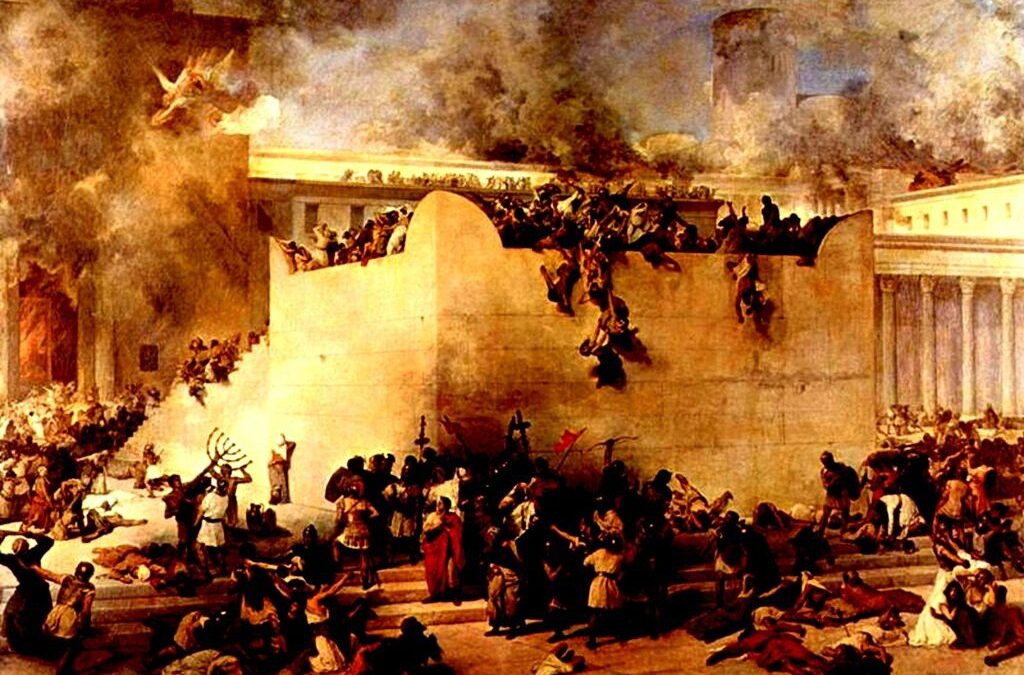
The Redemptive-Historical Significance of AD70

The Redemptive-Historical Significance of AD70

Until August of 2022, the year 70 AD was just another year in ancient history to me. It held no special significance other than I knew that a Roman army destroyed Jerusalem, and Jews and Christians were scattered throughout the empire. I could infer God’s purpose of separating Christianity from Judaism once and for all, but in terms of His salvific plans, I didn’t see any connection. And I don’t ever remember being taught in over four decades of my Christian life that there was any redemptive-historical significance to the horrific fall of Jerusalem. And horrific only begins to describe it. The ancient historian Josephus describes it in disgusting, often stomach turning detail. I’m sure I learned something about it in seminary, but whatever it was, it wasn’t memorable.

Then in that fateful month very much to my surprise, as those who read me often will know, I embraced postmillennialism. Up to that day I thought it was a completely discredited eschatological position. I found out I had rejected it for the same reason most others do: I was completely ignorant of what it really taught. If there is a way to know less than nothing about a topic, I knew that much. Yet I thought it was some kind of joke, until I learned it most certainly is not. I’ve learned since then that whatever critics think they know about it is always wrong, and I mean one hundred percent of the time. I have not found one single solitary steel man among those criticizing it. What I find is an abundance of straw men, question begging, and non sequiturs. That’s a lot of logical fallacies! And for whatever reason, postmillennialism lends itself to that. Before we get into the meat of the significance of AD70, let me tell you why I rejected the post-mill position, and every critic I’ve encountered seems to do so for the same reasons.

The Rejection of Postmillennialism
After my Christian youth when I was born-again into the thoroughly dispensational premillennial environment of the late 1970s, I eventually became pan-mill, as in it will all pan out in the end. Up to that point I engaged in “newspaper eschatology,” and all of the predictions about future events supposedly contained therein. Eventually it just came to seem like futile guess work and conjecture. Because of that I came to assume we can’t really know anything definitively about how things will end, so we just need to trust God who apparently didn’t to see the need to communicate that stuff clearly. Oh, how wrong I was! But we learn, hopefully.

Then in 2014 I was exposed to a solid case for amillennialism, and saw that just maybe God did communicate these things more clearly than I had realized. Unfortunately, this perspective on “end times” seemed to make me more pessimistic about the human race and life in this fallen world. The a-mill position teaches that the wheat and tares (weeds) grow up in the field of this fallen earth, and that good and evil are in perpetual conflict until the end. Given the seemingly ever present suffering and misery we see in the world, it’s not surprising I turned into a pessimist, as do most a-mills I’ve encountered. They, like our premillennial and dispensational brothers and sisters, see things growing increasingly worse until , as David Chilton puts it, “Christ returns at the last moment, like the cavalry in B-grade westerns, to rescue the ragged little band of survivors.” That’s basically what I believed because that’s what I thought these positions taught, and what I still think they do.

In studying postmillennialism, I learned something powerful that completely changed my perspective. Lorraine Boettner in his book, The Millennium, contrasts this idea of a conflict between good and evil, with the conquest of good over evil. It didn’t take long for him to convince me the latter is the biblical take on the nature of reality in our fallen world. Christ did not come to earth, die, rise again, ascend to the right hand of God, and send his Holy Spirit, to just pluck a few embers out of the burning fire of fallen humanity. Rather, he came to conquer the sin that destroys everything in His creation. That not only has profound effects on individuals saved from sin, but also in the communities they build, starting with families and extending out from there into society and cultures. Isaac Watts in the great Christmas hymn Joy to the World put it poetically best:

No more let sins and sorrows grow,
Nor thorns infest the ground;
He comes to make His blessings flow
Far as the curse is found,
Far as, far as, the curse is found.

The entire hymn is about Christ’s rule and reign on earth, not just in the hearts of his people or in the church, but over everything!

Unfortunately, until I learned what it really was, I thought postmillennialism was a late 19th and early 20th century version of liberal Christian and secular progress. Man in his hubris with the light of science and technology would conquer the world and usher in the kingdom of God. It was clear from my pre, pan, and amil perspectives, science and technology could never overcome sin in the heart of man, so postmillennialism was a delusion. William Jennings Bryan echoed what many Christians believed prior to World War I, and what many equate with postmillennialism today:

Christian civilization is the greatest that the world has ever known because it rests on a conception of life that makes life one unending progress toward higher things, with no limit to human advancement or development.

After he said this, in the 20th century some hundred million people died or were killed in the name of progress, and postmillennialism was tarred with the Bryan version of “progress.” That, however, has nothing whatsoever to do with a biblically rigorous postmillennialism.

Futurism, Preterism and AD70
Unfortunately, because of the perversion of postmillennialism at the hands of Christian liberals and secularists, the fall of Jerusalem in AD70 eventually turned from being a profound redemptive-historical pivot point, to an historical curiosity.

The growth of the “new premillennialism” of J.N. Darby and the Plymouth Brethren would in the 20th century turn into the dominant Evangelical eschatology of dispensationalism. This eschatology necessitated a futuristic interpretation of the Olivet discourse (Matthew 24:1–25:46; Mark 13:1–37; Luke 21:5–36) and the Book of Revelation, meaning the events that Jesus and John spoke about would not happen in the first century Jewish-Roman context, but at some time far off into the future. Amillennialists believe the same thing because when I embraced that eschatology for eight years that’s what I was taught and believed. Now it seems abundantly clear to me from a postmillennial perspective that a preterist interpretation makes the most sense of the texts and the historical facts on the ground.

The events Jesus spoke about, and most of the events John refers to (called partial preterism), have already happened. The word preterist comes from the Latin word for past, so this view is a contrast from the futurist view. Learning about the preterist view can almost cause one a case of intellectual whiplash. It makes my neck kind of ache just thinking about it given how unexpected it was after four plus decades as a Christian.

The debate about Revelation relates to the dating when John wrote it. For most of my Christian life I accepted “the consensus” of a later date, in the 90s AD, because the “experts” all seemed to believe that. I didn’t realize their motivations for deriving that perspective were primarily driven, known or not, by their eschatological assumptions (I wrote a piece last year about this, Eschatological Assumptions and AD70). If one takes a futuristic view of Jesus’ teaching in the Olivet Discourse, then it makes sense to see Revelation in the same way. So whatever evidence there is for the late date becomes dispositive, meaning it’s basically a slam dunk. Then last year I read Before Jerusalem Fell by Ken Gentry on the dating of the Book of Revelation, and I was shocked at how weak the evidence for the late dating was. I suppose a plausible case can be made, but to me the internal evidence, the actual content of the book itself, what John wrote, is dispositive, and slam dunk would describe it well—like a Michael Jordon tongue out in your face dunk. I was kind of shocked, really, not least because I had so easily accepted the later dating all these years.

The debate about the Olivet Discourse turns on how one chooses to interpret this verse in Matthew 24:

34 Truly I tell you, this generation will certainly not pass away until all these things have happened.

The debate is over what Jesus meant when he told them that all the things he was describing, not some of the things, would happen in “this generation.” It seems pretty straight forward, that it was the generation of the people he was speaking to when the words came out of his mouth. It’s a stretch to say Jesus meant “some generation in the far off future when these far off future events are going to occur.” It’s crazy to me that very serious people actually try to make that case, but they do and it’s what most Christians believe because of their eschatological assumptions. These people admit some of what Jesus was speaking about happened in the first century, but Jesus doesn’t give us that option. He says clearly, “Until all these things have happened.” So it’s either all in the past, or all in the future; there is no other option. Reading it the way Jesus intended, and his hearers would have understood, points to AD70, no pretzel logic required.

I would encourage anyone who wants to come to their own conclusions and not just take another’s word for it to read Gentry’s book, and for the Olivet Discourse and AD70 I would suggest two other books. The first is a little book from the early 19th century called, The Destruction of Jerusalem by George Peter Holford. He lays out in exacting detail how the historical record proves the preterist interpretation. The other is a book by R.C. Sproul called, The Last Days According to Jesus. Skeptics who have been trying to discredit the Bible for well over 200 years have argued that Jesus was predicting all these events, and since they didn’t happen Jesus was not who he claimed to be. The futurist position is one way to deal with it, but we don’t have to distort the text or Jesus’ words to address the critics’ lies. Preterism will do that nicely. Now let’s move on to some theology.

The Judgment of AD70
Unfortunately, because of the futurist focus on “end times” prophetic passages, the theological significance of the destruction of Jerusalem gets lost in the shuffle. That event, however, was a profound turning point in the history of redemption, of God’s plan to redeem His people and his entire creation. It took me a while on my postmillennial journey to figure this out. Theologically this has to do with God’s judgment upon His people, and what that meant for His redemptive plans.

In the discourse, everything turns on the meaning of the disciples’ question, “what will be the sign of your coming and of the end of the age?” People often take the Greek word for age, aión-αἰών, to mean world, so Jesus was telling the disciples about the end of the world. What comes into our minds when we hear that phrase? Likely a dystopian hell we’ve seen in a thousand movies. If one reads Revelation futuristically with that mindset, it certainly appears that way. But that is not what Jesus is referring to. I have a critically important question most Christians seem to miss. To whom was Jesus sent? And for whom was Jesus’ ministry? It was first the Jews, and only after that Gentiles, the rest of us.

The first passage confirming this message comes in Matthew 10 when Jesus sends out the 12.

These twelve Jesus sent out with the following instructions: “Do not go among the Gentiles or enter any town of the Samaritans. Go rather to the lost sheep of Israel.

Jesus confirms this in Matthew 15. The headline of the passage in our Bibles says, “The Faith of a Canaanite Woman.” God is using a heathen woman from a people with a lot of historical baggage for the Jews to make a theological point. She is screaming out for Jesus to heal her daughter of demon possession, and Jesus makes his mission clear:

24 He answered, “I was sent only to the lost sheep of Israel.”

Notice Jesus says “only.” It’s news to most Christians that the gospels are not about us! They are about God coming to His people, sending His anointed one to them, their Messiah. Only when he was rejected did the message extend out to the Gentiles. If you read through the Old Testament, but especially the prophets, this dual message is clear. Yahweh is consistently declaring blessing and judgment on His people, but eventually that blessing is to extend to the nations as he promised Abraham and the Patriarchs. It seems the blessing would not break out to the rest of the world until judgment came.

That judgment to come, what we see happen in AD70, was declared by John prior to the Baptism of Jesus in Matthew 3.

But when he saw many of the Pharisees and Sadducees coming to where he was baptizing, he said to them: “You brood of vipers! Who warned you to flee from the coming wrath? Produce fruit in keeping with repentance. And do not think you can say to yourselves, ‘We have Abraham as our father.’ I tell you that out of these stones God can raise up children for Abraham. 10 The ax is already at the root of the trees, and every tree that does not produce good fruit will be cut down and thrown into the fire.

Given my futurist eschatological assumptions, I completely missed that John is clearly declaring judgment to come upon the Jews. I thought John was mistaken like many Jews were about Jesus. His first coming wasn’t in judgment, but in mercy and grace. Judgment was for his second coming. That’s how I read the Olivet discourse as well, but Jesus is clearly speaking of Jerusalem where “not one stone here will be left on another; every one will be thrown down.”

Yahweh was in a legal covenant relationship with His people with the stipulation of blessing for obedience, and curses for disobedience. We see this laid out in detail in the Pentateuch, and played out in Israel’s history, declared in excruciating details in the prophets. Reading Jesus’ words in the Olivet Discourse from a preterist perspective is not at all a stretch, but in fact fits the entire flow of the historical narrative perfectly.

The Theological Significance of AD70
The Jews were promised salvation from sin and death from the very beginning when God told Adam and Eve the woman’s seed (offspring) would strike or bruise (crush in the NIV) the serpent’s head. When the covenant is revealed to Abraham, Paul confirms this seed refers not to offspring in general, but to Christ (Gal. 3):

 16 The promises were spoken to Abraham and to his seed. Scripture does not say “and to seeds,” meaning many people, but “and to your seed,” meaning one person, who is Christ.

All through Israel’s history, God communicated his redemptive plans in signs and symbols, or types and shadows as the theologians put it. These were concrete illustrations of the forgiveness of sin to come pointing beyond themselves to a greater truth, to the one who is The Truth in which redemption is found. When he came to fulfill all the promises, the Jewish religious leaders who represented the nation rejected the fulfillment for the types and shadows as if they were the thing, as if the blood of bulls and goats could do anything. The entire book of Hebrews was written to convince first century Jewish Christians of the superiority of the New Covenant. In chapter 8 quoting Jeremiah 31, the writer says:

13 By calling this covenant “new,” he has made the first one obsolete; and what is obsolete and outdated will soon disappear.

This could be considered a prophecy of the coming destruction of the temple. Hebrews was written while temple still stood because the writer was trying to convince Jewish Christians not to go back to the Old Covenant way of doing things. That was a possibility at the time he wrote. It seems the Jewish nation, including Jewish Christians, would not get the message that a new and superior way of salvation had appeared until God made the message clear. AD70 and the utter destruction of Jerusalem made it undeniably clear.

From that moment the Jewish religion changed completely. It was no longer the Mosaic religion of atonement for sin in sacrifice, but a moralistic religion of works. Jewish Christians now had to realize the former way was dead, over and gone forever; they could never go back. It was either Judaism or Christianity, the law or salvation by grace through faith, man’s works of futility or God’s transformational power in Christ in the human heart. God’s kingdom had now come in a completely different way than any Jew had foreseen. After Jesus had risen from the dead he told his disciples in Luke 24 that the entirety of Israel’s history found in Scripture, our Old Testament, was about him. Once the temple fell, God declared his covenant had been fulfilled in his Son, his kingdom come, His will now being done on earth as it is in heaven. Israel’s futility was ended, and in Christ alone would be found this good news of God (I Cor. 1):

30 It is because of him that you are in Christ Jesus, who has become for us wisdom from God—that is, our righteousness, sanctification and redemption.

Now with God’s law put in His people’s minds and written on their hearts (Jer. 31), God’s kingdom would no longer be limited to a tiny point of light in the Middle East. We read these prophetic words from Habakkuk 2:

14 For the earth will be filled with the knowledge of the glory of the Lord
as the waters cover the sea.