Uninvented: Why Miracles in the Bible Read Real

Uninvented: Why Miracles in the Bible Read Real

When I wrote about miracles in Uninvented, I pointed out how rare they are in redemptive history, which might surprise those who have never read the Bible. The basic secular consensus is that the Bible is all myths and fairy tales, so secular people tend to think the Bible is full of miracle stories. Only, it’s not. It starts with the greatest miracle of all, God creating all things out of nothing, creation ex nihilo, by speaking all of it into existence. If you buy that, the rest of the miracles in the Bible are instantly plausible, and easily believable.

The first miracles we encounter surround Moses, the Exodus, and Israel entering the promised land in approximately 1400 BC. Then, after 500 or so years, the prophets Elijah and Elisha perform miracles, and it would be another 800 years until the miracles of Jesus and the Apostles. The Lord spoke to his people, kings and prophets, but we’re not told how that happened. Outright miracles are rare.

Nevertheless, most people being immersed in secularism from birth don’t see miracles, however rare, as the least bit plausible or believable. In time, they develop what I call a question begging anti-supernatural bias. Simply put, they assume materialism or naturalism (matter is all there is, or the “natural” world runs on its own), and thus miracles can’t happen. So, when they read the miracles in the Bible, they conclude they must have been made up, invented by the authors. Since 95% of people believe God exists, it isn’t difficult to get them to believe the miracles in the Bible can be or are real. At the least, they won’t dismiss them out of hand because the existence of God makes them possible.

The most important thing we can encourage a non-Christian to do is read the Bible while being aware of the inherent, and unquestioned, anti-supernatural bias that secularism has programed into their minds. That should be rather simple. If they believe in God, in whatever way they might conceive him, the possibility of miracles naturally flow from that. If they don’t, just having them posit God as a possibility is all they need. Then, they will be more open to see the verisimilitude in the text, the realness in the stories. At the least, they will have to conclude what they’re reading is not myths and fairy tales, and not even close.

As I’ve written here before, I started listening to Christian testimonies some years ago. Something I consistently heard was how simply reading the Bible completely changed their inaccurate conception of Christianity. I believe the Bible is literally the word of God because that’s what it claims to be (chapters 2 and 3 in the book are what make this plausible, the Christian concepts of revelation and inspiration), so what the Lord declares through the prophet Isaiah (55) is true:

10 As the rain and the snow
come down from heaven,
and do not return to it
without watering the earth
and making it bud and flourish,
so that it yields seed for the sower and bread for the eater,
11 so is my word that goes out from my mouth:
It will not return to me empty,
but will accomplish what I desire
and achieve the purpose for which I sent it.

God’s word, and The Word, are the only things that can open a sinful human being’s heart and mind to saving trust in Christ. In philosophical terms, God is the primary cause, but as we see throughout Scripture, God uses sinful human beings to accomplish his purposes, or secondary causes, and that would be us! So, it is important to educate non-Christians on what the Bible claims for itself, which is divine revelation from God, and true history.

We should encourage our friends to start reading the stories of the One whom the entire Bible is about, Jesus of Nazareth. The gospels are incredibly powerful stories and have brought innumerable people to Christ over the last 2,000 years, including me. As a freshman in college, I was invited to a Bible study about “what the Bible says about who Jesus is.” That’s how I remember it being put to me, and it was the perfect question because that was something I wanted to know. The gospel we studied was John, a very good choice for any non-Christian to read, but any gospel will do, and Acts as well. I heard a testimony of an ex-atheist recently, and he said as he was reading Acts, he thought there is no way that it could be made up. Bingo!

One thing our non-Christian friends might not expect is how miracles are portrayed. They are never hyped or embellished, but are a simple part of the narrative, something you would expect from eyewitness testimony. Also, encourage them to notice the psychology of the people who encounter Jesus and his miracles. Everything he does is unexpected, which is why I argue he would be impossible to invent. In the book I call him the conundrum that is Jesus.

The Jesus in the gospels is a Messiah that would have been impossible for Jews to have made up because he was so unexpected. This includes not only his miracles but his teaching and personality. Jews never expected a miracle working Messiah, although the miracles confirmed he came from God. I love the way the gospels portray everyone who encounters Jesus. He just confuses the heck out of them.

The most impossible miracle for his disciples to have “made up” is the most important, the resurrection. There are many reasons for this I explore in Uninvented, but the impossibility of invention is from both sides of the ancient civilizational divide. Pagans wouldn’t make up a resurrection because their goal was to escape material reality. Jews wouldn’t either because resurrection was only something that happened at the end of time. You can see this in the interaction Martha has with Jesus when her brother Lazarus was still in the tomb (John 11). There are also significant psychological reason they would never have made it up, the most obvious was that Jesus was hung on a tree, and that meant he was under the curse of God. The Messiah? Impossible!


Uninvented: Elijah and the Prophets of Baal

Uninvented: Elijah and the Prophets of Baal

One of my favorite passages in the Bible is the story of Elijah and the Prophets of Baal (1 Kings 18-19). Even though I’m more than a little familiar with the passage, even having written about it in Uninvented, it continues to amaze me. Because of the supernatural element, this story would be rejected out of hand by those who come to the text with an anti-supernatural bias, but if you don’t come to the text with such a bias, it reads so real. We call that, as you may know, verisimilitude.

What makes it so believable are two things. One is the psychology displayed by all the characters involved, from Elijah himself, to King Ahab and Queen Jezebel, to the prophets of Baal, and the people of Israel who witness and respond to this contest of the spiritual forces of darkness and the living God. It’s also funny, with more than a little sarcasm and mockery that makes it even more realistically compelling.

The other reason it reads real is because of how perfectly it fits in the scope of redemptive history, illustrating in dramatic fashion the entire history of Israel’s struggle with idolatry. This struggle starts from the moment of the Exodus when the people of Israel come out on the other side of the parted Red Sea. As soon as the Israelites get a little impatient with Moses, they pressure Aaron into making a golden calf and say, “These are your gods, Israel, who brought you up out of Egypt.” And that was just the beginning.

The Lord through Moses made it clear he was bringing them into the land of promise to rid it of false gods and the wickedness associated with them. Even though Elijah’s encounter with the prophets of Baal was a kind of culmination of hundreds of years of Israel’s rebellion, it didn’t end it. It’s interesting that in the intertestimental period, the 400 or so years from Micah when prophecy stopped, to John the Baptist, there is no indication of the Jews worshiping other gods. I’ve been reading I and II Maccabees (c. 150 BC), and the Jews of the time wouldn’t think of sacrificing to Baal, but consistently called on the Lord, and the same is true of the Pharisaical Judaism of the gospels.

Prior to that, however, the people of Israel looked to heathen idols, and like our modern versions of false gods they can’t deliver. It is the futility of idolatry which makes the narrative so powerful. Baal was one of the most prominent false gods throughout Israel’s history, and one of the nastier. At this period, Israel was ruled by the wicked King Ahab and Queen Jezebel who gave Baal and his worshippers free reign in the country. Basically, Israel was no different than all the heathen nations that surrounded it. Throughout Israel’s history, the odds were always stacked against those faithful to Yahweh, the true Elohim (God) of Israel, and in the days of Elijah it was as stacked as it gets.

Being a prophet in ancient Israel was a tough job because speaking truth to power often resulted in torture or death, while being a false prophet was a good gig because it meant telling those in power what they wanted to hear.

Elijah went to meet Ahab, and his greeting indicates which kind of prophet Elijah was: “Is that you, you troubler of Israel?” Elijah replied it is not he who is the troubler, but Ahab who has “abandoned the Lord’s commands and have followed the Baals.” That was gutsy, but Elijah decides to put it to the test, to see who the real Elohim of Israel is. The Bible is often sparse in details, so we don’t know how this challenge was put to Ahab, but Elijah said:

19 Now summon the people from all over Israel to meet me on Mount Carmel. And bring the four hundred and fifty prophets of Baal and the four hundred prophets of Asherah, who eat at Jezebel’s table.”

And then:

21 Elijah went before the people and said, “How long will you waver between two opinions? If the Lord is God, follow him; but if Baal is God, follow him.”

But the people said nothing.

We have to fill in the blanks, but I can imagine the people thinking to themselves, Elijah, why rock the boat? Things are going fine, the economy’s doing well, no big wars, why don’t you just leave it alone. A true prophet of God can’t do that, so he explains the challenge to them, and they reply, “What you say is good.” I can also imagine them thinking, Baal has served us well all these years, I’m sure he’ll do fine.

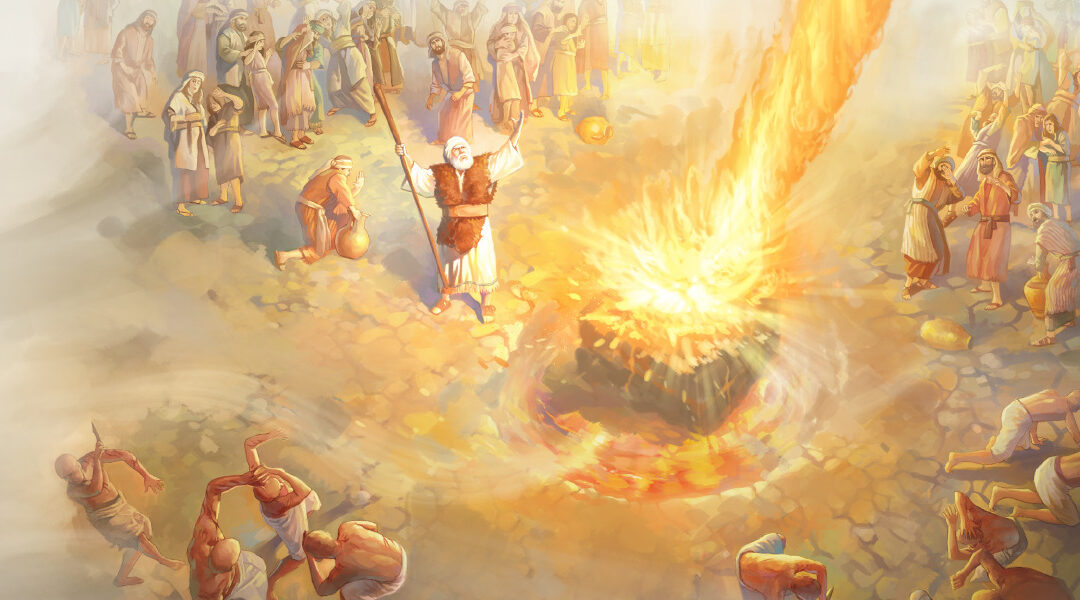
Elijah tells the prophets of Baal to prepare a bull for sacrifice and call on Baal to rain down fire to consume it. If he’s really Elohim, should be a piece of cake. They call on him for hours, “But there was no response; no one answered. And they danced around the altar they had made.” Then at noon, Elijah started to taunt and mock them. He suggested maybe they should shout louder. It almost verges on comedy when he says, “Perhaps he is deep in thought, or busy, or traveling. Maybe he is sleeping and must be awakened.”  After doing this most of the day, they get desperate and slash themselves as they danced “until their blood flowed.” The next sentence is pure sarcasm:

But there was no response, no one answered, no one paid attention.

Oh, how that is the story of all false Gods! Elijah said, ok, it’s my turn. The way that scene is set up is narrative perfection. Needless to say, fire came down from heaven and consumed the offering; God is no false, worthless idol. When the people saw this, in today’s vernacular we might say, they freaked out, fell on their face and cried out, “Yahweh, He is Elohim! Yahweh, He is Elohim!” Maybe Baal ain’t so great after all.

You’ll have to read the rest of the story to see what happens next, but it reads so very uninvented, especially as Elijah flees for his life from the king and queen, goes out into the desert and prays that God would just kill him and get it over with. God doesn’t answer his prayer, and in fact, Elijah is one of only two men in the Bible who doesn’t taste physical death, but maybe that’s a topic for another post.

Uninvented: David God’s Chosen King Counts His Fighting Men, and 70,000 Die!

Uninvented: David God’s Chosen King Counts His Fighting Men, and 70,000 Die!

In previous two posts I argued that King David’s life is counter intuitive to typically religious sinners who basically equate “religion” with moralism. Naturally, we think the purpose of religion is to be more moral, do more good than evil, more right than wrong, and that if we do, God will like us. If not, he won’t. God specifically chose David to be king of Israel because he was “a man after his own heart.” We would naturally interpret this through the lens of moralism, that it means, to be this man, David would do more good than evil, more right than wrong. But that is not the man we find in the pages of 2 Samuel, not at all. Therefore, in the title of my book, David had to be Uninvented. Somebody, anybody, making up the life of David would not make up the terribly flawed David that actually existed, the one who God declares is “a man after his own heart.”

I’ll briefly reiterate below the profound theological lesson we learn through David that culminates in the life, death, burial, resurrection, and ascension of Christ, but first let’s take a look at what is to me the most disturbing event in David’s very imperfect, sinful life. Most Christians focus on David and Bathsheba, as I did in my first post, and that’s bad enough. In my second post I focused on David as a pathetic father and leader, how he mishandled his son Amnon’s rape of his half-sister Tamar, and his son Absalom’s attempt to overthrow his father’s kingdom. All of this is merely prologue for what I consider the greatest sin of David’s life, something that caused the death of 70,000 of David’s innocent subjects. I’ll also briefly deal with the theology inherent in these disturbing events.

We read about it in 2 Samuel 24 (and a parallel account in I Chronicles 21). Because I want to focus on the theology, I’ll only briefly explain what happened, but here is an excellent short explanation from the Senior Minister of Tenth Presbyterian Church in Philadelphia (where my wife and I attended when we were in seminary). David gave a command to “Go and take a census of Israel and Judah” so he could “enroll the fighting men, so that I may know how many there are.” Joab, the commander of David’s army begged him not to do it, but the king overruled him. Bad idea.

As I was reading this story yet again, I found it distressing. It took nine months and twenty days (I love the specificity, which is an indication of the story’s veracity) of counting, and the whole time David was oblivious to his sin and the coming judgment of God for it. That’s a long time in which David had to reconsider what he was doing, but he never did. Hubris will do that to a man, which indicates the great sin David committed: he did not trust God, Yahweh, who created Israel, and promised to sustain her.

After Joab returns with the results, then David gets it, too late:

10 David was conscience-stricken after he had counted the fighting men, and he said to the Lord, “I have sinned greatly in what I have done. Now, Lord, I beg you, take away the guilt of your servant. I have done a very foolish thing.”

The bastard knew all along what he was doing was wrong! That makes me angry because he doesn’t seem to have cared if it was. But we see in his immediate response why he was “a man after God’s own heart.” Unlike King Saul who he replaced, when David was confronted by his sin, he repented. While he didn’t trust God in the most obvious of ways, he did trust God in the most important, to take away his sin. In this, he points us forward to the gospel. We cannot attain acceptance with God by obedience to the law; nothing we can do or not do will ever make us any more acceptable to him than we are in Christ, who is our righteousness, sanctification, and redemption.

Unfortunately, though, there are consequences for sin, and as we’ve already seen in his messy life, there are here as well.

The Lord says as punishment he will give David three options: three years of famine, three months of fleeing from his enemies while they pursue him, or three days of plague in the land. David responds in a way that again reflects his trust in God:

14 David said to Gad, “I am in deep distress. Let us fall into the hands of the Lord, for his mercy is great; but do not let me fall into human hands.”

The plague came, and 70,000 people died, not just one because of his sin with Bathsheba. That’s why to me David counting his fighting men is the far worse sin, yet most Christians don’t know about it while everyone, including many non-Christians, know the story of David and Bathsheba.

I have a hard time wrapping my mind around this story because it seems so blatantly unjust. David sinned, yet 70,000 innocent people died and not him? As I come across things like this in Scripture, I always go back to Moses’ words in Deuteronomy 32:3, 4:

I will proclaim the name of the Lord.
Oh, praise the greatness of our God!


He is the Rock, his works are perfect,
and all his ways are just.


A faithful God who does no wrong,
upright and just is he.

I don’t get to determine what is just or unjust because of the way it seems to me from my limited, finite perspective. If the Lord does it or allows it, it is just, or if he allows injustice, it is for a greater good, or something we can’t conceive.

Many reject the of God of Scripture because they think they have the right to judge what they read in the Old Testament (seldom do they argue against the New, except to reject miracles). No God, they assume, would act that way, or cause a people to act that way. Really? How would they know? Based on what standard? Whose standard? Is there even a standard? The only reason we know a line is crooked is because we know what a straight line is. Where does morally straight come from? Well, the God they reject! This idea of condemning God by the standard that comes from God himself is a fascinating study, and beyond the cope of a blog post, obviously. But when I come to things in Scripture that make no sense to me, like David counting his fighting men, and 70,000 people dying as a result, I accept something else Moses said in Deuteronomy 29:

29 The secret things belong to the Lord our God, but the things revealed belong to us and to our children forever, that we may follow all the words of this law.

And boy, are there a lot of secret things!

Uninvented: The Messy Life of David, God’s Chosen King, Continued

Uninvented: The Messy Life of David, God’s Chosen King, Continued

In my last post I looked at how it makes little sense to sinful “religious” people God that would chose such a flawed man as David and declare him, “A man after his own heart.” David’s adulterous encounter with Bathsheba and having her husband killed was only the beginning of the dysfunction in his life. Because of what he’d done, through Nathan the prophet, the Lord declared:

10 Now, therefore, the sword will never depart from your house, because you despised me and took the wife of Uriah the Hittite to be your own.

David repented, and the Lord took away his sin, but the child born of adultery died. Bathsheba conceived again, and gave birth to Solomon, who would become David’s heir to the throne. After Solomon’s peaceful reign, Nathan’s prophecy would eventually lead to civil war and destruction, and Israel’s exile by the Assyrians (the ten northern tribes, Israel), and the Babylonians (the two southern tribes, Judah).

The sword Nathan referred to started with David’s own son, Absalom. Because David had a number of wives and concubines, as was the custom for rulers at the time, he had children from different women, not always a recipe for harmony. In 2 Samuel 13 we read a sordid story many wouldn’t expect to find in the Bible. The stories in our Bibles, however, are of real people, fallen sinners who more often than not do what fallen sinners do. In this case, David’s son, Ammon had some serious lust for his stepsister, Tamar:

Amnon was frustrated to the point of making himself sick over his sister Tamar because she was a virgin, but it seemed impossible to do anything to her.

Eventually he creates a situation where he’s alone with her, and pressures her into having sex with him, but as is the case with lust after forbidden things, it doesn’t turn out well. After he had raped her, we read:

15 After this, Amnon hated Tamar with such intensity that the hatred he hated her with was greater than the love he had loved her with. “Get out of here!” he said.

I imagine Freud would have a field day with this, but what makes it even worse than rape in the ancient context is that Tamar was now seen as used goods. No other man would want her, so her life is basically ruined. We read that “Tamar lived in her brother Absalom’s house, a desolate woman.”

We also read something revealing about the weakness of David’s character: “When King David heard all this, he was furious.” But guess what he did about it? Absolutely nothing, like it never happened, except of course to ruin Tamar’s life. There were consequences for rape according to the law of Moses, but David ignores that to his shame. And as a king of Israel, he knew God’s law well, so ignorance is no excuse. Even worse, the job of the king is to dispense justice, yet because this crime was committed by his son, he did nothing. It actually makes me angry just thinking about it as I write. Imagine how Absalom felt.

David’s inexplainable neglect starts a series of events that bring chaos and misery to his life and kingdom. Two years pass, and we can imagine living with his sister, an abandoned woman, Absalom’s anger smoldering all that time. His father, the king, acts like it never happened, so Absalom figured he would take justice into his own hands. However, according to the law, rape is not a capital crime deserving death, but Absalom is not concerned with justice, but revenge. So, he has other brothers, sons of David, kill Amnon, and the bloodshed and misery in David’s life are just beginning, per God’s promise.

I want to reiterate the uninvented implication of this story. This morally pathetic David was declared by God, “a man after his own heart.” He sure doesn’t seem to act like it! That, as I argued in my last post, is the case if we assume the “religious” perspective on things typical to sinful human beings, i.e., moralism. However, God came in Christ to save sinners, and boy oh boy, was David a sinner. What differentiated him from Saul the failed king was that he knew it! He was quick to repent when confronted with his sin. He knew he could never achieve acceptance before a holy God apart from God’s mercy and grace. His utter dependence on God was what made him a man after God’s own heart, which is why David and his story could not be human invention, merely compelling fiction. As I say repeatedly, fiction didn’t exist in the ancient world.

Things go downhill from here. Because Absalom killed his brother, he had to flee to safety in another town, where he stayed for three years. Then we read these strange words from 2 Samuel 13:

37 Absalom fled and went to Talmai son of Ammihud, the king of Geshur. But King David mourned many days for his son.

Mind you, David isn’t mourning for his murdered son, Amnon, but for Absalom the murderer! Could David be any more morally obtuse! The next verse says David longed to go to Absalom because “he was consoled concerning Amnon’s death.” What about justice!

It only gets worse for David from here because there was no justice, and Absalom will never forgive his father. So, he conspires against his father by offering the Israelites the justice his father is failing to give them. David who previously had to run for his life from Jealous King Saul, now has to run for his life from his own son. After much blood in war is shed, Absalom is killed, and David’s response again shows his character and judgment as less than stellar. Even though Absalom’s rebellion caused so much suffering and death, and humiliated the king, here is how David responds:

33 The king was shaken. He went up to the room over the gateway and wept. As he went, he said: “O my son Absalom! My son, my son Absalom! If only I had died instead of you—O Absalom, my son, my son!”

Really, David? This son David weeps for is a treasonous rapist, yet David is blind to that. As his commander rebukes him, remember this is the man of whom the Lord said, “he is a man after my own heart.”

Then Joab went into the house to the king and said, “Today you have humiliated all your men, who have just saved your life and the lives of your sons and daughters and the lives of your wives and concubines. You love those who hate you and hate those who love you. You have made it clear today that the commanders and their men mean nothing to you. I see that you would be pleased if Absalom were alive today and all of us were dead.

It’s hard to imagine through the whole sordid story of David’s life he could be made to look any worse! Thus we conclude once again, you just can’t make this stuff up!

Uninvented: King David’s Messy Life as God’s Chosen King

Uninvented: King David’s Messy Life as God’s Chosen King

Reading through David’s life in 2 Samuel impressed upon me again just how Uninvented it is. Until the early ‘90s, many biblical scholars and assorted critics claimed David never existed because there had been no archaeological confirmation that he did. Archaeology finally confirmed David’s existence, but even though archaeology is the Bible’s best friend and confirms its historicity, we don’t need it to confirm it is indeed historical. The more you study David’s life in the wide scope of redemptive history, the more apparent it becomes sinful human beings could not made it up. One could write an entire book under the rubric of Uninvented on the life of David. That David’s life deserves a book-length treatment means a measly little blog post could never do it justice, but I’ll try.

On the surface David seems an unlikely candidate to be God’s chosen instrument to lead his people Israel. I recently wrote about him being the youngest of eight brothers to be chosen by God, and how counter cultural that was in the ancient world, but what seems more counter intuitive is God proclaiming him a “man after his own heart.” When the Lord rejected Saul as Israel’s first king because he had disobeyed him, through Samuel he said the man he sought would be “a man after his own heart” to be “ruler over his people.” When the Lord told Samuel who the replacement for Saul would be, he told him:

Do not consider his appearance or his height, for I have rejected him. The LORD does not look at the things people look at. People look at the outward appearance, but the LORD looks at the heart.

The Apostle Paul confirms the narrative in the New Covenant context saying:

22 After removing Saul, he made David their king. God testified concerning him: ‘I have found David son of Jesse, a man after my own heart; he will do everything I want him to do.’


23 “From this man’s descendants God has brought to Israel the Savior Jesus, as he promised.

But when you read about David’s life, on the surface it’s difficult to see how this adulterous murderer who was a terrible father could be a “man after God’s own heart.” What makes it impossible to make up, to be a story that came out of mere human imagination, is that it goes counter to everything we naturally see as “religious,” as does Christianity properly understood.

Sinful human beings apart from the grace of God see religion as morally attaining the acceptance of God. If we live up to his moral standards, God will accept us, if we don’t, he will reject us. It’s a simple, and intuitive, moral calculation, and it has nothing to do with Christianity. While Christians throughout history have turned Christianity into moralism, that doesn’t make Christianity moralism.

As shocking as this statement will be to most people, Christianity is not about becoming a more moral and better person. Any old religion can do that! Christianity, rather, is about God saving his people from their sins, which is why Jesus, the second person of the Trinity, came to earth, and why he was given his name. If we could gain acceptance before God by being more moral (i.e., by the law), than Jesus came to earth and died for nothing.

It’s only in a gospel context that David’s life and kingship makes any sense at all. As a made-up story, it makes none.

The reason is that if I have moral aspirations to be a better person, David is the last person I would choose. None of us could relate to being a warrior king in the ancient world, but it was necessary for God to establish the nation of Israel in a world where only might made right. But that’s not what makes David impossible to imagine as fiction; it’s his moral failings, and that are massive. I’ll briefly explain what I mean, but when I consider his life, and God declaring him “a man after his own heart,” from a human perspective I can’t wrap my brain around that. It makes absolutely no sense! Rather, you would think God would be embarrassed by the guy. Uh oh, I imagine God saying, I made a big mistake!

The is the story of David and Bathsheba, which every Christian knows, is a great example. It starts out this way.

In the spring, at the time when kings go off to war, David sent Joab out with the king’s men and the whole Israelite army.

Hmm, why didn’t David go? We’re not told, but it gave him the opportunity to commit adultery, and then this “man after God’s own heart” has the husband killed to keep it quiet. Nice move. But what indicates to us why God chose David is his response when confronted with what he’s done:

13 Then David said to Nathan, “I have sinned against the Lord.”

No justifying, no dissembling, no escaping responsibility, just acknowledging he has sinned, “against the Lord.” What? Wait a second. Didn’t he in effect rape Bathsheba, and have her husband killed? Didn’t he kinda sin against them? In fact, in Psalm 51, David’s great lament about this series of events, he says:

For I know my transgressions,
and my sin is always before me.
Against you, you only, have I sinned
and done what is evil in your sight;
so you are right in your verdict
and justified when you judge.
Surely I was sinful at birth,
sinful from the time my mother conceived me.
Yet you desired faithfulness even in the womb;
you taught me wisdom in that secret place.

Of course David sinned agains Bathsheba and her husband, Uriah the Hittite, but it is only God who makes sin sinful. 

Knowing this is why David was “a man after God’s own heart”; he knew salvation from our sin was from God’s mercy and grace alone. He knew we are sinners who can’t save ourselves. That you don’t make up!

The gospel makes absolutely no sense to sinners who are intent on making God accept us based on what we do or don’t do. We, by sinful nature, want God in our debt, not we in his. Christianity is the only religion in the history of the world that introduced mankind to the gospel (good news) of God’s grace, that the only way to have a relationship with our Creator is his completely unmerited favor. That can’t come from mere human imagination, nor King David who proclaims it.

I was going to deal with a couple other issues, but that will have to be in the next post, or two.

Uninvented: David and Goliath, A Biblical Story too Perfect to be Made Up

Uninvented: David and Goliath, A Biblical Story too Perfect to be Made Up

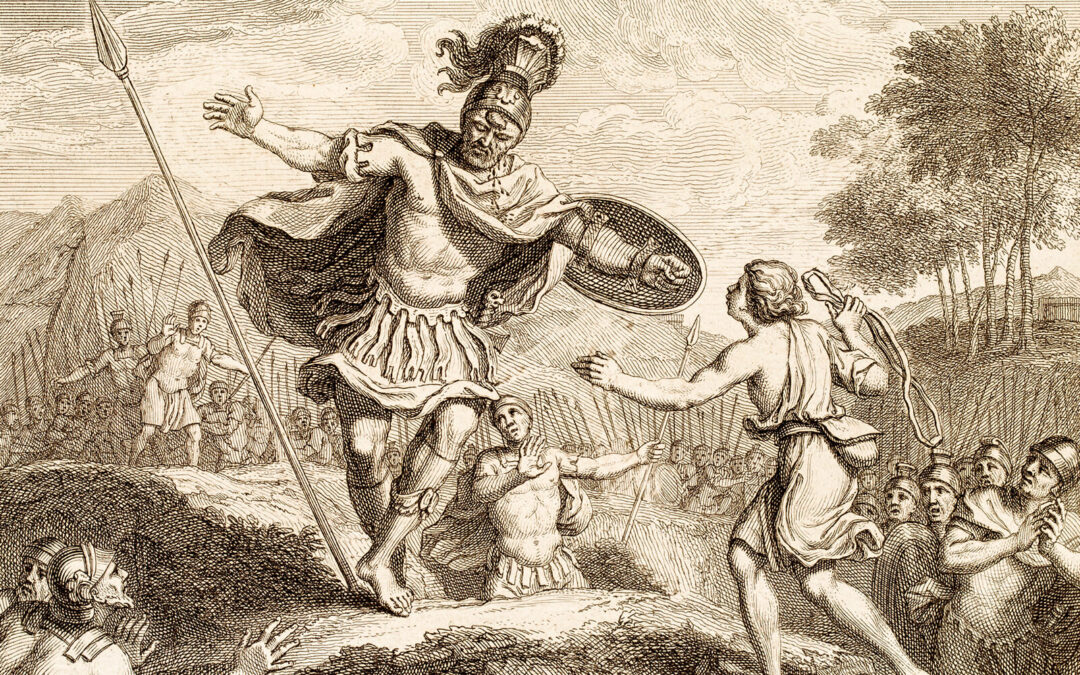
I haven’t read this iconic story from I Samuel 17 in years, and as I’m making haste in my reading through the Bible this time (as opposed to last time writing through it), I can more appreciate it in the long scope of redemptive history. It fits so perfectly knowing the beginning, middle, and end of the story, and everything in between for that matter. The Lord is amazing. As I’m reading the passage, and marveling at the various dramatic dynamics, I wondered how many movies have been made about it. I would guess quite a few. So, I did a search, and found one called, strangely enough, David and Goliath. The trailer starts with David reciting Psalm 23, then in big block letters: THE IMPOSSIBLE TRUE STORY. I couldn’t say it any better! In a nutshell, that is Uninvented!

Everyone knows the story. Even those who’ve never read it, which is likely most people in our anti-Christian secular age, know it means the little guy overcoming against impossible odds. The Philistines were the scourge of Israel having been in Canaan before the Israelites crossed the Jordan to occupy the land. The two nations had many battles, and in this one the two armies were arrayed on hills facing one another with a valley in between. Saul, Israel’s first king, was leading the army, and there was a stalemate. So every day the nine-foot-tall Goliath would come out mocking and taunting the army of Israel. He made them a deal. They pick one man to fight him, and if he is killed, the Philistines will be the subjects of Israel, if Goliath kills the Israelite, they will be subject to them. This was not good news for Israel’s army:

11 On hearing the Philistine’s words, Saul and all the Israelites were dismayed and terrified.

The uninvented beauty of the story is theological. Yes, it’s inspiring when someone through their own grit and determination can overcome “the giant,” but this isn’t about us, about human ingenuity and our ability to somehow beat the odds. It’s about God! And why it reads true is because of that.

In my last post I explained that God chose the youngest of Jesse’s eight sons, David, to be the future king of Israel, and how completely counter cultural that was. Ancient people don’t make up stories where the youngest is the hero, unless it’s true. That unlikely theme continues when we learn that Jesse’s three oldest sons had gone off to war with King Saul, and David is where he always is, tending sheep. The author again points out that David was the youngest to emphasize the contrast in God’s economy. As the Apostle Paul declares in I Corinthians 1:

27 But God chose the foolish things of the world to shame the wise; God chose the weak things of the world to shame the strong. 28 God chose the lowly things of this world and the despised things—and the things that are not—to nullify the things that are, 29 so that no one may boast before him.

This theme runs throughout Scripture which gives it all uninvented credibility.

The Bible is redemptive history, the long story of God saving his people from their sin in Christ. The Old Testament, including stories like David and Goliath, is not to be read primarily for inspiring moral stories because it’s not primarily about us. It’s about Jesus and needs to be read in light of his declaration in Luke 24 that everything in “the Law of Moses, the Prophets and the Psalms” is all about him! I’m not saying inspiring moral and spiritual stories are not valuable (and can help us grow in our relationship with God), or that the wisdom and knowledge we gain about life and human nature are not important, only those are not the most important things.

One of the many questions we might ask is, what does this say about the nature of our salvation in Christ. Something that’s impressed me this time reading through Old Testament history is how God consistently impresses upon the Israelites their salvation is of him. It starts with their Exodus from Egypt and continues through all the existential battles for Israel’s existence. A phrase reflecting this in Exodus and Deuteronomy is “mighty hand,” as in when Moses told the people:

Remember that you were slaves in Egypt and that the Lord your God brought you out of there with a mighty hand and an outstretched arm.

When you understand that it is God who saves, you realize the story of David and Goliath isn’t about David! And while Saul and his army don’t seem to get that, David does. He asks, what will be done for the man who kills “this uncircumcised Philistine that he should defy the armies of the living God?” Since it’s a pretty good deal, David figures why not. One of his brothers sees him asking about this, and he’s ticked off. And guess which brother it is? Yep, the oldest! The contrast is delicious.

Davis is brought to the king, and Saul is doubtful this young shepherd can beat the giant warrior, but David replies:

36 Your servant has killed both the lion and the bear; this uncircumcised Philistine will be like one of them, because he has defied the armies of the living God. 37 The Lord who rescued me from the paw of the lion and the paw of the bear will rescue me from the hand of this Philistine.”

What an incredible theological lesson. While the army of Israel and their king think the battle is about the giant and them, David knows it is about God who rescues. That has been the theme impressed upon me from Genesis through I Samuel. It’s a shame so many Christians don’t truly get this. It took me many years, decades, to finally learn to get my focus off me and put it on him, on the cross, Christ, God our Savior come in human flesh. Our struggles with sin only appear gigantic when we think they have the power of a Goliath. They don’t! Paul tells us why:

13 For he has rescued us from the dominion of darkness and brought us into the kingdom of the Son he loves, 14 in whom we have redemption, the forgiveness of sins.

Praise our Lord of sovereign grace!

Here is an interview with the editor of the movie David and Goliath.