
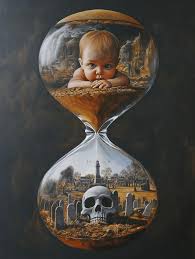
I think about time all the time. You might think this happens more as you enter your elderly years, but I’ve been thinking about it for a very long time. Well, not in biblical time, but in regular old human time. One of my favorite sayings is that God is never in a hurry, as we can see from him making promises that take thousands of years to come to fruition. Take the promise to Abram, for example, in Genesis 12. God promises him that all peoples on earth would be blessed through him, and then it takes 2,000 years for that promise to finally be fulfilled in Christ. That’s a long time! Inconceivable to us who are stuck in time. I vividly remember, although this only occurred to me recently, that when I turned 24, I really experienced time for the first time. Yeah, sorry about the repetition of that word, but It’s an obsession of mine. It reminds us every moment of every day that it will not stop, that it endlessly marches on, seemingly quicker and quicker, until it does indeed stop, for us.
Speaking of 24, my sister is almost four years older than me. As she moved into her later 20s she started bemoaning getting older, and I’d say, no big deal, happens to everyone, deal with it. Then on my 24th birthday back in 1984, I distinctly remember thinking, oh crap, I’m getting older; I’m mortal too! Nobody gets outta here alive, including me! Prior to that moment time, getting older and heading inevitably to death, was theoretical. All of a sudden, it wasn’t. And I was only 24! Kids, yes, kids, who are 24 appear to me now like they’re in high school. Speaking of kids, another moment this hit me was in the job I got after I graduated from Seminary in 1988 at a small Christian liberal arts college in central Pennsylvania, Messiah College (now University). When I started there I was 28 and the kids who attended were six to ten years younger than me, but by the time I’d been there five years, they were now eleven to fifteen years younger. One day early in a new school year as I was walking on the campus, I looked around and said to myself, “When did they let all these high school kids in!” They looked so young. Then it hit me, that they appear younger to me now that I’m a bit older. Think how they look now over 30 years later, like children, which of course they are.
Another one of the moments I look back on, although it took some years for me to realize it, was when I was probably in my mid-30s. My wife and I were involved in an Amway business for the decade of the 90s, and we’d go to big seminars from time to time. This one was in Miami, and Tim Foley, who played with the great Don Shula Miami Dolphins in the early ‘70s, was on stage. He was talking about “the three-to-five-year plan,” a plan that didn’t quite work out for us. Given my later obsession with the swift passage of time I’ll never forget what he said, how he said it, and my response. “For you youngsters out there, you think five years is a long time; it’s not!” And I said to myself, “Well, yes it is.” Oh, how wrong I was.
The passage of this mystery process of moments rushing by us is theoretical when we’re younger, something that really only happens to other people. It just isn’t real to us when we’re young. I encounter young folks in their 20s and 30s who when I lament time’s swift passage say they get it, but they have no idea. Not really until you get into your 40s does it move from the theoretical, it only happens to other people, to it’s happening to me! Then as it continues to press on you find as you go to the doctor or dentist that, apparently all of a sudden, they’re all younger than you!
I’ll share one last anecdotal experience you oldsters can possibly relate to. Our youngest son, speaking of 24, turned that age February 1. He’s now married with a baby recently born, but he was probably 19 or 20, and one day I was talking to him, as I’m wont to do as an old person, about the swift passage of time. I was getting frustrated because it’s impossible for a 20 year-old to understand, to see it like I do, and I said, “Oh, you can’t relate!” And he replied, “Then why do you keep telling me that?” Priceless. And I blurted out, “Because that’s what old people do!”
A Brief History of Time
The passage of time is no doubt trippy, in that old 60s/70s druggy term, but what is it? Why does it exist? As Christians, how are we to look at It? Do we deplore it? Worry about it? Curse it? Ignore it? Using the phrase “existential crisis” in my title kind of gives away my answer. Existential doesn’t just mean existence, but comes out of a 20th century philosophy called existentialism, which Wikipedia defines well: as “a family of philosophical views and inquiry that explore the human individual’s struggle to lead an authentic life despite the apparent absurdity or incomprehensibility of existence.” It’s the swift passage of time that pours lemon juice on that wound. It’s a war we can’t win against an incomprehensible enemy. Death, specifically our deaths, but also the very concept of death, brings any idea of the meaning of our lives into question. Without God life becomes a Woody Allen movie, leading to despair, denial, or resignation.
The great Augustine of Hippo, the 5th century Bishop and one of the most profound thinkers of all time, tripped out on time as well. In Book 11 of his Confessions as he is contemplating God and this mystery he says:
What then is time? If no one asks me, I know what it is. If I wish to explain it to him who asks, I do not know.
Time he says is a paradox. The past no longer exists, nor does the future, and we can’t quantify the present—it just is. The instant it happens it becomes the past that no longer exists; very strange. He talked about God’s creation in which time exists, and says if the present didn’t pass away like it does on this created earth, then that would be eternity. So time “tends not to be” because it’s constantly vanishing as it comes into being. As I said, trippy.
Einstein in the early 20th century added to the trippiness when he postulated that time and space were relative. Basically, that means time passes slower for fast-moving objects compared to something at rest. I’m not sure Einstein’s theory, supposedly proved by experiments, applies, but as we get older time does appear to move faster. Remember when you were young, summer vacation, all of maybe three months, seemed like forever. When we were kids, we would play outside all day until it got dark, and as teenagers would sing with Zeppelin and Robert Plant that “Dancing days are here again as the summer evenings grow.” After all, we have, it seemed, forever. As the decades pass and the years pile up, years seem like months, months like weeks, and weeks like days. Christmas seems upon us not long after New Years.
I’m sure people have been perplexed by time since God created it, but secularism which developed over the last several hundred years did something unique to time. It gave people the impression they could evade its consequences. Yes, everyone knows in the end it can’t be escaped, but they hope by ignoring it just maybe it will leave them alone. This is nothing new, although secularism made it more widespread. Blaise Pascal writing in the mid-1600s as if it was 2026:
In spite of all these miseries man wants to be happy, and only to be happy, and cannot help wanting to be happy. But how can he go about this? It would be best if he could make himself immortal, but since he cannot do this, he has decided to stop thinking about it. Being unable to cure death, misery, and ignorance, men have decided that in order to be happy, they must repress thinking about such things.
Files this under the more things change . . . .
One of the reasons Charlie Kirk’s assassination had such a profound impact, especially on young people, is that a young vibrant man in the prime of life, only 31, was cut down. That makes death not so theoretical after all, and as secularism’s deceits fade away faith becomes a more plausible alternative for many young people. Secularism and the rise of science, technology, and modern medicine gave people the impression we have some control over what happens to us in time, but that becomes increasingly difficult to sustain in an apparently random and chaotic world. As Pascal added, “The last scene of the play is bloody, however fine the rest of it. They throw dirt over your head, and it is finished forever.”
The Ultimate Question Mark: Death
It’s impossible to escape the question unless we are determined to ignore it, and many are, unfortunately. If they thought like I did, they wouldn’t. Have you ever watched an old movie from the 40s or 50s and suddenly realize almost everyone you’re watching is now dead. I always do. The movie is like moving life that doesn’t move captured in amber. Life, and time, however, keeps moving. Or having grown up in the era of sex, drugs, and rock and roll, I look back at the baby boomer generation, at those who reveled in youth and rebellion, and they are now tottering old senior citizens. I loved the band The Who in the 1970s. In a song called “My Generation,” Roger Daltrey in the flush of youth sings, “I hope I die before I get old.” Keith Moon did! At only 32. Bassist John Entwistle died young, at 57, and Daltrey and Pete Townsend are now entering their 80s. They didn’t get their wish.
In spite of the ignorance of youth and the deceits of secularism, the fear of death haunts us at every moment. Why do we fear it so? What is it about our ceasing to exist that terrifies us? That is the question. Why is it that animals and insects intuitively fear death even though they can’t think? Shouldn’t we be the least bit curious as to why that is? Given our mortality and its ever present reality in our world, it seems to me a good question to ask is, why does death exist? If we can find the answer to that question, maybe it will also lead us to the answer as to why we exist in the first place, and what it all means. Why is there something rather than nothing. Philosopher Martin Heidegger (1889–1976) in the 20th century called it “the fundamental question of metaphysics.” He asked: “Why are there beings at all, and why not rather nothing?” Good question.
Yet even in the face of e death’s certainty most people believe death, and its associated suffering, requires no explanation. It’s just a brute fact. But why does death seem so wrong? We may not feel outrage at the funeral of a great grandmother, but go to the funeral of a five-year-old and you will feel wrongness . . . viscerally . . . deeply . . . painfully. Which worldview holds the most compelling explanatory power for the anguish of death, atheistic materialism or Christianity? I rest my case.
We know the Christian explanation. God created reality good, his creatures rebelled and fell into sin and death. Therefore, sin and death are an aberration, not the way things were supposed to be. It feels so wrong because it is wrong! Far from seeing death as part of the Disney “circle of life,” or “natural,” just the way things are, we are all repelled by death as if it were an aberration because it is. When confronted personally with the possibility or actuality of death, no one treats it as “natural.” Viscerally we all hate death. Jesus hated death too.
Jesus stands before the tomb of his friend Lazarus (John 11), whom he would raise from the dead in minutes, and John writes, “Jesus wept.” This seems like a strange response when he knew he would shortly bring his friend back to life. To me these may be the most profound words in all of Scripture. Jesus is looking at the ultimate consequence of his creation marred, looking upon the ugliness and smelling the stench of the wages of sin, and he hates it! It broke his heart. And the Greek in this passage indicates that he wasn’t just sad, he was angry, as well he should have been. The image of God in man had been defaced, and it is a tragedy, literally, of biblical proportions.
Yet, strangely enough, the Bible never anywhere apologizes for, or is embarrassed by death. In the Book of Job, the most direct confrontation questioning the pain of sin and death in Scripture, God refuses to apologize or even explain anything! How can you explain the unexplainable? While we are never privy to the eternal Trinitarian councils as to why God created everything and allowed this disease to infect his creation, we know that the plan all along was to solve the problem. Jesus knew that too, but that didn’t mean the pain and perplexity and sadness of death isn’t real.
When something goes wrong most people want to know why, but the uncomfortable fact that we die and know it’s wrong seems to elicit little curiosity. For some reason it doesn’t occur to such people to ask why, or question what death means. In fact, if looked at correctly, death is the ultimate question mark, and God provides the answer. If what the Bible tells us isn’t true about life, death, and everything else, what is the alternative explanation? We must always consider the alternative because something must be true about death; it’s either a brute fact or some kind of aberration. Yet no other religion except what we find in our Bibles gives us any answers. For them death and suffering and evil just are, and we have to deal with it. There is no explanation and no ultimate solution. Least plausible is the view of the God-less, of the materialist-atheist.
I once heard William Lane Craig lay out the implications if atheism is true:
- Death is the end; the dirt is our future.
- There is no ultimate purpose in life
- There is no ultimate justice
- There is no basis for morality—Darwinian morality is all
Atheist‑materialists admit that we all experience purpose, long for justice, and act in moral ways. They expect us to believe that atoms coming together by chance for no reason at all explains the complexity of purpose, justice, and morality. I don’t think so. I, and almost every person on earth, don’t have enough faith to be an atheist. In 2026 the absolute poverty of the atheist‑materialist worldview is more apparent to more people than ever before.
Thankfully, when confronted with the question we have an answer: Jesus who conquered death, then tells us we shall be like him for we shall see him as he is. Our hope isn’t an immaterial bodyless eternal life in heaven, but eternal life in a material resurrected body on this earth. There are many passages in the Bible about the resurrection and this life to come. It’s hard to pick a favorite, but one certainly comes from the man I mentioned above who experienced horrible suffering with no answer as to why. Yet says, and we can affirm along with him (Job 19):
25 I know that my redeemer lives,
and that in the end he will stand on the earth.
26 And after my skin has been destroyed,
yet in my flesh I will see God;
27 I myself will see him
with my own eyes—I, and not another.
How my heart yearns within me!
Recent Comments