
My Post Mill Story and Isaiah 2
I’ve always thought I could do anything I put my mind to if I only worked hard and long enough. When I was a teenager I was convinced I could become the greatest guitar player in the world; Eddie Van Halen had nothing on me. Then when my interests changed to golf, I not only wanted to be the greatest golfer in the world, but the greatest golfer of all time. I know, it’s hilarious, especially because Tiger Woods has more talent in his pinky finger than I have in my entire body. But I’ve always been a big thinker. When I became a Christian, that didn’t change. I thought maybe I would be a missionary and Christianize the world. When my vision of Christianity expanded and I got into politics, I thought I would change the world that way. Next I thought I would become a scholar and change the world through academics and teaching. Whatever it was, I always wanted to “change the world.”
At some point along my Christian journey I realized that was impossible, or so I thought. I didn’t become a pessimist or cynic, but what I thought was a realist. This is a fallen world filled with fallen people, and it will always be so. Wanting to change it is a pipe dream, so much spitting into the wind. The best we could do is fill up the holes in the dikes, bale water in the sinking ship, and keep our eyes on our heavenly home and eternity. Things will go on like they always have, likely just getting worse until Jesus finally comes back and puts all things right in the final judgment. Then last year I realized this mentality was profoundly unbiblical, not to mention dishonoring to God. That was when much to my surprise I came upon post millennialism without looking for it, and then against my will concluded it is indeed the biblical eschatological position.
I’ve written about that here before so I won’t repeat it. What I want to write about is the phrase I used above, “change the world.” From my new perspective I no longer believe that is a futile fool’s errand, but a biblical imperative. Prior to my post mill conversion I believed that while God is sovereign and in control of all things, this world as fallen pretty much belongs to Satan. Isn’t it obvious? There are various verses that give the impression this is the case. One of the most direct assertions is 1 John 5:19: “We know that we are from God, and the whole world lies in the power of the evil one.” Other versions say in control of the evil one. Paul says our citizenship is in heaven, and Peter tells us as God’s elect we are exiles. The writer to the Hebrews says the Heroes of the faith “were longing for a better country—a heavenly one.” And what serious Christian doesn’t often feel that this world just isn’t our home; we belong somewhere else.
I discovered, however, that my thinking along these lines often became escapist because it was defeatist. The devil and his kingdom are on the offensive in this world, and the best we can do is defend ourselves against his ever-advancing onslaught. That’s what I used to believe. No more. I can’t give a full biblical exposition for the post millennial case in a blot post, but I will share my new perspective on two verses critical to it, both in Matthew. First the Great Commission of Jesus in Matthew 28:
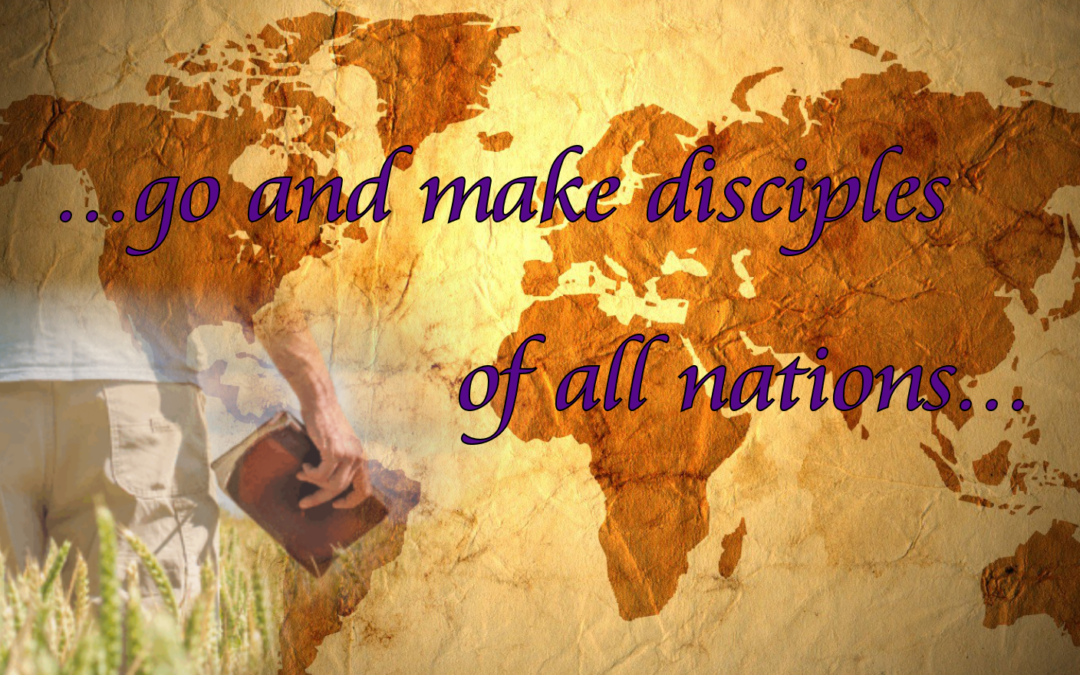
18 Then Jesus came to them and said, “All authority in heaven and on earth has been given to me. 19 Therefore go and make disciples of all nations, baptizing them in the name of the Father and of the Son and of the Holy Spirit, 20 and teaching them to obey everything I have commanded you. And surely I am with you always, to the very end of the age.”
First, Jesus has all authority, not some, so every single thing that happens in this fallen world is either allowed, controlled, or caused by him. The devil has no autonomous power. I basically used to look at this messed up world like he did. I mean, how could things be so messed up and Jesus actually be in control? Then when Jesus said baptizing and teaching them to obey everything, he is speaking of nations, not just isolated individuals in nations. And if they are being taught to obey everything Jesus commanded, then the culture will inevitably be Christianized. How can it not be!
The other Matthew passage is in chapter 16 after Peter declares that Jesus is “the Messiah, the Son of the Living God”:
18 And I tell you that you are Peter, and on this rock I will build my church, and the gates of Hades will not overcome it.
This rock is not Peter, but Peter’s declaration, and that declaration will drive the inevitable growth and advance of Jesus’ church. I used to look at the church as on the defensive, and hell on the offensive. Doesn’t that seem the way it is most of the time, if not all the time? But that’s not what Jesus says. Gates in the ancient world were defensive instruments, not offensive. So in fact, it is the church that is on the offensive, and the gates of hell will not be able to hold back its advance in this fallen world. That means Satan’s kingdom influence must inevitably shrink and the Kingdom of God spread its influence throughout the world. I must ask the question: Do we act like we’re on the winning team? That our victory is inevitable?
What has this to do with Isaiah 2? When I read that chapter this time through it was a jolt to realize how differently I used to read it. I’m speaking specifically of the first five verses. I won’t quote them here, but before in knee jerk fashion I automatically assumed this depiction was eschatological, meaning these events would surely never happen in this fallen world, but only in the new heavens and earth after Jesus returns. No more. I will quote one verse and pose some questions:
4 He will judge between the nations
and will settle disputes for many peoples.
Will there be disputes in the age to come when sin doesn’t exist? How exactly in this present age would the Lord “judge between the nations” so in due course “they will beat their swords into plowshares and their spears into pruning hooks”? May I suggest that is by the “descendants of Jacob” who “walk in the light of the Lord”? (Verse 5) You and me? His people, his body on earth, and he as its head seated at the right hand of God ruling over all things?
These kind of passages indicate, in a phrase I first heard from N.T. Wright, inaugurated eschatology, or the already and the not yet. In other words, the transformation that will be fully realized when Christ returns in the renewed and redeemed heavens and earth, is now partially realized in this fallen world through his church. In reading through Isaiah I found such passages over and over that in the past I instantly thought, well that’s not happening in this world! Oh yes it is, and yes it will. As Jesus said, Thy Kingdom come, thy will be done on earth as it is in heaven.
Recent Comments