Psalm 112 and the Man Who Will Never Be Shaken

Psalm 112 and the Man Who Will Never Be Shaken

Reading through the Psalms is a wonderful experience. You could park on one for days mining the depths for nuggets of truth into the greatness of our God. And God is the point of all 150 of them. One of the reasons the Psalms have been so beloved over the millennia is because sinful, fallen human beings can relate to the pathos we read there. The struggles of the writers are familiar to us as we go through the often painful experiences of living life in a fallen world among fallen people in a fallen body. But we mistake the power of the Psalms if we think they are about us. The words connect with us because they are profoundly about God which then puts our struggles into perspective.

When I wrote my first book, The Persuasive Christian Parent, I was introduced to a metaphor that became my favorite way of  explaining living in the messy world as I described it above: a puzzle. The fallen human tendency is to focus obsessively on the puzzle pieces. Until we grow older we imagine the pieces are all that exist; there is no puzzle into which each piece fits to make the picture of life make sense. Then depending on our level of maturity, or not, will we be able to keep the individual puzzle pieces of our lives in perspective with all the others we encounter.

Our secular Western culture, however, expects us to believe that in a universe filled with profound particulars (puzzle pieces), like sunsets, and birth, and music, and taste buds, and love, and sex, and DNA, that nothing transcends the pieces to give them ultimate meaning (the universal). We’re expected to believe the puzzle doesn’t even exist! We’re just stuck with the pieces. Christian Philosopher Douglas Groothuis in his wonderful book Truth Decay puts this exquisitely:

It is as if a stained‑glass window, which offered a pictorial message of a reality beyond itself when illuminated by the sun, were shattered into countless fragments, which a bemused onlooker is now rearranging into every pattern but it’s lost original.

Brilliant! Why do you think film maker Woody Allen always looks so miserable? He’s rid the universe of the only universal that can give particulars meaning—God! Every movie he makes is a different pattern, but nothing comes close to the original. Inevitably there is despair, dissatisfaction, or the blind leap—I’ll just pretend I found the original and ignore the vacuum in my soul.

It isn’t only atheists like Woody Allen who tend to see the world this way, that the particulars are where our true meaning and hope and purpose are found—we are too! Where do you think worry and doubt and fear and anxiety and frustration and anger come from? They come from thinking the pieces are sovereign and God is not! Shame on us, but it’s a constant temptation for every single one of us, and it requires constant vigilance to not fall into the clutches of this perniciously appealing temptation. Once we give in, it can turn into a sink hole growing bigger and bigger until it completely envelopes us. Which brings me to Psalm 112.

The answer to these ubiquitous temptations is found in the words of Jesus: “Man shall not live on bread alone, but on every word that comes from the mouth of God.” That and prayer and praise and thanks to God can make us the person to whom this Psalm refers, the blessed man:

 Praise the Lord!
Blessed is the man who fears the Lord,
who greatly delights in his commandments!

The right God-honoring attitude in all things we encounter is, Praise the Lord! How about that being our knee-jerk reactions to the “stuff” happening in our lives instead of complaining and moaning and whining. I know, I’m convicted too. But the promise is that we’ll be blessed if we do it. The blessings, i.e., the happiness and contentment that comes with praising the Lord is outlined in the next several verses, and what stands out to me are the following words:

He is not afraid of bad news;
his heart is firm, trusting in the Lord.
His heart is steady; he will not be afraid,
until he looks in triumph on his adversaries.

Oh, to live this way! Instead of living in fear we are steady; the Hebrew literally means to be established and is interpreted as to lean, lay, rest, or support. This person, which can be you and me, is stable, unmovable, reliable. Notice in verse two the impact this kind of life has on his children:

His offspring will be mighty in the land;
the generation of the upright will be blessed.

Living a truly Godly life of the blessed has a generational influence; it can’t be helped!

If we consider the “adversaries,” it is all those things in our lives that cause the opposite of triumph in the puzzle pieces of life. It’s treating those things as if they somehow had a power beyond the reach of Almighty God, as if in Christ all things did not work for our good, according to the Apostle Paul which is the promise of God himself. And notice the kind of person it is who lives in this reality of God’s ever-present goodness and power. He is gracious, merciful, and righteous, he deals generously and, conducts his affairs with justice. Those who are righteous in Christ—they who trust him in all things—will never be shaken.


“Unbelievable” Podcast, Apologetics, and Christian Conversions

“Unbelievable” Podcast, Apologetics, and Christian Conversions

I had my biggest show biz break earlier this week appearing on the Unbelievable Podcast with Justin Brierly. Promoting a book as a “nobody” author without a “platform” is a formidable challenge. Zillions of people write books and are trying to get noticed, so not having a “name” makes the game especially difficult. I’m convinced Uninvented is unique enough to justify the attention of a “somebody,” and I’ve prayed and worked to that end. One prayer has been to have someone with a big platform appreciate the book and give it some attention. Unbelievable is certainly a big platform given it’s maybe the longest running apologetics podcast in existence. I think Justin told me he started in 2004, and in the podcasting world that’s positively ancient! In apologetics circles everyone knows Justin and Unbelievable.

(In case you’re not familiar with the reference of the podcast title, it comes from a catchy 1990 pop tune of the same name.)

The reason I’m writing about it now (before the episode comes out) is because it got me thinking about apologetics and Christian conversions. If you’re not familiar with the podcast, Justin created a niche by often having two people with different perspectives on things having a respectful dialogue. He’s a very good facilitator, doesn’t act like a cheerleader for the side he may be on, and asks solid questions. He certainly demonstrated this in our conversation. I’ve never been a fan of apologetics debates, whether it’s the atheist against the Christian, or the Calvinist verses the Arminian, etc., but Unbelievable never felt like a debate platform to me. Rather it’s more like two people who may disagree just having a conversation with someone helping it along. No wonder it’s lasted so long.

Regarding the topic of apologetics and converting people, and as I state in Uninvented, I don’t see apologetics primarily as something to convert non-Christians, although it is of course used by Christians to help people see the veracity of Christianity. Rather I see it as a ministry for building up the faith, i.e., trust, of the saints in their God and Savior. The verse from which we get the English word apologetics is I Peter 3:15,

But in your hearts set apart (sanctify) Christ as Lord. Always be prepared to give an answer to everyone who asks you to give the reason for the hope that you have. But do this with gentleness and respect . . .

The word reason in Greek, ἀπολογία-apologia, means a verbal defense, specifically like what a lawyer does in a court of law. The words, “everyone who asks you” has always stood out to me. There are several ways to take this, but at the least it assumes our Christian life is so apparent to those we interact with that they’re prompted so ask us about the reason for our hope. It doesn’t apply to incognito Christians. Our faith should be so apparent to those we interact with that they might be motivated to ask us why we’re different. To them there is something about us that doesn’t seem “normal.” I like to think of it as being a little annoying for Christ as I try to throw out hints to people I interact with. It all depends on the relationship and the situation, but our relationship with Jesus has to be something that compels us to want to do this.

What I know, though, whether it’s on the Unbelievable podcast, or in any other interaction with a non-Christian or a Christian, is that nothing I say in and of itself will make any difference whatsoever. The transformation of the human heart is God’s business, not the power or persuasiveness of my words. I’ve learned this lesson six ways from Sunday; meaning it takes me a lot of failure to learn my lessons, but God is patient with clueless sinners like me. As with all sanctification, it’s painful but gratifying beyond description. It’s hard to describe, especially for one who for many years was deluded in thinking my words did have the power to change another person, how freeing it is to know I have literally zero power. That it’s all God. And being a convinced Calvinist, I mean literally all. I have a printout of these words from Zachariah 4:6 pinned to my bulletin board to remind me that it’s all him in all things:

“Not by might nor by power, but by my Spirit,” says the Lord Almighty.

I can hear the non-sequitur forming in some of your minds: then doesn’t this mean what we do and say doesn’t matter? If it’s all God, some think, then what we do doesn’t matter. Oh yes it does! God’s sovereignty, his rule over all things, never precludes human agency and responsibility. I’ve found in knowing and trusting God’s sovereign power is incredibly freeing. The results are not up to me, but the work and obedience, that is. Thy will be done should always be our final prayer.

Regarding apologetics, few Christians are good at it, and I was one of those for much of my Christian life. I’ve always been zealous to want to spread and defend the faith, I just didn’t work at it. But in 2009 I had a turning point. In an encounter with a co-worker, I did a terrible a terrible apologetics job and I was embarrassed, although my interlocutor wouldn’t have seen it that way. I was ashamed of myself, so I decided to dive in and learn how to defend the faith. I was delighted to discover a wealth of resources were now available that were not there in the over two decades since I had studied apologetics. Podcasts were a growing phenomenon and I listened to everything I could find, and there was a seemingly endless supply of books and website articles as well. I was amazed how little I knew and set about to rectify that.

As the Lord commands us to defend the reason for the hope that we have, he has graciously provided us with a faith that can be defended with integrity; we have the advantage of knowing Christianity is true! It only requires a commitment on our part to put in the effort to acquire that knowledge and develop the skills to use it. It doesn’t mean we have to know everything, and often the best strategy isn’t transmitting knowledge but just asking questions. Most people we will interact with have no idea what they believe or why they believe it. When we do, God may use us to bless others to advance his kingdom and build his church.


Psalm 75: God’s Providence and the Aquinas Nature/Grace Divide

Psalm 75: God’s Providence and the Aquinas Nature/Grace Divide

As I’ve written here numerous times recently, our tendency is to see history and current events happening “by chance,” as if there is no guiding hand directing people and events, and things just happen. Maybe if there is any guiding hand it’s of a very bad pin ball wizard. But in fact, there is an Almighty guiding hand, the God we read about in our Bibles. We find it easy to believe He directed all things in redemptive history, but outside of the Bible we tend to see history and current events as atoms in the form of people just colliding willy-nilly ending up who knows where. But these words in Psalm 75 don’t allow that interpretation of what happens in our world:

Not from the east or the west
or from the desert comes exaltation.
It is God who judges:
He brings one down, he exalts another.

Think about the implications of this. Not a single individual goes up or down in the world apart from God’s will, and this means anywhere and everywhere in the world. We call this God’s providence.

I don’t believe this is only at the highest reaches of geopolitical power, like presidents or kings or prime ministers, but who gets the corner office, or becomes a store manager, or gets a job in the first place, or gets the gig with the band, or any number of infinite examples of human relationships. The Apostle Paul put it this way in Acts 17 speaking of God, “He gives all life and breath and everything else,” which is as comprehensive as it gets.

This is important for a variety of reasons, not least of which it is true. God is the sovereign ruler of all things. Most importantly, the entire meaning of history is God advancing his kingdom in Christ, and Christ building his church by the power of the Holy Spirit. This means nothing that happens in our lives (Rom. 8:28) or in the lives of anybody on earth, is insignificant. God is ordaining all that happens, literally every single thing every single second of every single day toward the ends of his choosing (i.e., the advance of His kingdom and the building of His church). I’m guilty at times, and I’m sure most Christians are, of seeing some things as “just happening,” as if they are outside of the telos of God’s designs in the ultimate redemption of the universe. Nothing happens by accident. Jesus uses a bird to make the point:

Are not two sparrows sold for a penny? Yet not one of them will fall to the ground apart from your Father.

Some people rather than taking comfort from this fact of existence, struggle with trying to understand how God’s sovereign control of all things can coexist with man’s free will and accountability. This struggle has long and deep philosophical roots in Western history. I’ve never had a problem with it because I don’t feel the need to understand how both could be true at the same time because in the Bible they clearly are. We get into trouble when we think we either need to understand what is clearly a mystery of God’s being, or are owed such understanding.

But speaking of the deep philosophical roots, I’ve been listening to a podcast series on Thomas Aquinas from the Ezra Institute. It has helped me to further understand why people in Western secular culture struggle with or feel the need to understand God’s sovereignty vis a vis man’s free will. When I was a young Christian, I came across Francis Schaeffer’s The God Who Is There and learned that Schaeffer was not a big fan of Aquinas. For Schaeffer, Aquinas was the turning point in Western intellectual history, and thus culture, because he tried to synthesize the philosophy of Aristotle with Christianity.

For a long time I’ve tried to understand why some Christians think this was a disaster for Western civilization, and others think it was a good thing. The guys at the Ezra Institute are definitely of the former, and I understand better now why. Simply, what happened was Aquinas created a higher order of things in grace, and a lower order in nature. What ends up happening is a kind of dualism where the upper story is for spiritual things, and the lower story “natural” things. Eventually in Western culture as it secularized, the upper story is either unknowable or only accessible via a “leap” of faith, and “real” knowledge is only available in the lower story or material world. The result was a slowly evolving secularism where God became persona non grata and religion a purely personal matter with no relevance to culture.

The challenge for Christians is that we’re programmed in this dualistic view of things just living in a secular Western culture, even if we know intellectually that God is Lord over all creation, every square inch of it. I often use the example I learned from C.S. Lewis who said that Mary’s virgin birth was just as miraculous as every birth. Prior to reading that several years ago I hadn’t realized how programmed I’d been into seeing certain things as “natural” and other things as super-natural. There is nothing “natural” about any birth, or anything in God’s created material reality.

The Bible doesn’t allow us any such distinction, and intellectually I knew that, but I was still influenced to see things that way. I no longer am. To fight against this secularist tendency one practical thing I do now is no longer refer to the created world as “nature.” When Western culture was thoroughly Christian using the word nature wouldn’t have been a problem because everyone agreed that meant God’s created material reality. But as the 19th century progressed, especially with the physics of Newton in full bloom and the idea of evolution percolating among intellectuals, nature soon came to mean “nature,” as in something in the lower story that runs all by itself. Nowadays if you hear or read a secular person use the word nature, it’s amazing what “nature” can do. Just replace that word with God, and there would be no difference.

In our day we should only refer to “nature” as creation because anytime the word nature is used in our secular culture the assumption is “acts on its own.” If we’re to be salt and light to our dark world, we have to be smart about how we use language and affirm our Creator God every chance we get. The fact of the matter is this, “since the creation of the world God’s invisible qualities—his eternal power and divine nature—have been clearly seen, being understood from what has been made . . .”

If you like philosophy and this topic interests you, you can listen to the podcast here: Aquinas and the Nature/Grace Divide. It looks like there are nine total episodes, but the one I specifically linked to is about the topic of this post.


Interim Census Bureau Report Shows Red States on a Roll

Interim Census Bureau Report Shows Red States on a Roll

When we moved from Illinois to Florida in June 2017 one of the first things I noticed was how many cars had out-of-state license plates. It was remarkable. I’d never seen anything like it. What is even more remarkable is that it hasn’t changed! When my wife and I are driving together I’m always pointing out cars from everywhere but Florida. I don’t know if it’s been all 50 states, but if not it’s close. I’ve even seen Hawaii and Alaska! I learned at one of our county GOP meetings earlier this year that 1,100 people a day are moving to Florida, and something like 80 percent are moving to the greater Tampa Bay area where we live. It’s funny to hear the locals complain about the annoyances that come from a growing population, but I was born and raised in southern California, and we lived in the Chicago area for 17 years, so the crowds don’t bother me so much.

There is, however, something to be learned from this phenomenon that speaks to the dynamics of the times in which we live. I came across this piece that most Americans know is a fact even if they don’t know much: “Interim Census Bureau Report Shows Red States on a Roll.” Here are a some takeaways from the report:

Even with possible fudging, the Census Bureau’s latest interim report shows that Blue states are losing population while Red states are gaining population.

As in the old divide between Communist East Germany and the free West Germany created by Konrad Adenauer after World War II, people migrate towards freedom. In the wake of the great Wuhan Pandemic lockdowns, it is no surprise that more people chose to move. Unlike Germany, there is no wall to prevent internal migration within the United States toward freer states.

The South is now the largest population area in the U.S. The Northeast and Midwest lost population “due to negative net domestic migration.”

Both Red and Blue states appear to be doubling down on their governing strategies. Red states are increasing job opportunities, while Blue states look increasingly to the federal government to bail them out of the mess caused by fleeing taxpayers.

Over the last five years many told me these people coming from blue states like California and New York were going to turn red states blue. Nope! I intuitively knew that wasn’t the case given the reasons we left Illinois, in addition to the weather, had to do with the Democrat dysfunction in Illinois. And this was when Florida was still considered a “tossup” state and could go either way. Had 30,000 people voted differently for governor in 2018, Ron DeSantis would not have been governor and Florida would have turned into a Covid hellhole like other blue states. Thank God it didn’t!

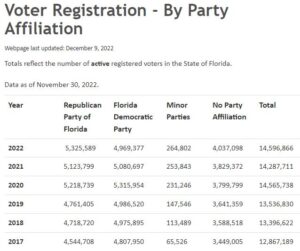
Since we moved here I heard about the growing Republican registration advantage over Democrats which proved my intuition was correct. As you can see from the chart, when we moved here the Democrats had a 250,000 plus advantage, now it’s Republicans 350,000 plus! That is amazing, and speaks to the genius of the Founding Fathers of the great American republic (it is not a Democracy).

Given the challenging times in which we live it’s easy to be a David Doomer or Negative Nellie or Debbie Downer. It often appears all lemons with no lemonade, glass definitely half empty, if that. I choose not to see things that way because of God’s providence, and that America’s founding and blessings are not an accident. All of America’s Founders and the founding generation, even those many claim were Deists, believed America’s birth was ultimately God’s doing. It was absurd anyone could possibly think these poor little colonies could be any match for the mighty British Empire. In a book I recently read, The Indispensables, this mindset was put well:

“The madmen of Marblehead are preparing for an early campaign against his Majesty’s troops,” scoffed a Loyalist newspaper in early 1774, skeptical of the idea that Americans could threaten the most experienced and skillful military professionals on the planet at the time.

We tend to look back at America’s founding as inevitable, but it only was in God’s mind. From a human perspective it looked impossible. For this reason the 56 men who signed the Declaration of Independence thought they were very likely signing their death warrant. Benjamin Franklin captured the frightening reality of the moment with his statement on the signing, “We must all hang together, or most assuredly, we will all hang separately”

But they didn’t hang, and via that Declaration and the Constitution in 1787 gave us the most incredible experiment in republican government in the history of the world. In effect, the red migration is a continuation of that experiment that I believe will allow it to continue for generations to come. Doomers think I’m nuts and it’s already over given what’s happened in the last two years, but I very much beg to differ.

There are many reasons for my optimism, but one is the nature of the republic the Founders created seen in this red migration. The concept known as federalism gives Americans an escape valve. The way such a valve works in a container is when pressure builds up to a dangerous level (as in a steam boiler) it opens automatically to let out steam; the states are that escape valve.

The struggle at the founding of America was how to get 13 separate sovereign colonies to unite to form one government. Some founders wanted a stronger central government, and others stronger state governments. The latter group was more influential initially given how skeptical all the founders were about centralized power in government, and the first governing document of the United States of America, the Articles of Confederation reflected that. Adopted in November 1777, it proved to not work very well in practice. This gave the Federalists the leverage to create a new constitution with a stronger Federal governement which was ratified on September 17, 1787.

States for most of American history had a large measure of sovereign power, but over time as the Federal government grew states allowed their constitutional prerogatives to languish. Thankfully, what the Founders created still works pretty much as intended, and as the Federal Leviathan has become increasingly tyrannical, people in blue states are not putting up with it. Even red areas of blue states have gotten fed up and are voting to succeed from those states.

Back in the ‘80s during the Reagan era a line became famous among conservatives: Being a liberal means never having to say you’re sorry. No matter how much misery and destruction progressive leftist policies create progressive leftists double down and push more such policies. It seems tens of millions of Americans have had enough of it and are voting with their feet. Thankfully that makes it much less likely they’ll have to “vote” with their guns.