Apr 8, 2017 | Truth

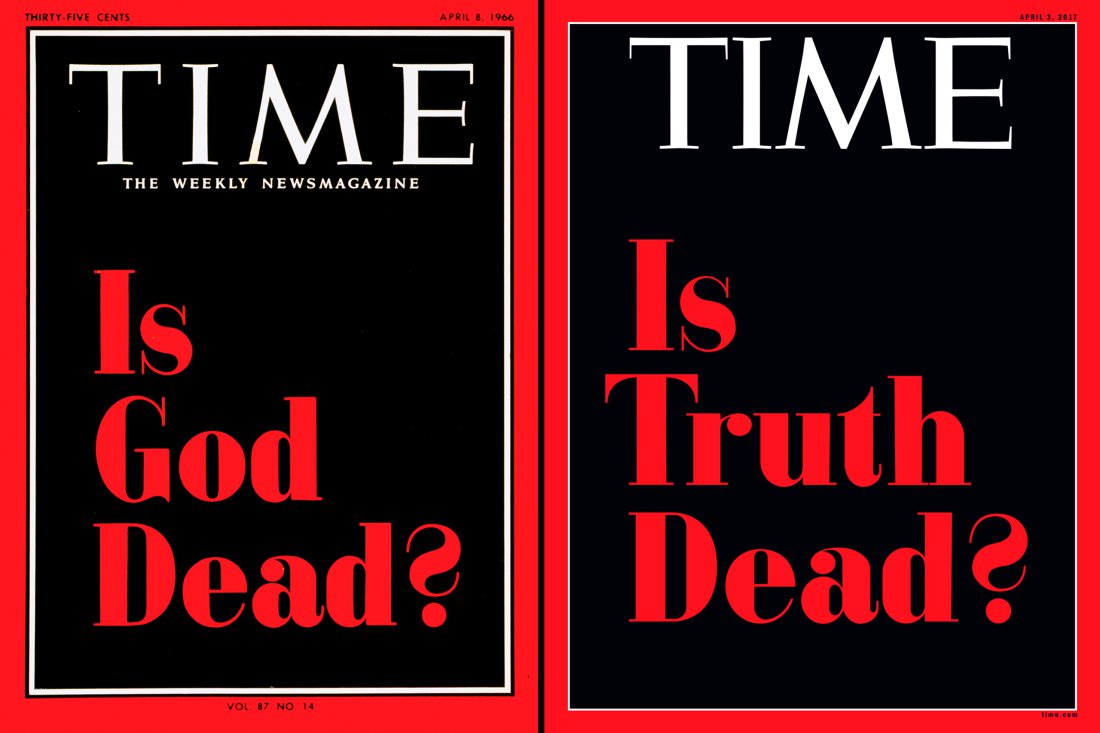
On this day in 1966, Time Magazine published it’s (in)famous cover story, “Is God Dead?” It was about some radical theologians who decided to take the theos out of the ology. It has not exactly proved to be prophetic. In some parts of the world God is more popular than ever, even in countries that are officially atheist like China. Europe, on the other hand, instead of being the vanguard of the future, as predicted by secularists for decades, is dying on the spiritual vine. Not only are churches empty, but most Western Europeans are not even having enough children to replace their populations. Growing Muslim populations, by contrast, are filling the spiritual vacuum (which we know nature abhors) because they value the next generation and are passionate about their God.
No, God is indeed not dead, but here comes Time almost 51 years later again asking another question of negation: “Is Truth Dead?” I will give the magazine credit for logical consistency. If there is no God, there is no truth. As I often ask my kids, if all we are is lucky dirt, then what makes one thing true and not another, or what makes something right and not wrong? Nothing. In the moral realm, you cannot get ought from is. If all we are is lucky dirt who’s to say torturing babies for fun is wrong. And if God is dead truth is dead. Without God the only thing that can make one thing ultimately true or not is power.
(more…)
Apr 7, 2017 | Notable Quotations

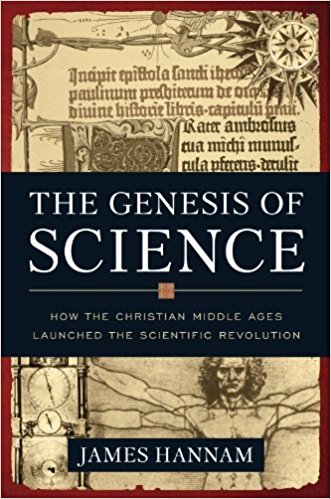
[T]he most significant contribution of the natural philosopher of the Middle Ages was to make modern science even conceivable. They made science safe in a Christian context, showed how it could be useful and constructed a worldview where it made sense. Their central belief that nature was created by God and so worthy of their attention was one that Galileo wholeheartedly endorsed. Without that awareness, modern science would simply not have happened.
—James Hannam, The Genesis of Science: How the Christian Middle Ages Launched the Scientific Revolution, p. 342.

Apr 5, 2017 | Explanatory Power

I recently finished reading a book called The Genesis of Science: How the Christian Middle Ages Launched the Scientific Revolution by James Hannam. The title appealed to me when I first heard of the book because of a fiction that has been promulgated since the mid-1800s of a war between religion and science. Nothing could be further from the truth. All the great strides of early science were made by Christians because they wanted to glorify their Creator by discovering how a universe created for us worked.
While some science was done by ancient Greeks, and Muslims and Chinese of the Middle Ages, it was in the Christian West where science as a continually expanding discipline was established. How ironic, then, that science has been used by secularists for the last 150 years as a battering ram against Christians. How even more ironic that we can thank Jesus of Nazareth for all the blessings of modern science and technology! Of course Christians know this, and do thank him for these blessings all the time, but just in an historical sense, without Jesus we’d still likely be stuck in some kind of “dark ages.”
(more…)
Apr 2, 2017 | Plausibility

Modern “New” Atheists (there is nothing “new” about them) are fond of painting Christians as wishful thinking Neanderthals who may as well believe in Unicorns and leprechauns. A Creator God, parted seas, resurrection, and various and sundry other miracles are no different, they confidently assert. I would say this is a prime example of the pot calling the kettle black, but I don’t want to insult kettles.
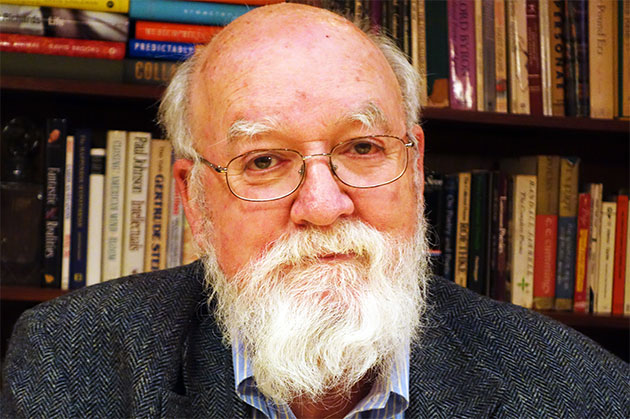
I came across a version of an atheist creation story at Evolution News that is typical of the illogical leaps atheists have to make to imagine a universe and life springing up without a Creator God. The guilty part in this case is famous atheist and “materialist philosopher” Daniel Dennett. These paragraphs come from a New Yorker profile on the man and his thought, and specifically how life evolved:
Four billion years ago, Earth was a lifeless place. Nothing struggled, thought, or wanted. Slowly, that changed. Seawater leached chemicals from rocks; near thermal vents, those chemicals jostled and combined. Some hit upon the trick of making copies of themselves that, in turn, made more copies. The replicating chains were caught in oily bubbles, which protected them and made replication easier; eventually, they began to venture out into the open sea. A new level of order had been achieved on Earth. Life had begun.
The tree of life grew, its branches stretching toward complexity. Organisms developed systems, subsystems, and sub-subsystems, layered in ever-deepening regression. They used these systems to anticipate their future and to change it. When they looked within, some found that they had selves—constellations of memories, ideas, and purposes that emerged from the systems inside. They experienced being alive and had thoughts about that experience. They developed language and used it to know themselves; they began to ask how they had been made.
(more…)


Recent Comments