
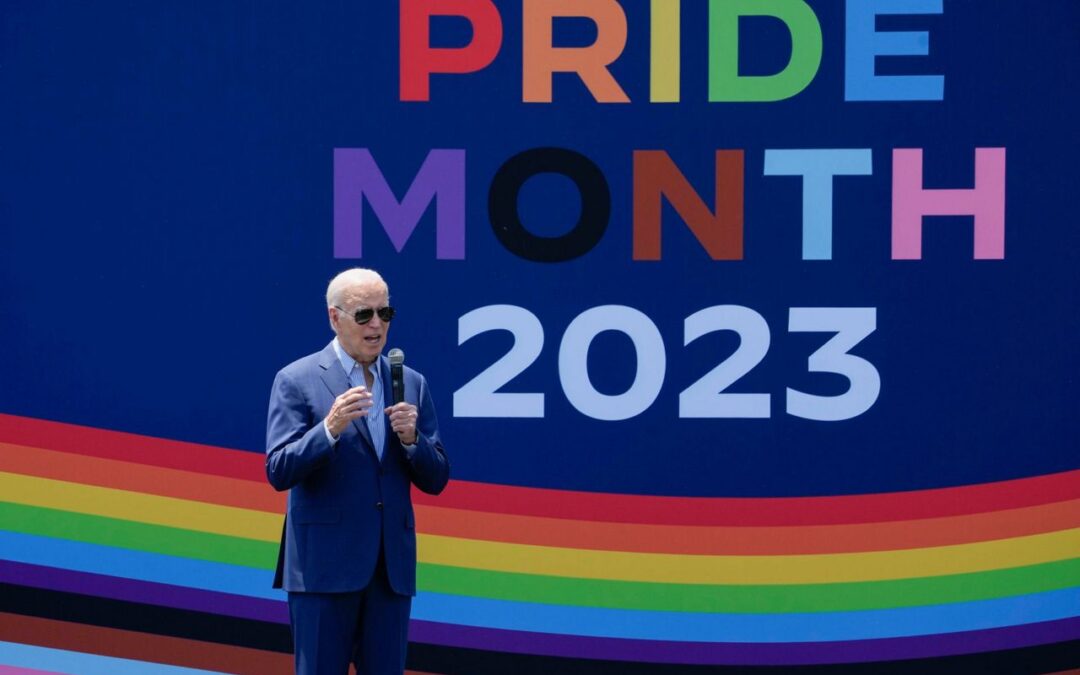
Christianity is Now Hate and Bigotry, and the Hope that Brings
In case you weren’t aware of it, if you’re a conservative Christian, believe the Bible is God’s actual word of revelation to mankind and the truth about human sexuality, you’re a bigot filled with hatred for “sexual minorities.” Yes, no better than any garden variety racist. No better than the Klu Klux Klan burning crosses in your black neighbor’s yard. I’m sure this is not news to anybody. But among our cultural “elite” and the lunatic left (those currently running the United States government, all the organs of culture and corporate America) it is commonly accepted. The word Christian slips off their lips with a condescending smear, and to them we are second-class citizens in our supposedly enlightened queer nation. Leftists (what almost all liberals have become) started out playing the victims. Then they asked for tolerance, and got tolerance. Next they demanded acceptance, and got acceptance. Finally, they demanded celebration, and those who refuse to celebrate will be made to pay by the alphabet mafia. Welcome to 2023 America! And what a grand place it is.
I saw this clearly coming during the runup to some unelected judges in black robes on the highest court in the land re-defining marriage in 2015. A large section of the less diplomatic and careful left branded those who didn’t support gay “marriage” as bigots and haters. Those pushing this perversion of marriage at a legal and PR level on an ambivalent population we’re much more careful. They told blatant lies sweetened with honey that went down easily with the unsuspecting and ignorant. It’s all about tolerance, just letting homosexuals have the same rights as heterosexuals. How could anybody be against that? The more prescient knew it could never stop there, and once marriage was redefined and homosexuality completely normalized, the transgender insanity circa 2023 was inevitable.
I was reminded of this unpleasant reality not only because it’s so called “pride month” (which God says goes before destruction) and daily shoved in our faces, but also because I read this article about a women who was a big name in Hollywood, thus appropriately left wing most of her life, and who became a conservative and Christian and now “has her friends mystified.” That’s almost funny, and speaks to how insular the woke left is. They live in an echo chamber only ever encountering people exactly like them and dismiss as unworthy ideas they disagree with. Such people are also deeply self-righteous and judgmental. Anyone who doesn’t think like them is unclean and unworthy of respect. Conservative Christians are modern lepers to them, and it is such people who hold almost all positions of cultural and government power in America today.
All of this is stunning, but completely unsurprising to anyone who knows the history of Enlightenment rationalism that in due course rid the world of God and His word. Once that started happening it led inexorably to the suffocating secularism of the modern world with the help of Kant, Hegel, Marx, Darwin, Nietzsche, Freud, et al. The 20th century gave us progressivism, cultural Marxism a la the Frankfurt School, “the 60s” and the sexual revolution, so called, radical feminism, no fault divorce, and eventually it had to get to homosexuality and their “rights.” Marx’s two primary goals of perpetual revolution and his communist Utopia was to be realized by the destruction of the family and religion, i.e., Christianity. The woke left in our day, the cultural Marxists, are his progeny, and even though he would be surprised the economic version of Marxism he predicted failed, he would be pleased as punch at the cultural version that hasn’t. It’s creating all the chaos, confusion, suffering, pain, and misery he could have ever hoped for, the conditions for communism’s perpetual revolution.
The article I mentioned above is definitely worth reading because it’s instructive of just how deeply ingrained this pathology is on the secular left, and it is important to realize the threat they pose to everything that is godly, good, and right. The goal of their push for sexual perversion, and that includes any sex outside of a married man and woman, and erasing biological sex, is and always has been the destruction of the family. You can look at the writings of leftists since the 1930s and it’s all there. The difference today is that all vestiges of Christian leaven that once made Western civilization flourish and prosper and held back wickedness are gone. In addition, we have a generation of leftists in cultural and political power today who are effectively woke zombies who can’t help themselves. They are compelled by generations of very effective brainwashing to silence or destroy any who get in the way of cultural revolution, their greatest enemy being Bible believing conservative Christians. If you’re also white and male, you get to the top of the list.
This is the bad news which we all know. The good news that most fail to appreciate is that because zombies aren’t subtle, normal people, which is the vast majority of the population, are waking up to just how pathologically evil and abnormal all this is. For Christians, this reminds us of the fundamental irrationality of evil, and that it is built and sustained on the pretzel logic of lies. God’s created reality, as for God Himself, cannot be mocked, people reap what they sow. Sooner or later it will bring the consequences of God’s judgment which happens whenever His law is transgressed. But God’s judgment isn’t an end in an of itself—it is revelatory as well. In such an environment the ugliness of sin and man pretending he can be God contrasts powerfully with the beauty of God’s law and the gospel of His grace in Christ. We have the answer to all the chaos and misery! And it goes through the cross.
We have something to sell that’s attractive and it works! All of Christian history proves it. And it doesn’t just work in our private lives or in churches, but it works for entire civilizations. Many Christians, and all secular people, don’t realize that what turned the ancient pagan world where, in Thomas Hobbes words, life was nasty, brutish, and short, into the modern world where it generally is not, was Christianity. Without God’s word, and God’s law, the gospel and the Holy Spirit, there would be no rule of law, no hospitals, no human rights, no universal education, no science or technology, no capitalism and wealth, and all the blessings that can bring, and much more. Secular culture, however, paints Christianity and God’s law as constricting when it is the most liberating thing that’s ever existed, in fact the only thing!
I’m currently reading a wonderful book that makes this case by an Indian named Vishal Mangalwadi, The Book That Made Your World: How the Bible Created the Soul of Western Civilization. If you’re wondering what it is we’re trying to do in the so-called culture wars (and politics and everything else), you’ll find what that is in this book. We’re not just trying to save souls so people can go to heaven when they die. Rather, we’re part of Christ’s charge and mission to bring God’s kingdom on earth as it is in heaven. Before Jesus ascended into heaven to the right hand of God, he said all authority in heaven and on earth had been given to him, therefore go and make disciples of all nations, not just people. And this means, he says, teaching them everything he had commanded them. We need to get busy!


Recent Comments