
Apr 19, 2017 | Notable Quotations

I believe like a child that suffering will be healed and made up for, that all the humiliating absurdity of human contradictions will vanish like a pitiful mirage, like the despicable fabrication of the impotent and infinitely small Euclidean mind of man, that in the world’s finale, at the moment of eternal harmony, something so precious will come to pass that it will suffice for all hearts, for the comforting of all resentments, of the atonement of all the crimes of humanity, of all the blood that they have shed; and that it will make it not only possible to forgive but to justify what has happened.
Theodore Dostoevsky, The Brothers Karamazov

Apr 16, 2017 | Theology

It is a glorious thing that on this day all around the world billions of Christians celebrate the bodily resurrection of their Savior. Those who don’t, think that those of us who do are deluded. Maybe we are, but the vast majority of those who reject the bodily resurrection of Christ have never given a single solitary minute to examining the evidence. Most of these don’t believe a man coming back from the dead is possible, so why bother with evidence. I’m sure there are others who don’t want to engage the evidence because they don’t want it to be true. If God did become a man, died for their sins, and was raised for their justification, then they are confronted with a choice. Rebels have a hard time giving up their rebellion.
For me, if this resurrection of Jesus of Nazareth really did happen, it is, by very far, the most important historical fact of human history. And orthodox Christians don’t believe Jesus’ resurrection is a “spiritual resurrection” in our hearts, a beautiful idea about new life and some such thing. No, we believe the man himself, a human being just like you and me, was killed by the Romans, was laid in a tomb, and three days later revealed himself as risen to his followers. We believe this because there is a significant amount of historical evidence that it in fact happened. Jesus himself knew we, and his followers at the time, needed evidence because, well, people don’t just rise from the dead!
(more…)

Apr 13, 2017 | Culture

We live in the age of The Sovereign Self. Phrases heard throughout the culture like, “Just be true to yourself,” or “As long as it makes you happy” are common. Such ideas reflect the triumph of the subjective, which basically asserts that each individual can determine their own reality. This almost ubiquitous mentality could not have been put any better than by Supreme Court Justice Anthony Kennedy in a decision from 1992:
At the heart of liberty is the right to define one’s own concept of existence, of meaning, of the universe, and of the mystery of human life.
Actually, this is more like a recipe for anarchy. What if I define my concept by taking away someone else’s liberty? On what basis could Justice Kennedy say that is not valid? After all he said It’s my “right” to define reality (“the universe”) as I wish. No, the Justice’s sentiments are sentimental nonsense. Realty will never bend itself to my wishes, no matter how hard I wish. And if we let our kids drink this dangerous cultural Kool-Aid, they will suffer for it because as I often say, reality doesn’t take any jokes.
(more…)
Apr 8, 2017 | Truth

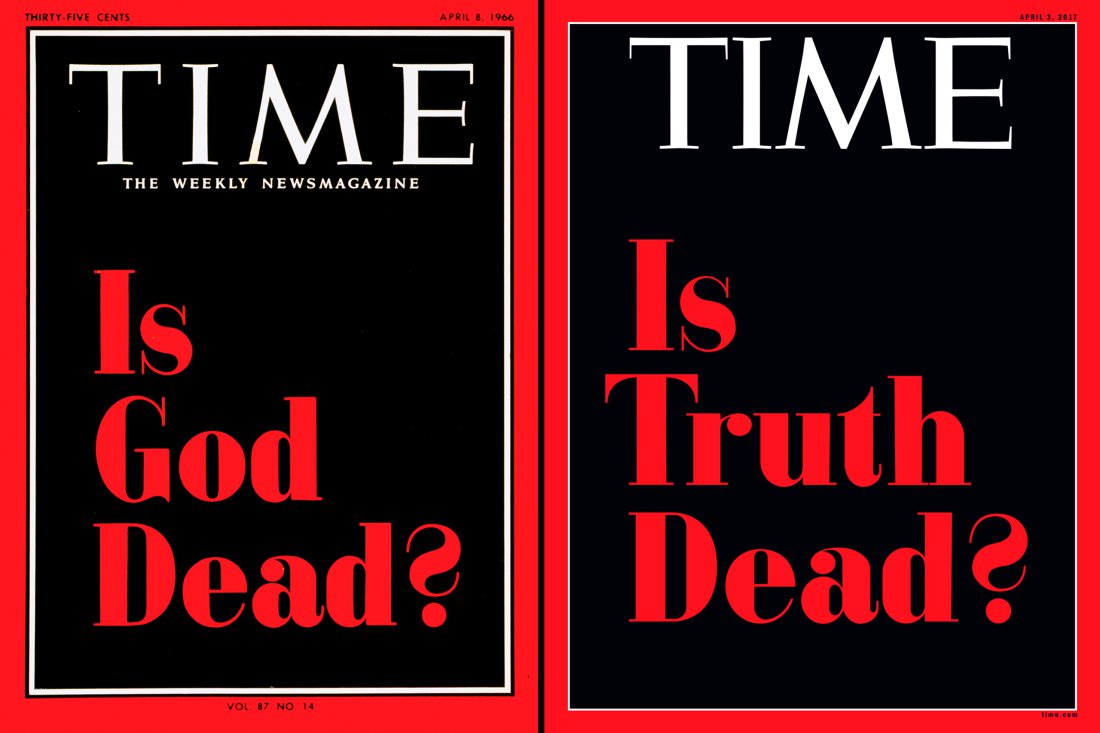
On this day in 1966, Time Magazine published it’s (in)famous cover story, “Is God Dead?” It was about some radical theologians who decided to take the theos out of the ology. It has not exactly proved to be prophetic. In some parts of the world God is more popular than ever, even in countries that are officially atheist like China. Europe, on the other hand, instead of being the vanguard of the future, as predicted by secularists for decades, is dying on the spiritual vine. Not only are churches empty, but most Western Europeans are not even having enough children to replace their populations. Growing Muslim populations, by contrast, are filling the spiritual vacuum (which we know nature abhors) because they value the next generation and are passionate about their God.
No, God is indeed not dead, but here comes Time almost 51 years later again asking another question of negation: “Is Truth Dead?” I will give the magazine credit for logical consistency. If there is no God, there is no truth. As I often ask my kids, if all we are is lucky dirt, then what makes one thing true and not another, or what makes something right and not wrong? Nothing. In the moral realm, you cannot get ought from is. If all we are is lucky dirt who’s to say torturing babies for fun is wrong. And if God is dead truth is dead. Without God the only thing that can make one thing ultimately true or not is power.
(more…)
Apr 7, 2017 | Notable Quotations

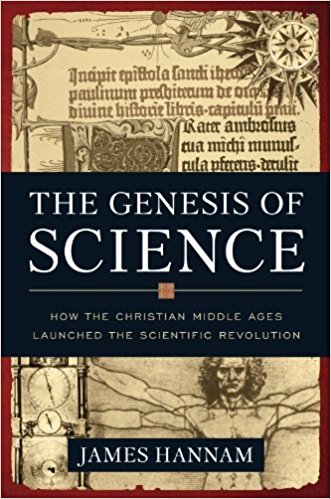
[T]he most significant contribution of the natural philosopher of the Middle Ages was to make modern science even conceivable. They made science safe in a Christian context, showed how it could be useful and constructed a worldview where it made sense. Their central belief that nature was created by God and so worthy of their attention was one that Galileo wholeheartedly endorsed. Without that awareness, modern science would simply not have happened.
—James Hannam, The Genesis of Science: How the Christian Middle Ages Launched the Scientific Revolution, p. 342.


Recent Comments