
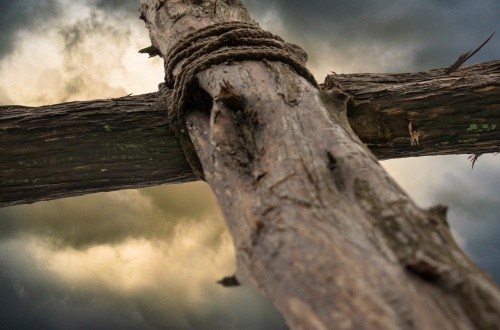
Recently at a church service the closing hymn was That Old Rugged Cross, for over a hundred years a beloved hymn to conservative Protestants. It had been a long while since I’d sung it, and I noticed the final stanza got the ultimate hope of our faith backwards, although most Christians wouldn’t think so. I myself wouldn’t have given it a second thought until not too many years ago. The final stanza reads:
To that old rugged cross I will ever be true, its shame and reproach gladly bear; then he’ll call me some day to my home far away, where his glory forever I’ll share.
In fact, our home is this very earth upon which we live which Jesus came to redeem and restore to its previous Edenic glory, and Jesus will complete the job when he returns. Sure, it doesn’t quite feel “homey” because sin still exists and we long to be freed from being afflicted by its doleful effects. That, however, is a process only to be fulfilled at Christ’s second coming when we receive our new bodies and live on this new redeemed, renewed, and restored earth. That’s when we will be fully home. Heaven could never be our home because we won’t have our bodies, and we were never meant to live a bodyless existence. The Christian hope in the final analysis is not heaven, but a physical, resurrected body, on a material earth Christ redeemed from sin. We’re merely living the down payment now as we await the glory to come. These words of the Apostle Paul say it a whole lot better than I can, and notice not a word of heaven:
18 For I consider that the sufferings of this present time are not worth comparing with the glory that is to be revealed to us. 19 For the creation waits with eager longing for the revealing of the sons of God. 20 For the creation was subjected to futility, not willingly, but because of him who subjected it, in hope 21 that the creation itself will be set free from its bondage to corruption and obtain the freedom of the glory of the children of God. 22 For we know that the whole creation has been groaning together in the pains of childbirth until now. 23 And not only the creation, but we ourselves, who have the firstfruits of the Spirit, groan inwardly as we wait eagerly for adoption as sons, the redemption of our bodies. 24 For in this hope we were saved.
Our hope is completely material in orientation. Why we tend to think it isn’t, I’ll address below.
We give the devil entirely too much credit, as if this earth belonged to him and our goal is to escape it. Our goal, in fact, is to transform it, as Jesus prayed, “Thy kingdom come, thy will be done on earth as it is in heaven.” That wasn’t a prayer for thousands of years in the future when he returns, but a prayer fulfilled at his first coming. Like the mustard seed and leaven (Matt. 13), Jesus wants us to know his kingdom’s coming on this earth is inevitable and all pervasive. It’s why Paul says when we are in Christ we’re part of a “new creation, the old has passed away the new has come” (2 Cor. 5:17). One day nobody will be able to deny this new creation as the kingdom’s transformational power goes out from God’s people to all the earth.
Satan, the World, and our Home
If we’re to talk about this sinful fallen messed up world, it’s important to be clear about what world we’re talking about. The physical earth and material world while always belonging to God its creator, was ruled by Satan since Adam and Eve rebelled, and he remained in the driver’s seat until Christ ascended on high and sent his Holy Spirit 50 days later at Pentecost. At that moment, Satan like the strong man in Jesus’ parable (Matt 12, Mark 3), was bound up for a thousand years so he could no longer deceive the nations (Rev. 20:1-3) and the gospel could go forth and bear fruit across the entire earth as it has these last 2,000 years. Prior to the ascension and Pentecost, that couldn’t have happened.
The problem with thinking heaven is our home and that it is far away, is that it’s not true. Jesus tells us as much in Luke 17:
20 Being asked by the Pharisees when the kingdom of God would come, he answered them, “The kingdom of God is not coming in ways that can be observed, 21 nor will they say, ‘Look, here it is!’ or ‘There!’ for behold, the kingdom of God is in the midst of you.”
The kingdom of God, of Heaven, is right smack dab in the middle of where we live. In that sense we’re “home,” only it doesn’t feel like it sometimes because we still need to tidy up, clean out the junk in the garage and attic, and put on some additions and redecorate. We need to truly make it feel like home, and that is the process of the Christian life, thy kingdom come!
Whatever heaven is, we can say with assurance that our residence there is only temporary. Theologians have termed our time there as the intermediate state, as in, it’s a temporary state of our eternal existence. We won’t get too comfortable there because we’ll be longing for our actual eternal home on this renewed, restored, and redeemed earth, the one paid for by Jesus’ blood. While we are in this fallen world living in our fallen bodies surrounded by fallen people, our mission is to make it as homey, eternally speaking, as possible, a place where God’s law is honored, and Christ exalted as King of kings and Lord of lords. In other words, in obedience to Christ we are bringing heaven to earth and discipling the nations. That is the Great Commission, not merely saving people from the fires of hell. We are not only attempting to sanctify ourselves, but working to sanctify the world, and the peoples and nations in them. It’s a tough job, difficult in every way, against the grain, but look at the progress over the last 2,000 years; from only a handful of people to over 2 billion, and transformation beyond what Jesus’ followers could ever imagine.
Havin said that, there are numerous passages in the New Testament that give us the impression this earth, rather than the fallen world, is not our home. Just this morning as I write this, we had a missionary from Thailand give sermon in I Peter 2. Peter opens his letter telling us he’s writing “to those who are elect exiles” in several Roman provinces in Asia Minor (modern-day northern Turkey). There is some debate as to whether Peter is speaking to Jewish or Gentile Christians, but Christians tend to read this as applying to our spiritual estate in the world, and not the literal description of Christians Peter was writing to who had been scattered, or dispersed, throughout Asia Minor. The word exiles in Greek means pilgrim or sojourner, so we conclude that must be us on this earth. Then in chapter 2, Peter says:
11 Dear friends, I urge you, as foreigners and exiles, to abstain from sinful desires, which wage war against your soul. 12 Live such good lives among the pagans that, though they accuse you of doing wrong, they may see your good deeds and glorify God on the day he visits us.
Again, we tend to read this as if it’s directly to us and about our spiritual estate in this fallen world, we being the foreigners and strangers and aliens in a fallen world. In some ways that’s true, but Peter is in fact writing to Christians living in the thoroughly pagan cultures of the time. Yes, it is analogous to living in a fallen world among heathens in our own day, but we’re the ones doing the transforming. We are not helpless before the juggernaut of evil wrought by the devil in this world. He’s been defeated! And now we bring the victory earned by our Savior and God to bring Joy to the World. As Isaac Watts wrote and we sing on Christmas, “He comes to make his blessings flow, Far as the curse is found.”
There are other passages that we could explore that give us the same impression, but how we read these depend on our eschatological assumptions, which most Christians are unaware they even have. If we see the world as belonging to the devil, and that it will get increasingly worse until Jesus returns to save the day, we’ll think we’re the ones who are the exiles and strangers here. By contrast, it’s the lost sinners who feel that way in God’s world, and we have to help them see that. If we realize Jesus took the world back at his first coming, and enabled the possibility of his kingdom to invade what was enemy territory, then we’ll see our mission as taking back what is rightfully his. We’re the light that drives out the darkness, and light always wins. We’re the salt that preserves and enhances. And as Paul says in Romans 14:
17 For the kingdom of God is not a matter of eating and drinking but of righteousness and peace and joy in the Holy Spirit. 18 Whoever thus serves Christ is acceptable to God and approved by men.
In other words, people want what we have! That is how the kingdom is advanced, as God’s Spirit is apparent in our lives and he works in the souls of those we encounter.
Why Do We Seek to Escape This World?
Why do we think heaven is our home and not this earth? Why do we think in such escapist terms? Until a couple hundred years ago most Christians didn’t, in fact. While they realized life was extremely short and perilous, instead of escape they saw their mission in life as bringing heaven to earth, God’s kingdom come His will be done. All Christians thought this way to one degree or another regardless of their view of “end times,” or eschatology. In fact it wasn’t until the mid-19th century that the “eschatology wars” started because of a new player on the eschatology stage, J.N. Darby.
I won’t go into the details of his thinking because I’ve done that here numerous times before (see here and here and here), but since the 1920s it’s been known as dispensationalism, and by the 1970s Antichrist, rapture, and tribulation had become pop culture mainstays. The entire point of this version of “end times” eschatology is escape. The term “end times” itself was popularized in this period and came to mean a dystopian hell from which all true Christians were supposed to be rescued. I was born-again into this milieu in which the zeitgeist, or the spirit of that Christian age, was all about escape. I even remember praying one time right before I graduated from college that the rapture would happen so I wouldn’t have endure real life after college. But all of this mentality is the result of a false, unbiblical spirituality that goes back to the influence of Platonism on the early church.
If you never did your study on the ancient Greek philosopher Plato and his influence in church history, you wouldn’t know that the distrust of this material world found at times in Christianity came from him. His unfortunate influence in this regard was most powerfully felt with the rise of the heresy of Gnosticism in the second century. Plato gave the Western world a dualistic view of reality, upper/lower, spiritual/material, good/bad, and it’s wormed its way through Christianity ever since.
The 16th century German Lutheran movement of Pietism was one worm that eventually allowed a kind of Gnostic dualism to fully dominate the church, which is the answer to my questions. Pietism is the bad guy. And in case you’re wondering, I’m not talking about piety, or a dedicated pious life of a vibrant personal relationship with our God through Christ. That kind of piety and Pietism are two completely different things. This kind of Gnostic dualism is a way of seeing the world, a mindset that mistakes this world for something inherently bad that we’re to get away from to experience true eternal life, the life of God meant for us in Christ. Francis Schaeffer called it a two story view of reality.
The Alternative to Escape: Transformation
One of the most unfortunate effects of Pietism is how it causes Christians to over spiritualize everything. The tendency is to downplay the importance of this world of material things, and only give true value to that which is forever, the spiritual, the not “this worldly.” I’m not talking about the perverse desires of this world the Apostle John talks about in I John 2, but rather to the contrast he makes, doing the will of God on this earth. The mission of God in Christ, the Great Commission, is distinctly for this world. The charge Jesus gave to his disciples right before he left the earth was to “make disciples of all nations,” not just the people in those nations, and having baptized them, teaching them to observe all that he commanded them. And he promised he would be with us always on this earth “to the end of the age.” This wasn’t his only final message. In Acts 1 he expands on it:
6 So when they had come together, they asked him, “Lord, will you at this time restore the kingdom to Israel?” 7 He said to them, “It is not for you to know times or seasons that the Father has fixed by his own authority. 8 But you will receive power when the Holy Spirit has come upon you, and you will be my witnesses in Jerusalem and in all Judea and Samaria, and to the end of the earth.”
He wanted the disciples’ vision to be the entire earth so that the blessings promised to Abraham and the Patriarchs would come upon all peoples and nations; true Israel would now touch the four corners of the earth. The Great Commission and being his witnesses to the ends of the earth could only happen after Pentecost. Once he sent his Spirit he himself would be with us in power, the power to transform lives which in due course would transform civilizations. That is the point of the Great Commission, what makes it Great, not only saving souls to go to heaven when we die. Jesus wants his earth back, and we’re the down payment!
This transforming power, contrary to the Pietistic mentality of most Christians, affects every nook and cranny of existence, everything Christians put their hearts and minds to. I don’t need to define everything because it means, literally, every single thing we do. What happens when the spirit comes? Read Galatians 5, and compare “the works of the flesh” to “the fruit of the spirit.” This is transformation! And it not only transforms us personally, or in our relationships, but it makes us productive citizens. When Paul tells us the kingdom of God is a matter “of righteousness, peace and joy in the Holy Spirit,” imagine a town or city or county or state or country filled with kingdom people who exhibit these qualities. Can you? It’s something wholly different than John Lennon could Imagine. We’re so used to seeing dysfunction and strife and “works of the flesh” we think that’s what it will always be. Jesus said otherwise.
Recent Comments