
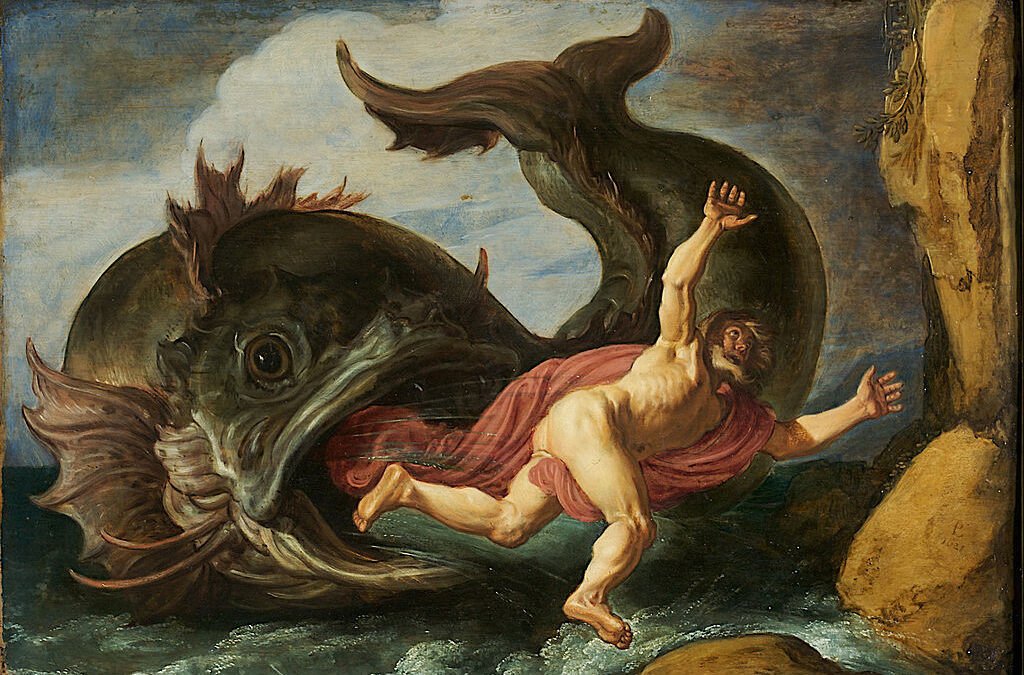
I recently read through Jonah in one sitting, and yet again it reminds me why it’s one of my favorite books in the Bible. It’s got a kind of honesty about it that makes it endearing. You think, this guy is not unlike all of us! And the Bible makes no apologies for telling his story.
Speaking of the Bible, we call the different writings in our Bibles books, and the word bible, τὰ βιβλία in Greek, means a collection of books, but many of the “books” in our Bibles are very short. Jonah has only four chapters and is a quick but compelling read. It starts right away with action. God calls Jonah to go to Nineveh, and he runs away in the opposite direction! He doesn’t just walk, or saunter, or slither away, he runs! I love how honest the Bible is about human rebellion and sin amongst God’s own people. The portrayal of those people is not flattering to say the least, which is one reason the Bible has such verisimilitude and credibility. It reads real and seems real because it is in fact the accurate story of this people whom God has called to bring salvation to the world. Only, it doesn’t quite work out the way they envisioned it, Jonah being a prime example. To use a semi-vulgar word to express this, Jonah is pissed about God planning to have mercy on this pagan nation who are the sworn enemies of his people.
What stood out to me this time through was the word “provided” in my NIV, used four times as the story rushes along. Some other translations use appointed. The Hebrew word has these meanings:
- (properly) to weigh out
2. (by implication) to allot or constitute officially
3. also to enumerate or enroll
In other words, God is calling the shots here. I like the word provided because it implies what is being supplied or made available is meant to help that person. It’s not just God telling us to do something because He said so. God commands us for our Good and His glory. As I was reading, Romans 8:28 leapt to mind:
And we know that in all things God works for the good of those who love him, who have been called according to his purpose.
And Paul is making sure we understand this isn’t speculation, isn’t something we wonder about or should have any doubt about, but something we know.
God’s Provision for Jonah
Jonah in his rebellion decides to run away from God’s express command, hitching a ride on a ship specifically to run “away from the presence of the Lord.” We’re familiar with the story, but it’s the little details that make it so powerful.
Not long into the journey a violent storm arises and threatens to wipe out the ship. As the crew is throwing things overboard to try to save the ship, Jonah goes down into the hold and of all things, falls asleep! The man was depressed. And why not. He knows this is God rebuking him for his choice. The men go down to get him and see he’s asleep and they are shocked. How in the world can this guy be sleeping at a time like this? Being ancient people they cast lots to see who’s to blame for the storm, and of course it falls to Jonah. When they ask who he is, and where he comes from:
9 And he said to them, “I am a Hebrew, and I fear the Lord, the God of heaven, who made the sea and the dry land.
He’s almost blasé. He obviously doesn’t fear this God enough. After he tells the men what he did, they are terrified. So when they ask what they must do to mollify this Creator God, he says to throw him into the sea. I’m sure they think this will only make this Creator God angrier, so they try harder to save the ship which makes the storm worse. Then despite their inclinations, they throw him overboard, and of course the storm calms immediately. Chapter 1 ends with telling us what happened to Jonah next:
17 Now the Lord provided a huge fish to swallow Jonah, and Jonah was in the belly of the fish three days and three nights.
Ah the big fish. These is where the skeptics sign off. Surely this is metaphorical because nobody could live three days in the belly of a big fish like a whale. Impossible! As if anything is impossible with Almighty God, He who created everything out of nothing and controls every molecule by his infinite wisdom and power. Yet, the text doesn’t say Jonah was alive in the belly of the fish. I’ve always assumed he was until I came across this short video which lays out the argument that Jonah died. I always assumed he was alive because the text says that “Jonah prayed to the Lord his God from the belly of the fish,” and if he prayed he was alive. But when Jonah prays he says, “out of the belly of Sheol I cried, and you heard my voice.” Sheol is the realm of the dead. Also, Jesus affirms Jonah’s ordeal in the big fish as a symbol of his death (Matt. 12:40) and implicitly of his resurrection. If Jesus was dead while he was “in the heart of the earth,” so Jonah was dead in the belly of the great fish. As Jesus was brought back to life, so was Jonah. Either way, the story works as a picture of God’s ultimate redemptive plans in Christ.
God’s provision of a big fish for Jonah is meant to get his attention, something we sinners always seem to need if we’re going to finally quit running away. It works. Chapter 2 is Jonah’s prayer of lament and repentance after which the fish vomits him on to dry land. It seems kind of extreme that the Lord would have to put one of his own people through this, but as the great 19th century poem by Francis Thompson declares, He is The Hound of Heaven. The first stanza fits perfectly:
I fled Him, down the nights and down the days;
I fled Him, down the arches of the years;
I fled Him, down the labyrinthine ways
Of my own mind; and in the midst of tears
I hid from Him, and under running laughter.
Up vistaed hopes I sped;
And shot, precipitated,
Adown Titanic glooms of chasmed fears,
From those strong Feet that followed, followed after.
But with unhurrying chase,
And unperturbèd pace,
Deliberate speed, majestic instancy,
They beat—and a Voice beat
More instant than the Feet—
‘All things betray thee, who betrayest Me’.
To one degree or another, this is every Christian’s experience. Jesus was given his name because he came to save his people from their sins (Matt.1:21), and God’s plan of redemption would never be left up to his creatures. Somehow, some way, he will always “get his man,” or woman. But God’s “provision” for Jonah wasn’t done yet because Jonah was a reluctant convert. Chapter 3 starts with, “Then the word of the Lord came to Jonah a second time.” God is willing to give Jonah a second chance, and he’d best listen this time lest the big fish swallows him for good.
Jonah was reluctant because God was calling him to preach to Israel’s hated enemies, the Assyrians. It would only be a generation later that the Assyrians would wipe out the northern kingdom of Israel in 722 BC. That wouldn’t have surprised Jonah. So we can imagine him thinking, “Why in the world would the Lord want to have mercy on this people, on Israel’s enemies?” Jonah goes through the city for three days, as he was in the belly of the big fish, preaching God’s judgment to come, and to his horror they repent so God relents and doesn’t bring judgment upon them. I love to read Jonah’s response because it reads so real (4:1):
But to Jonah this seemed very wrong, and he became angry.
God, how dare you have mercy on these people! They aren’t supposed to get a second chance. I read some time ago the kind of evil and horror the Assyrians were capable of, and Jonah’s response is not unreasonable, but his job isn’t to think, only to obey. Jonah tells us exactly what he feels:
2 He prayed to the Lord, “Isn’t this what I said, Lord, when I was still at home? That is what I tried to forestall by fleeing to Tarshish. I knew that you are a gracious and compassionate God, slow to anger and abounding in love, a God who relents from sending calamity. 3 Now, Lord, take away my life, for it is better for me to die than to live.”
Just kill me now! Then God’s provision kicks in again to try to get His message across to Jonah, that he has no right to be angry (4:4). Jonah goes outside of the city to see what’s going to happen to it, hoping God decides to bring calamity after all. As he’s there, God provides three things: a plant to grow and provide shade for Jonah which makes him “very happy”; a worm to eat the plant, no more shade; then a scorching east wind and hot sun so Jonah grows faint. Unhappy again, he hopes God would just take him out of his misery and kill him. As the king of the universe He should for his rank insubordination, but He is the gracious and compassionate God Jonah so despises.
God asks him if he’s justified in being angry about the plant, one he had nothing to do with growing, and he says he is. Then he tells the Lord:
“And I’m so angry I wish I were dead.”
There’s no resolution in this little book, and the story ends with God asking him a rhetorical question. Jonah had nothing to do with the plant growing, nor did he with the great city of Ninevah. The Lord asks why He shouldn’t have concern for the people and even the animals of such a city. That’s it. Story over.
God’s Provision in Christ
It’s fascinating that Jesus would use the story of Jonah to point to God’s ultimate sacrifice for the sins of His people, and his own brutal death and burial. As is the crucifixion, the story of Jonah is one of God’s mercy, something we find hard to comprehend exactly because it’s God’s mercy. Why would God have to do something so horrible just to have a relationship with His people? His judgment and ultimate justice requires it, but he decided to do it because of His mercy. As Paul says of the crucifixion, and Jonah could relate (I Cor. 1:23):
We preach Christ crucified: a stumbling block to Jews and foolishness to Gentiles.
All Christians believe God is sovereign, the king and ruler of the entire universe, of all things visible and invisible, but most Christians have a hard time believing He is sovereign over the salvation of His people. God choosing whom He will save doesn’t sit well with them, and that the Hound of Heaven never fails.
God, however, is a choosing God, not a God who waits for the choosing of his creatures to accomplish his redemptive plans. He chooses Noah, then Abram, then Jacob, Moses, and eventually David through whom He will bring about a Messiah who will be prophet, priest, and king. We see this choosing God in the story of Moses asking God to show him His glory (Ex. 33):
19 And the Lord said, “I will cause all my goodness to pass in front of you, and I will proclaim my name, the Lord, in your presence. I will have mercy on whom I will have mercy, and I will have compassion on whom I will have compassion.
God is the one who decides who will get his mercy, and as with Jonah, to us it can often appear unfair. God’s nature is to be the one who initiates the relationship to save, and at that moment in history God chose to have mercy on the people of Ninevah.
None of us can conceive of why God would create a world in which he would allow a fall to happen, and thus have sin and death enter his perfect created world, but here it is. He told Adam, the day you eat of the tree I told you not to eat of it, you shall surely die. The moment he listened to his wife and took and ate some of the fruit, everything changed. In my study of philosophy and world religions, I discovered that the only plausible explanation for evil and suffering and sin is found in Judaism and Christianity, and this is it. God never had to create anything. Unlike Islam where God is a solitary monad, alone, in Scripture a Triune God is revealed who can have existed perfectly content without other beings, but he decided otherwise.
When He did create these beings, both angels and humans, they had to be genuinely free and able to chose obedience or rebellion. Any real relationship that isn’t robotic requires such choosing and the free will to choose. God being God knew the risk, and what would happen, but there was clearly no other way. The devil chose rebellion and treason first, then when God made man the devil was allowed to take man down with him. However God already had a plan for that, a provision if you will, and that was He Himself in the person of His Son becoming a man and being the required sacrifice for that rebellion and treason. It’s so bizarre yet strangely plausible enough to enable us to believe it with integrity. The evidence, historical, philosophical, textual, archaeological, personal is so overwhelming that after 2000 years over two billion people believe it. They agree with me and the argument of my book, Uninvented, that there is absolutely no way it could be made up, mere invention of the human imagination.
That’s where Jonah and the crucifixion and God’s provision in our salvation come in. Who could ever make up such stuff? The ancient pagan gods were not known for their mercy, to say the least. They had to be placated in all kinds of silly and horrific ways. Read the prophets. A big fish swallowing a man for three days who vomits him out so he can go preach repentance and mercy to his bloodthirsty enemies? Really? If you want someone to believe your story, you don’t make this one up. Then this same God coming Himself, becoming one of his creatures to take their place so justice could be done and the relationship restored? Seriously? No wonder Paul calls the cross foolishness to the Gentiles, the pagans, and a stumbling block to the Jews. It’s absurd! But true.
When Jesus said we are to love our enemies, he provided the first example by loving us, even unto death on a cross. I’m sure to Jonah that would have “seemed very wrong.” In the ancient world you didn’t love your enemies, you killed them! Who would say something so stupid? Jesus! Again, nobody in the ancient world makes up something like that. The concept of sacrificial love was unknown among ancient pagans, Greek or Roman or any other peoples. Jews alone among ancient peoples knew about “loving your neighbor as yourselves” (Lev. 19:18), but nobody could comprehend the Creator God becoming a man to love us! He Himself is our provision. Out of that provision flows true human flourishing and ultimate fulfillment, flows the fruit of the Spirit, love, joy, peace, patience, kindness, goodness, faithfulness, gentleness and self-control, material blessings in this life, and spiritual blessings forever more.
Recent Comments