
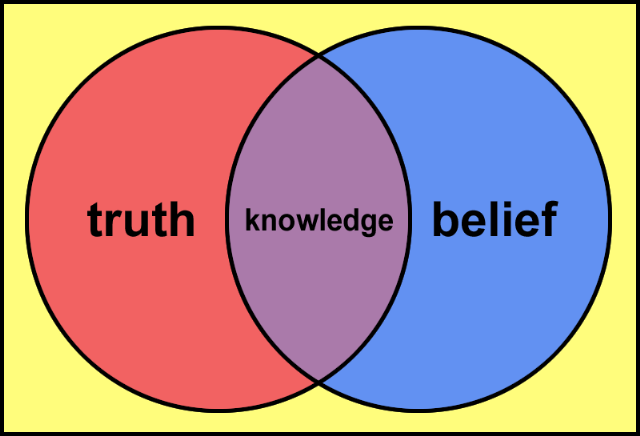
I recently heard New Testament scholar Daniel B. Wallace on a podcast say that we need to understand the difference between the search for truth and the search for certainty. Most Americans, and westerners in general, think that because you can’t have the latter, the former is impossible as well. That’s one side of the divide where the agnostics and skeptics congregate, and for whom any debate about ultimate meaning is a fruitless waste of time. On the other are those who believe absolute certainty is achievable, and act like they’ve found it. Arrogant, absolutist atheists are the most obvious offenders of this mindset, but Christians aren’t immune from it either. There are certain kinds of fundamentalist Christians (Protestant or Catholic) who think absolute certainty is a requirement for and evidence of genuine Christian faith. You’ll see shortly what this is tragically mistaken.
I had never heard or read, that I’m aware of, truth and certainty contrasted in such a way, but the more I thought about it, the more I realized its genius. As Christians engage with secularism in the 21st century, I’m convinced that much of the conflict turns on epistemology: how we know, what we know, if we can know is at the center of the struggle for faith in our time. The natural human search for certainty is inextricably linked to epistemology, and to insist on certainty of an absolute sort is the enemy of knowing. That may sound strange or counter intuitive to some. A couple questions may come to mind if you think so:
- Shouldn’t we be certain of what we know?
- How can we have confidence in our knowledge if we are not absolutely certain of it?
These questions confuse knowledge with certainty, as if knowing is only possible when there is absolute certainty. Dr. Wallace’s formulation tells us what’s at stake: Truth. If we are primarily searching for certainty, and expect to attain it, chances are we’ll lose or reject truth in the process. Why would that be? Good question. Here is the answer:
- The insistence on certainty assumes such (absolutely certain) knowledge is possible for finite creatures which in fact they cannot ever possess.
It should be obvious, but for fallen, sinful creatures it obviously isn’t, that the only being capable of absolute certainty is God himself! If we insist on absolute certainty we are claiming that we have the ability to know as God himself knows. The problem is that by definition God is omniscient, i.e., he knows all things. In case you haven’t noticed, human beings are not, and don’t! And all of them, all of us, live every day in everything we do and say without absolute certainty. I could cite examples all day long. Do you know with absolute certainty that:
- your doctor won’t harm you?
- your plane will make it to it’s destination?
- the bag of spinach you just bought won’t give you Salmonella?
- you won’t have a car accident in your next trip to the store?
- the sun will come up tomorrow?
That last one, you surely think, is as absolutely certain as anything can be, but just because the sun has come up in the east every morning for all of recorded history, doesn’t mean you can be absolutely certain it will tomorrow. From all this we can conclude that certainty exists on a continuum, from less to more, based on whatever evidence is available, how much we trust an authority, information available to us from a variety of sources, and so on. The issue comes down to this: can I trust the knowledge available to me so that with beyond-a-reasonable doubt certainty I can act? This is true whether we’re talking about trusting a doctor, or pilot, or airline, or retailer, or driver, or our senses, or the Bible; we seek knowledge and thus truth, and as much certainty as is possible.

The atheist, agnostic, and apathetic (the “Triple A’s”) insist the Bible shouldn’t belong in such a list. But trusting historical knowledge is no different than any other branch of knowledge, and truth like in any other endeavor is available to us. The messages coming from our secular culture tell us the Bible doesn’t deal with real knowledge and truth, that it’s so much made-up stuff by ancient people who didn’t know any better. But the more I learn, and the more intimately familiar I become with that book, the more I am convinced by the evidence inside and out, that I and my family can trust it with our lives, now and forever. Luke says as much to begin his gospel:
Many have undertaken to draw up an account of the things that have been fulfilled among us, 2 just as they were handed down to us by those who from the first were eyewitnesses and servants of the word.3 With this in mind, since I myself have carefully investigated everything from the beginning, I too decided to write an orderly account for you, most excellent Theophilus, 4 so that you may know the certainty of the things you have been taught.
That we may know!
Recent Comments